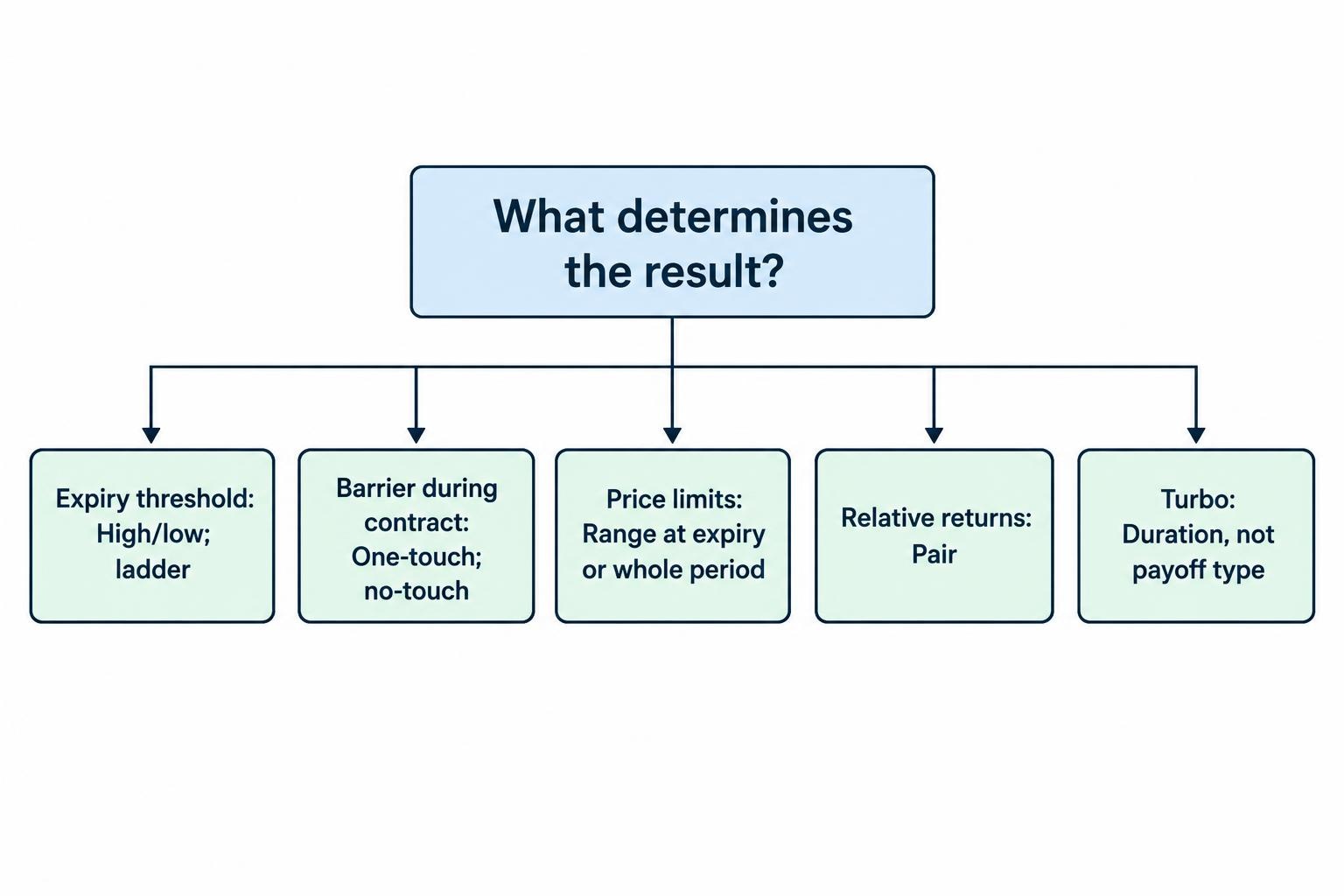
Binary options differ mainly in the condition that determines their payout. Some compare a price with a strike at expiry. Others depend on whether a barrier is touched during the contract, whether a price stays within a range, or how two assets perform relative to each other.
Those differences matter more than the product name. A trader can make the same market forecast, choose two contracts with similar labels and receive opposite results because their observation rules differ. “Ends inside a range” and “stays inside a range” are a straightforward example.
The main categories discussed here are high/low, one-touch, no-touch, range, ladder and pair options. Turbo describes a short duration rather than a separate payoff. Classic usually refers to a basic high/low format, although neither marketing label provides a complete contract specification.
Australian rules and the scope of this comparison
ASIC has banned the issue and distribution of binary options to retail clients. The restriction began on 3 May 2021 and has been extended until 1 October 2031. Describing binary options simply as “legal in Australia” leaves out the restriction most relevant to ordinary readers.
The definitions below explain contract mechanics. References to overseas providers illustrate their published terms and do not establish availability or authorisation for Australian retail customers. Retail and wholesale status are legal classifications, not simply descriptions of how experienced someone considers themselves.
CFDs should not be presented as an automatic substitute. Moneysmart describes CFDs as complex, costly and high risk. Their returns depend on price changes and position size, and leverage can magnify losses. A different regulatory treatment does not make them suitable for a particular person.
Comparison of the main binary option types
The table describes common contract designs. Providers may use different names, observation periods, price sources or rules for an exact tie. The advantage of a structure is its ability to express a particular forecast, not evidence that the forecast will be profitable.
| Type | What determines the result | Observation basis | Main advantage | Main limitation |
|---|---|---|---|---|
| High/low | Whether the settlement price is above or below a strike | Usually the expiry observation | Direct expression of a price-level forecast | An otherwise correct directional view can miss the required level or time |
| One-touch | Whether a specified barrier is reached | Qualifying observations during the contract | A later reversal need not erase a qualifying touch | The barrier may never be reached before expiry |
| No-touch | Whether a barrier remains untouched | Qualifying observations throughout the contract | Expresses a view that a particular level will not be reached | One qualifying touch can determine a loss |
| Range or boundary | Whether the price finishes inside or outside two limits, or remains within them | Expiry or the entire period, depending on the contract | Can express a view about price dispersion rather than one direction | Terminal and whole-period rules produce different outcomes |
| Ladder | Separate above/below propositions at several strikes | Usually expiry for each selected rung | Allows comparison of different price thresholds | Several positions can concentrate exposure to the same market move |
| Pair | Whether one asset outperforms another under a defined calculation | Specified reference and settlement observations | Expresses relative performance rather than an absolute rise | Return calculations and timing must be comparable |
| Turbo | The condition of the underlying binary contract | A very short duration, often described in seconds | Keeps the observation window short | Fast repetition and timing sensitivity can increase practical risk |
These categories are not an exhaustive classification of every product using the binary label. A contract should be assessed by its actual payoff and settlement rules, particularly where the provider combines several conditions.
High and low binary options
A high/low binary asks whether the settlement price will be above or below a specified strike. The strike is the comparison level. It may be the entry price, but that is not a universal requirement: some contracts let the customer select another level.
A rise/fall contract commonly compares the final observation with the entry observation. A higher/lower contract may instead use a separately specified barrier. Both are directional propositions, but they do not necessarily ask the same question.
How the expiry condition works
Suppose a hypothetical contract pays if AUD/USD finishes strictly above 0.6600 at its stated expiry. A settlement value of 0.6601 satisfies that condition. A value of 0.6700 also satisfies it, but the larger rise does not increase a fixed payout.
If the exchange rate rises during the contract and then finishes at 0.6599, the above-strike contract loses under those assumed terms. The earlier rise is irrelevant because this contract observes the final value.
The distinction between entry price and strike is equally important. If the exchange rate starts at 0.6600 but the required strike is 0.6650, a rise to 0.6630 is insufficient. Predicting an increase is not the same as predicting an increase beyond the contracted threshold.
Dukascopy’s explanation of call and put binaries uses call for an above-strike forecast and put for a below-strike forecast. These labels do not create the same rights as conventional options to buy or sell an underlying asset.
What classic binary options means
Classic is a marketing description commonly associated with the basic high/low format. It does not identify an additional payoff or a standard legal category.
There is no need to divide it into four supposedly universal products called high call, high put, low call and low put. The economically relevant details are the selected direction, comparison level, expiry and treatment of equality. Any further label needs a definition in the provider’s terms.
Pros and cons of high and low options
| Pros | Cons |
|---|---|
| The above-or-below condition is relatively easy to explain and calculate. | A small move across the strike can determine the entire expiry payoff. |
| A fixed settlement condition makes the required forecast explicit. | A favourable move before expiry does not necessarily produce a winning result. |
| Selecting a separate strike can express a view about the size of a move. | A higher success probability may be offered with a smaller net profit. |
The simplicity of high/low binary options concerns the rule, not the probability of predicting it correctly. A two-outcome contract does not imply that each outcome has a 50% chance.
One-touch binary options
A standard one-touch binary pays if the reference price reaches a specified barrier during the observation period. It is path dependent: the route taken by the price matters, rather than only its final value.
The barrier can be above or below the starting price. An upper barrier expresses a view that the market will reach a higher level; a lower barrier expresses a view that it will reach a lower level. The contract specifies what counts as reaching it.
A touch can matter even after a reversal
Assume a price starts at 100 and an upper barrier is set at 105. It rises to a qualifying observation of 105.2, then falls to 99 before expiry. Under a standard one-touch condition satisfied by reaching or exceeding 105, the touch has occurred.
An expiry-based contract requiring a finish above 105 would lose on the same path. The difference comes entirely from the observation rule.
Deriv’s touch/no-touch documentation provides a primary example of contracts determined by whether a barrier is touched during the contract period. A successful touch and the time cash becomes available are separate matters. Immediate payment should not be assumed unless the settlement terms provide for it.
Similar labels can conceal a different design
A product called “touch” may include an additional losing barrier. Dukascopy’s published touch-binary terms describe a design with profit and loss levels on opposite sides of the opening price. The first level reached determines the result, with a refund condition if neither is reached before expiry.
That is materially different from a plain one-touch contract with one target and a loss if the target is not reached. Reaching the profit level eventually would not rescue a contract already settled at its losing barrier.
Pros and cons of one-touch options
| Pros | Cons |
|---|---|
| A qualifying touch can satisfy the condition even if the market later reverses. | The target must be reached during the specified observation window. |
| The contract expresses a forecast about a price excursion rather than an exact closing value. | Observation frequency and the definition of a touch can affect the result. |
| An upper or lower barrier can reflect the direction of the anticipated move. | Products with a second losing barrier introduce a different, more restrictive condition. |
A distant barrier is not attractive merely because its advertised return is large. The relevant comparison is the payment against the probability of a qualifying touch, including any additional conditions.
No-touch binary options
A no-touch binary pays if the reference price avoids a specified barrier throughout the observation period. For a plain contract, one qualifying touch is enough to defeat that condition, even if the price immediately moves away again.
No-touch is related to one-touch, but buying the opposite prediction is not automatically a hedge or a way to remove risk. The purchase prices, payouts, observation rules and existing exposures must all be considered.
Avoiding a barrier is different from moving sideways
Suppose the reference price starts at 100 and the no-touch barrier is 95. A move upward to 110 can be consistent with success, provided the price never registers a qualifying touch of 95 during the contract.
A market therefore does not need to remain flat for a no-touch contract to win. A directional move away from the barrier can also satisfy the condition. Conversely, a market that ends almost unchanged may still produce a losing result if it briefly reached the barrier earlier.
Consider a path from 100 to 94.9 and then back to 100.1. The final price looks stable relative to the starting point, but a lower-barrier no-touch condition at 95 has failed under ordinary reach-or-cross terms.
The distinction is between the final change and the extremes recorded during the period. A forecast based only on where the market will close leaves out information that this contract requires.
Why no-touch is not automatically protection
A hedge is an exposure intended to offset another risk. Its suitability depends on how the combined positions behave, rather than on the name of the additional contract.
For example, a person holding an asset might also buy a no-touch contract with a barrier below the current price. If the asset falls through that barrier, the asset holding and the no-touch contract can both lose value. That combination may add downside exposure instead of reducing it.
The comparison of one-touch and no-touch options should therefore distinguish a forecast about a barrier from a demonstrated portfolio hedge.
Pros and cons of no-touch options
| Pros | Cons |
|---|---|
| The condition can express a view that one particular level will remain unvisited. | A brief qualifying touch can defeat the contract even if the market later recovers. |
| A move away from the barrier can be consistent with success. | A small final price change does not establish that the barrier was avoided. |
| The barrier makes the relevant failure condition explicit. | Adding the contract to a portfolio can increase, rather than offset, an existing risk. |
Extending the observation period gives the market more opportunities to reach an unchanged barrier. For otherwise identical monitoring conditions, avoiding a barrier over a longer period is a stricter requirement than avoiding it over a shorter one.
Range and boundary binary options
Range and boundary contracts use an upper and lower price level. Their names often sound interchangeable, but two different observation rules need to be separated.
An expiry-based range contract asks where the price finishes. A whole-period range contract asks whether the price remains between the barriers throughout the observation window. An outside version may similarly mean finishing outside or touching a boundary at any time.
Finishing inside or outside a range
Assume a hypothetical range has a lower limit of 95 and an upper limit of 105. An ends-inside contract requiring strict inequality pays if the final observation is greater than 95 and less than 105.
The market can move to 108 during the period and return to 100 at expiry. That path still satisfies the ends-inside condition because the earlier excursion is not part of this particular test.
An ends-outside contract tests the final observation against the same limits. A finish at 107 would satisfy the outside condition; a finish at 100 would not. Exact boundary values require separate treatment in the rules.
Staying inside or touching a boundary
A stays-inside contract introduces an additional requirement: the reference price must avoid the disqualifying boundaries throughout the relevant period.
On the path that reaches 108 and then returns to 100, an ends-inside contract can win while a stays-inside contract loses. The final chart point is identical, but the earlier observations change the result.
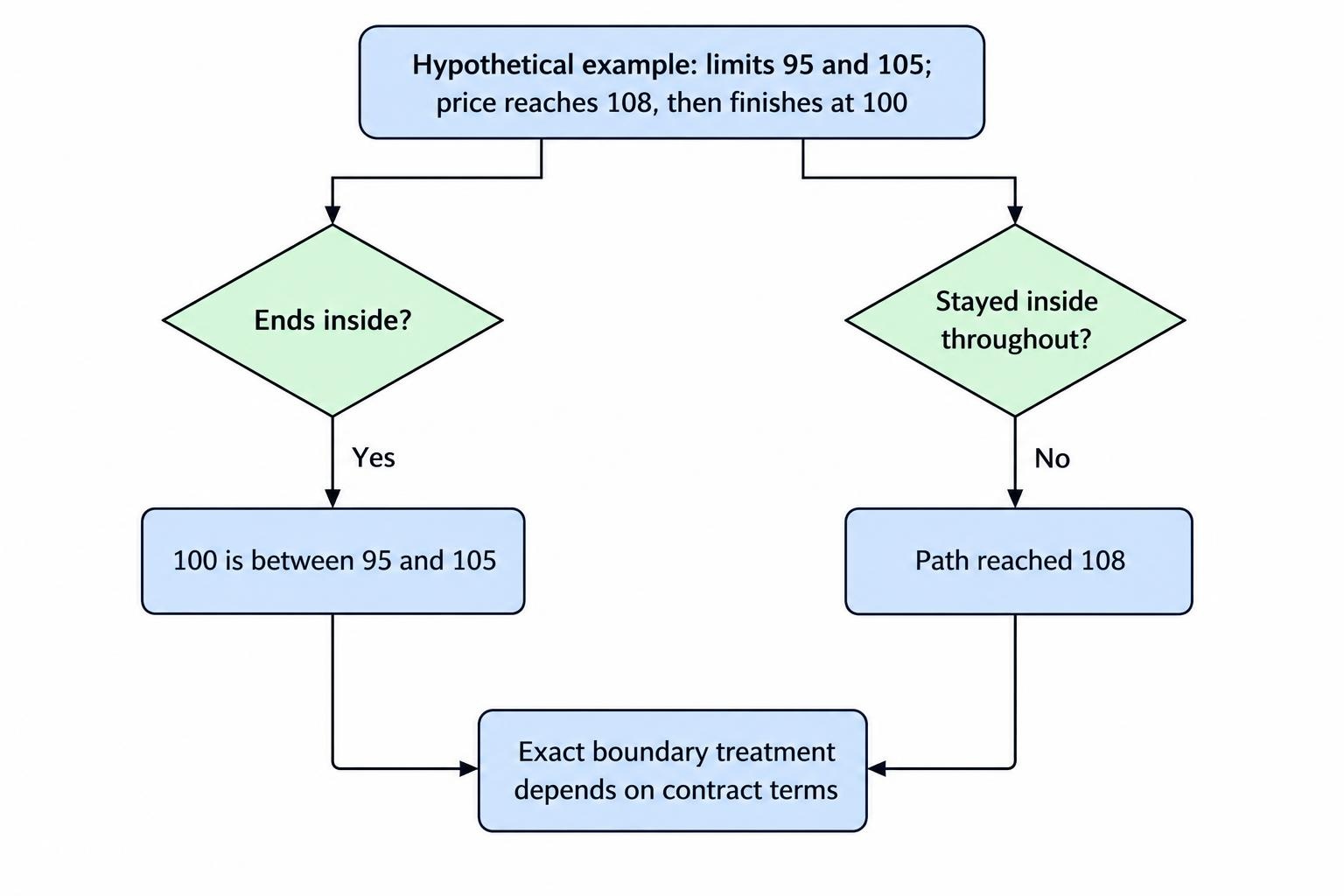
Deriv’s contract explanations explicitly distinguish ends-between/ends-outside from stays-between/goes-outside. Its rules also illustrate why equality matters: a boundary observation can be treated differently from a price strictly inside the range.
For a hypothetical contract where touching either boundary defeats the stays-inside condition, a price of exactly 105 is sufficient. A different contract requiring movement strictly beyond 105 would need another observation. The words “touch”, “reach”, “exceed” and “finish” should not be treated as synonyms.
Pros and cons of range and boundary options
| Pros | Cons |
|---|---|
| The contract can express a view about where prices will be distributed rather than one direction alone. | “Inside” may refer to expiry only or to the entire period, producing different outcomes. |
| An expiry-only design can tolerate earlier excursions outside the range. | A whole-period design can lose on one qualifying boundary observation. |
| An outside proposition can cover moves in either direction. | The payout must compensate for the probability of the precise outside event being tested. |
| Two specified levels make the required price region visible. | A narrow range can be difficult to satisfy even when the market appears relatively quiet. |
A wider range generally makes an otherwise identical inside condition easier to satisfy, but that does not establish a better purchase. The quoted cost or return may change at the same time.
Nor does an inside contract require stagnant prices. A market can trend within a sufficiently wide interval. Equally, a market that looks sideways over a longer chart can cross a narrow intraday boundary repeatedly. The scale of the forecast must match the actual barriers and duration.
The central issue with boundary and range options is therefore the event being priced. A general expectation of low volatility does not specify either the final price distribution or the probability of avoiding both boundaries.
Ladder binary options
A binary ladder presents several strikes or price thresholds. Each selected rung can represent a separate above-or-below proposition with its own price or payout.
The term does not necessarily describe one contract that automatically pays several amounts as the market climbs. It may describe a menu of individual contracts, or a package whose combined return depends on how many selected conditions are satisfied.
IG’s description of ladder digital contracts frames them around whether the market is above or below selected levels at expiry. That is an expiry test, rather than necessarily a test of whether the price touched each level earlier.
Several binary positions can produce several portfolio outcomes
Suppose a hypothetical trader buys three separate above-strike contracts with thresholds of 101, 103 and 105, each costing $20. Assume their total settlement payments on success are $36, $44 and $60 respectively.
If the market finishes at 104, the first two conditions are satisfied and the third is not. Total receipts are $80 against a $60 combined cost, producing a $20 profit before any other charges.
If the market finishes at 102, only the first contract pays. Receipts of $36 against the same $60 cost leave a $24 loss. Receiving a payout on one rung does not establish that the combined position is profitable.
Each component still has a binary outcome under these assumptions. The portfolio has several possible totals because it contains several contracts. Saying that ladder options are “not truly binary” confuses the individual payoff with the combined position.
More strikes do not necessarily diversify risk
For above-strike contracts on the same reference price and expiry, the conditions are nested. Finishing above 105 also means finishing above 103 and 101. A sufficiently large downward move can make every selected above-strike contract lose together.
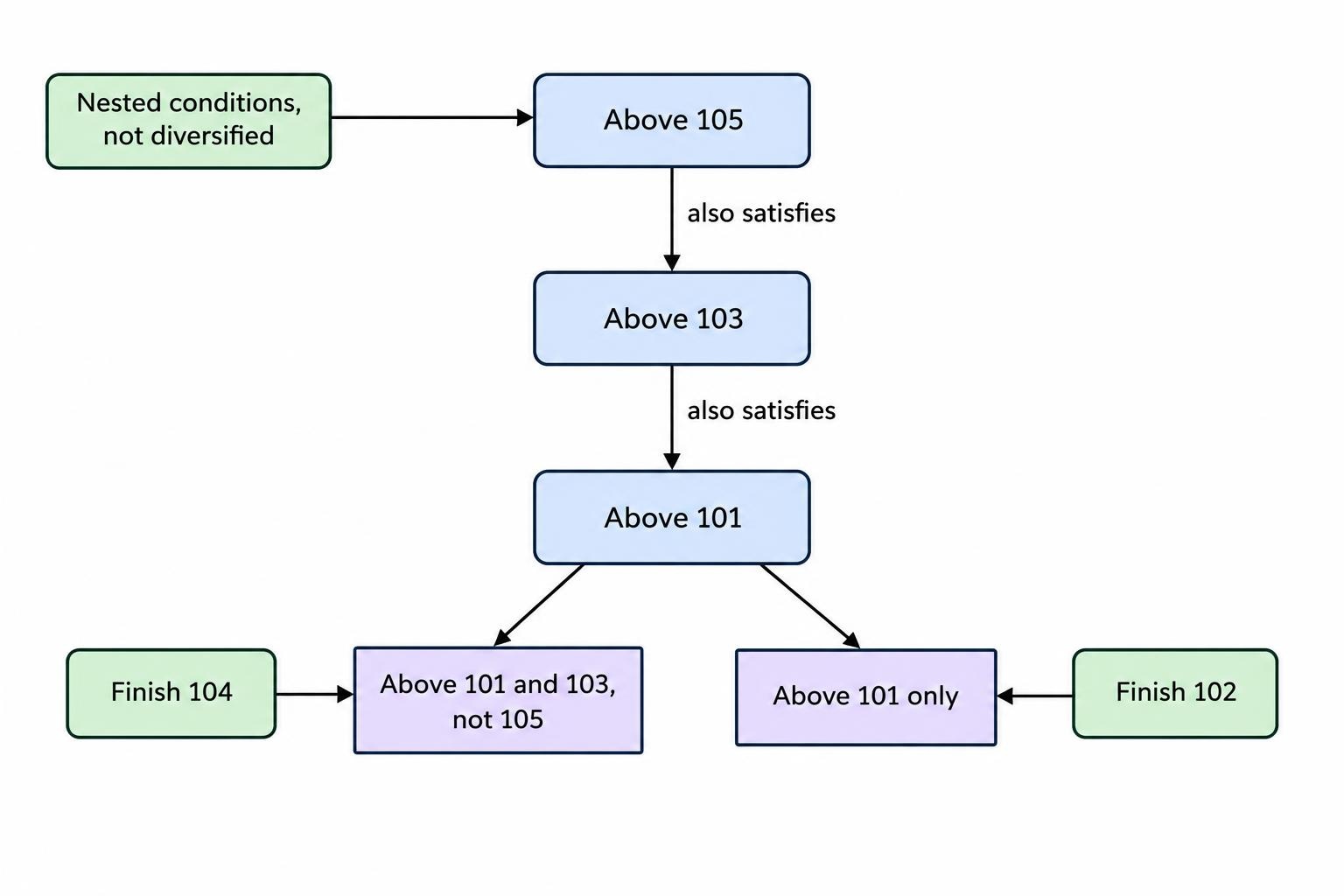
Splitting a budget across rungs therefore changes the distribution of payouts without automatically spreading exposure across independent risks. The connection to correlation and trading risk is direct: several positions can still depend on the same market outcome.
Pros and cons of ladder options
| Pros | Cons |
|---|---|
| Different strikes let a trader express different thresholds within one market view. | Several rungs can all lose after the same unfavourable move. |
| Each rung’s cost and potential payment can be assessed separately. | Winning on some rungs may still leave the combined position at a loss. |
| The combined payoff can be calculated across several settlement scenarios. | A more complicated payoff requires tracking every stake, threshold and settlement rule. |
A larger advertised return on a more demanding threshold should be assessed against its probability. Ladder binary options do not create extra expected value simply by displaying several payout percentages together.
Pair binary options
A pair binary compares two assets according to a stated performance measure. The proposition might be that one share, index or other reference asset will outperform another over the contract’s measurement period.
Outperformance usually concerns a return or normalised change, rather than which asset has the higher numerical price. The starting observations and calculation method must be specified.
Dukascopy’s 2015 announcement of pair binaries described contracts based on the daily relative performance of two assets. That historical example illustrates the structure; it is not evidence of current availability for Australian retail clients.
Relative performance can differ from absolute gains
Suppose Share A rises from $100 to $102, while Share B rises from $50 to $51.50. Share A gains 2%; Share B gains 3%. Under a percentage-return comparison, Share B outperforms even though its dollar gain per share is smaller.
The same idea applies when both assets fall. If Share A loses 2% and Share B loses 5%, Share A has outperformed by three percentage points. A contract favouring Share A could satisfy its relative-performance condition despite Share A declining.
This changes the forecast being purchased. The question is not necessarily whether either asset will rise. It is whether their measured returns will appear in the selected order.
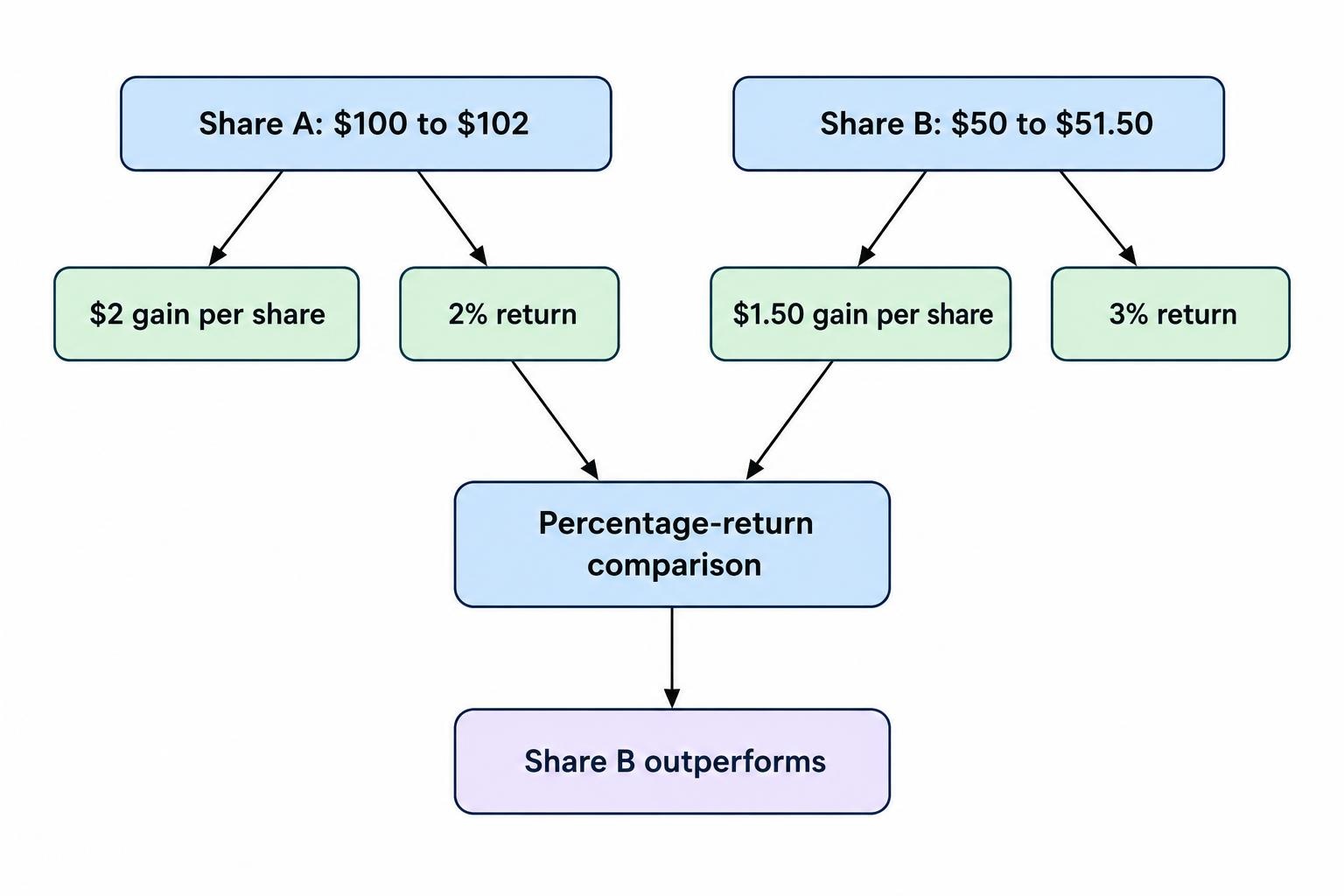
A larger performance gap does not automatically increase a fixed binary payout. Outperformance by 0.1 percentage point and by ten percentage points can generate the same payment if the contract tests only which return is greater.
Comparison rules matter
The reference period might begin at purchase, at the market open or at another scheduled observation. Assets traded in different sessions can have mismatched information windows. Currency conversion, dividends, share splits and price adjustments can also affect a return comparison if the terms account for them differently.
Pair binaries need not involve companies in the same sector. A same-sector pairing may be economically easier to interpret, but it does not remove company announcements, changing correlations or differences in market sensitivity.
The comparison with forex is only partial. A currency quotation expresses one currency in units of another. A pair binary adds its own performance formula, expiry and fixed payoff, so experience trading an exchange rate does not automatically transfer to the contract.
Pros and cons of pair options
| Pros | Cons |
|---|---|
| The contract can express an expectation of relative rather than absolute performance. | Correctly predicting one asset’s direction is insufficient if the other performs better. |
| A selected asset can outperform even when both assets decline. | Starting prices, observation times and return adjustments can change the comparison. |
| The proposition can focus on differences between two businesses or markets. | A larger outperformance margin may earn no more than a narrow win. |
Relative performance can reduce reliance on a simple bullish or bearish view. It does not establish market neutrality or eliminate common exposure to economic news.
Turbo and 60-second binary options
Turbo describes a short contract duration, not a distinct settlement condition. Providers may use the label for different periods, including 60 seconds or less. A contract called turbo could still use a high/low condition, a touch condition or another specified payoff.
The exact clock matters more than the label. A contract lasting sixty seconds from acceptance is not necessarily the same as one expiring at the next fixed minute boundary. A late entry into a scheduled expiry may leave much less than sixty seconds of exposure.
Short duration changes execution sensitivity
Suppose a trader observes a price at 12:00:00 but the contract is accepted at 12:00:02. If the reference price changes during that interval, the entry condition may differ from the one visible when the decision was made.
That delay represents a larger fraction of a one-minute observation window than of a one-day window. It does not prove that every short contract is mispriced, but it makes the exact entry process more consequential.
Execution and latency concern when an instruction arrives, when it is accepted and which observation establishes the contract. A countdown on the screen is not a substitute for those rules.
Pros and cons of turbo options
| Pros | Cons |
|---|---|
| The exposure is confined to a short, defined window. | Small timing differences can materially change the entry or final observation. |
| The result is available quickly once settlement is completed. | Quick results can encourage repeated staking before cumulative losses are assessed. |
| The underlying payoff may remain straightforward to describe. | Speed does not improve the payout or demonstrate a forecasting advantage. |
Experience does not make a sixty-second contract inherently suitable. Faster decisions can be consistently wrong, and repeating a negative expected return more often increases exposure to it.
For example, an assumed expected loss of $2 per contract becomes $100 across fifty identical stakes, provided the assumptions remain unchanged. That is an average across possible outcomes, not a promise about a particular session. The speed of the contracts changes how quickly the exposure can accumulate.
Comparing payouts across contract types
A contract type tells you which event determines payment. It does not tell you whether the price is attractive. A high-probability event can be expensive, while an unlikely event can offer a large payment without representing good value.
The starting point is to separate the purchase cost, net profit and total amount returned. If a $100 stake earns an $80 net profit on success, the total return of cash is $180. Describing the transaction only as an “80% payout” can obscure that distinction.
Break even depends on both gains and losses
Assume a full $100 loss on failure, an $80 net profit on success and no other costs, refunds or ties. The success rate needed to break even is 100 divided by 180, or approximately 55.56%.
At a 50% success rate, the average result is a $40 probability-weighted gain minus a $50 probability-weighted loss: an expected loss of $10 per contract. At a genuine 60% success rate, the same terms would imply an expected gain of $8.
The difficult part is establishing that probability before committing money. A barrier appearing distant, a chart appearing quiet or a company appearing stronger than its competitor is not a numerical probability estimate.
For a different pricing format, suppose a contract costs $30 and returns a total of $100 on success. Its break even success probability is 30%, before costs. That calculation concerns the event specified in that contract, whether it is a touch, an expiry threshold or a relative-performance result.
Probability and expected value provide a common framework for comparing these structures. A larger advertised payment does not establish a higher expected return, and a higher success rate does not establish profitability.
The event definition comes before the calculation
A probability estimate for finishing above a level cannot simply be reused as the probability of touching that level. A market can touch an upper barrier and finish below it. Similarly, an estimate for ending inside a range does not establish the probability of remaining inside throughout.
For the same observation window and compatible boundary rules, staying inside is a stricter event than merely finishing inside. Any valid stays-inside path finishes inside, but many ends-inside paths have previously left the interval.
This logical relationship does not supply the actual probabilities. It shows why apparently similar contracts need separate analysis and why their quoted prices or returns can differ.
Settlement terms that change the result
The reference price should be identified precisely. A bid, ask, midpoint, last transaction or calculated index can give different observations at the same moment. Rounding rules can then affect whether the recorded value is above, below or equal to a barrier.
IG’s published digital contract details illustrate the importance of specified reference sources and equality rules. The existence of an independent chart showing a different number does not by itself establish a settlement error; the comparison must use the contractual benchmark.
Settlement and ties also need explicit treatment. An exact match might count as success, failure or a refund depending on the design. Opposite-looking selections are not necessarily perfect complements if both exclude equality.
Observation frequency matters for barrier contracts. A market may cross a level between recorded samples. Whether that crossing qualifies depends on the agreed monitoring method and data. The contract’s start time, end time and time zone must therefore be considered alongside the barrier itself.
Early exit is another separate feature. Where offered, its price may depend on the remaining time and the provider’s quotation. Selling before expiry can produce an amount different from either terminal outcome; it should not be assumed to be available throughout the contract.
The useful distinction between binary option types is the precise event each one prices. High/low and ladders focus on thresholds, touch contracts on price paths, ranges on one or two boundaries, and pairs on relative performance. Turbo shortens the clock. None of those labels replaces the payout calculation, settlement specification or Australian retail restriction.
This article was last updated on: October 22, 2026