Offshore binary options brokers operate through companies based outside Australia. That overseas address matters, but it is not the main question. The more useful questions are which company holds your account, what it is authorised to offer, and where you could pursue a complaint if it refuses to return your money.
For Australian retail clients, the starting point is clear: ASIC’s prohibition on the issue and distribution of binary options took effect on 3 May 2021 and has been extended until 1 October 2031. An overseas licence does not, by itself, override ASIC’s binary options product intervention order.
A platform accepting an Australian address, displaying prices in Australian dollars or processing a deposit does not establish that its offer is authorised. Before comparing payouts or withdrawal speeds, establish who is making the offer and whether its claimed permissions actually apply.
What makes a binary options broker offshore?
For this guide, an offshore broker is a provider whose contract with the customer is made through a company outside Australia. The trading name on the screen may differ from that company’s legal name. Its payment processor, software provider and customer support business may be separate organisations again.
Those distinctions matter because a complaint needs a named respondent. A familiar logo is not enough. You need to identify the company that agreed to provide the account and the company responsible for any money owed to you.
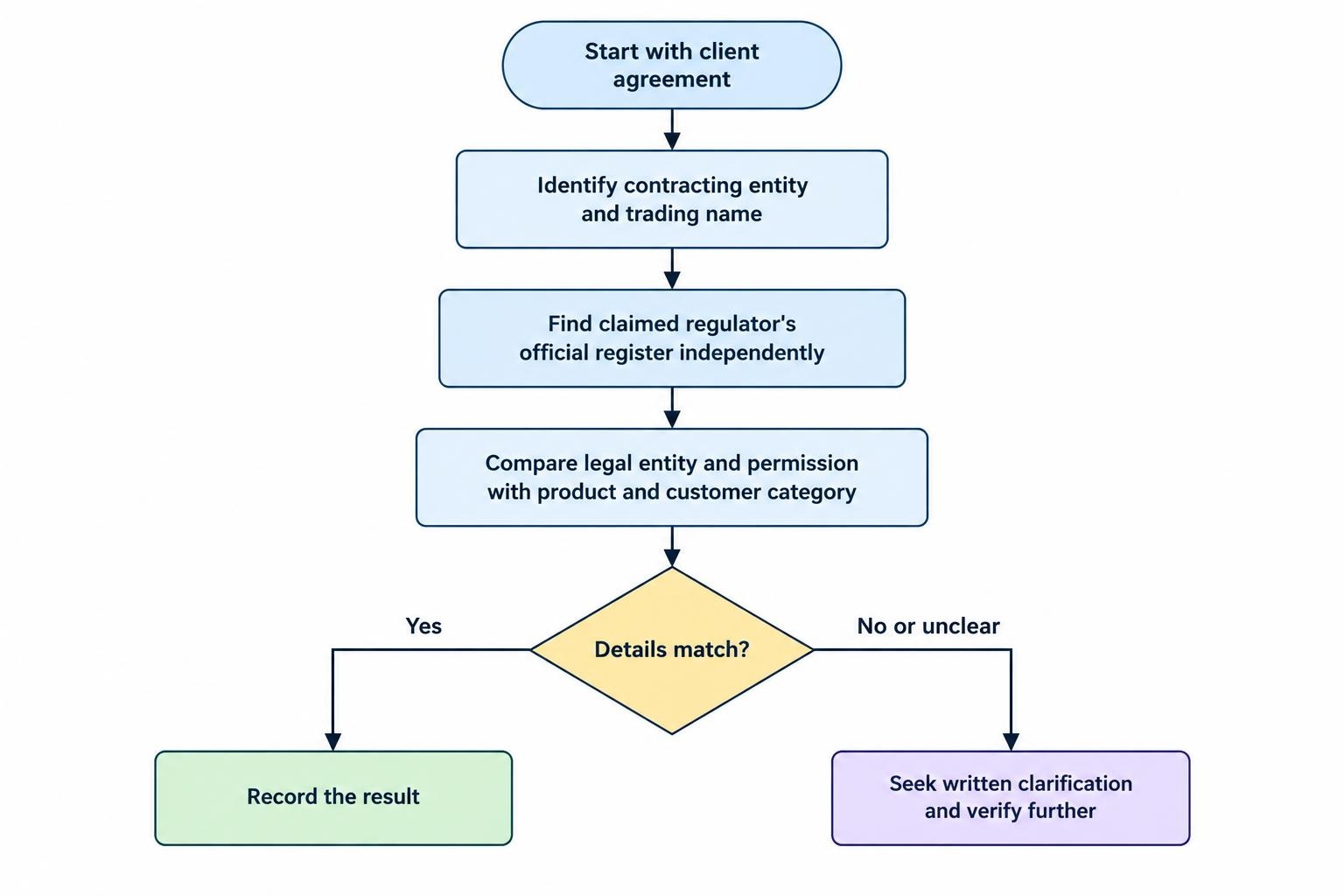
Start with the client agreement. Find the contracting entity, its incorporation jurisdiction, the stated regulator and the provisions covering disputes. Compare those details with the account confirmation and payment records. If different documents name different companies, ask for a written explanation rather than assuming they all carry the same obligations.
Offshore location alone does not prove fraud. Equally, a foreign company’s existence does not prove financial supervision. Keep three questions separate: does the company exist, does it hold the relevant financial services permission, and does that permission cover the service offered to you?
The broader rules sit within binary options regulation in Australia. This article focuses on the extra problems created by overseas contracting entities: checking authorisation, identifying applicable protections and assessing whether a practical complaint route exists.
Does operating overseas remove Australian licensing obligations?
Not automatically. Australian licensing requirements can apply to a business outside Australia. The assessment involves what the provider does, its connection with Australia and whether an exemption applies. Overseas incorporation is not a universal exemption.
Conduct intended, or likely, to induce people in Australia to use a financial service can be relevant to whether an overseas provider needs an Australian financial services licence. The cross-border framework is covered in ASIC Regulatory Guide 121 on doing financial services business in Australia.
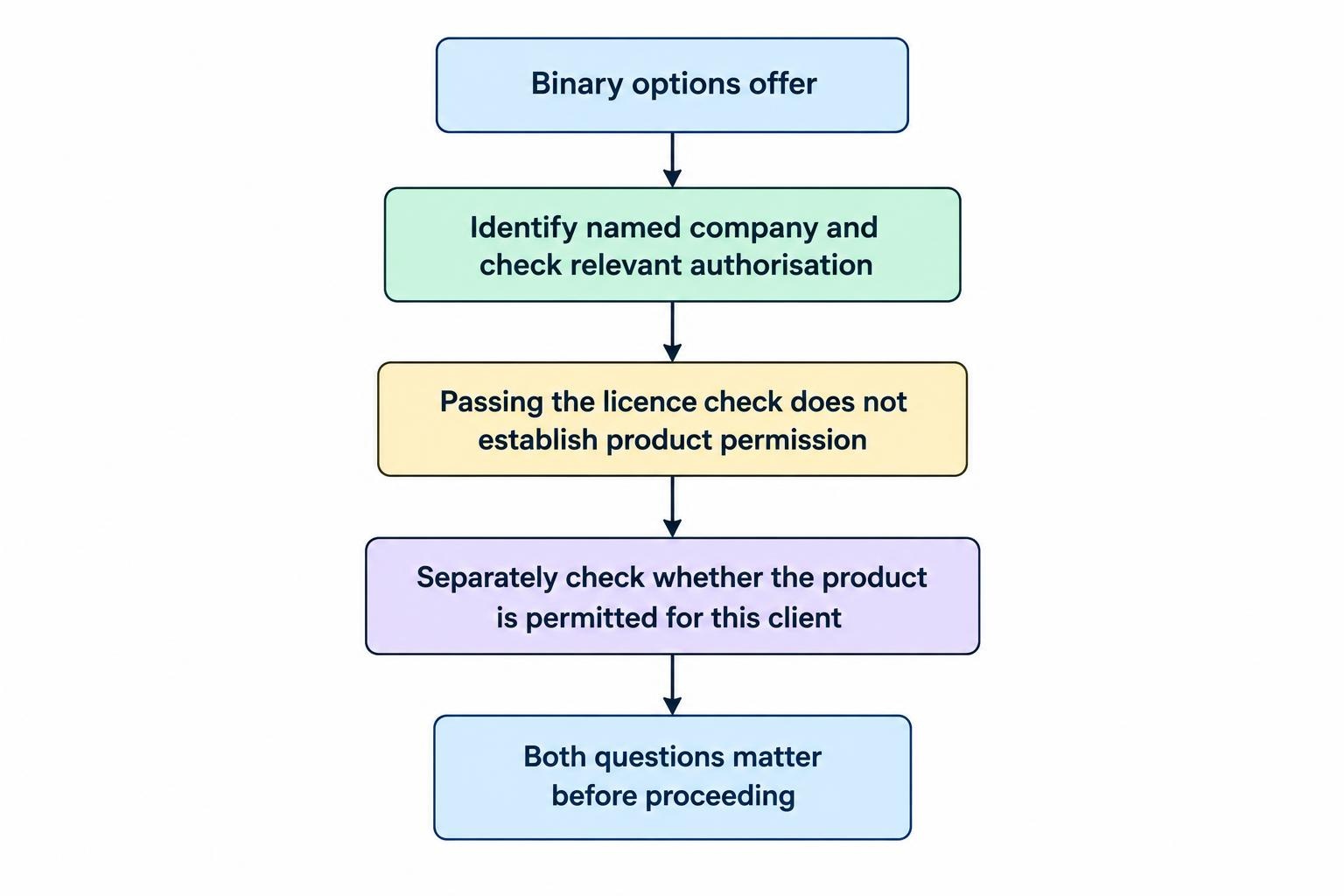
Do not confuse licensing with product permission. Even where a company holds an AFS licence, that does not mean every product it offers is available to every customer. A licence check and a check against the retail binary options prohibition answer different questions. Both matter.
Nor should you treat successful registration as a regulatory decision. An online form can accept information without establishing that the resulting service complies with Australian requirements. A deposit button is a payment function, not a legal opinion.
For an Australian retail customer, an explanation that stops at “we are licensed overseas” leaves the central issue unanswered. Ask what authorises the named company to provide the named product to someone in your circumstances. A reference to a foreign certificate, without addressing Australian requirements, is not an adequate answer.
Check the legal entity, not just the trading name
Identify the company responsible for your account
Write down the full legal name shown in the client agreement, its company number, its claimed financial licence number and the regulator’s name. Keep the trading name in a separate field. This prevents a search result for one group company being mistaken for authorisation held by another.
Also record the website address and the date of the agreement. If you are investigating an existing account, retain the version you accepted rather than relying only on the terms currently displayed online. Your evidence should show what was presented to you at the time.
Consider a hypothetical group with an Australian company and an overseas company using the same brand. If your agreement names the overseas company, a licence belonging to the Australian company does not establish the overseas company’s permissions. You still need evidence connecting the contracting entity to the service being offered.
Verify permissions through official records
For Australian claims, use the ASIC professional registers search. Check the legal name, licence or representative number, current status, recorded website addresses and any conditions. Make sure you are viewing the financial services register rather than an unrelated registration.
For a claimed overseas licence, locate the regulator independently. Do not rely solely on a certificate image or a link supplied in a sales chat. Search the legal entity and inspect what the official record actually says. Where the record is unclear, ask the authority whether the claimed permission covers the product and customer category.
Keep a dated copy of the result. A useful record includes the entity name, the permission checked and the address of the official register. Our guide to checking a broker’s licence covers the verification process in more detail.
Separate registration, licensing and promotional badges
A company registration confirms something different from financial services authorisation. Moneysmart’s checks before investing distinguish company registration from licensing and warn that scammers can misuse genuine licence details. Match the offer to the actual licence holder, not just to a number that produces a search result.
| Claim displayed | What to investigate | What not to assume |
|---|---|---|
| Company registration certificate | Whether the named company exists in the stated jurisdiction. | That incorporation authorises binary options business. |
| Financial services licence | The holder, status, permitted activities, products and customer categories. | That it covers another group company or an Australian retail offer. |
| Private dispute scheme membership | The scheme’s rules, eligibility requirements and available remedies. | That membership is a government licence or guarantees payment. |
| Awards, ratings or software certificates | Who issued them and precisely what was assessed. | That they establish financial services permission or protect account balances. |
Do not award extra regulatory weight to several badges saying much the same thing. Five certificates of uncertain relevance do not answer one unresolved licensing question. The distinction between foreign regulators and private certificates deserves attention before any badge is treated as protection.
An unclear answer should remain unclear in your assessment. Do not fill missing evidence with positive reviews, a long operating history claimed by the business, or assurances from an account manager. None of those resolves a mismatch between the company in the contract and the company on the register.
The financial risks do not stop at losing trades
Account balances and insolvency
There are two separate questions about money on a platform: what balance does the account display, and what money can you actually recover? A profitable trade record answers neither the provider’s ability to pay nor your position if the company fails.
If a provider claims that customer money is segregated, ask what that means for your account. Which company holds it? Under what arrangement? What happens if that company becomes insolvent? Do not translate a short marketing statement into a promise that every dollar will be returned.
For an existing offshore account, retain statements showing deposits, withdrawals and the balance separately. These records help distinguish money you transferred from profits recorded by the platform. The legal treatment of each may require advice. Our page on client money and broker insolvency examines that separate issue.
Prices, settlement and disputed results
A binary option can turn on whether a reference price finishes above or below a strike at expiry. That makes the settlement method important. A chart that looks broadly similar to another chart is not enough to resolve a dispute over the exact price and time used.
For any disputed transaction, preserve the contract identifier, stake, strike, expiry time and time zone, settlement price and stated reference feed. Record the applicable tie rule too. Without those details, a screenshot may show disagreement without explaining its cause.
Fraudulent price handling is also a documented concern. The SEC and CFTC investor alert on binary options fraud describes complaints involving trading software manipulated to distort prices and payouts. That warning does not establish misconduct by every offshore provider, but it shows why a platform’s own display should not be treated as independent evidence.
Payment recipients and missing links
Check who received each payment. If the beneficiary differs from the contracting company, preserve the payment instruction and ask for the relationship to be explained in writing. A separate processor is not, on its own, proof of wrongdoing. An unexplained recipient still creates an evidence problem worth resolving.
Keep bank references, card transaction details or cryptocurrency transaction identifiers outside the trading account. Do not rely on continued access to the platform as your only record. Save correspondence showing why the payment was requested and which account it was meant to fund.
These questions belong to counterparty and platform risk, not trading strategy. Reducing the stake on each trade does not answer whether the company holding the remaining balance will return it.
Why attractive account features do not establish safety
A higher advertised payout changes the reward on a successful contract. It does not change the identity of the company that owes the payment. Keep those assessments separate. Comparing percentages before checking authorisation puts the easiest number ahead of the harder question.
The same applies to a small minimum deposit. A low entry amount can reduce the first payment, but it says nothing about the legitimacy of the offer. It also does not justify sending more money later because the first amount felt manageable.
A successful withdrawal is useful evidence that one payment occurred. It is not proof that the account is genuine or that future withdrawals will be honoured. Scamwatch’s investment scam warning describes schemes that allow small withdrawals to build trust before blocking access to larger amounts.
For example, receiving A$50 after depositing A$200 does not validate a later request to deposit A$5,000. The earlier payment and the later request are different events. Assess the new request on its own evidence rather than treating the first withdrawal as a permanent pass.
Demo accounts answer another narrow question: how the demonstration behaves. They do not test the recovery of real funds, the enforceability of a contract or the handling of an actual complaint. A smooth demonstration cannot settle a legal entity mismatch.
Reviews need the same discipline. A reviewer’s claim that a platform accepts Australians does not establish permission to serve Australian retail clients. Look for the entity, date and evidence behind the claim. If those are absent, the review has not answered the regulatory question, however polished its comparison table may be.
Do not accept wholesale classification just to gain access
A request to change your customer classification deserves separate scrutiny. Wholesale status is not simply a premium account tier. It affects the protections associated with the service and should not be accepted as an administrative shortcut.
Moneysmart’s binary options warning for Australian consumers states that wholesale clients do not have the same consumer protections as retail clients. It expressly warns against agreeing to wholesale treatment just to access binary options.
Do not sign a declaration that misstates your circumstances or experience. If a provider presents classification documents, obtain independent Australian legal or financial advice about what they mean before agreeing. The provider’s wish to open the account is not a substitute for advice about your position.
Ask for the proposed basis of classification and the consequences in writing. Keep those documents even if you decide not to proceed. Our guide to retail and wholesale trading clients addresses the distinction without treating it as a route around the retail prohibition.
What complaint rights might be available?
Begin with the exact contracting entity and the complaint provisions in its agreement. Record the address for complaints, the stated governing law and any named dispute resolution scheme. Then verify the scheme independently. A support email address and an external complaint mechanism are not the same thing.
Access to the Australian Financial Complaints Authority is not automatic because you live in Australia. The complaint must concern an AFCA member and meet other requirements, including applicable time limits and jurisdiction rules. Check AFCA’s complaint eligibility requirements against the named firm rather than the brand alone.
If an overseas scheme is named, ask whether it accepts complaints from Australian residents about that entity and product. Check what outcomes it can provide and how they are enforced. Do not assume a published maximum award is a guarantee that your complaint qualifies or that money will be available.
For an existing dispute, write a concise chronology: what was offered, what you paid, what happened, what explanation the company gave and what remedy you want. Attach transaction evidence. Separate a disputed trade result from a refused withdrawal so each issue can be assessed clearly.
The guide to broker complaints and AFCA covers Australian complaint routes. Where a substantial sum is involved and the respondent is overseas, obtain legal advice about jurisdiction, likely costs and practical recovery prospects before committing to proceedings.
What to do if you have already sent money offshore
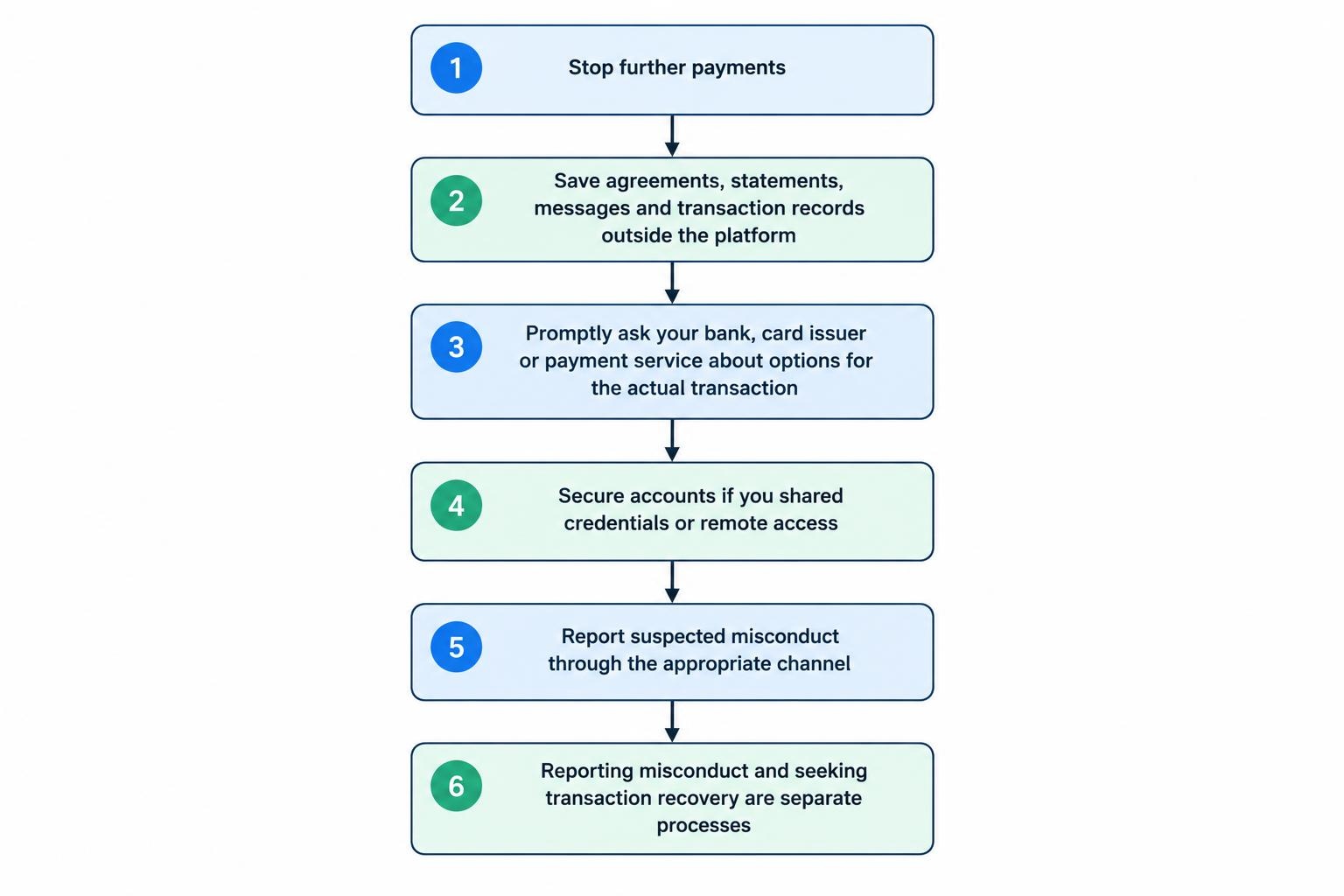
Focus first on preventing further loss and preserving evidence. Do not increase the balance to test whether the company will eventually pay. If you suspect a scam, contact the financial institution used for the payment promptly and explain exactly what happened.
Reporting misconduct and recovering money are different processes. ASIC’s reporting guidance states that it cannot recover money lost through scams or resolve individual disputes. It directs scam reports to Scamwatch. Reporting still matters, but it should not replace urgent contact with your payment provider.
- Stop further payments. Do not send another deposit in response to pressure or a promise that it will release the existing balance.
- Save records outside the platform. Keep agreements, account statements, payment receipts, withdrawal requests and messages. Include dates, amounts and recipient details.
- Contact your bank, card issuer or payment service. Ask what options apply to the actual transaction and what evidence they need. Do not assume reimbursement is available.
- Secure affected accounts. If you shared passwords or allowed remote access, tell the financial institution and take steps to protect the accounts involved.
- Keep the withdrawal issue documented. Record the amount requested, the request date and every reason given for delay. Avoid replacing a written record with repeated telephone conversations.
Be cautious about anyone who contacts you promising to recover the money for an advance fee. Scamwatch’s money recovery scam warning covers approaches from people posing as lawyers, government agencies and other trusted organisations. Requests for taxes, investigation funding or remote access can be part of a second scam.
There is no need to prove every aspect of the case before asking your financial institution for help. Provide the evidence you have and add further records as they become available. The practical priority is to stop the exposure from growing.
For a fuller response plan, see what to do after a binary options scam. Avoid posting identity documents, account credentials or complete payment details publicly while looking for help.
A practical decision for Australian retail readers
Assess an offshore binary options offer in the right order: the product restriction, the contracting entity, its permissions and the available complaint route. Payouts, app features and deposit methods come after those questions, not before them.
If the purpose is to learn about markets, an offshore binary account is not required. Paper exercises can separate market study from depositing money with a provider. If the purpose is longer term investing or another form of market participation, compare alternatives to binary options on their own risks and costs.
The decision should not rest on whether a platform lets you open an account. It should rest on whether the offer is authorised for you, whether the responsible company can be identified, and whether its promises are backed by verifiable obligations rather than a convincing screen.
This article was last updated on: October 22, 2026