Binary options bonuses are promotional credits offered to encourage account opening, deposits or further trading. The headline might promise a deposit match, a no deposit bonus or reimbursement for a losing trade. None of those labels tells you how much money you can withdraw.
For Australian retail clients, the starting point is regulation, not the bonus percentage. ASIC banned the issue and distribution of binary options to retail clients from 3 May 2021 and extended that prohibition until 1 October 2031. A promotional offer does not create an exception.
This article explains how bonus conditions work, how to calculate turnover requirements, and what to do if a credit has become an obstacle to withdrawing your own money. It does not recommend bonus offers or provide promotional codes.
Australian rules come before bonus terms
An offshore address does not automatically put an offer outside Australian restrictions. The binary options product intervention order includes offers received in Australia within its application provisions. Access to a registration form, an Australian dollar account or a working deposit button is not evidence that the product can lawfully be supplied to an Australian retail client.
The restriction concerns the issue and distribution of the product, not just how a promotion is worded. Removing the word “bonus”, calling the credit a reward, or advertising the account through a social media group does not answer the regulatory question.
Separate that question from the commercial terms. An offer can have clearly written conditions and still be inappropriate to accept. Equally, a foreign registration number does not establish that the provider has permission to offer the product to you.
Trading credit is not the same as cash
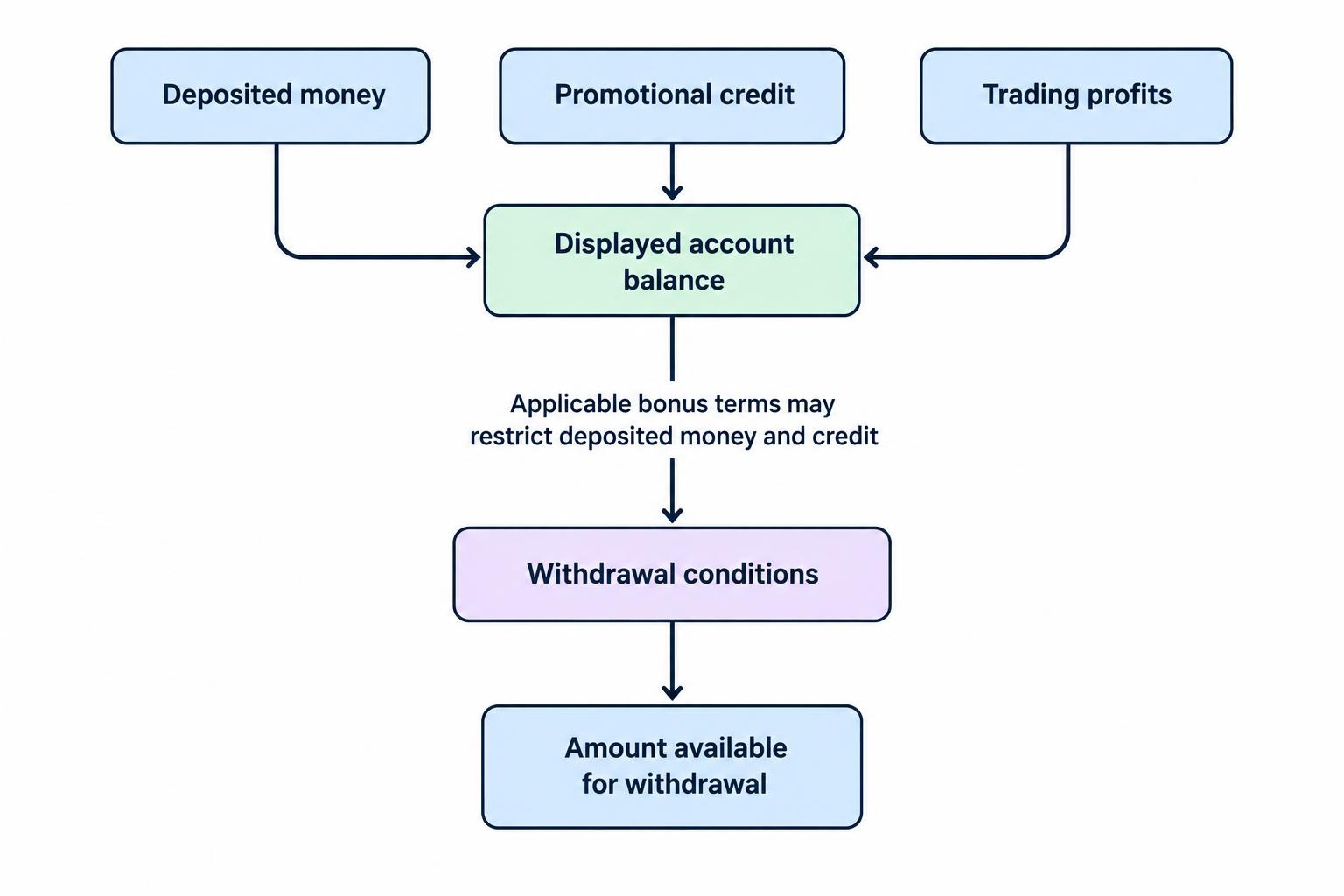
A bonus can increase the balance displayed on a trading screen without increasing the amount available for withdrawal. The useful distinction is between your deposited money, promotional credit, trading profits and withdrawable funds. Those amounts need not be identical.
Withdrawal restrictions attached to binary options bonuses are a documented concern. The CFTC warning on off-exchange binary options identifies bonuses that require a minimum amount of trading before any funds can be withdrawn. That condition can affect much more than the promotional credit itself.
Suppose you deposit A$1,000 and receive A$500 in credit. The screen shows A$1,500, but the extra A$500 may carry conditions that also restrict access to the original A$1,000. The bigger number is not necessarily a bigger benefit.
Before evaluating a percentage, establish whether the promotion creates withdrawable cash, conditional trading credit or a credit that can never itself be withdrawn. If the terms do not distinguish these clearly, the advertised value cannot be assessed reliably.
What different bonus labels can mean
The following are promotional structures to recognise, not a list of verified current offers. The written conditions matter more than the name.
Deposit matches and repeat deposit bonuses
A deposit match calculates credit as a percentage of qualifying funds. A hypothetical 50% match on A$1,000 produces A$500 in credit, subject to any cap. A repeat deposit offer uses the same idea to encourage another payment.
Check whether the percentage applies to the whole deposit, whether a minimum payment is required, and whether accepting another credit starts a new turnover obligation. A larger deposit should not become the price of preserving an earlier promotion.
No deposit bonuses
A no deposit bonus promises an initial credit without an opening payment. That does not establish that the credit or resulting profits can be withdrawn without further conditions.
Look for any later deposit requirement, profit withdrawal cap, expiry date or trading obligation. If payment becomes necessary to access the advertised benefit, assess the offer on that basis rather than treating “no deposit” as the whole arrangement.
Loss refunds, “risk free” trades and cashback
A loss refund is only comparable to a cash refund if the reimbursement is withdrawable cash. Replacing a lost A$100 stake with A$100 of restricted credit leaves you in a different position.
The same test applies to cashback: what is returned, when is it credited, and can it leave the account? A promotional label does not provide insurance. Check the substance of the promise, including any conditions attached to the replacement credit.
How to calculate a bonus turnover requirement
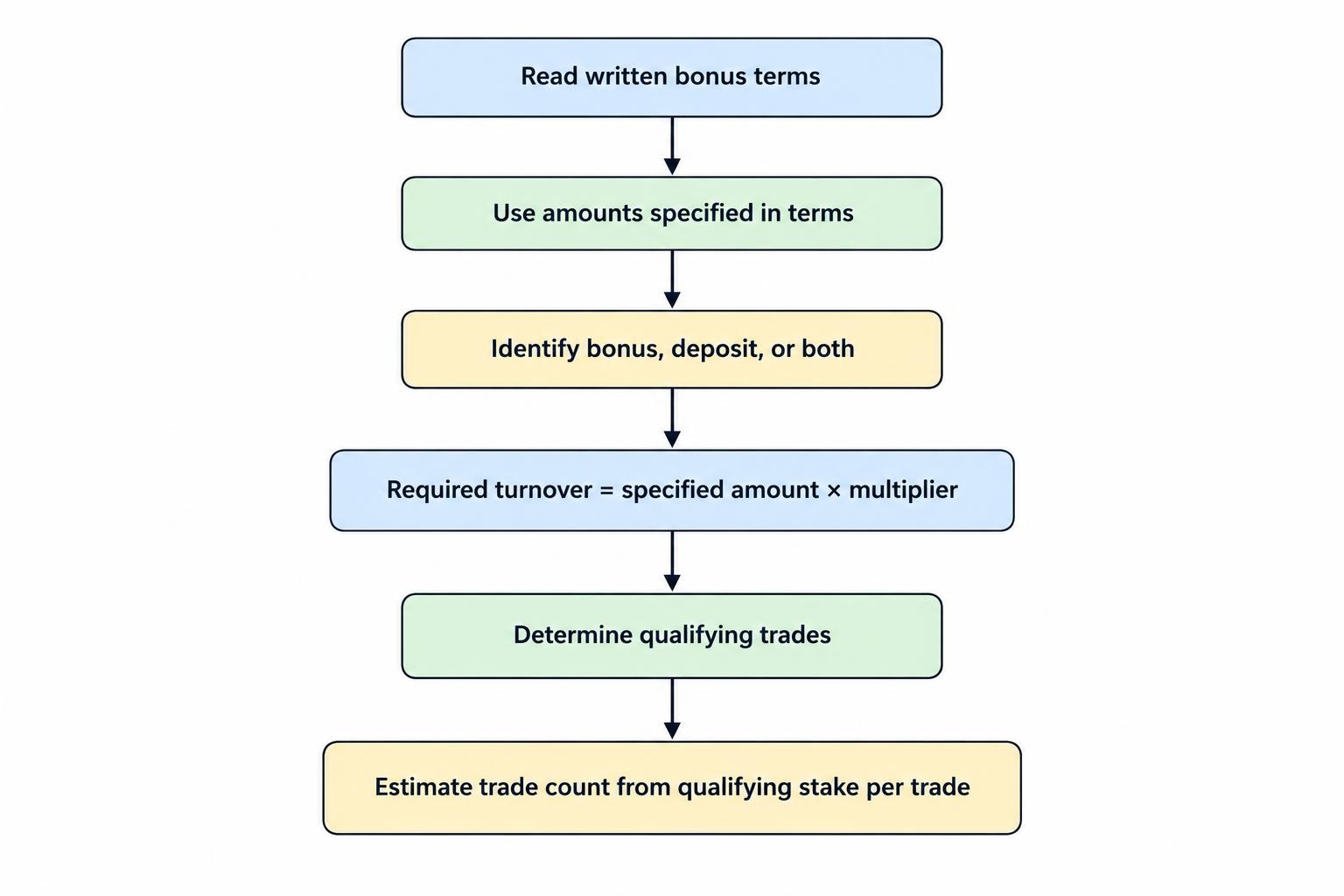
Turnover means the accumulated value of qualifying trades, not the profit earned. If each qualifying trade uses a A$25 stake, 20 trades produce A$500 of turnover regardless of whether those trades make or lose money.
The basic calculation is:
Required turnover = the amount specified in the terms × the turnover multiplier.
The important phrase is “the amount specified”. A requirement of “30 times” is incomplete unless the terms identify whether that multiplier applies to the bonus, the deposit or both.
Consider a hypothetical A$1,000 deposit with a A$500 bonus. Assume every A$25 trade counts in full:
| Basis for a 30 times requirement | Required turnover | Number of A$25 trades |
|---|---|---|
| A$500 bonus only | A$15,000 | 600 |
| A$1,000 deposit only | A$30,000 | 1,200 |
| A$1,000 deposit plus A$500 bonus | A$45,000 | 1,800 |
These are illustrations, not standard industry terms. The same advertised bonus can produce very different obligations depending on the calculation basis. Completing the turnover also does not mean the account will retain its starting value.
This mechanism has appeared in enforcement findings. The CFTC’s 2019 order concerning Shira Uzan found that purported bonuses were used to prevent withdrawals, involved no actual transfer of funds to customer accounts, and typically carried a requirement to trade 30 times the bonus amount. Customers were not always told that the bonus would lock them into the account.
For any written requirement, also check which trades qualify. Do cancelled trades count? Are some markets excluded? Does only part of a stake contribute? Without those answers, a turnover calculation can look achievable on paper while understating the actual trading required.
A bonus does not repair the payout mathematics
Extra credit does not change the payout on each contract unless the contract terms expressly change it. A requirement to place more trades can therefore add exposure to the same unfavourable arithmetic.
Take a hypothetical A$25 trade offering an 80% net profit on a win. A winning trade earns A$20, with the stake also returned. A losing trade loses A$25. At an assumed 50% chance of winning, the expected result is:
(0.50 × A$20) − (0.50 × A$25) = a A$2.50 expected loss per trade.
Across A$15,000 of turnover under those assumptions, the expected trading loss is A$1,500. That calculation is not a forecast of a particular account balance: outcomes vary, and an account may run out of usable funds before completing the requirement. It shows why A$500 of promotional credit cannot sensibly be valued without considering the trading attached to it.
At an 80% net profit payout, the break-even win rate is approximately 55.56%, before other costs or restrictions. The guide to probability and expected value in binary options covers that calculation in more detail.
Increasing stake sizes would reduce the number of trades needed to reach a turnover target, but it would also put more of the remaining balance at risk on each outcome. It is not a free shortcut.
The withdrawal conditions worth checking
The most consequential bonus terms concern access to money, not the promotional percentage. Read the account agreement and withdrawal policy alongside the offer, rather than relying on a banner or a message from a salesperson.
- Funds affected: Does the restriction apply only to the credit, or also to deposits and profits?
- Cancellation: Can the bonus be removed without further trading, and what else would be deducted?
- Withdrawal consequences: Would a withdrawal request cancel the credit or trigger another adjustment?
- Time allowed: When does the requirement start, and what happens if it expires unfinished?
- Qualifying activity: Which trades count, and how is progress calculated?
- Profit restrictions: Is there a cap on what can be withdrawn from bonus-related trading?
Request a worked calculation rather than accepting an assurance that cancellation is “simple”. Ask what happens if you stop trading immediately and request the return of your remaining deposited money. The answer should identify the amount payable and every proposed deduction.
If a credit appeared without your request, preserve the account history and ask when and how acceptance was recorded. Avoid placing trades just to investigate whether the withdrawal button starts working. That adds financial exposure without resolving the dispute.
Keep routine account checks separate from promotional conditions. A request for identity documents and a demand for hundreds of additional trades are different issues. The guide to binary options withdrawal problems examines how to organise the evidence when access to funds is disputed.
When a bonus becomes a warning sign
Pause if a representative pushes you to deposit before providing the conditions, promises unrestricted withdrawals that contradict the agreement, or introduces new requirements only after you ask for your money. Do not let an expiring offer set the timetable for a financial decision.
A small successful withdrawal does not prove that the remaining balance will be paid. Scamwatch’s investment scam warning describes schemes that allow small withdrawals to build trust, then invent reasons not to release larger amounts. It also warns that scammers can create fake performance data.
Apply that distinction to screenshots and testimonials. A picture of an account balance shows a number on a screen. It does not establish that the money exists, belongs to the account holder or is available without further payment.
Another warning is a changing explanation: first a turnover target, then a new deposit, then a tax or release payment. Ask for the contractual basis in writing. Do not treat another transfer as a sensible way to test whether the next promise will be honoured.
What to do if you have already accepted a bonus
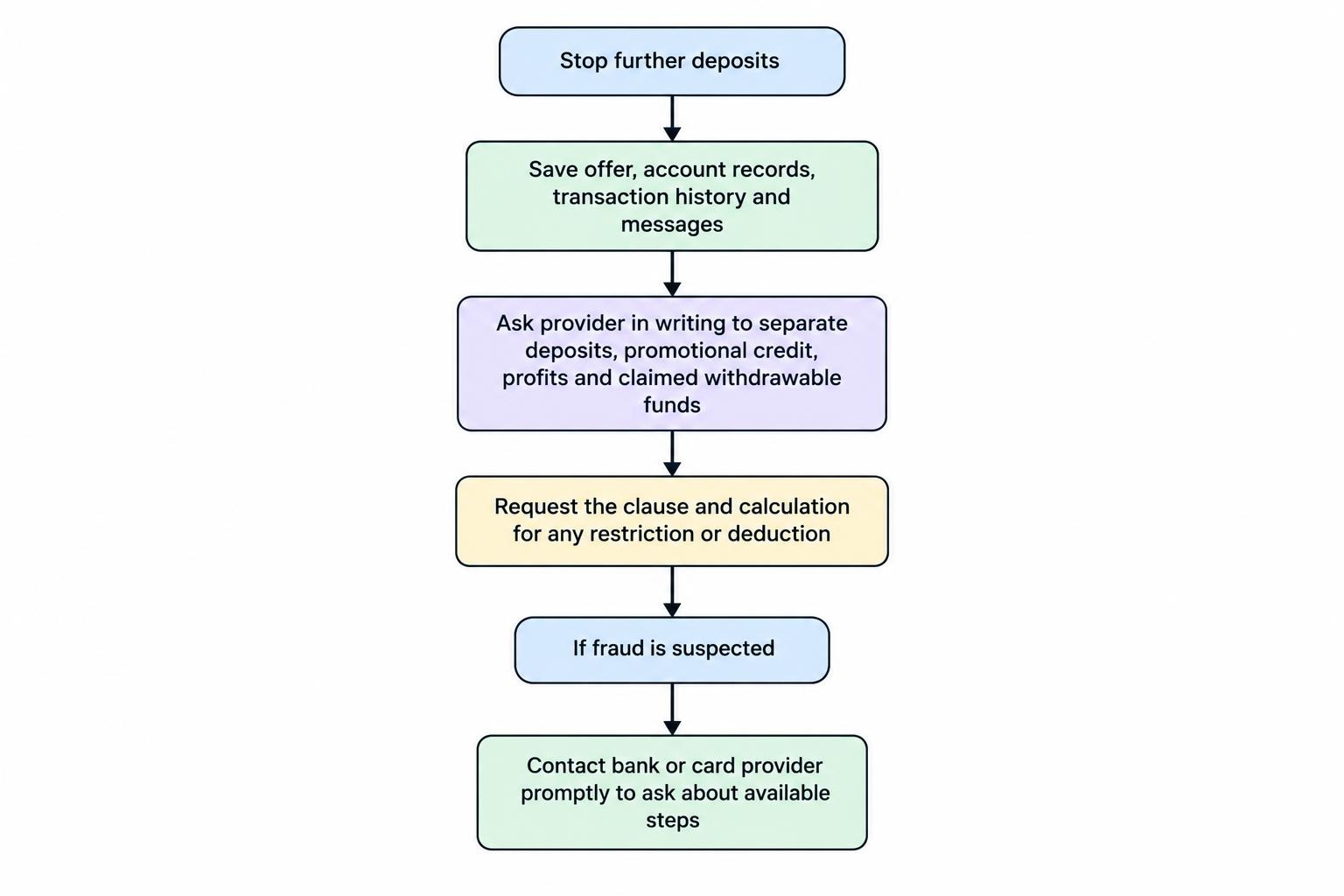
Start by stopping additional deposits. Preserve the offer, the terms available when you accepted it, account statements, transaction records and all messages about withdrawals. Save copies outside the platform so they remain available if access disappears.
Write to the provider asking for the remaining deposited funds, promotional credit, trading profit and claimed withdrawable amount to be shown separately. Request the clause relied on to restrict withdrawal and a calculation of any proposed deduction. If you want the bonus cancelled, ask for the financial consequences before agreeing.
If you suspect fraud, contact your bank or card provider immediately and ask what steps may be available to stop further losses or dispute payments. Scamwatch’s money recovery scam guidance also warns against people who promise to retrieve stolen funds in exchange for fees, tax payments or access to your devices.
Describe events accurately when speaking to your payment provider. Explain what was promised, what you paid, and why you believe the withdrawal restriction or later demand was misleading. A disputed payment is not automatically refundable, so ask about the process without assuming a guaranteed result.
Assess the offer without paying to find out
If your aim is to study binary options mechanics, a bonus is an unnecessary complication. You can calculate payouts, record hypothetical trades and test expiry rules without depositing money or accepting a credit. Paper trading binary options separates that learning exercise from withdrawal conditions and promotional pressure.
For an Australian retail client, the regulatory position remains the first decision point. Use the guide to binary options regulation in Australia to examine that issue, rather than assuming an overseas account or promotional code provides permission.
A bonus should never be valued at its headline amount without accounting for the conditions attached. If accessing it requires more deposits, more trading or surrendering access to your own money, the larger displayed balance can leave you worse off. Declining the promotion costs nothing; accepting it may be much harder to undo.
This article was last updated on: October 22, 2026