Cryptocurrency binary options are contracts whose payout depends on a defined event involving a crypto price, such as whether Bitcoin finishes above a stated level at expiry. They do not give you ownership of the cryptocurrency. The contract’s price condition, deadline and settlement rules determine the result.
For Australian retail clients, the regulatory position comes before any market analysis: ASIC’s prohibition on issuing and distributing binary options remains scheduled to run until 1 October 2031. The ASIC announcement extending the binary options ban sets out that restriction. The examples below explain the product, not a route around the ban.
How Cryptocurrency Binary Options Work
A crypto binary contract turns a price condition into a defined payout. With a straightforward higher/lower contract, the question might be: “Will BTC/USD finish above US$100,000 at 14:05 UTC?” The contract needs a strike price, an expiry time, a settlement price source and a rule for an exact tie.
Under a fixed stake structure, a successful contract returns the stake plus an agreed profit. An unsuccessful contract can lose the entire stake. The amount by which Bitcoin moves beyond the strike does not increase that fixed profit.
That separates the contract from buying Bitcoin directly. A binary position does not place coins in your wallet or give you the right to buy them. It also differs from an ordinary option whose value can change with the size of the underlying price move.
Other binary structures can test whether a price touches a barrier or stays inside a range. Those conditions need different analysis: finishing above a level and touching it at any point are not the same event.
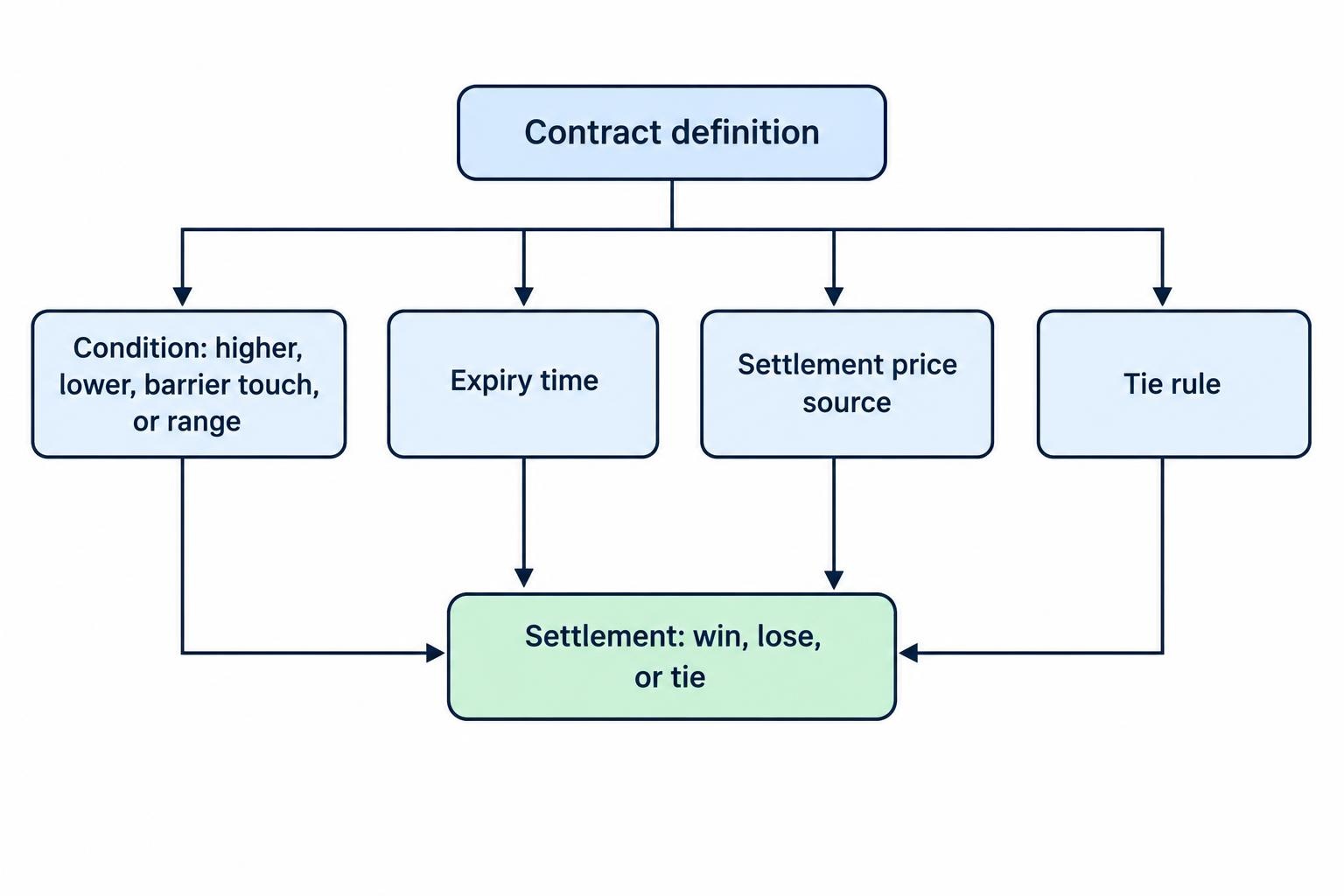
A Hypothetical Bitcoin Contract
Assume a contract has the following terms: an A$100 stake, a strike of US$100,000, expiry at 14:05 UTC and an 80% net profit on a successful outcome. It pays if the settlement price finishes strictly above the strike. For this example only, an exact tie returns the stake.
| Settlement price | Contract result | Amount returned | Net result |
|---|---|---|---|
| US$100,050 | Win | A$180 | A$80 profit |
| US$99,950 | Loss | A$0 | A$100 loss |
| US$100,000 | Tie under the assumed rule | A$100 | A$0 |
These are invented figures, not current market prices or an available offer. Fees and currency conversion are excluded.
Notice that Bitcoin could rise well above the strike during the contract, then finish below it. The higher contract would still lose. A correct view of the general trend is not enough; the required condition must hold at the contractual deadline.
The Payout Matters as Much as the Price Forecast
An advertised “80% payout” needs careful reading. In the example above it means an A$80 profit plus the return of the A$100 stake, not an A$80 total payment. Always separate net profit from the total amount returned.
The unequal win and loss amounts create a mathematical hurdle. Five wins and five losses at that payout produce A$400 of profits and A$500 of losses: a net loss of A$100, before charges.
For contracts with a fixed profit rate, full stake losses and no ties, the break even win rate is:
Break even win rate = 1 ÷ (1 + net profit rate)
At an 80% net profit rate, that is approximately 55.56%. Charges raise the hurdle. Refunds and other settlement outcomes change the calculation, so they cannot simply be ignored.
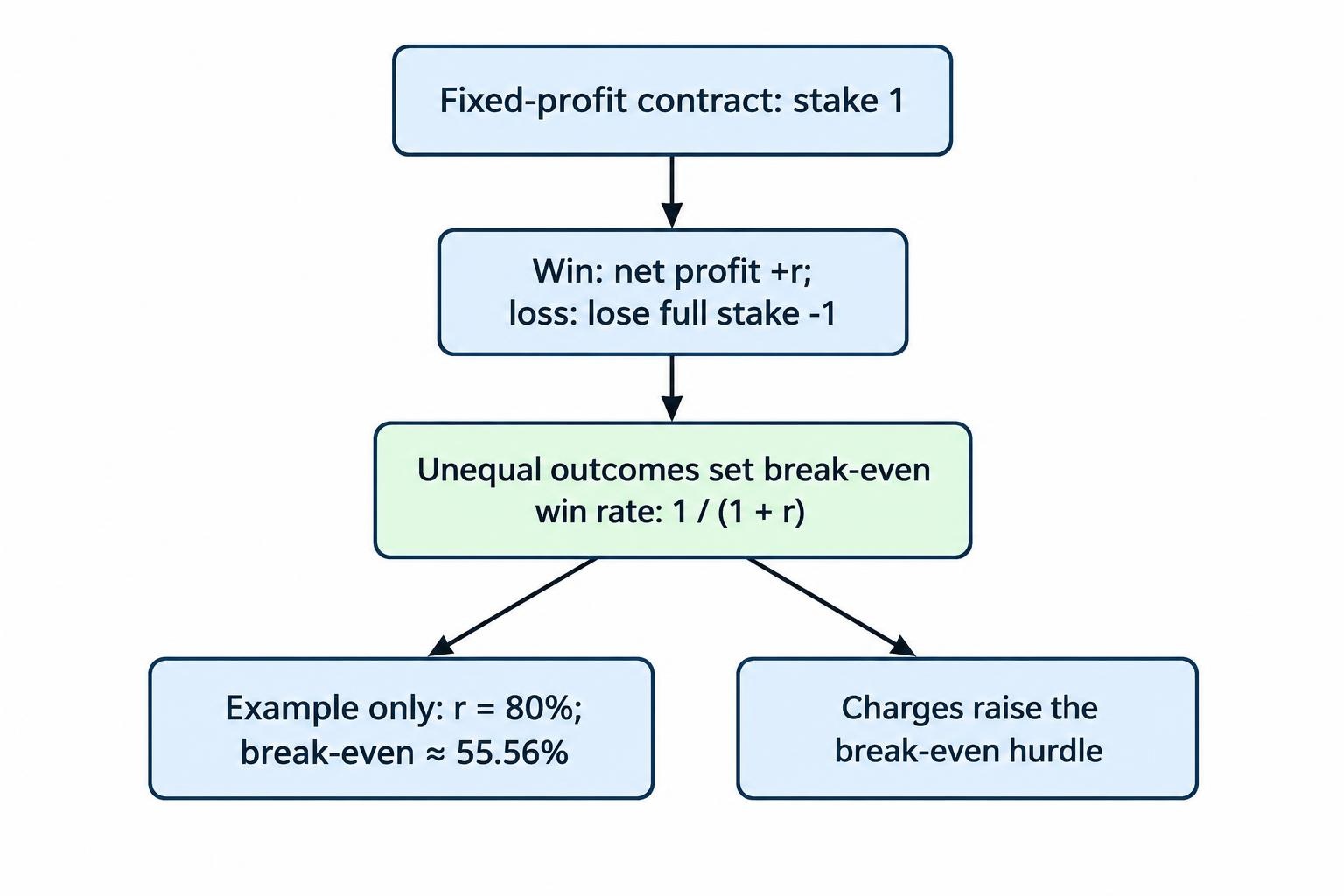
The practical implication is straightforward: a forecast that is right half the time does not break even under these assumptions. A fast moving crypto market does not repair that arithmetic. The guide to probability and expected value in binary options develops the calculation beyond this example.
Bitcoin, Ethereum and Other Crypto Underlyings
Bitcoin Contracts
For a Bitcoin contract, start with the full instrument label rather than the familiar BTC symbol. BTC/USD, BTC/AUD and BTC/USDT do not state the same price relationship. A chart showing one cannot automatically verify a contract settled against another.
Also establish whether “Bitcoin” means a spot exchange price, an index, a futures price or a platform’s own quotation. Each description leads to a different verification task. The Bitcoin binary options guide covers the underlying in more detail.
Ethereum Contracts
Apply the same checks to ETH contracts. Treat an Ethereum price forecast as a separate proposition from a Bitcoin forecast, even when both charts appear to move together. Similar movement on a screen does not make two contracts interchangeable.
The relevant question remains narrow: what must the designated ETH price do before, or at, the deadline? A view about the network’s longer term prospects does not answer that question. The Ethereum binary options guide examines ETH contracts separately.
For other coins, resist choosing an underlying because its chart looks dramatic. Check whether the settlement price can be independently reconstructed and whether the contract terms identify the asset without ambiguity. An unfamiliar ticker deserves more checking, not a larger stake.
The Settlement Price Can Decide the Outcome
“The Bitcoin price” is not a complete settlement instruction. A contract needs to identify which price counts and how it is captured. A last traded price, a bid, an ask and an average calculated over a time window are different measurements.
The distinction is visible in established benchmarks. The CME CF Bitcoin Real Time Index publishes once per second, while the Bitcoin Reference Rate represents a daily US dollar reference price at 4 pm London time using transactions collected over a calculation window. The CME explanation of its Bitcoin pricing benchmarks shows why a real time display and a daily reference rate serve different purposes.
This does not mean a binary platform uses either benchmark. That must appear in its own contract documentation. Displaying a familiar exchange or index name on a chart is not a substitute for naming the settlement source in the terms.
Consider a hypothetical expiry where your separate chart shows US$100,002 but the contract settles at US$99,998 against a US$100,000 strike. Before alleging an error, check the instrument, venue, timestamp, price type and rounding method. Those details could explain the difference, although they do not prove the platform acted correctly.
Retain the stated rules and the relevant records. A screenshot without a timestamp or feed identifier may not establish which observation governed settlement. The guide to price feeds and benchmarks covers these verification questions across markets.
Market Hours and Contract Availability Are Separate
Around the clock crypto pricing does not guarantee uninterrupted access to a particular binary contract. The underlying price feed, the contract’s dealing schedule and the platform’s operational availability are separate matters. Never infer all three from a “24/7” banner.
For any hypothetical analysis, record the expiry in a named time zone. “Five minutes” also needs a clear starting point: the moment you press a button, the moment an order is accepted, or a fixed clock time. Those arrangements can produce different deadlines.
Australian local time adds another opportunity for confusion when daylight saving changes. Keep research records in UTC where practical, then convert the deadline for local use. The guide to cryptocurrency volatility and market hours examines scheduling and price behaviour without treating every hour as equivalent.
Volatility Does Not Make Direction Easier to Predict
Crypto prices can change sharply over short periods. Moneysmart’s crypto asset risk guidance identifies this volatility and warns that crypto investments can lose their entire value. For a binary contract, the immediate issue is how that movement interacts with its strike and expiry.
A larger move does not automatically improve a higher/lower forecast. If you do not know its direction, more movement can carry the price either side of the strike. Even a strong directional view may fail over the chosen interval.
Contract type matters too. Greater movement can make a barrier easier to reach while making a no touch condition harder to preserve, all else equal. It does not make every binary structure more attractive.
Keep the forecast horizon aligned with the contract. An argument about adoption over several years cannot, by itself, justify a prediction about the next minute. A busy chart is not a trading edge.
Trading Crypto and Paying With Crypto Are Different
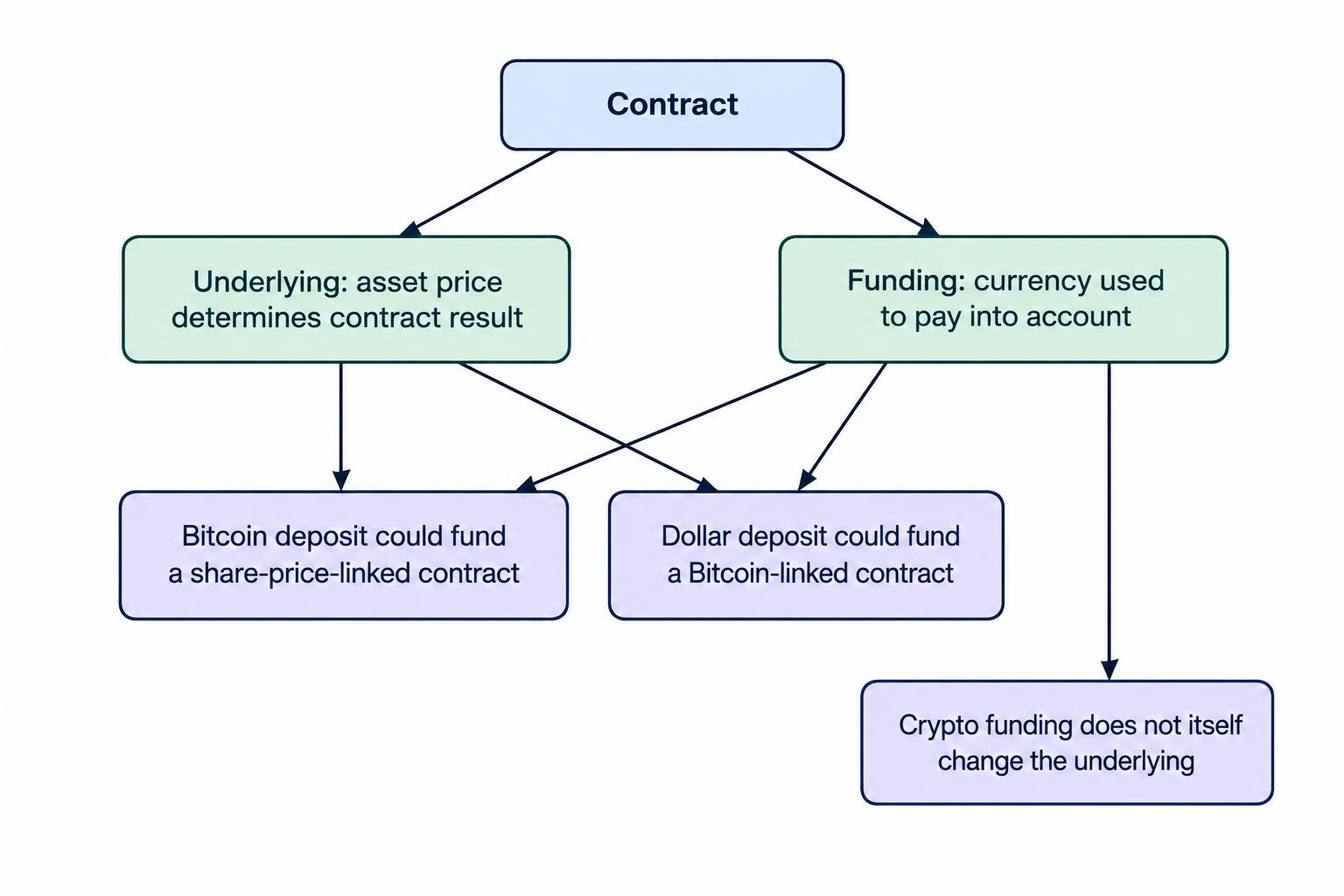
A crypto underlying describes what determines the contract’s result. Crypto funding describes how money reaches an account. A Bitcoin deposit could fund a contract linked to a share price; a dollar deposit could fund a contract linked to Bitcoin. Neither label tells you the other.
Using cryptocurrency does not create an Australian retail exemption. The binary options intervention instrument expressly includes cryptoassets within the assets covered by its definition. Its territorial provisions also address offers received in Australia, so an overseas address is not, by itself, a workaround.
Account denomination creates another distinction. If a balance remains denominated in Bitcoin, its Australian dollar value can change even when the number of bitcoin stays constant. Conversion charges and payment costs should be recorded separately from contract wins and losses.
Do not treat a functioning deposit button, crypto wallet address or foreign registration claim as evidence that a retail offer is permitted. The broader guide to binary options regulation in Australia covers the legal framework.
Platform Risk Exists Beyond the Market Forecast
Even a correctly predicted outcome does not remove the risk posed by the platform holding the account. Price analysis and the ability to recover money are different questions.
The joint CFTC and SEC alert on binary options fraud records complaints involving refused withdrawals, identity theft and software manipulation intended to generate losing trades. These warnings concern binary platforms generally; they are not evidence against every individual operator.
A displayed profit is therefore not the same as money received back. Nor does a polished interface establish that prices, account balances or withdrawal processes are reliable. Treat demands for more deposits to recover losses as a reason to stop, not a reason to increase exposure.
How to Study Crypto Binary Contracts Without Funding One
Paper analysis can test whether you have understood the mechanics without sending money to a platform. Start with an independently documented price series and write the hypothetical contract terms before observing the result.
Record the asset pair, strike, entry timestamp, expiry, settlement observation and assumed payout. Include the tie rule. Then calculate both the win rate and the net result under those assumptions; reporting only successful predictions hides the effect of unequal payouts.
A useful exercise is to compare the same directional forecast across several preselected expiries. Do not choose the best deadline after seeing the chart. That changes the question from “Would this rule have worked?” to “Can I find a favourable result?”
Keep the limits of the exercise clear. Paper results do not demonstrate live execution quality, withdrawal reliability or legal availability. They can show whether a proposed rule survives its own arithmetic. For cryptocurrency binary options, that is a more useful starting point than promises of easy profits.
This article was last updated on: October 22, 2026