A managed trading account scam sells a reassuring idea: someone else will do the difficult work, and you will collect the profits. The person may call themselves an account manager, senior analyst or professional trader. The practical question is less impressive: what control are they asking you to hand over?
For binary options, that could mean sending money to a supposed trading fund, sharing account credentials or letting someone operate your computer. These arrangements deserve scrutiny before any discussion of returns. They belong within the wider problem of binary options scams, but the management pitch adds a personal relationship that can make an otherwise suspicious offer feel reassuring.
What a Managed Trading Account Scam Involves
In a genuine management arrangement, another party makes investment decisions under an agreed authority. A scam borrows that language without providing the service, authority or safeguards the customer believes they are buying.
Separate three questions. Who receives the money? Who can place trades? Who can move money out? Those are different powers. An account carrying your name does not, by itself, answer any of them.
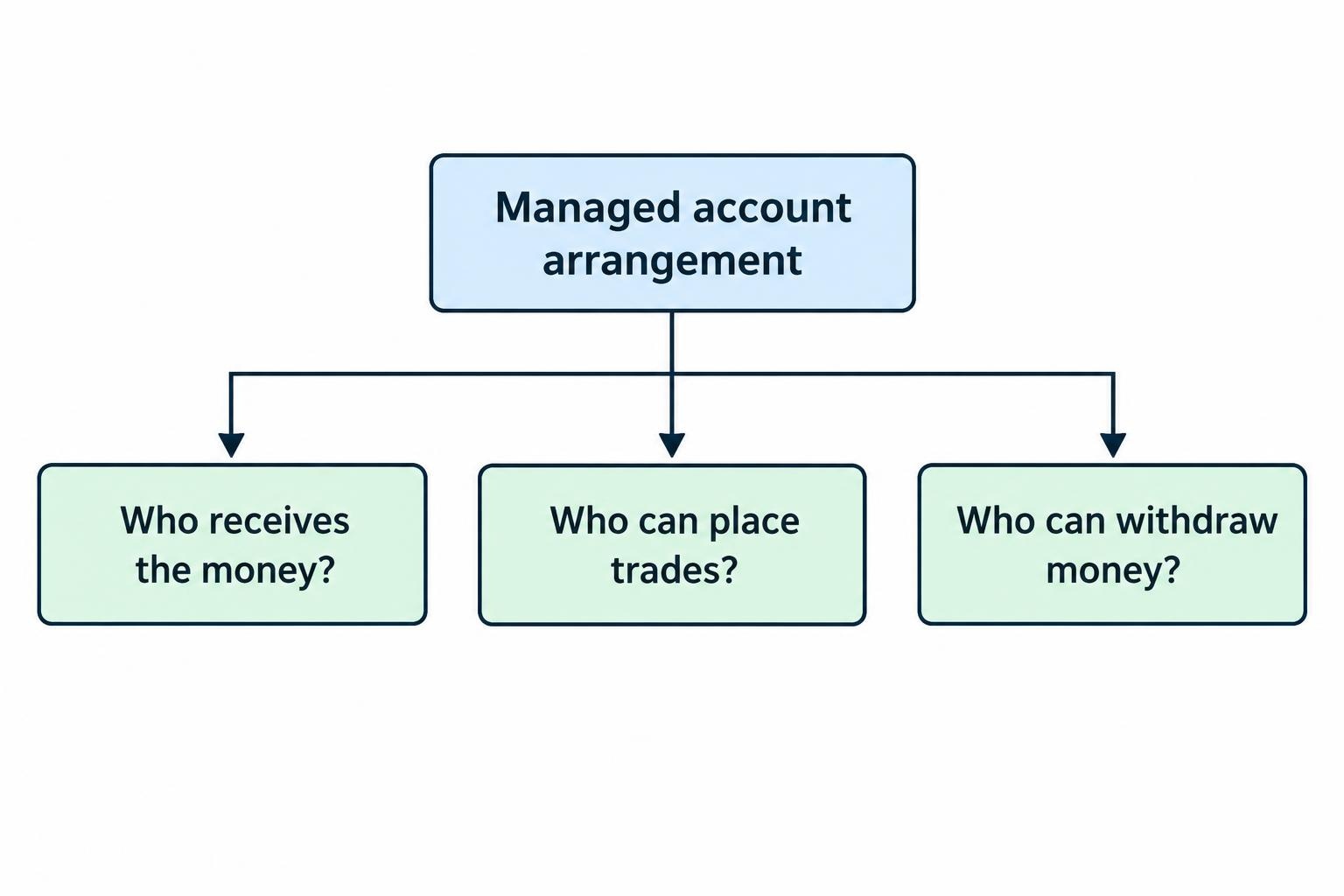
Consider two possible arrangements. In one, you transfer money to a person who promises to trade a combined fund. In another, you keep an account but give someone permission to trade it. The first raises questions about where the money goes. The second raises questions about account access and decisions made with your money. Neither becomes safe simply because the operator uses the word “managed”.
A losing account is not automatically evidence of fraud. The concern is deception: false identities, fabricated performance, misleading promises or money used for purposes other than those agreed.
The Australian Binary Options Ban Comes Before the Sales Pitch
ASIC’s prohibition on issuing and distributing binary options to retail clients took effect on 3 May 2021 and has been extended until 1 October 2031. The dates and scope are set out in ASIC’s binary options ban extension.
For an Australian retail customer, that restriction should come before questions about a manager’s claimed success rate. A promise that “we place the trades for you” is not evidence that an offer complies with the ban.
Do not treat an overseas address, management agreement or professional account label as an answer. Ask what product is being offered, which legal entity provides it and why the operator believes it can offer that service to you. Do not sign declarations about your circumstances that are inaccurate.
How the Manager Builds Trust
The sales process can begin with an advertisement, social media contact or introduction through someone you know. Investment scammers impersonate financial businesses, promise large returns with little risk and create pressure to act before checking the offer. Some allow small withdrawals to build confidence before refusing larger ones. These are documented patterns in Scamwatch’s investment scam guidance.
The management pitch gives those tactics a human face. Instead of assessing a platform alone, you are assessing someone who answers questions, remembers previous conversations and appears invested in your success.
Keep the distinction clear: helpful communication is not independent verification. Ask yourself whether you would accept the same payment instructions from a stranger without the friendly calls.
A useful test is to pause the conversation and explain the arrangement to someone unconnected with it. Leave out the manager’s personality. Describe only the company, permissions, payment destination, withdrawal process and evidence of performance. If the offer becomes difficult to justify once the relationship is removed, stop there.
Displayed Profits Are Not Proof of Trading
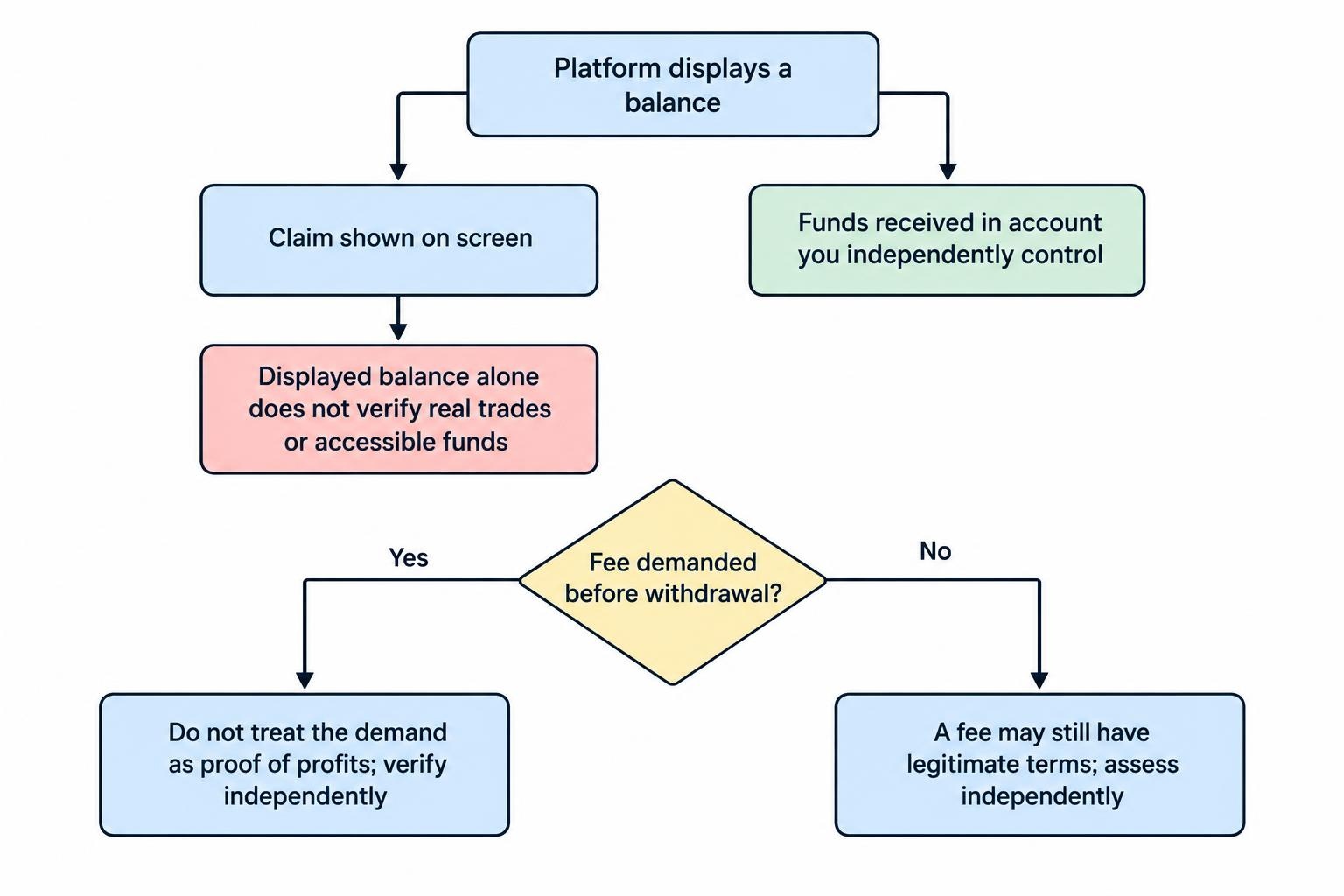
A balance, transaction history or chart inside a platform does not independently establish that trades happened. ASIC has documented fake crypto trading platforms that display profits and transactions even though no trading takes place. Deposits go to scammers, followed by demands for fees to release the supposed proceeds. See ASIC’s warning about fabricated trading platforms.
That warning concerns crypto platforms, not a finding about every binary options service. The verification lesson still applies: do not use evidence controlled by the seller as the sole proof of the seller’s claims.
Separate a displayed balance from money actually received in your independently controlled account. Also separate a screenshot of a winning trade from evidence about all trades, losses, fees and withdrawals. A polished dashboard can answer what a platform wants to show you without answering where your money is.
Profit Sharing Does Not Remove Your Risk
A proposal to split profits can sound fairer than an upfront management charge. It still needs careful examination. The manager’s opportunity to earn money and your exposure to losses may be very different.
Take a hypothetical A$5,000 account with a 30% performance fee. If trading produces a genuine A$1,000 profit, the manager receives A$300 and you retain A$700 before other charges. If the account instead loses A$2,000, who pays that loss? Unless an enforceable arrangement says otherwise, do not assume the manager contributes anything.
This example does not make performance fees fraudulent. It shows why “I only get paid when you win” is not a capital guarantee.
Ask how profits are calculated, whether earlier losses must be recovered before another fee is charged, and whether deposits can be mistaken for investment gains. Do not pay a fee calculated on a screen balance you cannot independently verify. The fee formula cannot compensate for uncertainty about whether the account or trading is real.
A Documented Managed Fund Fraud
On 28 December 2023, the US CFTC announced default judgments involving Tradewale and its manager for fraudulent solicitation and misappropriation connected with a purported managed forex fund. The court found that approximately 17 customers provided about US$713,520 and none received their principal back. The case is recorded in the CFTC’s Tradewale managed fund enforcement release.
This was a US forex case, not an Australian binary options ruling. It illustrates a narrower point: a management service and trading claims can be the packaging for taking customer money, rather than evidence that customer money is being managed.
Check the Person, the Business and the Authority Separately
Verify the legal entity and claimed Australian financial services licence or authorised representative status independently. Scammers can copy genuine licence details. Company registration alone does not establish permission to provide financial services, and an AFS licence does not mean ASIC endorses an investment. Moneysmart’s checks before investing cover these distinctions.
Use independently obtained contact details to ask the genuine business whether the person works for it and whether the proposed service is theirs. Do not make that verification call using a number supplied by the person being checked.
For the proposed arrangement, request written answers to four questions:
- Which legal entity is responsible for the management service?
- What authority permits that entity to provide the proposed service to you?
- Where will the money be held, and who can withdraw it?
- How can you revoke trading authority and raise a complaint?
Compare the answers rather than collecting documents for their appearance. A licence certificate, contract and payment instruction should tell a consistent story. If different business names appear, require a clear explanation before proceeding.
The separate guide to checking a broker’s licence covers the verification process in more detail. Do not let the manager conduct that check on your behalf.
Account Access Can Create a Second Loss
Remote access deserves particular caution. Screen sharing software can let another person control a device. Sharing banking passwords or one time security codes can expose accounts and personal information. These risks are covered in Scamwatch’s remote access scam warning.
In a proposed trading arrangement, ask why anyone needs access beyond the service they claim to provide. Placing trades is not the same task as logging into your bank, reading your email or approving a transfer. Treat requests to cross those boundaries as reasons to stop, not routine administration.
Do not share banking credentials, authentication codes or cryptocurrency wallet recovery phrases. If someone says a security warning is normal, verify that claim independently rather than following instructions while they remain connected.
Where access or identity documents have already been shared, consider the wider exposure, not just the trading balance. Our guide to identity theft and remote access scams addresses that separate risk.
Worked Example: A Manager Demands Payment Before Withdrawal
The following example is hypothetical. An Australian customer sends A$2,000 to a person offering to manage a binary options account. A dashboard later shows A$6,400. The manager then demands a separate A$1,320 payment, described as 30% of the A$4,400 displayed profit, before any withdrawal can proceed.
The arithmetic is consistent with the quoted percentage. That does not validate the underlying profit, the manager or the demand.
The customer has sent A$2,000 and received nothing back. The A$6,400 is a claim displayed on a platform, not money under the customer’s independent control. Sending the requested A$1,320 would increase the amount paid to A$3,320 without resolving the original uncertainty.
The customer should not treat the supposed A$6,400 balance as something they must rescue by paying more. Instead, preserve the messages and payment records, stop further transfers and contact the payment provider about the money already sent.
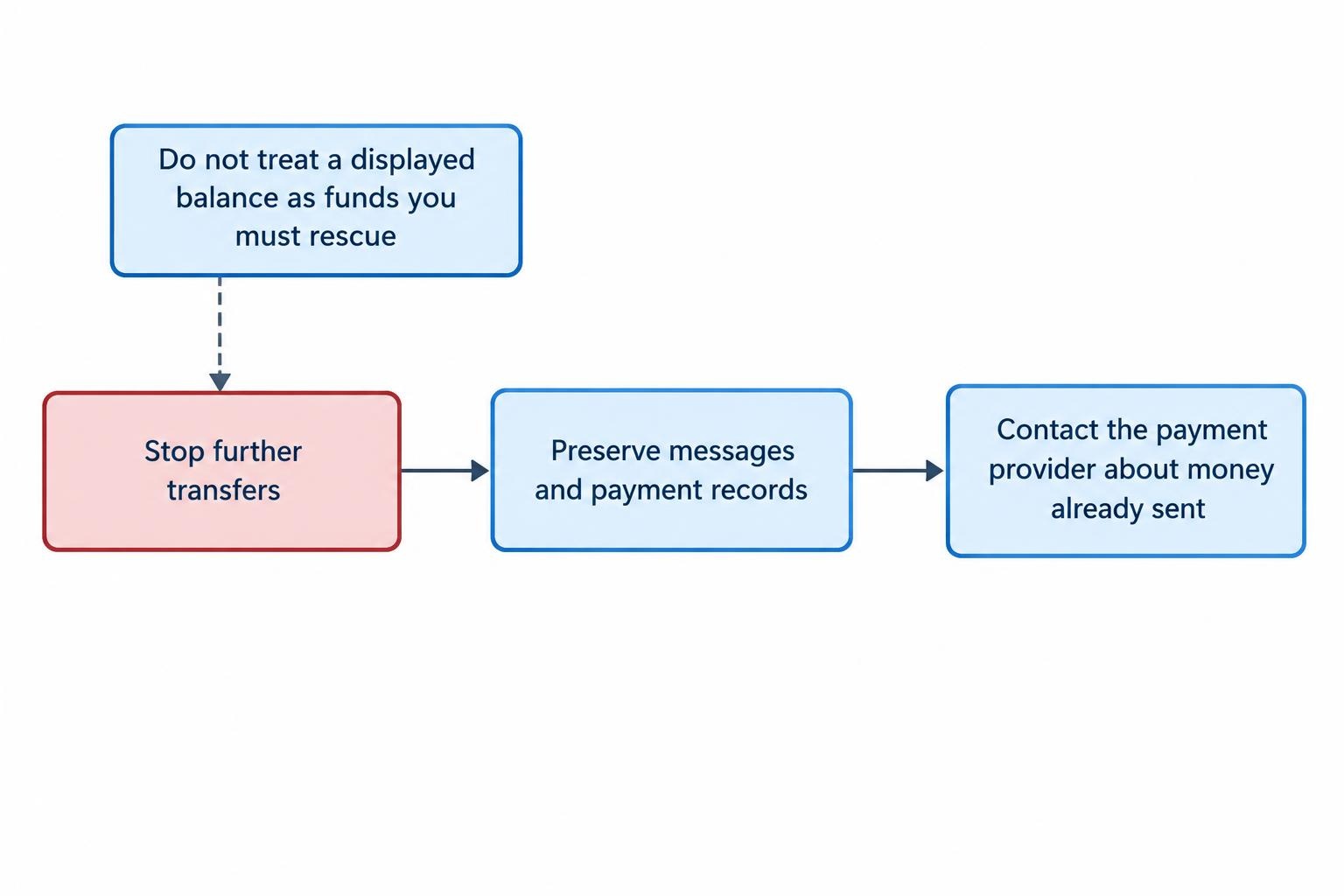
Whether the demand is called commission, tax, insurance or clearance, examine what it requires: another payment before access to funds that may not exist. The related guide to fake tax and withdrawal release fees covers those demands without assuming that every genuine financial service charge is fraudulent.
What to Do if You Suspect a Managed Account Scam
Stop Further Payments and Contact the Payment Provider
Stop sending money and contact your bank, card provider or other payment provider immediately. Explain what happened and ask what action is possible. If you sent cryptocurrency, notify the exchange or service used to send it. Report the scam to Scamwatch and be wary of anyone offering recovery for another payment. These steps appear in Moneysmart’s guidance after a scam.
Be precise about which payments you authorised and which transactions, if any, happened without your permission. Do not change the account of events to make it sound more favourable. Accurate records are more useful than a guessed explanation.
Secure Accounts and Devices
If someone accessed your device, disconnect it from the internet and use a trusted device to begin securing affected accounts. Change exposed passwords, review unfamiliar account activity and enable multifactor authentication. Arrange help to check for harmful software where needed. The Australian Signals Directorate’s hacking recovery guidance sets out containment and recovery steps.
If the trading account is with an independently verified provider, contact that provider through its genuine support channel about removing third party access. Do not rely on the suspected manager to confirm that access has been revoked.
Preserve a Clear Record
Keep payment receipts, transaction identifiers, account statements, messages, contracts and screenshots already available to you. Write a short timeline showing when contact began, what was promised and when each payment occurred. Do not reconnect a compromised device or make another payment just to gather more evidence.
The broader guide on what to do after a binary options scam covers reporting and follow-up actions. A report is not a promise of reimbursement, but it creates a record and gives the relevant organisations information to assess.
Helping Someone Who Still Trusts the Manager
Avoid turning the conversation into an argument about whether the person was foolish. Focus on one manageable decision: no further payments until the business and offer have been independently checked.
Offer to help organise receipts or make a call to the bank. Ask what evidence would change their view, then distinguish that evidence from another reassurance supplied by the manager.
The immediate aim is to stop further loss. You do not need to settle every question about the platform, trading strategy or person behind it before taking that precaution.
This article was last updated on: October 22, 2026