Binary options comparisons are useful only when they compare how money is made, lost and accessed. Two products can follow the same share price or currency pair yet create very different obligations. A fixed payout, an option premium, a margin deposit and a share purchase are not interchangeable amounts of risk.
For Australian readers, availability comes first. ASIC’s prohibition on issuing and distributing binary options to retail clients took effect on 3 May 2021 and runs until 1 October 2031. That restriction remains relevant as at 21 October 2026; an accessible offshore platform does not establish permission to offer its products in Australia. See the ASIC announcement extending the binary options ban.
This comparison separates product mechanics from broker selection. It covers the differences that matter before examining individual contracts, trading platforms or advertised returns.
Binary Options Compared With Other Products
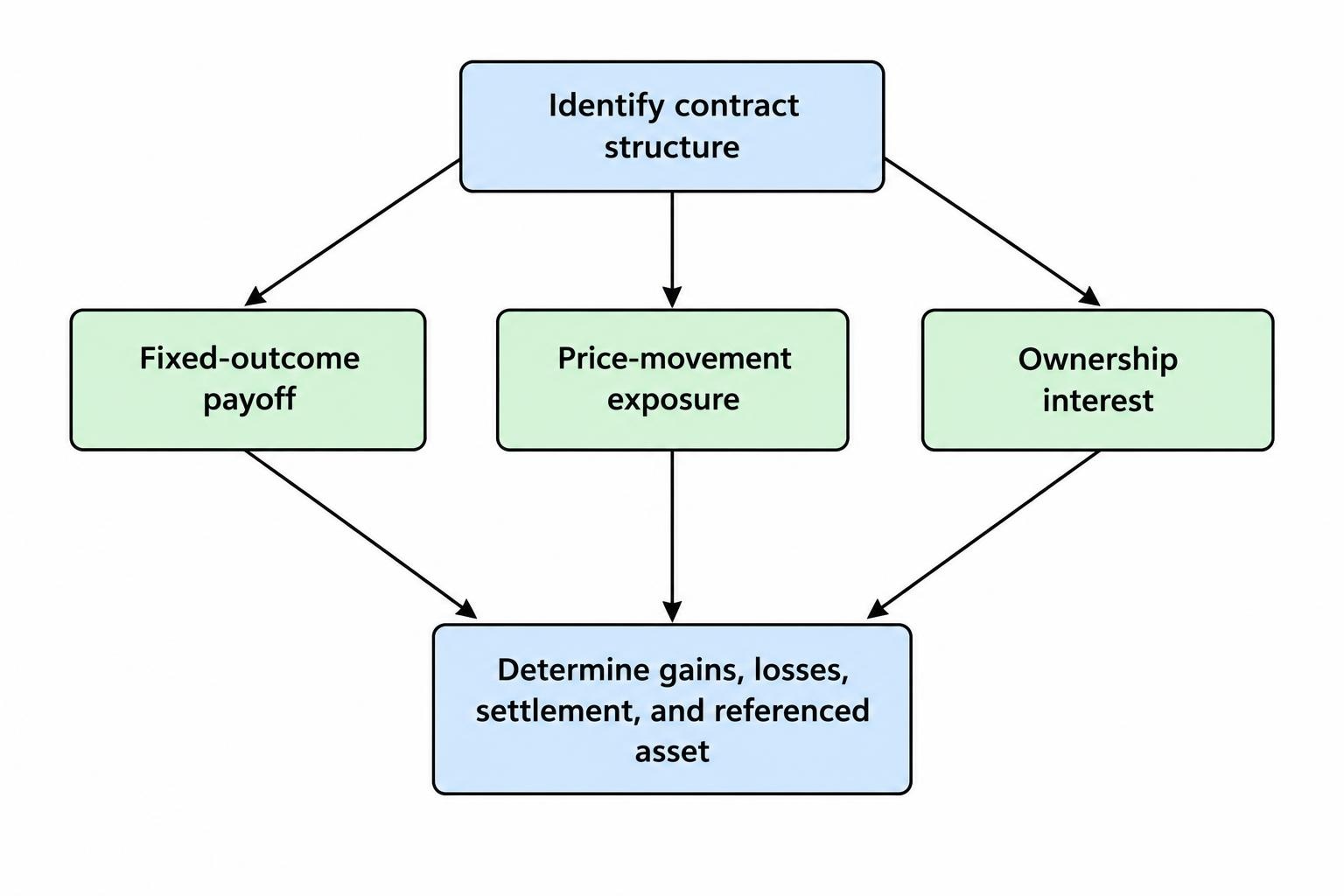
A binary option pays a predetermined amount when its settlement condition is met. In a conventional fixed stake contract, an unsuccessful outcome can mean losing the entire stake. Other products calculate returns through price changes, ownership rights or contractual obligations.
| Product | What determines the result? | Main distinction to examine |
|---|---|---|
| Binary options | Whether a stated condition is met under the settlement rules | Fixed outcomes and a deadline |
| Margin forex | Exchange rate movement, position size and costs | Exposure can exceed the margin deposited |
| CFDs | The price difference between opening and closing | No ownership of the referenced asset |
| Vanilla options | Strike price, underlying price, time remaining and other pricing factors | Buying an option differs from writing one |
| Futures | Contract price movement multiplied by contract size | Margin requirements and settlement obligations |
| Fully paid shares | Share price changes and any dividends | An ownership interest rather than an expiry wager |
| ETFs | The fund’s investments, strategy and costs | Ownership of fund units, not a fixed payout contract |
| Prediction markets | An event outcome and the contract’s purchase price | Potentially similar binary economics under different market arrangements |
The underlying market does not settle the comparison. “Trading gold” could mean buying a fund, entering a futures contract or taking a binary position. Start with the contract, then examine the asset it references.
Binary Options vs Forex and CFDs
Forex describes a market; binary options describe a payoff structure. A binary contract referencing AUD/USD and a margin forex position can express the same directional view, but they do not reward it in the same way. The distinction matters more than whether both platforms display an identical chart.
With a fixed payout binary, a small qualifying move can produce the same winning payment as a much larger move. With margin forex, the size of the exchange rate movement and the position determine the trading result before costs. Our binary options vs forex comparison examines that difference without treating currency trading as a single product.
CFDs extend the price difference model to markets such as shares, indices and commodities. They create contractual exposure rather than ownership. A deposit opens a position, but the position’s full value drives gains and losses.
Australian retail CFD protections include gearing limits, margin closeout arrangements and negative balance protection. These reduce certain risks; they do not make individual positions safe or prevent the loss of account funds. The protections are outlined in ASIC’s current CFD intervention order update.
Compare the total exposure, financing charges and exit rules, not just the opening deposit. The binary options vs CFDs guide separates these costs from the fixed payout model. A lower deposit can mean greater gearing rather than lower risk.
Binary Options vs Vanilla Options
The shared word “options” can obscure a substantial difference. A conventional call or put gives its holder a contractual right associated with the underlying asset. Its value is not restricted to a predetermined winning payment or a complete loss.
A purchased option can still expire worthless. Its price also responds to time remaining and volatility, so getting the market direction right may not be enough. Writing a new option creates a different obligation from buying one, or selling an existing purchased option to close it. These distinctions appear in the ASX options trading booklet.
The useful comparison is between defined positions, not product names. A purchased call, a covered call and an uncovered written call have different risk profiles. Our binary options vs vanilla options comparison focuses on those differences, including premium, expiry and potential obligations.
Binary Options vs Futures
Futures use standardised contracts with defined sizes and settlement terms. Their gains and losses follow price movement multiplied by the contract’s value per point or unit. That differs from a binary contract where crossing a settlement threshold determines a fixed outcome.
Margin is collateral, not a maximum loss figure. Futures can require initial margin and further payments as positions move against the holder. Some contracts settle in cash; others have delivery obligations. The ASX explanation of futures margin and settlement sets out these mechanics.
Contract size deserves particular attention. A position can be too large for an account even when the opening margin appears affordable. The binary options vs futures comparison examines exposure and settlement rather than presenting exchange trading as protection against market losses.
Binary Options vs Share Dealing
Buying fully paid ordinary shares creates an ownership interest in a company. Buying a binary option on that company’s share price does not. The binary holder has a settlement condition, not a continuing claim on the business.
This changes the time horizon. An ordinary share does not expire because a trading timer reaches zero. Its value can still fall sharply, dividends are not guaranteed, and a failed company can leave shareholders with nothing. Removing a short deadline does not remove investment risk.
Keep the comparison consistent: fully paid shares bought without borrowing are different from shares bought using margin, and different again from short selling. Our binary options vs share dealing guide compares ownership, capital requirements and holding periods. It does not assume that every transaction labelled “stocks” involves owning shares.
Binary Options vs ETFs
An exchange traded fund gives the investor units in a fund. Returns depend on its holdings or investment strategy, rather than whether one price condition is satisfied at a deadline. This makes ETFs a different category of exposure, not a slower version of binary trading.
Broad funds can spread exposure across many investments, but not every ETF is broadly diversified. A narrow sector fund, a geared fund and a broad share index fund require different assessments. Market, currency, liquidity and strategy risks remain relevant, alongside the costs covered in Moneysmart’s ETF guidance.
The binary options vs ETFs comparison separates fund ownership from fixed outcome speculation. Compare the fund’s actual mandate, management fee and trading spread rather than assuming that an exchange listing makes all funds alike.
Binary Options vs Prediction Markets
Prediction markets can look different while retaining similar economics. A yes/no event contract may pay a fixed amount after settlement, with the purchase price determining the potential gain and loss. The event might concern an economic release rather than a share price, but the outcome can still be binary.
For Australian readers, Moneysmart’s prediction market warning identifies that no prediction market operators are currently licensed as financial markets in Australia. Overseas authorisation should not be treated as Australian approval.
Compare the contract’s resolution wording, evidence source, cancellation rules and dispute process. A familiar event does not guarantee straightforward settlement. Our binary options vs prediction markets guide examines the overlap without treating a change of label as a change in economic risk.
Compare Returns Using the Same Denominator
An advertised binary payout cannot be compared directly with a share’s percentage return. The figures measure different things. A binary payout percentage commonly describes profit relative to the stake on a winning contract. A share return describes the change in value of an ownership position, with income and costs considered separately.
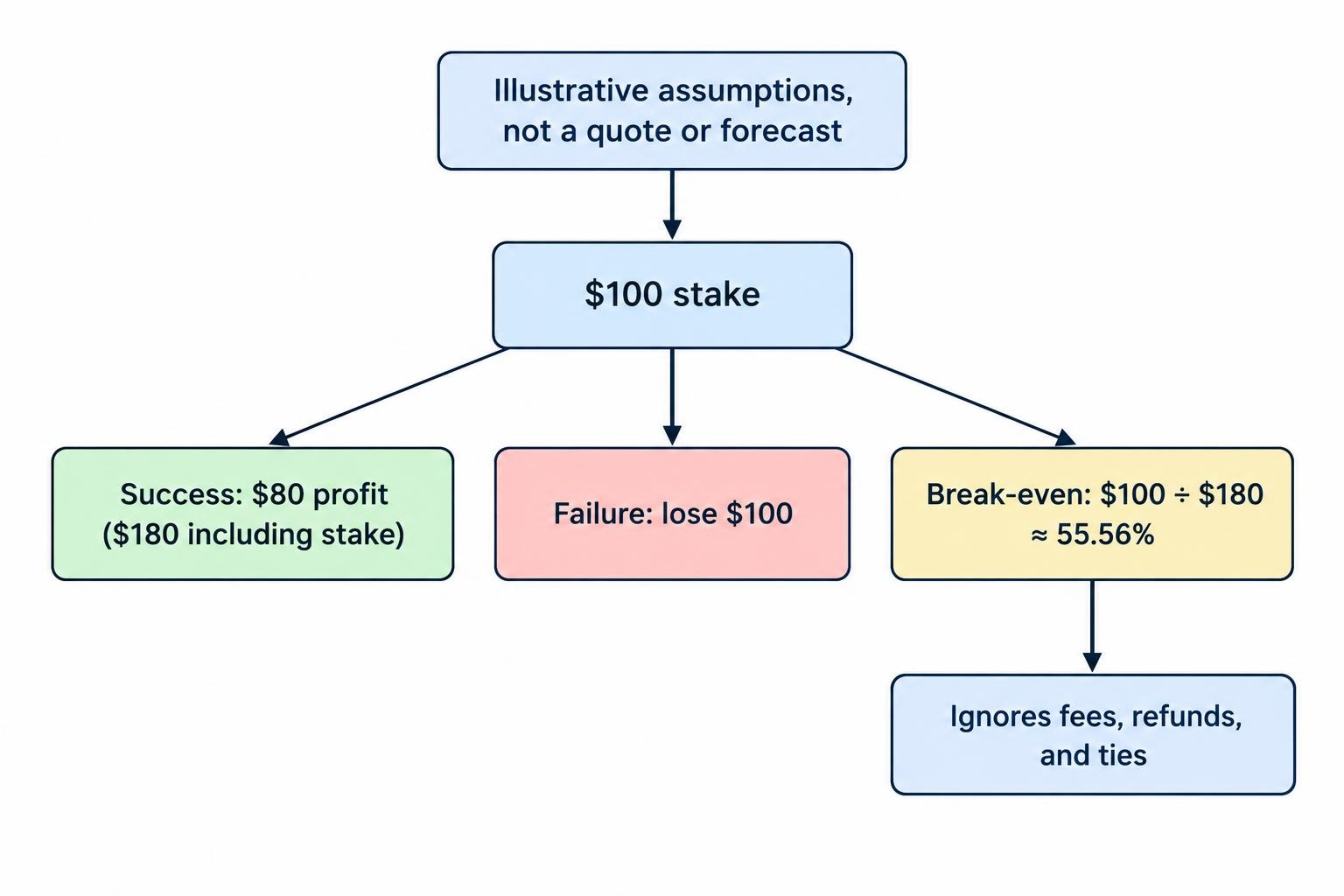
Consider a hypothetical $100 binary stake offering $80 profit on success and losing $100 on failure. A win returns $180 including the original stake. Ignoring fees, refunds and ties, the break even win rate is $100 divided by $180, or approximately 55.56%. A 50% success rate produces an average loss of $10 per contract under those assumptions.
Now compare a hypothetical share purchased at $50 and later valued at $51. Two fully paid shares cost $100 and gain $2 before costs. The binary’s larger winning percentage does not prove a better opportunity: its entire stake was exposed to a different settlement condition.
A purchased call adds another distinction. If its strike is $50 and its premium is $1 per share, a $51 underlying price at expiry produces $1 of intrinsic value per share. That covers the premium but leaves no profit before costs. These are arithmetic illustrations, not equivalent positions or available quotes.
Compare Broker Terms Only After Comparing Products
Product comparison and broker comparison answer different questions. The former concerns the contract’s economics. The latter concerns who provides it, under what terms, and with what practical and legal protections.
When reviewing any provider, establish the contracting legal entity before comparing interface features. Then examine the reference price, settlement process, withdrawal conditions and complaints arrangements. A brand name or polished app is not enough information to assess the agreement.
Payout comparisons also need matching conditions. An advertised maximum payment says little unless the underlying market, strike, expiry and settlement rules are comparable. A higher payment may accompany a harder condition rather than a better deal.
Our broker comparisons address provider differences separately from product mechanics. They should not be interpreted as confirmation that an offshore provider may offer binary options to Australian retail clients. Legal availability is a threshold question, not another feature to score against customer support or chart colours.
Make the Comparison Match the Purpose
A useful comparison starts with the intended job: ownership, income, hedging or short term speculation. Then compare the holding period, total exposure, possible loss, exit conditions and costs using the same assumptions.
Do not rank products by the size of a winning trade alone. Ask what happens when the view is wrong, when the timing is wrong, and when the position cannot be closed at the expected price. Those questions reveal more than an advertised payout.
Binary options have a simple looking outcome, but simplicity of presentation is not simplicity of risk. A countdown timer is not a risk control. The better comparison is the one that makes the obligations visible before money changes hands.
This article was last updated on: October 22, 2026