Binary options payment methods include cards, bank transfers, digital wallets and cryptocurrency. The differences matter less at the deposit screen than they do when money goes missing, a withdrawal stalls or an unexpected fee appears. A fast payment is not necessarily a recoverable payment.
For Australian readers, there is a more basic restriction: ASIC’s ban on issuing and distributing binary options to retail clients took effect on 3 May 2021 and extends until 1 October 2031. Changing the payment method does not change that restriction. The ASIC announcement extending the binary options ban sets out its scope and duration.
This guide compares payment arrangements and their risks. It is not a list of ways to fund an offshore account or bypass a bank’s controls.
Payment acceptance is not regulatory approval
Separate three questions before assessing any payment arrangement: who receives the money, whether the underlying service can lawfully be offered, and what protection applies if something goes wrong. A successful transaction answers none of these questions by itself.
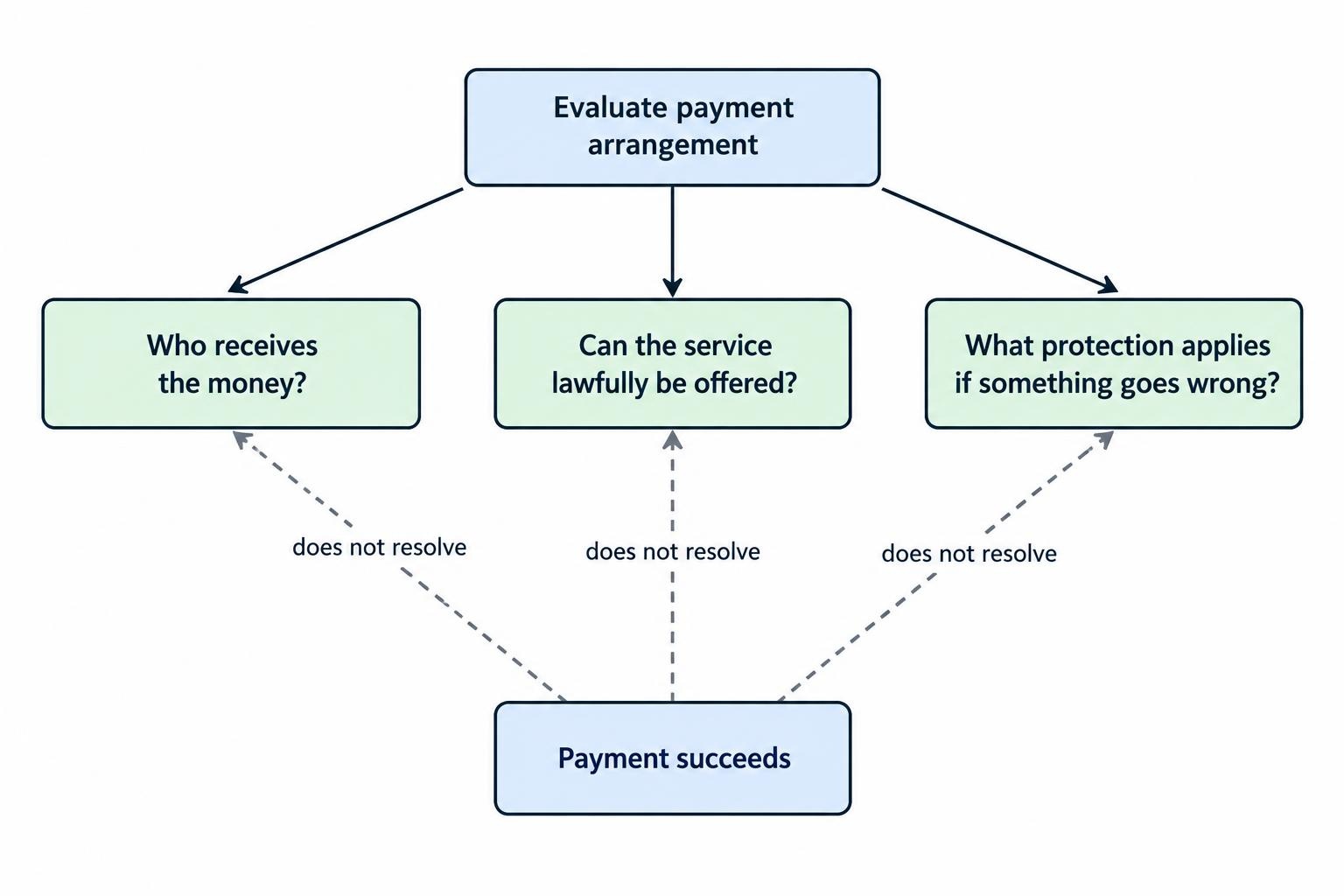
A familiar payment logo should not substitute for checking the legal entity behind a trading platform. Nor should an Australian dollar balance, Australian phone number or local receiving account. Start with the rules covering binary options regulation in Australia, rather than the convenience of the checkout.
For payment due diligence, identify the platform’s contracting company, the named payment recipient and any processor between them. Ask for a written explanation where those names differ. An explanation is something to verify, not a reason to ignore the discrepancy.
Do not describe a payment as an unrelated purchase, split it to avoid controls or use another person’s account because a platform representative suggests it.
Comparing the main payment methods
The following comparison identifies what to examine. It does not confirm that any platform accepts these methods, or that a payment provider permits their use for binary options.
| Payment method | What to examine | What not to assume |
|---|---|---|
| Debit or credit card | Merchant identity, issuer charges and dispute eligibility | A chargeback will reimburse a losing trade |
| Bank transfer | Beneficiary name, destination and payment reference | A local account makes the platform authorised |
| Digital wallet | Underlying funding method, permitted use and dispute terms | Every wallet transaction has purchase protection |
| Cryptocurrency | Asset, network, address, fees and recovery options | A visible blockchain transaction can be reversed |
| Prepaid card or voucher | Refund capability, ownership evidence and withdrawal arrangements | Deposit acceptance guarantees a usable withdrawal route |
Debit cards, credit cards and prepaid cards
When reviewing a card payment, distinguish the trading platform from the merchant shown on the statement. Keep the receipt, merchant description, transaction date, amount and currency. These details help establish what was paid and to whom if a dispute follows.
Debit and credit card payments can qualify for chargebacks in eligible circumstances, including certain unauthorised, duplicate or unfulfilled transactions. Deadlines apply, and eligibility depends on the circumstances and applicable terms. The NT Consumer Affairs chargeback factsheet outlines the process and the evidence consumers should preserve.
Do not treat that process as insurance against trading losses. Describe events accurately when speaking to the issuer: a payment you approved after being misled is not the same factual situation as someone using your card without permission.
For prepaid cards, ask whether refunds can return to the card and what happens if it expires or is discarded. Keep the card and purchase records while any payment issue remains unresolved. A card that works for spending should not be assumed suitable for receiving an account withdrawal.
Bank transfers and Australian payment services
For bank transfers, examine the beneficiary before the payment speed. Does the receiving account belong to the contracting company, a disclosed processor or an unexplained third party? A request to pay an individual who has no clear connection to the business deserves particular caution.
PayID allows a bank account to be addressed using an identifier such as a phone number or email address. It also displays a recipient name before confirmation. Australian Payments Plus describes these PayID name checks, which help users check where a payment is going. The displayed name is not an assessment of the recipient’s investment service.
Do not group PayID, Osko, BPAY and PayTo together as though they offer identical payment arrangements. Identify the actual service involved and ask your bank about its controls and dispute process. Never assume a bank transfer has the same reversal mechanism as a card payment.
Retain the beneficiary details and transaction reference, not just a screenshot saying “successful”. For a fuller comparison of domestic and international arrangements, see the guide to bank transfers for trading payments.
Digital wallets and mobile payment apps
“Digital wallet” can describe different arrangements. A wallet may hold a balance, connect to another account or provide an interface for a card payment. The app name alone does not tell you which arrangement applies.
Apple Pay and Google Pay are prominent examples of mobile wallets using tokenised card credentials. Tokenisation replaces the original card number with a substitute credential; it does not assess the merchant’s conduct. The RBA submission on digital wallets and payment schemes distinguishes these payment layers.
Before relying on a wallet’s protection, read the terms covering the actual transaction. Check permitted uses, exclusions, dispute deadlines and whether transferring a balance differs from purchasing goods or services. Do not assume retail shopping protections cover financial trading.
Also examine the complete cost: adding money, converting currency, paying the merchant and withdrawing the remaining balance. Moving money through another app can add another set of terms without solving the underlying risk. The guide to digital wallet payments examines these distinctions in more detail.
Cryptocurrency payments
Cryptocurrency introduces risks beyond the trading account itself. A payment instruction needs to identify the asset, network and destination, not just display a coin symbol. An address error or incompatible transfer can create a separate loss before any trading occurs.
Network fees and difficult recovery are material concerns. Moneysmart’s crypto asset risk guidance highlights incorrect addresses, transaction fees and the difficulty of recovering crypto sent to scammers. A transaction appearing on a blockchain is evidence of movement, not evidence that the recipient is trustworthy.
Keep the payment asset separate from the account’s display currency. Ask what value is credited, which conversion rate applies and what asset would be used for a withdrawal. A balance labelled in US dollars does not answer those questions.
Requests to buy crypto after a card or bank payment is blocked should prompt a stop and review, not an improvised workaround. The separate guide to cryptocurrency payments covers the payment mechanics without treating crypto as a route around Australian restrictions.
Compare the full cost, not the deposit headline
“No deposit fee” is too narrow a measure. Review each stage of the payment: the amount leaving the original account, the value credited after conversion, any withdrawal deduction and the amount eventually received back.
Request written figures for the relevant currency and payment route. Check whether quoted charges belong to the platform, payment provider or another intermediary. Where a percentage applies, establish which amount it is calculated against.
A hypothetical cost example
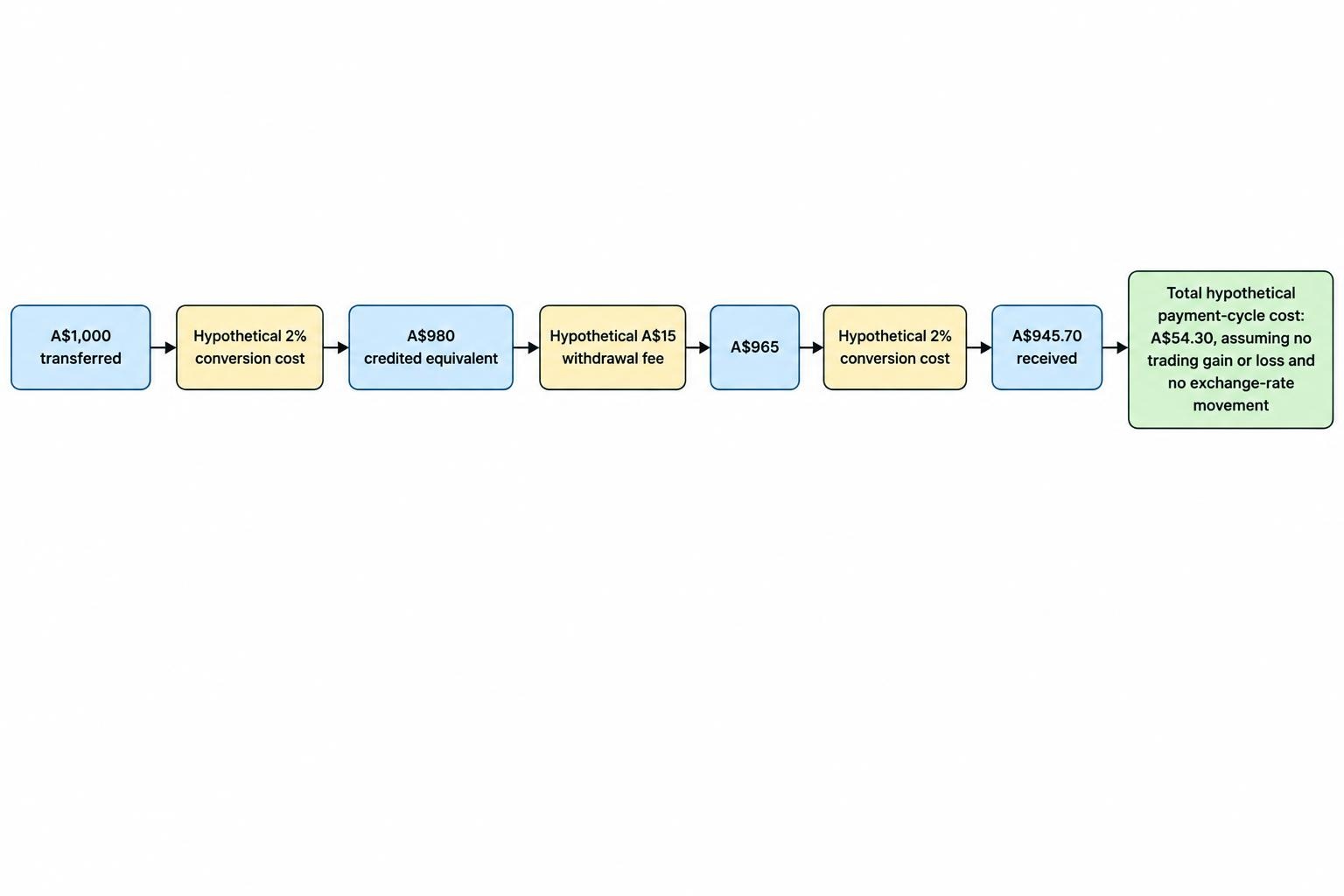
Suppose A$1,000 is transferred and a hypothetical 2% conversion cost reduces the credited value to the equivalent of A$980. Assume no trading gain or loss and no exchange rate movement.
A withdrawal fee equivalent to A$15 leaves A$965. A further hypothetical 2% conversion cost reduces the amount received to A$945.70. The payment cycle has cost A$54.30, even though there was no separate deposit charge.
These are illustrative figures, not a provider quotation. Their purpose is to show why both directions matter. A minimum withdrawal fee also needs checking against the expected withdrawal amount, rather than being dismissed because the dollar figure looks small.
The guide to deposit and withdrawal fees separates payment charges from other account costs.
Read the withdrawal arrangements before judging convenience
A deposit method should never be assessed in isolation. Ask how money would leave the account, which name must appear on the receiving account and what evidence the platform would request.
Check whether the published terms require deposited funds to return through the original payment route, and how any remaining balance would be handled. Do not assume there is one universal “return to source” rule covering every provider and payment type.
Expired cards, closed bank accounts and several funding methods deserve a written explanation rather than a support agent’s casual reassurance. Ask how those circumstances are handled and preserve the reply.
Read processing times carefully too. Establish whether a quoted timeframe covers the platform’s review, dispatch of funds or receipt in your account. A status marked “approved” is not a substitute for checking the receiving account.
For existing account holders, the guide to broker deposits and withdrawals covers account procedures. Do not make another deposit simply to test whether a withdrawal promise will be honoured.
Keep payment security separate from trust in the platform
Use strong, separate passwords and enable account authentication controls. At the same time, avoid treating an encrypted checkout or an authentication prompt as an endorsement of the recipient. Payment security and merchant honesty answer different questions.
Before uploading identity documents, verify who is requesting them and why. Never disclose your banking password, wallet recovery phrase or security codes to a platform representative. Do not install remote access software so someone can “help” complete a payment.
Keep receipts, statements, relevant terms and correspondence somewhere you control. Record dates and transaction references while they are easy to retrieve. A clear chronology is more useful in a dispute than a folder of unlabelled screenshots.
If a payment or withdrawal looks suspicious
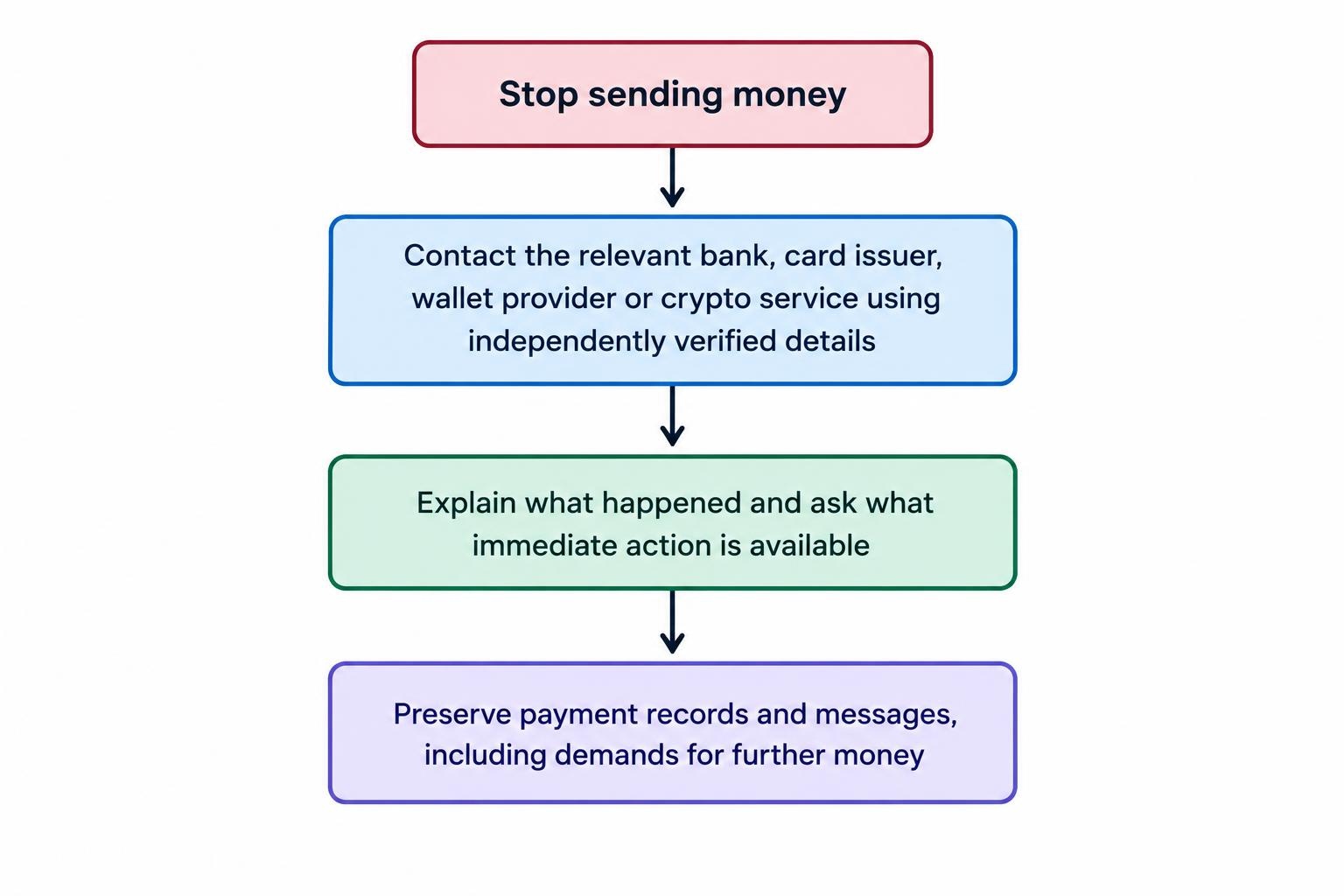
Stop sending money and contact the bank, card issuer, wallet provider or crypto service involved through independently verified contact details. Explain what happened and ask what immediate action is available. Preserve payment records and messages, including any demand for more money.
Treat requests for a new “tax”, insurance payment or release deposit as a reason to pause and verify independently. An account balance on a screen is not proof that paying another fee will release it.
Be wary of unsolicited recovery offers. Scammers target people who have already lost money and promise recovery in return for fees, supposed taxes or further payments. Scamwatch’s warning about money recovery scams identifies these tactics and advises working with the financial institution involved.
Which payment method is safest?
There is no universally safest payment method for binary options. Compare the recipient, transaction permissions, written terms, costs and realistic dispute options. Do not confuse stronger payment controls with protection against the underlying trading or platform risk.
Borrowing does not improve that position. Do not use credit cards, overdrafts, personal loans or buy now pay later services to fund speculative trading or chase an inaccessible balance. A promised withdrawal is not a repayment plan.
For Australian retail clients, the regulatory restriction comes before payment convenience. A different checkout button does not turn a prohibited offering into an authorised one.
This article was last updated on: October 22, 2026