Learning binary options starts with three questions: what event decides the result, when is that result measured, and how much does each outcome pay? A chart alone cannot answer them. You can predict the general direction correctly and still lose because the contract measures a different price, at a different moment.
For Australian readers, the regulatory position comes first. ASIC prohibits the issue and distribution of binary options to retail clients. The ban began on 3 May 2021 and has been extended until 1 October 2031. These lessons explain the product; they are not a route around ASIC’s binary options prohibition.
Use this learning hub to connect contract terms, payout arithmetic and practice exercises. You do not need to deposit money to study any of them.
Start with the contract, not the chart
A binary option pays according to whether a stated proposition is true or false. For a simple price contract, that proposition might be: “Will AUD/USD finish above 0.6500 at the stated expiry?” The contract settles for a predetermined cash amount or nothing. It does not give you ownership of the currency or the right to buy it, a distinction covered in the SEC’s binary options definition.
The result depends on the written condition, not whether the market moved broadly as expected. “Above 0.6500” differs from “at or above 0.6500”. Finishing above a level differs from touching that level before expiry.
This is why reading the terms belongs before learning chart patterns. A trading idea cannot be evaluated until you know exactly what would count as a win, a loss or a tie.
Read the terms that decide the result
Before calculating anything, translate the contract into plain English. You should be able to complete this sentence: “I risk this amount on this condition, measured at this time, using this price, for this possible return.”
| Contract term | What to establish | Why it matters |
|---|---|---|
| Underlying market | The asset or benchmark being measured. | A familiar market name does not identify the exact price feed. |
| Strike and condition | The threshold and the event required to win. | Above, below, touching and remaining inside a range describe different outcomes. |
| Expiry | The settlement time and applicable time zone. | The relevant result may differ from the next chart candle’s closing price. |
| Stake and payout | The amount at risk, net profit and total amount returned. | A payout percentage is meaningless without knowing what it includes. |
| Settlement rules | The reference price, treatment of equality and any disruption provisions. | These determine how the final result is calculated. |
If any term is missing, leave the example unresolved rather than guessing. The lesson on how binary options work follows these terms through the contract lifecycle.
Follow one hypothetical trade from start to finish
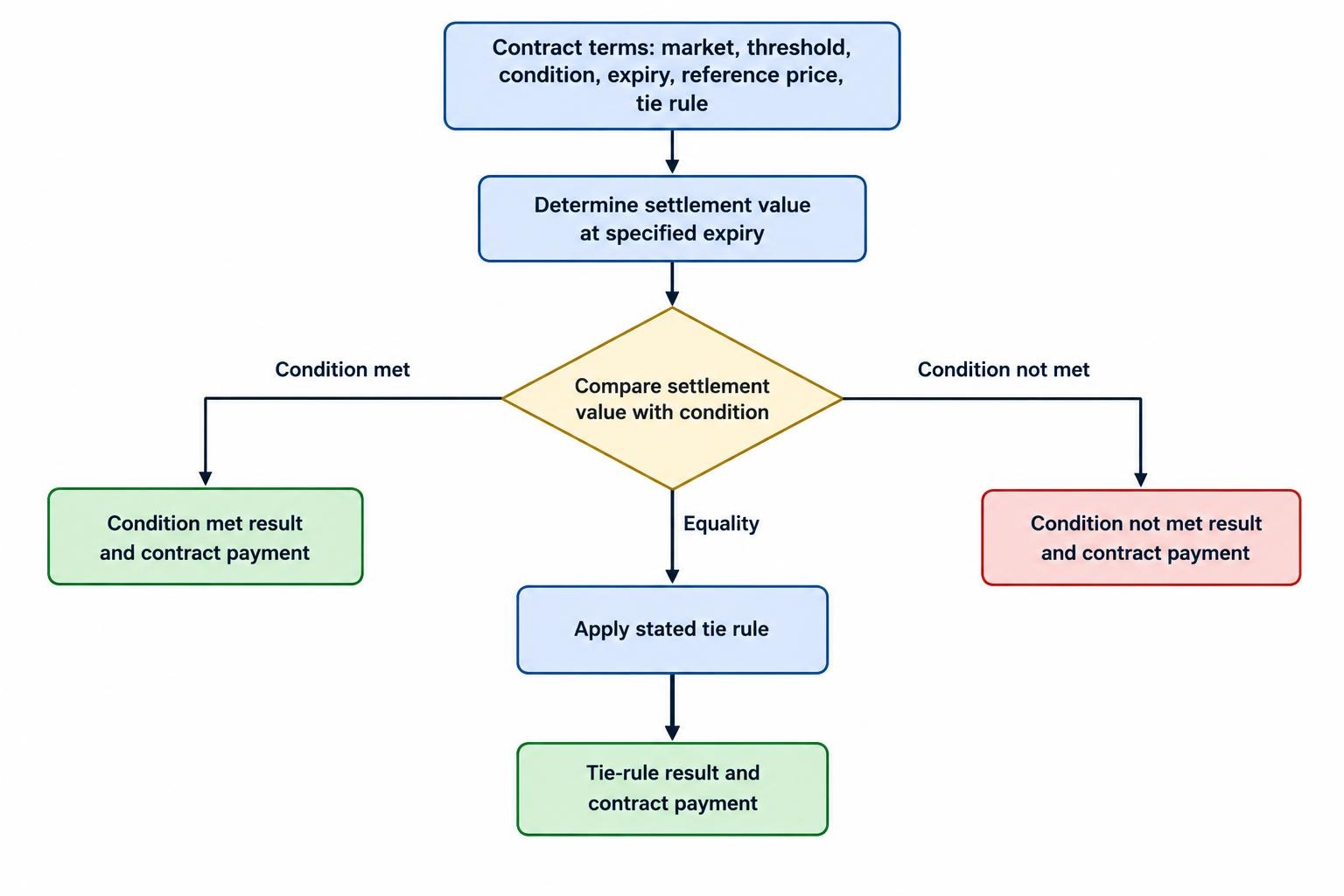
Suppose a practice contract asks whether AUD/USD will finish above 0.6500 at 14:05:00 on its stated clock. The hypothetical stake is A$20. A successful result earns an 80% net profit on that stake, and an unsuccessful result loses the full A$20. For this example only, an exact tie returns the stake.
If the settlement price is 0.6502, the condition is met. Net profit is A$16, and the total amount returned is A$36: the original A$20 plus A$16 profit.
If the settlement price is 0.6498, the condition is not met. The amount returned is zero and the net loss is A$20. If settlement is exactly 0.6500, the assumed tie rule returns A$20, leaving no profit or loss.
Notice what does not change the successful payout: finishing at 0.6550 instead of 0.6502. Under these assumed terms, both outcomes earn A$16. A larger market move does not produce a larger payment.
These numbers are teaching assumptions, not current offers. Other contracts can use different pricing, settlement and tie rules. Use the binary options worked examples to practise separating the market result from the money result.
Learn payout arithmetic before win rates
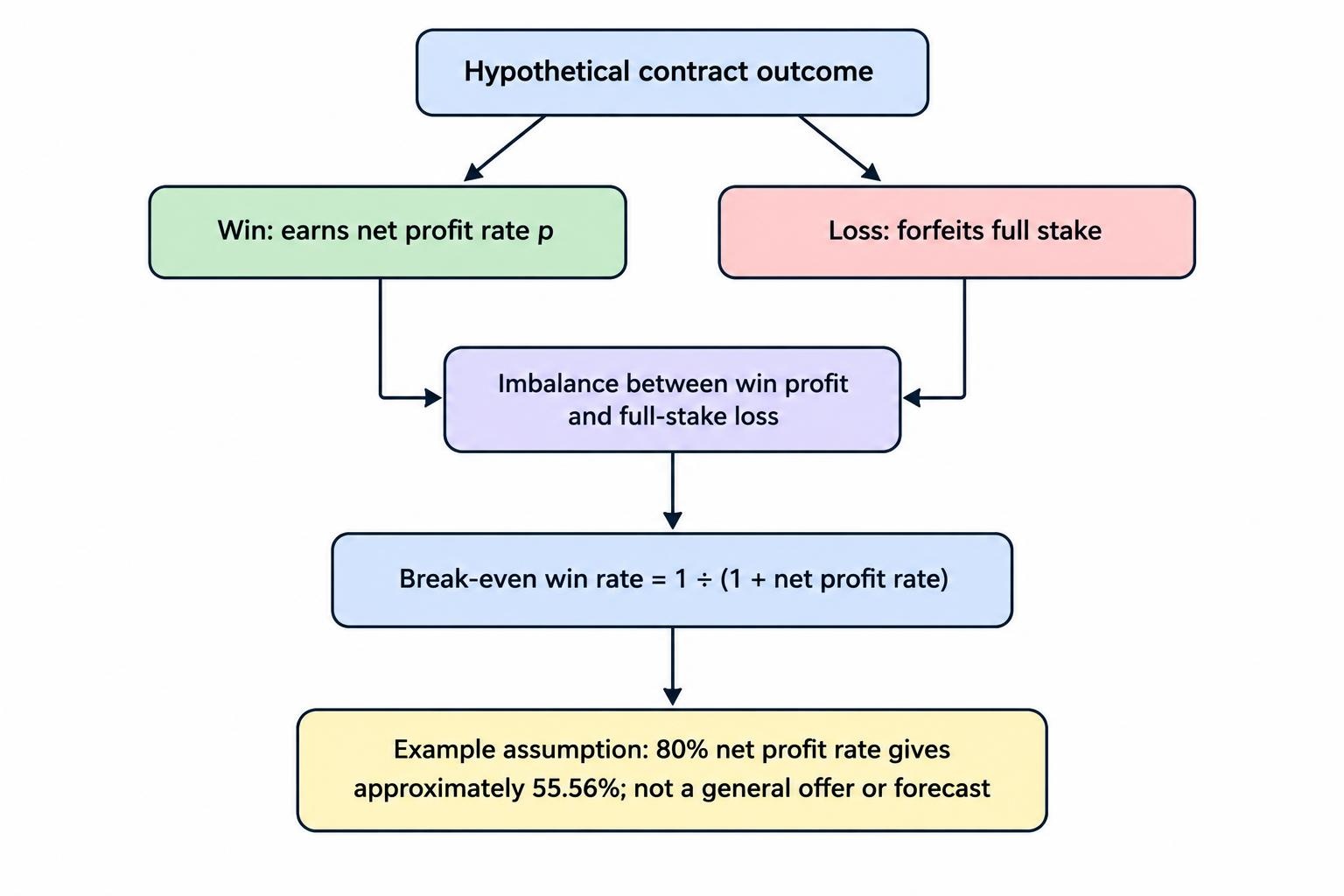
An 80% profit on a winning stake does not balance a 100% loss on an unsuccessful stake. Winning half the time is therefore not enough under those terms.
Consider 100 hypothetical contracts, each risking A$20 at the same 80% net profit rate. Fifty wins earn A$800. Fifty losses cost A$1,000. The combined result is a A$200 loss before any other charges.
For a contract that loses the entire stake when unsuccessful, with no ties or fees, the break even win rate is:
Break even win rate = 1 ÷ (1 + net profit rate)
At an 80% net profit rate, that is 1 ÷ 1.80, or approximately 55.56%. A lower profit rate raises the percentage of wins needed to break even.
Expected value puts the same arithmetic into an average per contract. If the assumed probability of winning is 50%, the A$20 example has an expected result of:
(0.50 × A$16) − (0.50 × A$20) = −A$2
That is a mathematical average under the assumptions, not a prediction that every contract loses A$2. The harder question is whether the assumed probability is justified. A handful of wins cannot establish it.
Study probability and expected value in binary options before treating a win rate as evidence of profitability. Always compare results with the payout actually available in the exercise, not a more generous number remembered from elsewhere.
Keep different contract types separate
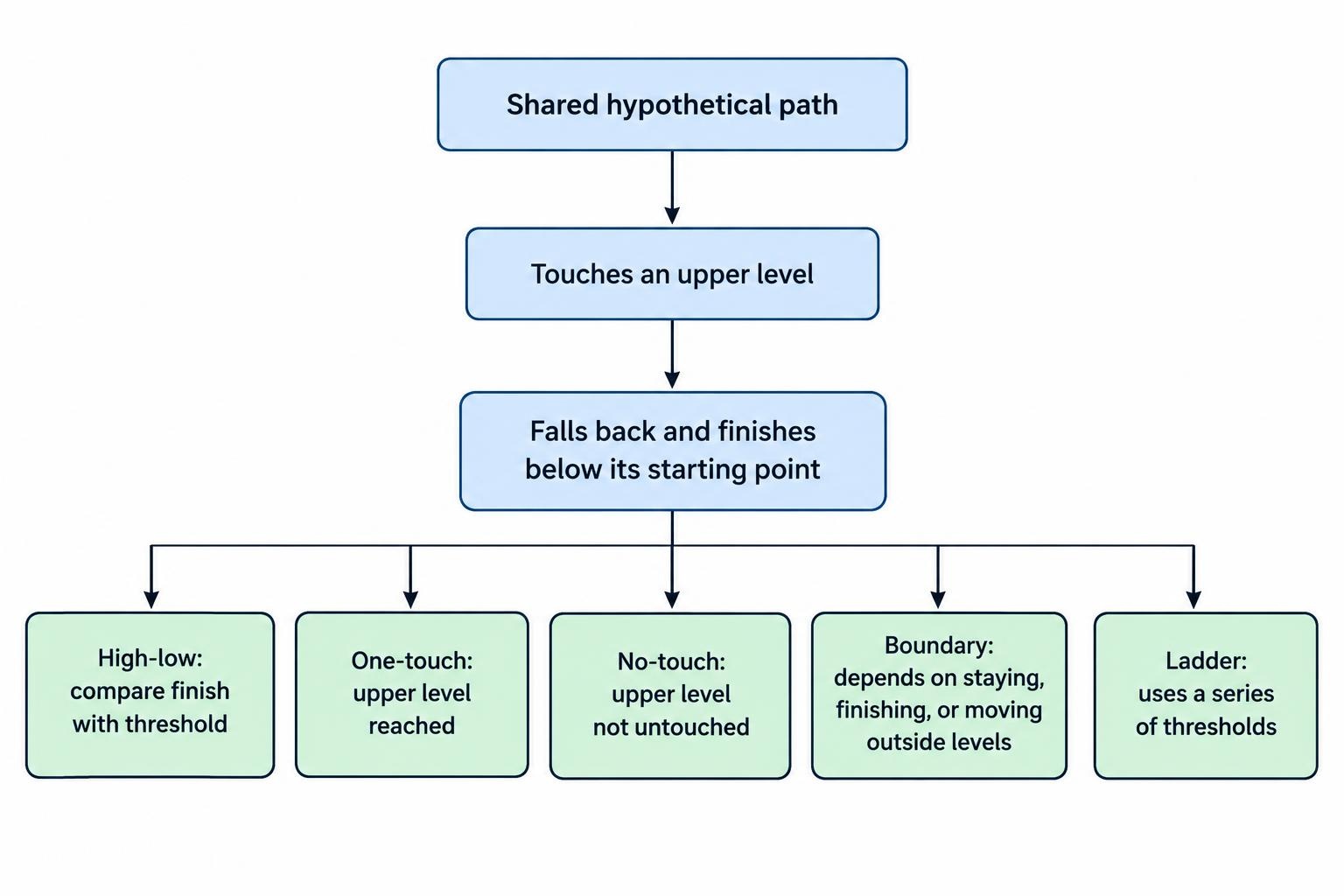
Binary options do not all ask the same question. A high low contract tests whether a price finishes above or below a threshold. A one touch contract tests whether a level is reached during the observation period. A no touch contract tests whether it remains untouched.
Boundary contracts concern whether the price stays within, finishes within or moves outside stated levels, depending on their wording. Ladder contracts use a series of thresholds, with terms attached to each.
The practical lesson is simple: the same price path can produce different results under different contracts. A price might touch an upper level, fall back, and finish below its starting point. That path could satisfy a touch condition while failing an above strike expiry condition.
Use the guide to binary option types to compare their conditions. Do not transfer a method between types without checking what the new contract measures.
Separate chart prices from settlement prices
A chart is an analysis tool. The contract’s settlement rules determine the result. Treat those as separate jobs, even when the displayed prices appear to match.
For each paper exercise, record the reference feed, expiry timestamp and required comparison. If your analysis uses a different chart, note that difference. Do not substitute its closing price simply because it is easier to retrieve.
Equality deserves its own check. If a contract requires a price strictly above the strike, equality does not satisfy that condition. Whether the contract then refunds the stake, records a loss or applies another provision depends on its terms.
The lesson on binary options settlement and ties covers these edge cases. A sensible learning exercise should leave no room for deciding the rules after seeing the result.
Practise without turning practice into a deposit decision
A spreadsheet or notebook is enough to rehearse contract mechanics. Write down the condition, stake, payout and expiry before observing the outcome. Afterwards, record the settlement value and calculate the net result.
Keep the rules unchanged during a batch of exercises. If you alter the entry condition after three losses, you are no longer evaluating the original idea. You have started another exercise, whether the spreadsheet admits it or not.
Record every qualifying observation, including inconvenient ones. Mark missing prices as missing rather than choosing the nearest favourable quote. Separate correctly completed exercises from profitable results: following the process and making money are different measurements.
The paper trading binary options guide provides a structure for this work without requiring a funded account.
Practice can show whether you read terms correctly and calculate returns consistently. It cannot prove that a provider will accept an order at the displayed terms, settle a disputed result fairly or honour withdrawals. A successful simulation is evidence about the simulation, not a certificate for everything outside it.
Put loss evidence ahead of strategy claims
Historical Australian outcomes provide a useful reality check. In the issuer data examined for ASIC Report 736 on the binary options intervention, between 74% and 77% of active retail clients lost money in each quarter between April 2020 and the ban’s commencement on 3 May 2021.
Those figures describe the reviewed period and providers. They are not a forecast for an individual account. They do, however, give a firmer starting point than a promotional screenshot showing several successful trades.
In your exercises, measure net profit, losing streaks and the effect of changing payouts. Counting wins alone hides too much. Smaller stakes reduce the cash lost on an unsuccessful contract, but they do not turn a negative expected value into a positive one.
Repeated losses also show why recovery staking needs scrutiny. Increasing the next stake raises the amount exposed; it does not improve the contract’s condition or payout.
Treat access and marketing as separate questions
A platform accepting your address or payment is not proof that its offer complies with Australian rules. Nor should access be the reason to accept wholesale classification. Wholesale clients do not have the same consumer protections as retail clients, and Moneysmart’s binary options warning advises against agreeing to that treatment just to obtain access.
Apply the same discipline to courses, signals and automated systems. Ask what evidence would establish the claim: complete results, losing periods, recorded payouts and rules fixed before each outcome. A polished dashboard does not answer those questions.
Do not confuse a displayed account balance with money you can withdraw. Pressure to add funds or pay for an upgraded account to ease withdrawal restrictions warrants caution. These tactics feature in the SEC alert on fraudulent binary options platforms. Keep the educational task separate from any request for money.
Choose your next lesson
If the terminology still feels unfamiliar, follow the binary options beginner’s guide in order. If the basic contract makes sense, work through the numerical examples, then test your grasp of probability and settlement.
A useful standard is whether you can explain a hypothetical contract without looking at its chart: what decides the outcome, what happens at equality, how much each result pays, and what win rate would be needed to break even.
If one answer is missing, that is the next lesson. The aim is to evaluate the proposition accurately, not to reach a deposit screen faster.
This article was last updated on: October 22, 2026