Binary options broker comparisons should start with the business behind the platform, not its advertised payout. The useful questions are who holds the account, which rules apply, how contracts settle and whether the withdrawal terms match the sales pitch. Chart colours can wait.
This page provides a framework for comparing providers and directs readers to individual broker matchups. It does not rank offshore platforms as suitable for Australian retail clients or treat an accessible registration page as permission to trade.
Australian Eligibility Comes Before Broker Features
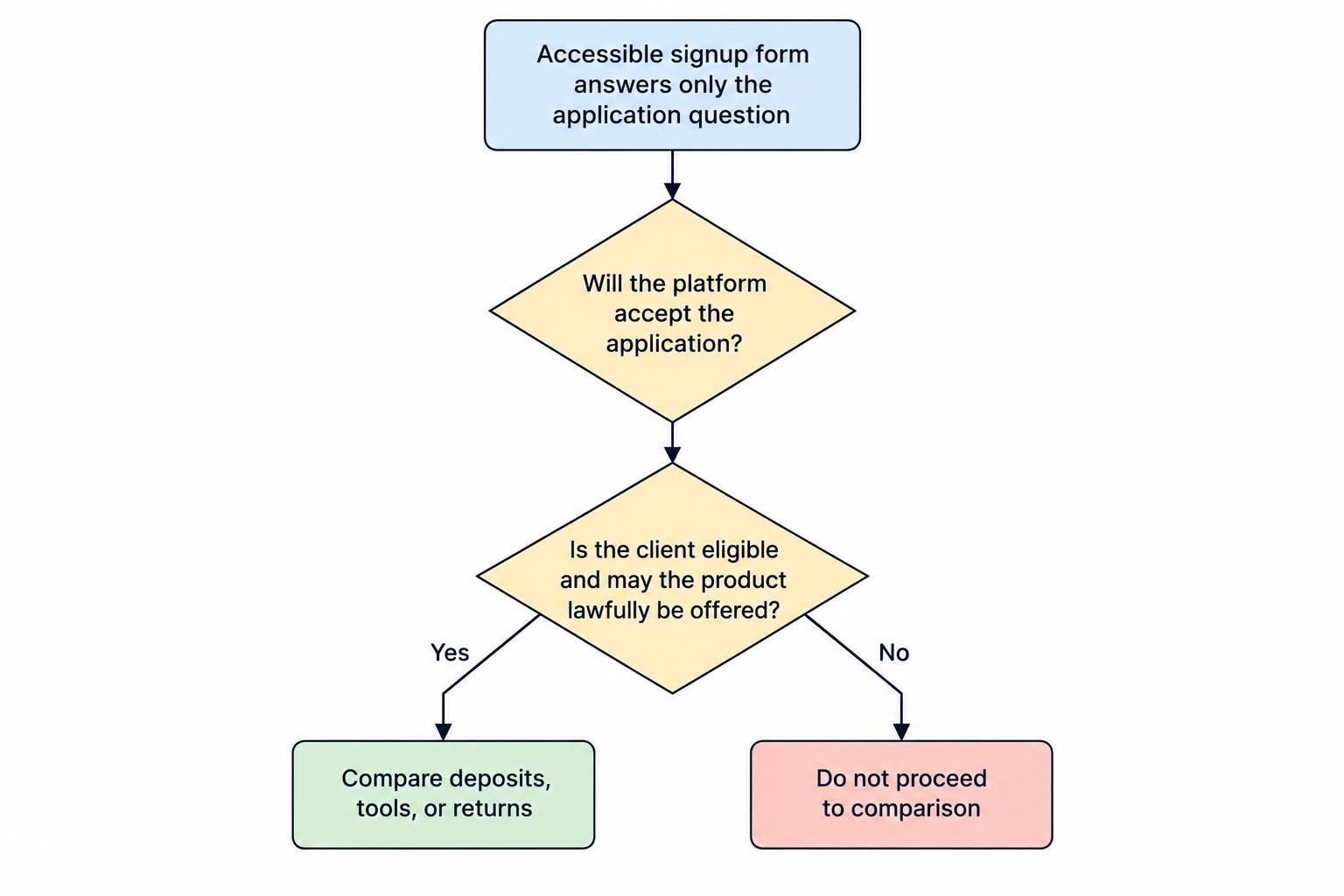
ASIC’s prohibition on issuing and distributing binary options to retail clients took effect on 3 May 2021 and has been extended until 1 October 2031. That restriction comes before any comparison of deposits, trading tools or returns. An overseas registration or an account denominated in Australian dollars does not create an exemption from the ASIC binary options product intervention order.
Keep two questions separate: “Can this platform accept an application?” and “Can this product lawfully be offered to this client?” A functioning signup form answers only the first.
For Australian retail readers, broker comparisons are therefore research tools rather than a shopping list. They can help assess claims, examine an existing account or identify missing evidence. They should not become instructions for bypassing local restrictions.
Choose a Head-to-Head Comparison
The following comparisons focus on three broker pairings. None of the pairings implies equivalent authorisation, ownership or client protection. Those points need evidence for each contracting entity.
Quotex vs Pocket Option
For Quotex vs Pocket Option, the useful comparison starts with the entity named in each agreement and the terms attached to the same contract. Compare payout definitions, expiry rules, settlement prices and access to transaction records. A headline return cannot settle the question if the underlying contracts differ.
Keep account features separate from legal eligibility. An easier interface or lower entry amount would not resolve an authorisation problem.
Deriv vs IQ Option
The starting point for Deriv vs IQ Option is the exact product and account entity under review. Do not transfer a finding about one financial product to another simply because both appear under the same brand.
Record the relevant jurisdiction, client category and contract type before comparing tools. Otherwise, a comparison can place unlike accounts side by side and produce a confident answer to the wrong question.
IQCent vs RaceOption
For IQCent vs RaceOption, examine the account agreement, payment conditions and complaint route independently for each provider. Check any claims about shared ownership, separate ownership or common technology rather than inferring a relationship from similar branding.
Give withdrawal restrictions and verification requirements more attention than promotional offers. The relevant comparison is between enforceable terms, not two welcome banners.
Compare the Contracting Entities, Not Just the Brands
Start a comparison sheet with the full legal name in each client agreement. Add the registration number, stated address, governing law and claimed financial services authorisation. Record the date of every document. If the agreement and payment instructions name different businesses, ask for a documented explanation rather than assuming the relationship.
For Australian authorisation claims, check the entity through ASIC’s professional registers search. The register provides licence or registration status, relevant conditions and information about the services a business is licensed to provide. Match the record to the entity making the offer; finding a similar company name is not enough.
Also distinguish company registration from financial services permission. An Australian Company Number establishes neither authority to offer a financial product nor approval of that product. Holding an AFS licence is not an ASIC endorsement or a guarantee against loss. These distinctions form part of Moneysmart’s investment verification checks.
Use “not verified” where evidence is missing. Do not replace it with “regulated” because a certificate looks official, or with “unregulated” without identifying which authorisation was checked. Precision matters in both directions.
What a Useful Broker Comparison Should Include
Assess both providers against the same questions. This prevents one platform receiving credit for a well advertised feature while the equivalent information remains unknown for the other.
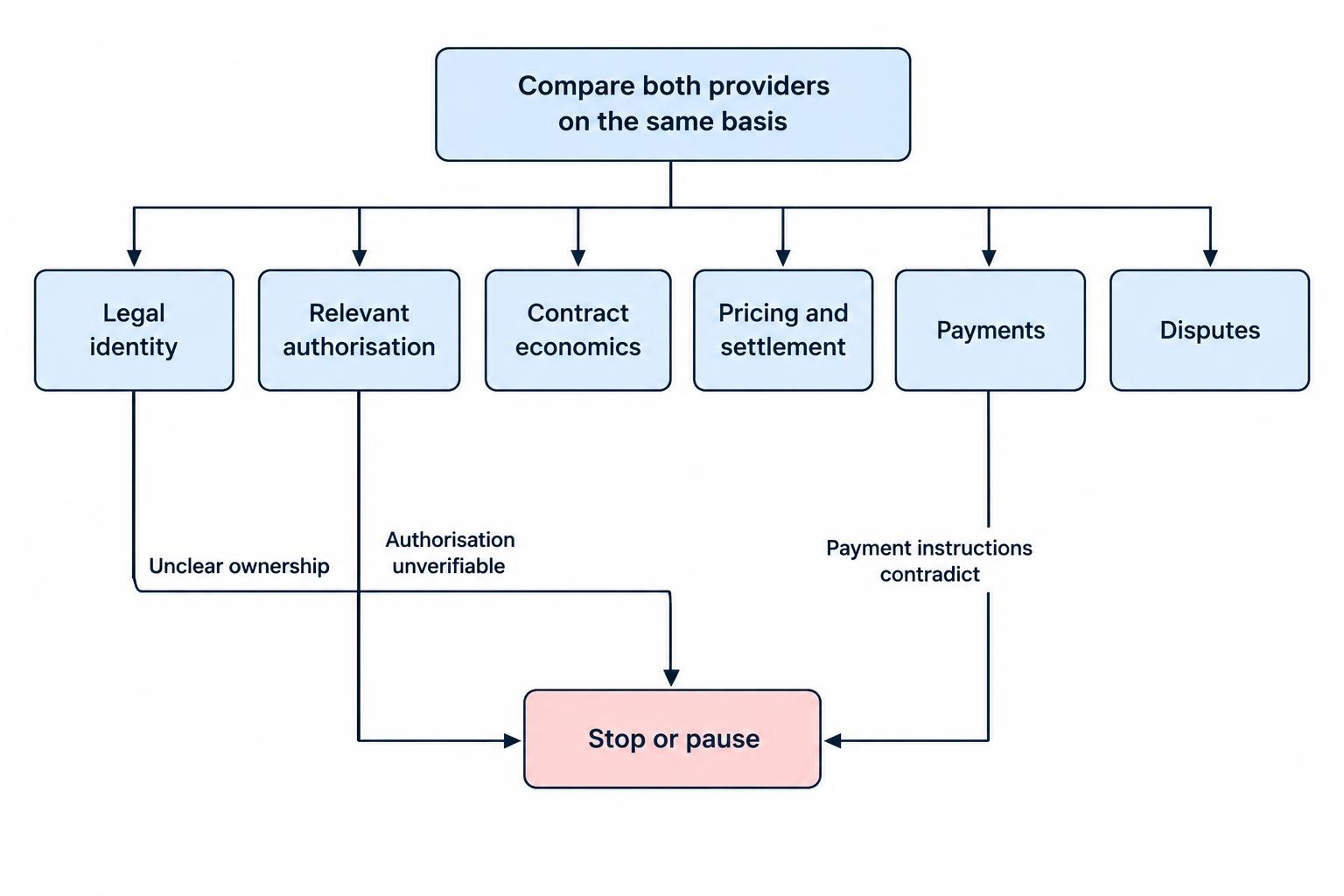
| Comparison area | What to establish | What should not substitute for evidence |
|---|---|---|
| Legal identity | The entity responsible under the client agreement | A brand name, logo or company registration badge |
| Authorisation | Current permission relevant to the product and client | A licence number without a matching register record |
| Contract economics | Net profit on a win, loss on a loss and treatment of ties | An unexplained “up to” payout |
| Pricing and settlement | The reference price, expiry rule and correction procedure | A chart screenshot without contract details |
| Payments | Withdrawal conditions, fees, verification and processing stages | Fast deposit processing |
| Disputes | A documented complaint process and any applicable external route | A friendly chat response or testimonial |
Some findings should stop the assessment rather than reduce a numerical score. Unclear ownership, unverifiable authorisation or contradictory payment instructions should not be cancelled out by extra indicators and a polished mobile app.
Compare Payouts on the Same Basis
A payout percentage needs a definition. Establish whether it describes net profit or the total amount returned, including the original stake. Then compare the same underlying market, direction, expiry and observation time. Mixing different contracts produces an attractive table but weak analysis.
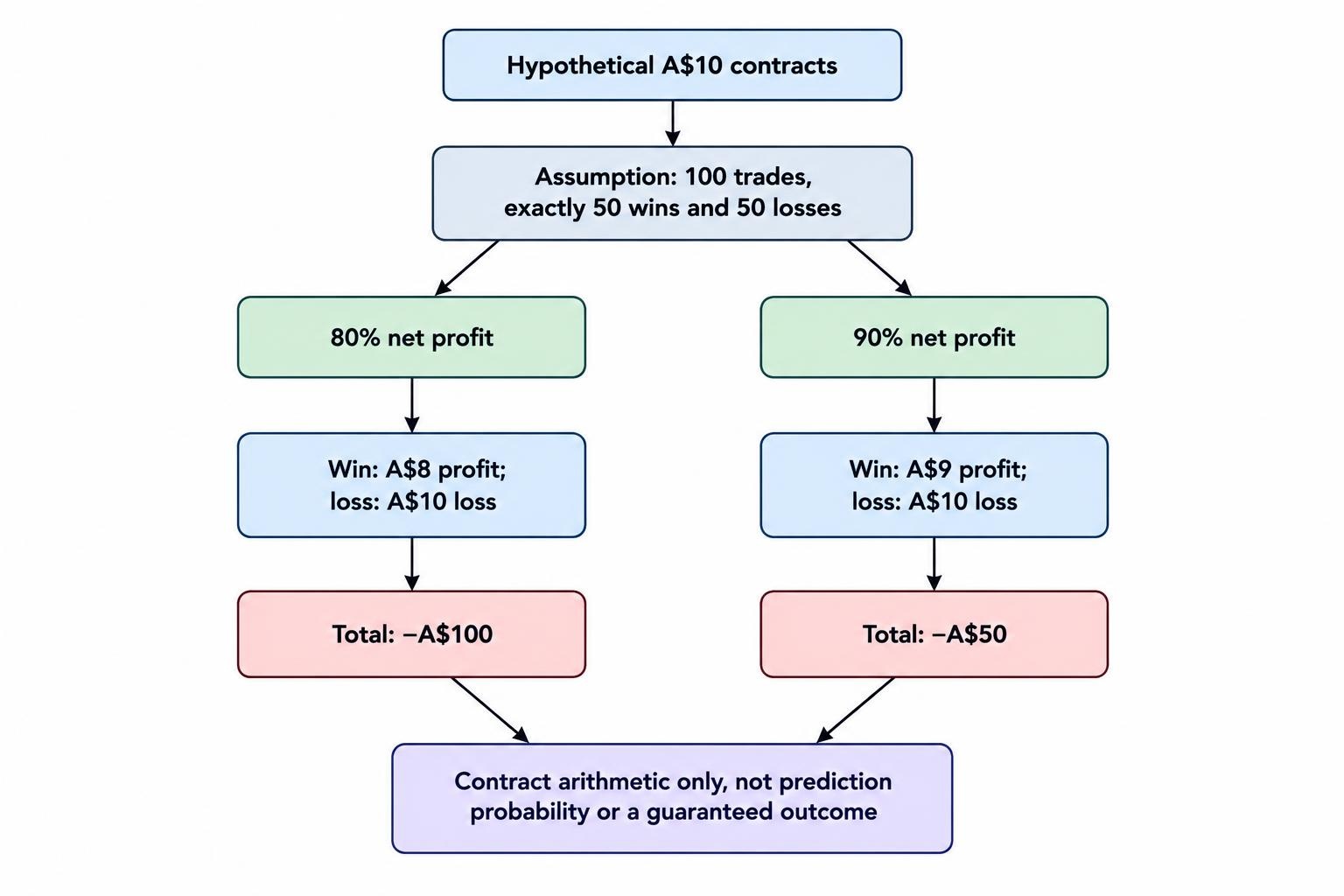
Consider a hypothetical A$10 contract that returns the stake plus 80% net profit after a win. A winning trade earns A$8; a losing trade loses A$10. With no fees, refunds or ties, the break-even win rate is 55.56%. At 90% net profit, it falls to 52.63%.
The calculation is the amount lost divided by the combined potential profit and loss: 10 ÷ 18 for the first contract and 10 ÷ 19 for the second. These figures describe contract economics, not the probability of predicting the outcome correctly.
Across 100 hypothetical A$10 trades with exactly 50 wins and 50 losses, the 80% contract loses A$100. The 90% contract loses A$50. The higher payout improves that assumed result; it does not turn it into a profit.
Before using an advertised return, check whether it applies to the actual contract being assessed and whether other conditions change the result. The separate guide to broker payouts and contract terms covers those details without turning this comparison hub into a payout manual.
Read Settlement and Execution Rules Together
A payout comparison remains incomplete without the conditions that decide who receives it. Identify the price used to accept an order, the strike price, the expiry timestamp and the price used for settlement. Check the time zone and what happens when the settlement price equals the strike.
Two charts showing slightly different prices do not, by themselves, establish misconduct. First establish whether they represent the same instrument, price source and timestamp. A cash market quote, futures contract and platform generated price should not be treated as interchangeable without checking the contract.
Assess the evidence available after an order, too. Look for transaction identifiers, accepted entry times, expiry times and recorded settlement values. If a provider can reject, cancel or correct transactions under its agreement, identify the circumstances and any review process.
Do not turn an isolated screenshot into a general execution rating. A useful comparison distinguishes a documented contractual rule from an allegation, an unresolved discrepancy and a measured result.
Withdrawal Terms Deserve More Weight Than Deposit Speed
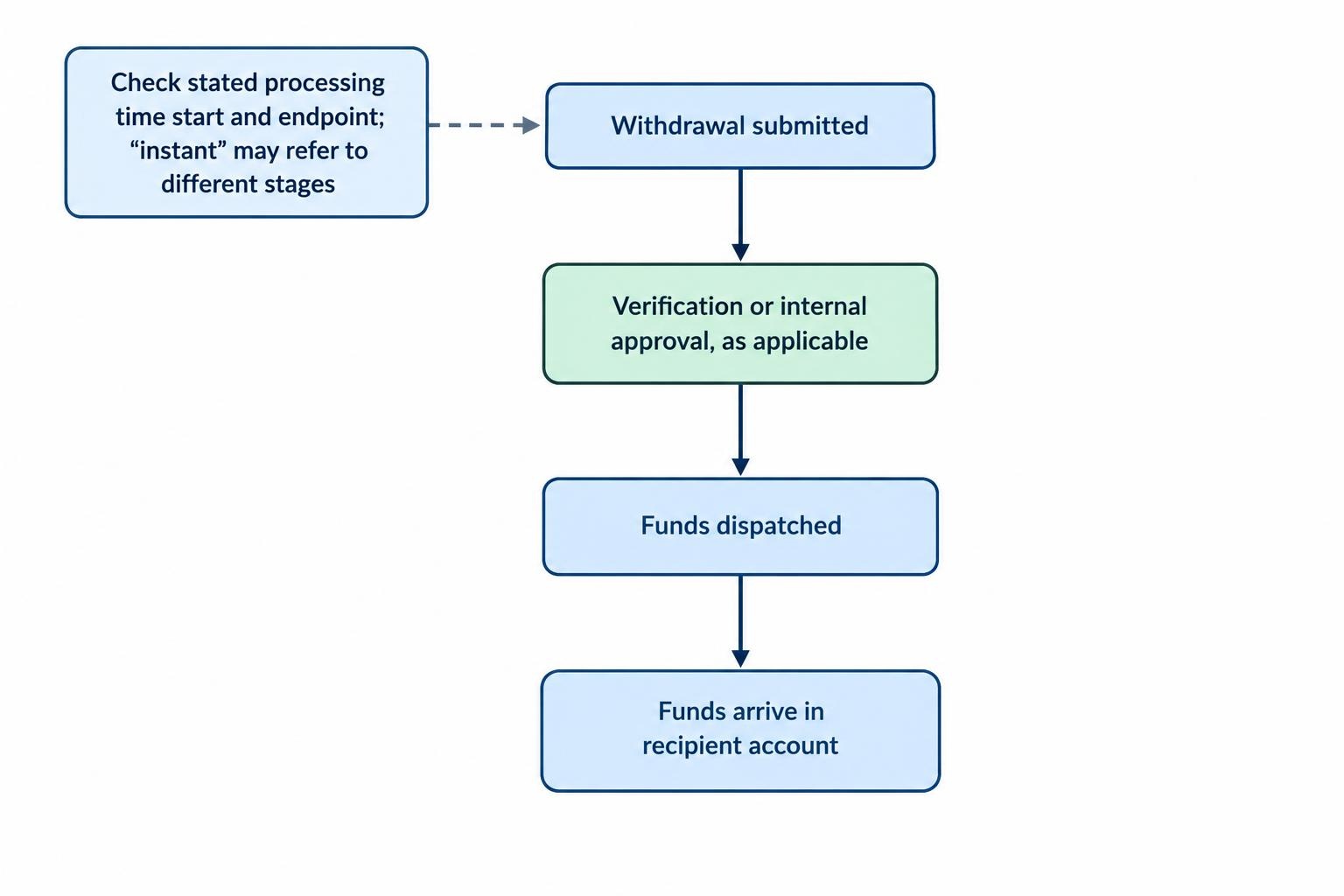
Read the withdrawal policy before considering payment convenience. Record the minimum withdrawal, applicable charges, identity checks, destination restrictions and stated processing period. Establish when that period starts: at submission, after verification or after internal approval.
This is not paperwork for paperwork’s sake. Complaints received by the US Securities and Exchange Commission include allegations of refused withdrawals, identity theft and software manipulation involving binary options platforms. The SEC’s binary options fraud warning documents those complaint categories; it does not establish that every provider has committed them.
Compare written obligations rather than promises such as “instant withdrawals”. Ask whether the claim covers approval, dispatch of funds or arrival in the recipient’s account. Those are different stages.
Do not deposit money merely to test whether an unverified provider pays out. A successful transaction would establish only that the transaction occurred, not that future withdrawals are guaranteed. Likewise, an unresolved complaint needs evidence before it becomes a finding against an entire business.
Keep Demo Features and Promotions in Their Place
A demo account can help assess interface layout, order entry and access to trade history. It cannot establish whether real withdrawals will be honoured or how a dispute will be resolved. Give it credit for the questions it can answer, not the ones it cannot.
Apply the same discipline to bonuses. If an offer exists, examine whether accepting it changes withdrawal rights, creates turnover requirements or affects account closure. Compare the underlying account without the promotion before considering the offer itself.
Minimum deposits belong in this secondary category too. A smaller opening amount changes how much money is initially requested. It does not answer who receives that money, what protections apply or whether the product may be offered to the client.
Check Warnings Without Treating Silence as Approval
Search the legal name, brand name and relevant domain when checking regulatory warnings. Read the actual notice and preserve its jurisdictional context. A warning about unauthorised activity in one country should not be rewritten as a finding about every activity everywhere.
The Moneysmart investor alert list is not exhaustive. A business being absent from it does not establish that the business is trustworthy. Warning searches supplement identity and authorisation checks; they do not replace them.
Keep complaint evidence equally disciplined. Dates, transaction records, correspondence and the provider’s response are more useful than an unexplained star rating. Similar allegations deserve investigation, but repeated wording across anonymous reviews is not the same as independent verification.
Make the Comparison Traceable
A defensible comparison lets the reader follow each finding back to a dated document, register record or clearly described calculation. It separates advertised terms from verified facts and labels unresolved points plainly.
Avoid a single overall score that lets attractive features outweigh unresolved legal questions. Present eligibility and authorisation first, contract economics next, then payments, dispute handling and usability. If the evidence does not support a winner, say so.
For a repeatable assessment, use the broker evaluation checklist alongside the relevant head-to-head comparison. The purpose is not to find the most persuasive sales page. It is to establish what can be verified, what remains uncertain and whether the comparison should proceed at all.
This article was last updated on: October 22, 2026