A broker complaint needs a clear account of what went wrong, evidence of the loss, and a request for a remedy. Repeated messages to an account manager may achieve little if the complaint never reaches the firm’s complaints team.
The Australian Financial Complaints Authority (AFCA) provides an independent dispute resolution route for eligible complaints about member financial firms. It is not a regulator, a court, or a service that can recover money from any trading platform.
For binary options complaints, the starting point matters: ASIC’s prohibition on issuing and distributing binary options to retail clients took effect on 3 May 2021 and runs until 1 October 2031. A platform accepting Australian customers does not, by itself, establish that it operates lawfully or that AFCA can hear a complaint against it.
Check whether AFCA can consider the broker complaint
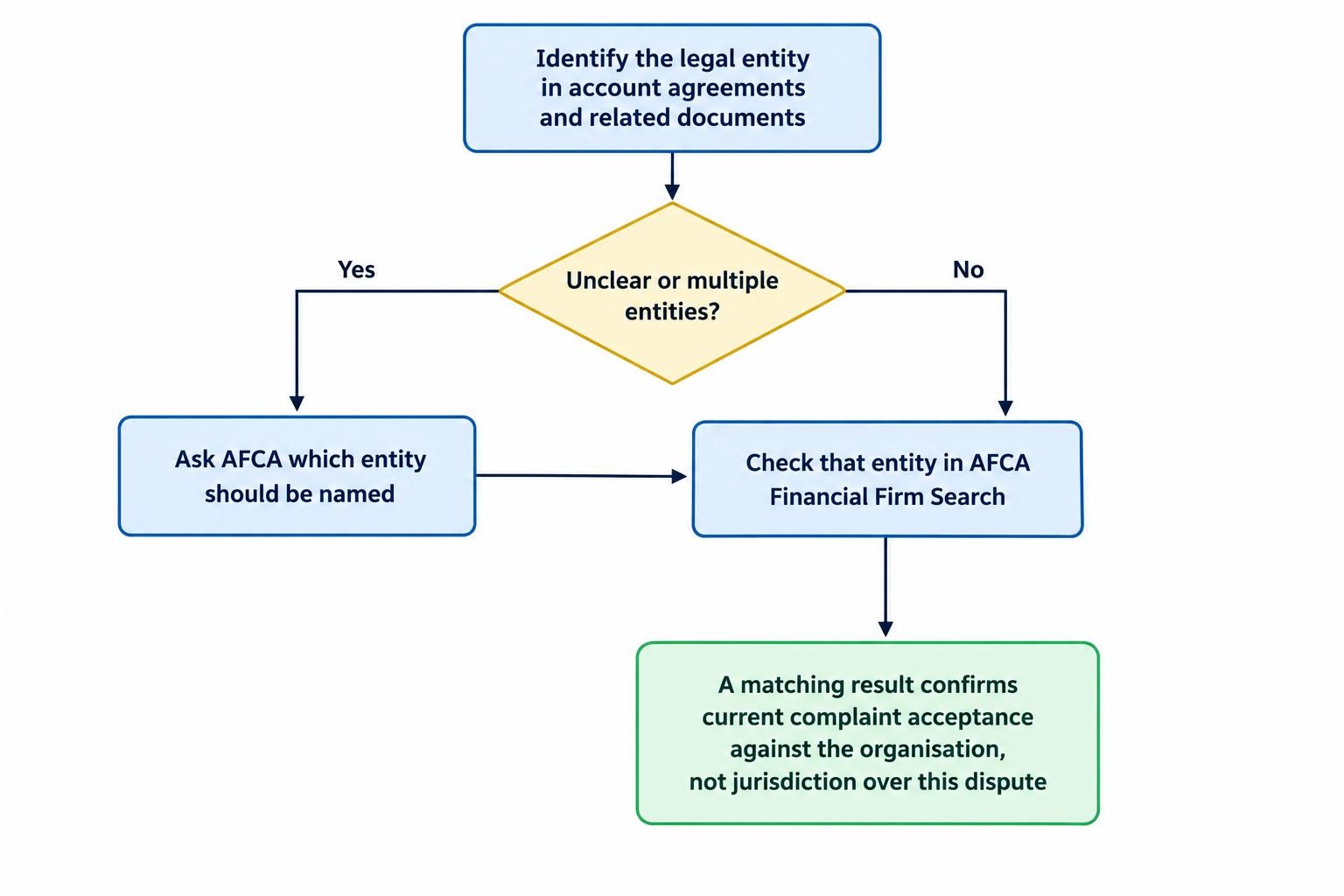
Start with the legal entity that provided the service, not just the brand displayed above the login screen. Find the company name in the account agreement, disclosure documents, statements and payment instructions. Record any Australian financial services licence number and the entity’s claimed country of registration.
Use AFCA’s Financial Firm Search to check the entity and its complaint contact details. The search displays organisations against which AFCA can currently accept complaints. Membership is not an endorsement of the firm or its products, and it does not mean every dispute falls within AFCA’s jurisdiction.
Match the result carefully. A company with a similar name, a related business in another country, or an Australian business elsewhere in the same corporate group may not be the party to your agreement. If the paperwork names several companies, provide all of them to AFCA and ask which entity the complaint should concern.
Check licensing separately through the process in our guide to checking a broker’s licence. An ABN, company registration certificate or private dispute resolution badge should not replace that check. Keep copies of the documents and claims that persuaded you the business was authorised.
Separate broker conduct from trading losses
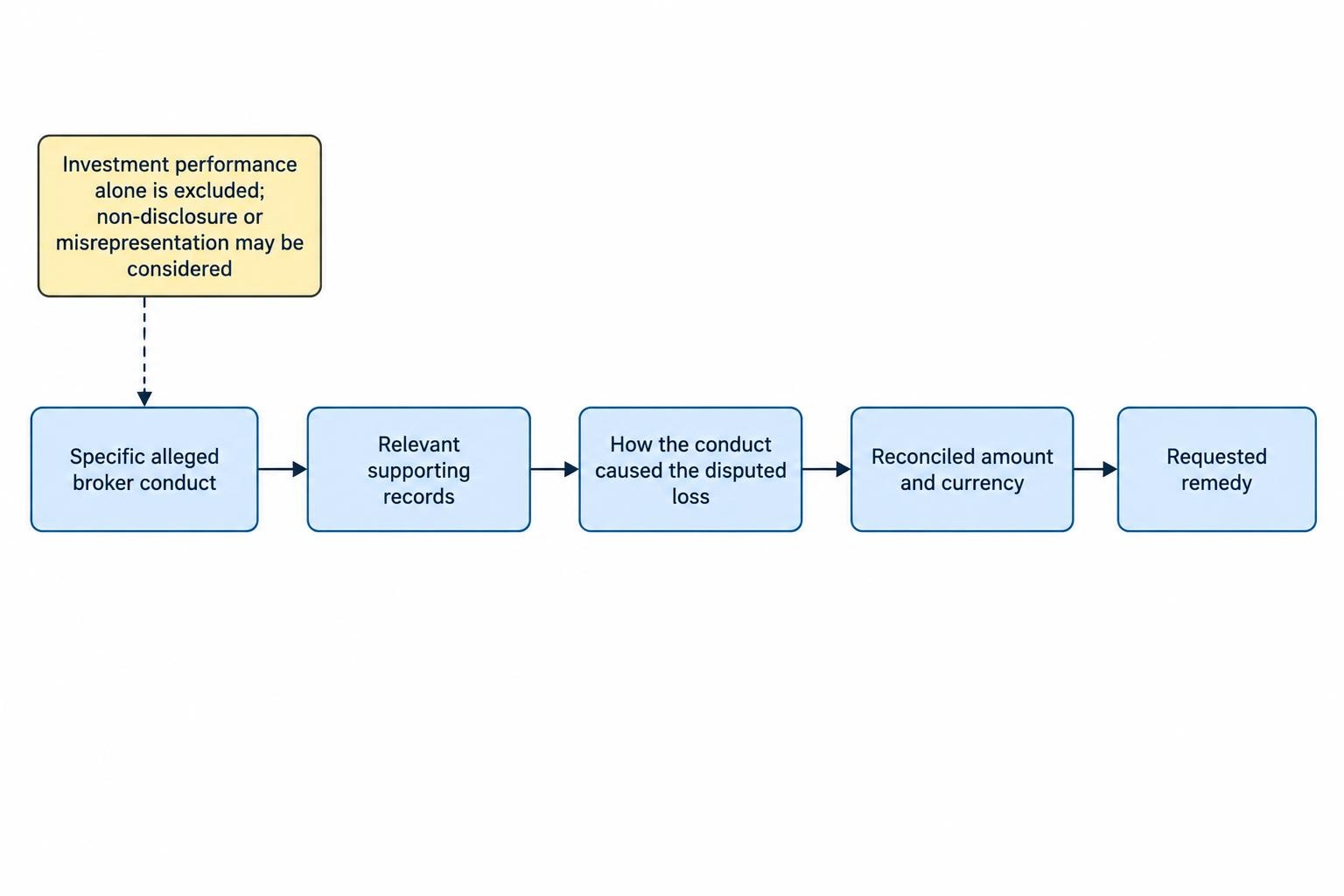
A complaint should identify the broker’s alleged error and explain how it caused your loss. “My account lost money” does not identify misconduct. “The firm executed transactions I did not authorise” presents a different issue.
AFCA’s investment and financial advice complaint criteria cover matters such as incorrect transactions, misleading information, wrongly calculated charges and failures to follow instructions. Complaints solely about investment performance are excluded, although complaints involving non-disclosure or misrepresentation can be considered.
| Complaint issue | What to explain | Useful supporting records |
|---|---|---|
| Withdrawal not paid | The amount requested, the applicable terms, and the reason given for withholding payment. | Withdrawal confirmation, account statement, verification correspondence and payment records. |
| Disputed trade or settlement | The instruction given, what the platform recorded, and the contractual settlement rule. | Trade identifiers, timestamps, order confirmations and the relevant contract terms. |
| Misleading statements | What was represented, when you relied on it, and which payments or decisions followed. | Advertisements, emails, messages and dated disclosure documents. |
These are ways to frame a complaint, not promises that AFCA will accept it or award compensation. Membership, eligibility, exclusions, time limits and monetary jurisdiction still matter.
Build an evidence file before access disappears
Save records while you can still access the account. Keep original downloads alongside screenshots, and preserve emails with their dates and sender details. Avoid cropping away the account number, transaction identifier or surrounding conversation needed to establish context.
Prepare a short chronology. Record when you opened the account, made each payment, received disputed instructions, requested a withdrawal and first complained. Distinguish the date an event happened from the date you discovered it.
Reconcile the money separately. Show deposits, withdrawals received, fees and the amount still disputed. Label each currency. If you converted a foreign currency amount into Australian dollars, explain the conversion used rather than presenting an unexplained total.
Do not treat a displayed platform balance as proof that the whole amount is recoverable. Separate money you transferred from claimed profits, bonuses and other account credits. Explain why you say each disputed amount is owed.
For a pricing dispute, record the asset, expiry, timezone, benchmark and settlement terms. A screenshot from another chart is useful context, but first check whether it measures the same instrument at the same time.
Raise the complaint through internal dispute resolution
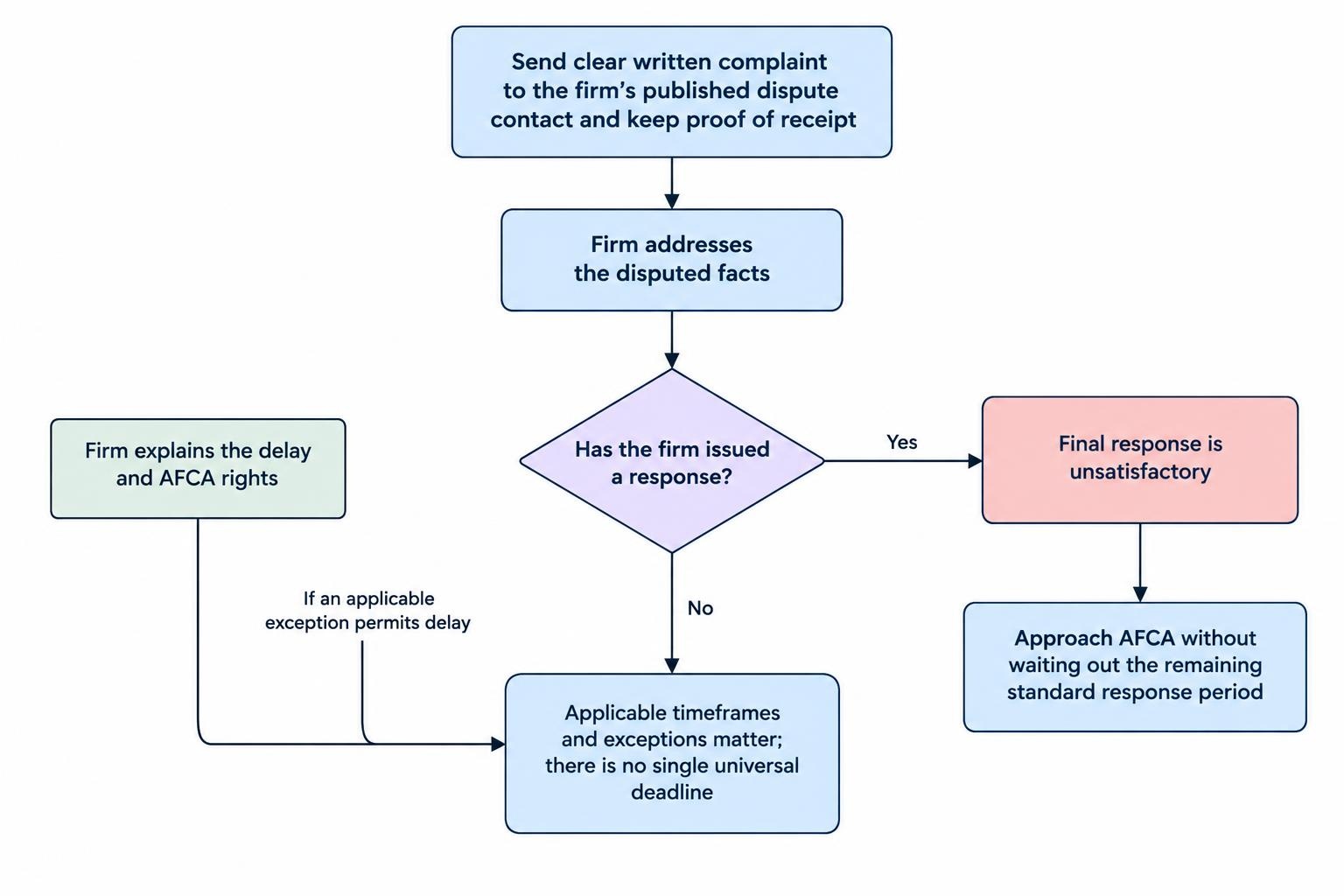
Send the complaint to the financial firm’s published internal dispute resolution (IDR) contact. You can copy the account manager, but do not rely on that person to escalate it. Keep evidence of when the firm received your complaint.
For firms subject to the relevant requirements, ASIC Regulatory Guide 271 on internal dispute resolution generally requires a response to a standard complaint within 30 calendar days. Other timeframes and exceptions apply. Where an exception permits delay, the firm must provide a delay notification explaining the reasons and your AFCA rights.
You do not need legal language. Describe the conduct, identify the loss and state the outcome requested. An earlier expression of dissatisfaction may already count as a complaint; referral to a specialist team does not necessarily mark the start of the complaint period.
Ask the firm to address the disputed facts, identify the contractual provisions it relies on, and preserve relevant records. If it gives an unsatisfactory final response before the standard response period ends, you need not wait out the remaining days before approaching AFCA.
A practical complaint template
Subject: Formal complaint concerning account [account number]
I am complaining about [legal entity name] concerning [brief description of the issue].
On [date], [describe what happened]. I believe the firm acted incorrectly because [explain the disputed conduct and relevant terms or representations].
The amount I dispute is [amount and currency]. My calculation and supporting documents are attached. I request [payment, correction, fee refund or another stated remedy].
Please confirm receipt, provide a complaint reference, preserve the relevant account records, and send your written response addressing these issues.
Replace the placeholders with facts you can support. Do not describe a payment you approved as unauthorised simply because you later discovered deception. Explain both the authorisation and the deception accurately.
Watch the AFCA complaint deadlines
For most complaints, the ordinary deadline is the earlier of six years after you became aware, or should reasonably have become aware, of the loss, and two years after the financial firm’s IDR response, where one was provided before lodging with AFCA.
The earlier deadline controls. A recent rejection does not necessarily give an old complaint another two years. AFCA’s complaint process and time limits allow extensions in some cases involving special circumstances, but you should not assume an extension will be granted.
Contact AFCA promptly if a deadline may be close. Explain any missing documents rather than delaying contact while you assemble a perfect file. If there are existing court proceedings, a previous settlement or an earlier decision about the dispute, disclose that too.
Court limitation periods are a separate issue. Do not assume that correspondence with the broker, an ASIC report or an AFCA complaint protects every possible legal claim. Obtain legal advice where a court deadline may matter.
Present the complaint clearly to AFCA
AFCA is free for consumers, and you can contact it on 1800 931 678. Prepare the firm’s legal name, your account details, the chronology, the amount disputed, the remedy requested and any IDR response.
Lead with a short summary, then attach the supporting records. Name documents so they are easy to locate: “Withdrawal request, 14 August” is more useful than “Screenshot 47”. Number longer attachments and refer to the relevant pages.
Keep allegations separate from established facts. If you suspect a trade record was changed, identify the inconsistency and attach both versions. If a conversation took place by telephone, give the date, participants and your recollection, making clear that it is your account of the call.
The AFCA Rules and Operational Guidelines govern eligibility, exclusions, remedies and monetary limits. Ask AFCA to assess uncertainties about the correct respondent or account classification rather than assuming that membership settles those questions.
What happens after lodging?
AFCA may help the parties negotiate or participate in conciliation. If the dispute does not settle, it may provide a preliminary assessment or proceed to a determination. Not every complaint follows every stage.
Respond to requests by the stated deadline. If the firm supplies records that conflict with yours, identify the disputed entry and explain why it matters. Repeating the entire complaint makes the disagreement harder to isolate.
Consider settlement offers against the evidence and the outcome requested. Check the payment amount, currency, payment date and any release of further claims. A settlement that addresses only a fee dispute may not resolve a separate withdrawal issue unless the agreement says so.
Do not assume that AFCA will order repayment of every deposit or accept claimed future trading profits as a loss. Explain the connection between the conduct and the amount claimed. Monetary claim limits and compensation caps are different, and other rules govern interest, costs and non-financial loss.
For a large claim, ask about those limits before reducing the amount claimed or signing a release. Seek legal advice if accepting an outcome could affect a larger court claim.
Offshore brokers and complaints about banks
If the broker is not an AFCA member, AFCA cannot simply require it to participate because you live in Australia. Ask AFCA to confirm the position if the entity is unclear, but do not let that enquiry delay protective action through your bank or payment provider.
A separate complaint about a bank concerns the bank’s conduct, not automatic responsibility for the broker’s debts. Identify what the bank allegedly did wrong, such as its response to a scam report, and the loss you say followed.
Since 12 March 2026, AFCA’s jurisdiction has expanded to include eligible scam complaints about receiving banks and accounts opened without authority, including where the complainant is not the bank’s customer. The AFCA factsheet on receiving bank complaints sets out the conditions. The change does not itself create new legal duties or guarantee reimbursement.
Raise the issue with each relevant bank first. If complaining about both the sending and receiving bank, AFCA assesses those as separate complaints. Provide transaction references, recipient details and the times you reported the suspected scam.
Ask your card issuer promptly whether a payment dispute is available. Do not assume that a chargeback will succeed or describe authorised trading losses as card fraud. Our guide to trading payment chargebacks covers that separate route.
ASIC reports and AFCA decisions serve different purposes
Report suspected unlawful financial services conduct to ASIC, but keep that separate from pursuing compensation. ASIC has no role in resolving individual financial disputes or deciding AFCA cases. Its guidance on disputes with financial firms distinguishes regulatory reporting from individual dispute resolution.
For ordinary broker complaints, an AFCA determination becomes binding on the firm if you accept it. If you do not accept it, you retain your legal rights to pursue the matter in court. Read the determination and its acceptance instructions carefully before deciding.
A binding outcome is not the same as money already received. If a firm fails to comply, tell AFCA promptly. If it is insolvent or has disappeared, obtain advice about the remaining recovery options rather than assuming that an award guarantees payment.
Protect yourself while the complaint continues
Do not send another deposit to make the complaint “eligible”, unlock a withdrawal or pay a supposed recovery agent without independent verification. A demand for more money is not evidence that an existing balance can be recovered.
Contact your bank immediately if you suspect a scam or have exposed payment details. Scamwatch’s steps after a scam cover urgent bank contact, identity support, reporting and follow-up recovery scams. Act on account security alongside the complaint; one should not wait for the other.
If the incident involves a fake platform, stolen identity documents or remote access to your device, follow the broader steps in what to do after a binary options scam.
The strongest complaint is not the longest or angriest. It identifies the correct firm, sets out the disputed conduct, reconciles the money and requests a defensible remedy. Preserve the evidence, watch the deadlines and keep the broker complaint separate from bank disputes and regulatory reports.
This article was last updated on: October 22, 2026