An offshore trading account does not put income outside the Australian tax system. For an Australian tax resident, leaving profits with an overseas platform is not, by itself, a reason to leave them out of a tax return. The questions are who owns the income, how the trading activity is classified, when the income arises and what its value is in Australian dollars.
This guide covers offshore accounts used for binary options trading, including retained profits, withdrawals, currency conversion and foreign tax. It sits alongside the broader guide to binary options tax in Australia. Account location matters, but it is not a tax treatment.
Keep the Australian binary options ban separate from tax reporting
ASIC’s product intervention order prohibits the issue and distribution of binary options to retail clients and runs until 1 October 2031. The ASIC announcement extending the binary options ban sets out that restriction. An overseas platform accepting a registration or deposit does not establish that its offer complies with Australian requirements.
This article addresses reporting questions that can arise from existing accounts and past transactions. It is not a recommendation to open an offshore account. Keep the provider’s regulatory position and your tax position as separate items for review; a broker’s explanation of either is not a substitute for checking it.
Tax residency comes before the account’s location
Australian tax residents generally need to declare income from worldwide sources, including overseas business activities, investments and capital gains. The ATO guidance on Australian residents’ foreign and worldwide income sets out that starting point. Foreign and temporary residents can have different obligations, so establish your status before applying the resident rules.
For a straightforward review, write down who legally owns the account and whether that person’s tax residency changed during the period being examined. Flag any company, trust, joint ownership or account operated for somebody else. Do not assume that the name shown on a dashboard answers every ownership question.
Also separate the provider’s address from the source of each receipt. An offshore account can contain trading proceeds, interest, refunded deposits and transfers from your own wallet. Give your adviser the underlying transactions rather than labelling the entire balance “foreign income”. That description is too broad to prepare a reliable return.
Do you pay tax only when you withdraw?
Withdrawal is not a universal tax trigger. Section 6-5 of the Income Tax Assessment Act 1997 includes ordinary income derived during the income year and treats an amount as received when it is applied or dealt with on your behalf or as you direct. These statutory rules on ordinary income and receipt are why a “nothing withdrawn, nothing taxable” approach can fail. The correct timing still depends on the income’s character and the arrangement.
Suppose an adviser has established that settled trading profits are assessable ordinary income when credited as genuine, available funds. A profit credited on 25 June 2026 would not move into the following income year simply because the trader withdrew it on 10 July 2026. Choosing to reuse that credit for another contract does not, under that assumption, erase the first receipt.
The word “genuine” matters. If a platform displays a balance that cannot be substantiated, imposes disputed restrictions or appears to have fabricated transactions, do not treat the screenshot as a complete tax record. Preserve the evidence and ask an adviser to examine what rights, receipts and losses actually existed.
Separate deposits, returned stakes and profits
Start with a cash reconciliation, not the withdrawal total. Record money you contributed separately from trading results, fees and money taken out. This gives an adviser something that can be checked against statements.
The following hypothetical account uses US dollars throughout. It assumes no opening balance, open positions, bonuses, interest or transfers to another account.
| Account movement | USD amount | Reconciliation treatment |
|---|---|---|
| Deposits from the account owner | $2,000 | Add to account funding |
| Profit on winning contracts, excluding returned stakes | $900 | Add to trading results |
| Stakes lost on losing contracts | $500 | Subtract from trading results |
| Account fees | $100 | Subtract from the cash balance |
| Withdrawals | $800 | Subtract cash transferred out |
| Closing cash balance | $1,500 | Match against the account statement |
The arithmetic is $2,000 + $900 − $500 − $100 − $800 = $1,500. The trading result after the listed fees is $300. Neither the $800 withdrawn nor the $1,500 closing balance measures that result.
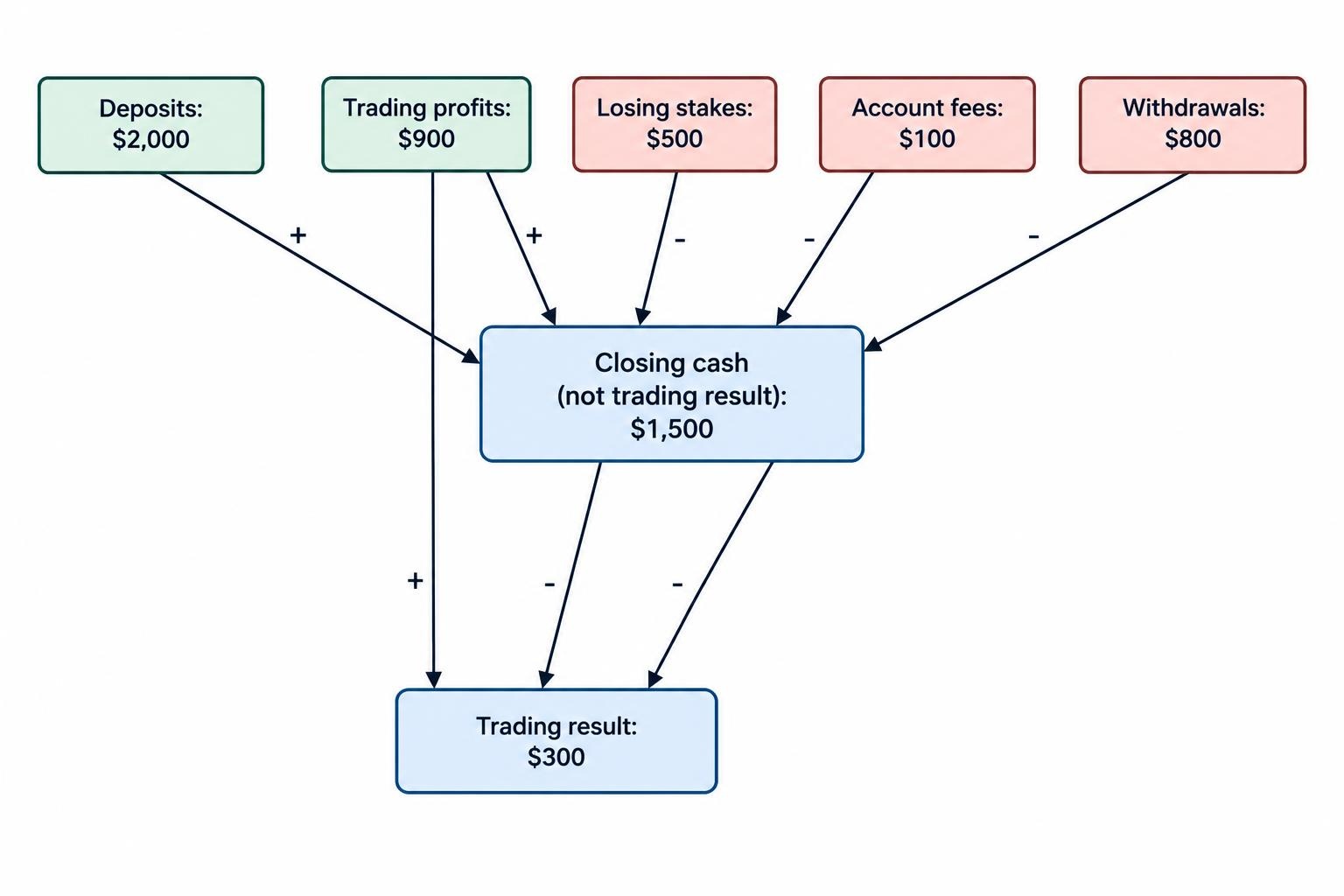
This is an accounting example, not a taxable income calculation. It does not establish whether the losses and fees are deductible, which tax rules apply or how to translate each amount into Australian dollars.
Check how the platform uses “payout”, too. If a successful $100 contract returns $180 including the original stake, the profit component is $80. Recording $180 as profit while also failing to account for the stake would distort the result. Keep the gross settlement information even if your worksheet shows the profit separately.
The offshore account does not decide income or capital treatment
Before converting totals or choosing a return label, resolve how the contracts and activity should be treated. Do not select a category because the platform calls the activity “investing”, or assume that a foreign provider’s tax summary follows Australian rules.
Ask your adviser to examine the contract terms, your purpose and the way you conducted the activity. The separate guide to income versus capital treatment addresses that classification question. This offshore account guide deals with the additional reporting work once that position has been established.
Keep losing transactions in the records even where the account finished the year ahead. Equally, do not treat a fall in the displayed balance as proof of a deductible loss. Identify whether the movement came from settled contracts, withdrawals, fees, currency changes or a disputed account adjustment. Have the loss treatment checked before using it to reduce another amount on the return.
Convert foreign currency amounts into Australian dollars
Foreign income, deductions and foreign tax paid must be translated into Australian dollars for the return. The applicable conversion rules can require a transaction date rate or permit an average rate in suitable circumstances. The ATO foreign exchange rate guidance explains those alternatives. Do not assume that multiplying a year’s net US dollar result by the withdrawal date rate produces the correct answer.
For an illustrative conversion, assume US$100 of income requires translation when A$1 buys US$0.65. Its Australian dollar value is US$100 ÷ 0.65, or A$153.85. At an assumed rate of US$0.67 per Australian dollar, the same US$100 translates to A$149.25. These are example rates, not current market quotations.
Build your worksheet with the original currency, relevant date, rate, rate source and translated amount. Keep income, losses, fees and foreign tax in separate columns. If you want to use an average rate, ask whether it is appropriate for the transactions rather than choosing whichever method produces the smaller figure.
Ask separately whether holding, spending or transferring foreign currency needs a forex tax calculation. A translation worksheet should not be mistaken for a complete review of every currency issue.
Foreign tax paid does not automatically settle the Australian liability
Eligible foreign income tax paid on income or gains included in Australian assessable income may qualify for a foreign income tax offset. Conditions and an offset limit can apply; foreign tax being payable is not necessarily enough. The ATO guide to foreign income tax offsets covers eligibility, calculation and timing. Do not simply subtract every overseas deduction from the Australian tax bill.
For review, retain the foreign assessment or withholding certificate, proof of payment and a calculation connecting the tax to the income reported in Australia. Ask what the charge legally represents and who received it.
A platform message demanding “tax” before releasing a withdrawal needs independent checking. Request the taxing authority, legal basis, calculation and payment evidence. Do not make another payment just to obtain paperwork that should substantiate the original demand. A label in a chat message is not adequate evidence for an offset claim.
Can the ATO receive offshore account information?
Yes. Under the Common Reporting Standard, participating jurisdictions exchange eligible financial account information. The ATO receives information about Australian residents’ overseas accounts through that process. The ATO description of the Common Reporting Standard explains the exchange and the financial institutions covered. It does not mean that every platform, jurisdiction or account falls within the same reporting arrangements.
Prepare the return from complete records rather than from assumptions about what might be reported. Do not wait for a foreign balance to appear in prefill before investigating it, and do not use an automatically supplied figure without reconciling it.
Where names, addresses or account ownership details have changed, keep documents explaining those changes. If two accounts belong to you, mark transfers between them so the same movement is not mistaken for a new trading receipt at the destination.
Keep records that explain the whole account
Tax records generally need to be retained for five years from lodgment, although different periods and exceptions can apply. Check the ATO requirements for records you need to keep before deleting older material. Ask about longer retention where documents support assets still held, carried forward losses or an unresolved review.
For an offshore trading account, assemble a file that lets somebody reconstruct events without access to your login:
- Ownership and terms: account holder details, the provider’s legal entity, contract conditions and bonus restrictions.
- Trading history: contract identifiers, timestamps, stakes, settlements, returned stakes and profit or loss components.
- Cash movements: deposits, withdrawals, internal transfers, fees and matching bank or wallet entries.
- Tax calculations: classification advice, currency rates, translated amounts and foreign tax evidence.
- Disputed activity: correspondence about frozen funds, altered balances, rejected withdrawals or missing transactions.
Export statements and transaction files periodically, then store a separate backup. Record the platform’s time zone and preserve the original files before editing a spreadsheet. That makes it easier to investigate transactions close to the end of an income year.
The guide to trading records for tax purposes covers the broader record keeping process. For offshore accounts, concentrate on making the foreign statement, payment trail and Australian dollar worksheet agree.
Crypto funding and missing income need separate review
If you funded an account with cryptocurrency or received withdrawals in cryptocurrency, include wallet addresses, transaction hashes, quantities, timestamps and exchange records in the adviser’s file. Do not provide only the final amount credited to your Australian bank account.
Have the funding and withdrawal steps reviewed alongside the trading activity. The tax considerations for crypto funded trading accounts guide addresses that separate layer; a binary options profit worksheet should not be expected to answer it.
If an earlier return omitted an offshore account, reconstruct the affected year before lodging the next one. Identify the receipts, classification, exchange rates and any foreign tax, then ask a registered tax agent whether an amendment or voluntary disclosure is appropriate. Do not place an old amount into a later year simply to make the totals catch up.
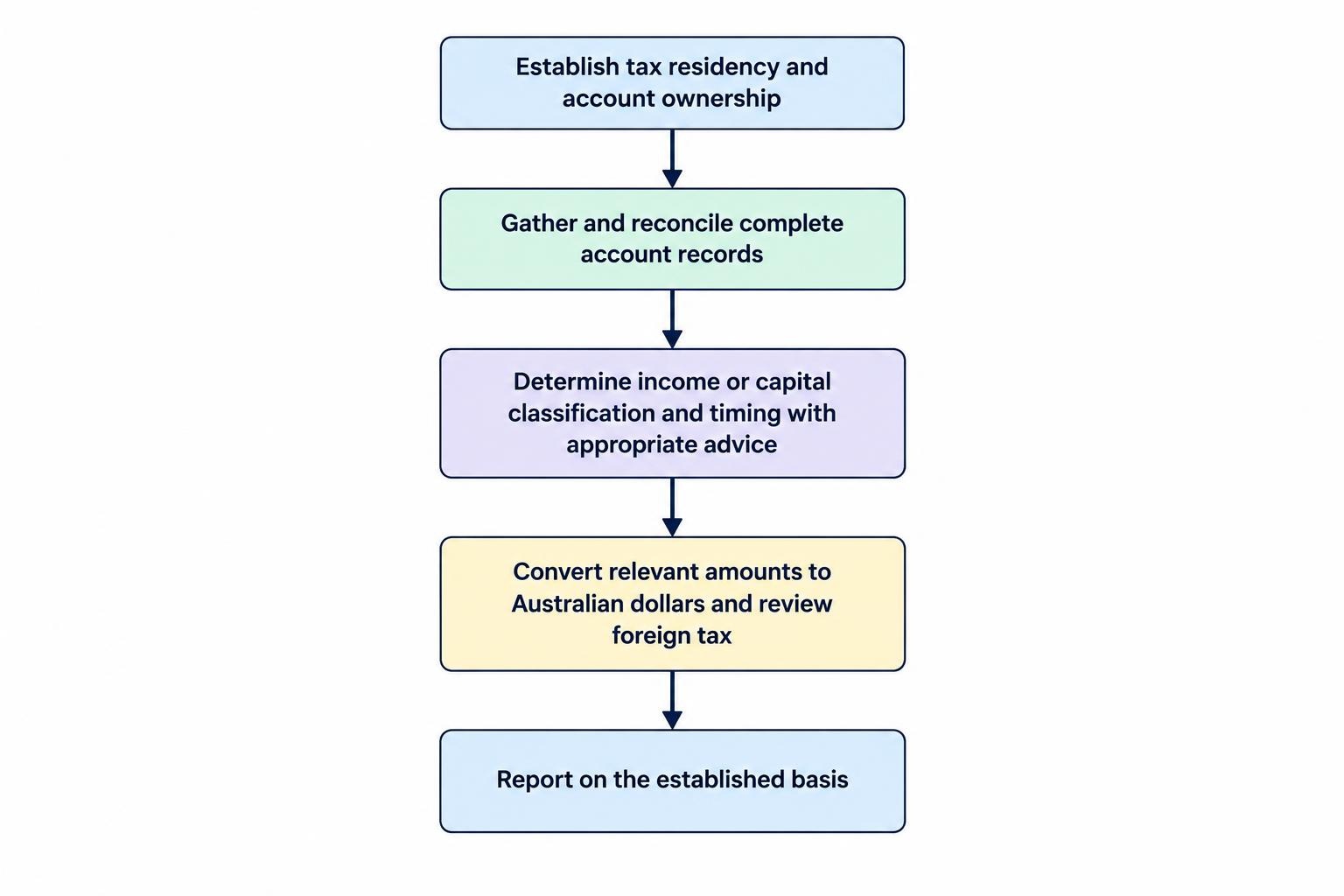
The practical approach is to reconcile first, classify next and report on that basis. A withdrawal history alone cannot do the job. This is general information, not personal tax advice; obtain advice based on your residency, contracts and complete transaction records.
This article was last updated on: October 22, 2026