A binary options broker’s advertised payout tells you what a winning contract might earn. It does not tell you which price decides the result, whether a tie counts as a loss, or what restrictions apply to withdrawing the proceeds. Those details sit in the contract terms, and they can matter more than a few extra percentage points on a promotional banner.
For Australian retail clients, the regulatory position comes first. ASIC banned the issue and distribution of binary options to retail clients from 3 May 2021 and extended the prohibition until 1 October 2031. The ASIC announcement extending the binary options ban sets out that restriction. An attractive payout does not override it.
The explanations below are for evaluating advertised offers and contract documents, not for finding a route around the ban. All monetary examples are hypothetical and use Australian dollars unless stated otherwise.
What a Broker’s Payout Percentage Actually Means
Start by separating three amounts: the stake, the profit on a winning contract, and the total amount returned. Promotional wording can blur them.
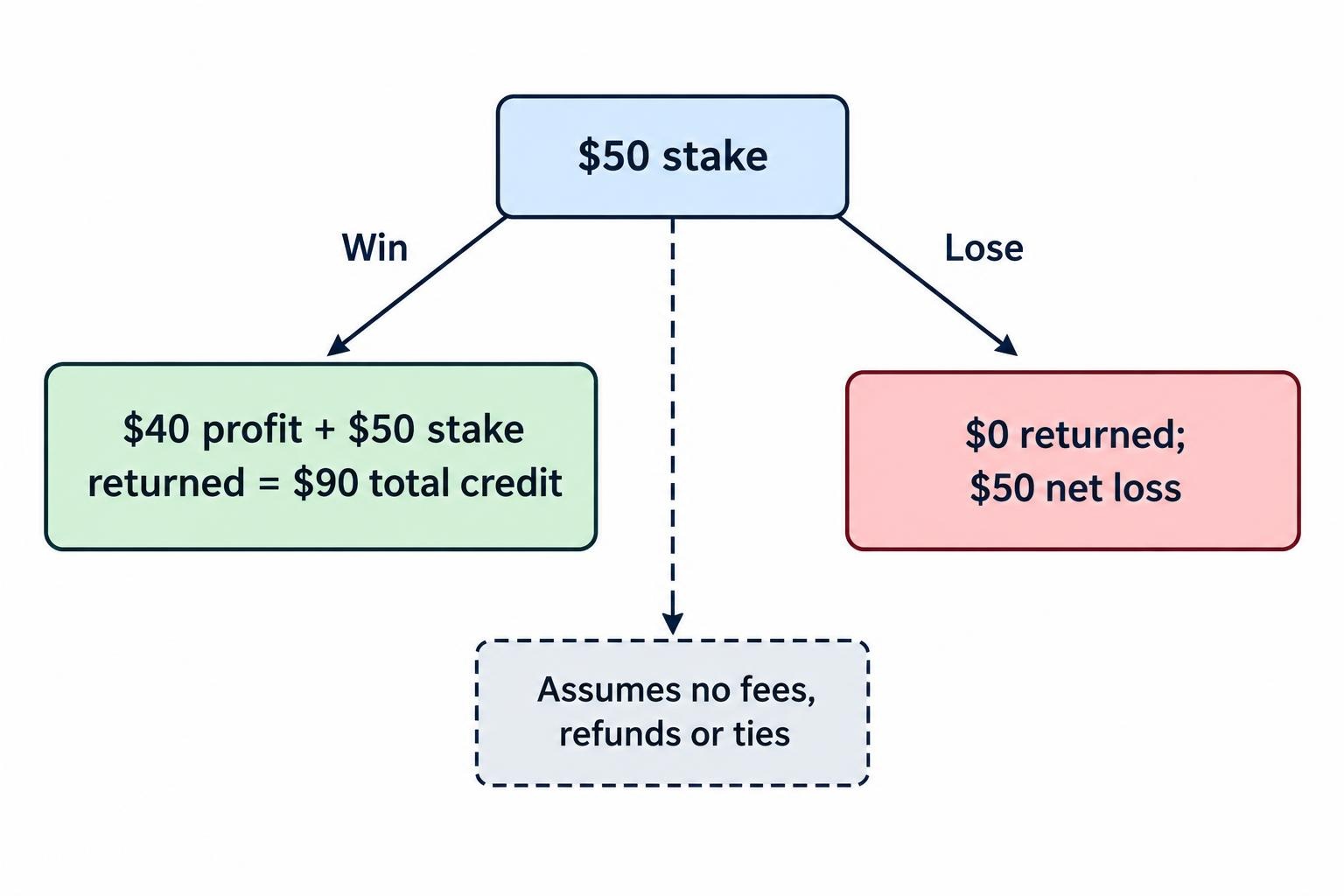
Suppose a contract costs $50 and offers an 80% profit payout. A win produces $40 profit and returns the original $50 stake, giving a total credit of $90. A loss produces no return if the contract has no loss refund. The net outcomes are therefore plus $40 or minus $50, not plus $80 or minus $50.
The following examples assume that the advertised percentage means profit on the stake, with no fees, refunds or ties:
| Advertised profit payout | Profit on a win | Total returned on a win | Net loss on a losing contract |
|---|---|---|---|
| 70% | $35 | $85 | $50 |
| 80% | $40 | $90 | $50 |
| 90% | $45 | $95 | $50 |
Do not assume every document uses “payout” to mean profit. A stated cash payout of $90 on a $50 contract could describe the total settlement amount, including the stake. Translate every quote into actual money before comparing it. The guide to binary options payout calculations covers this distinction in more detail.
Compare the Available Rate, Not the Maximum Advertised Rate
An offer of “up to 95%” gives a ceiling, not a complete contract quote. To assess it, identify the conditions attached: the asset, contract type, direction, expiry, stake and account category. If the maximum applies only to a different contract from the one being examined, it is not the relevant rate.
A comparison also needs to distinguish a promotional page from an order ticket and an accepted trade confirmation. A screenshot of a headline rate does not establish which payoff applied to an individual contract.
For a fixed payout contract, the confirmation should record the accepted stake and settlement amounts. Keep changes to quotes for new orders separate from any proposed change to an already accepted contract. If the documents allow adjustments, identify the events that trigger them and how the adjustment is calculated.
Higher advertised payouts are not automatically better offers. A contract requiring a larger price move may pay more while being harder to win. Compare like with like: the same event, strike, expiry and settlement method. Otherwise, the percentages describe different propositions.
If an improved rate requires a larger deposit or a paid account tier, include that condition in the comparison. More money committed to an account is not a free upgrade.
How Payouts Change the Break-Even Win Rate
A payout below 100% creates an imbalance between the amount earned on a win and the amount lost on a losing contract. Winning half the time does not cover that imbalance.
Where each loss costs the entire stake and there are no other charges, the calculation is:
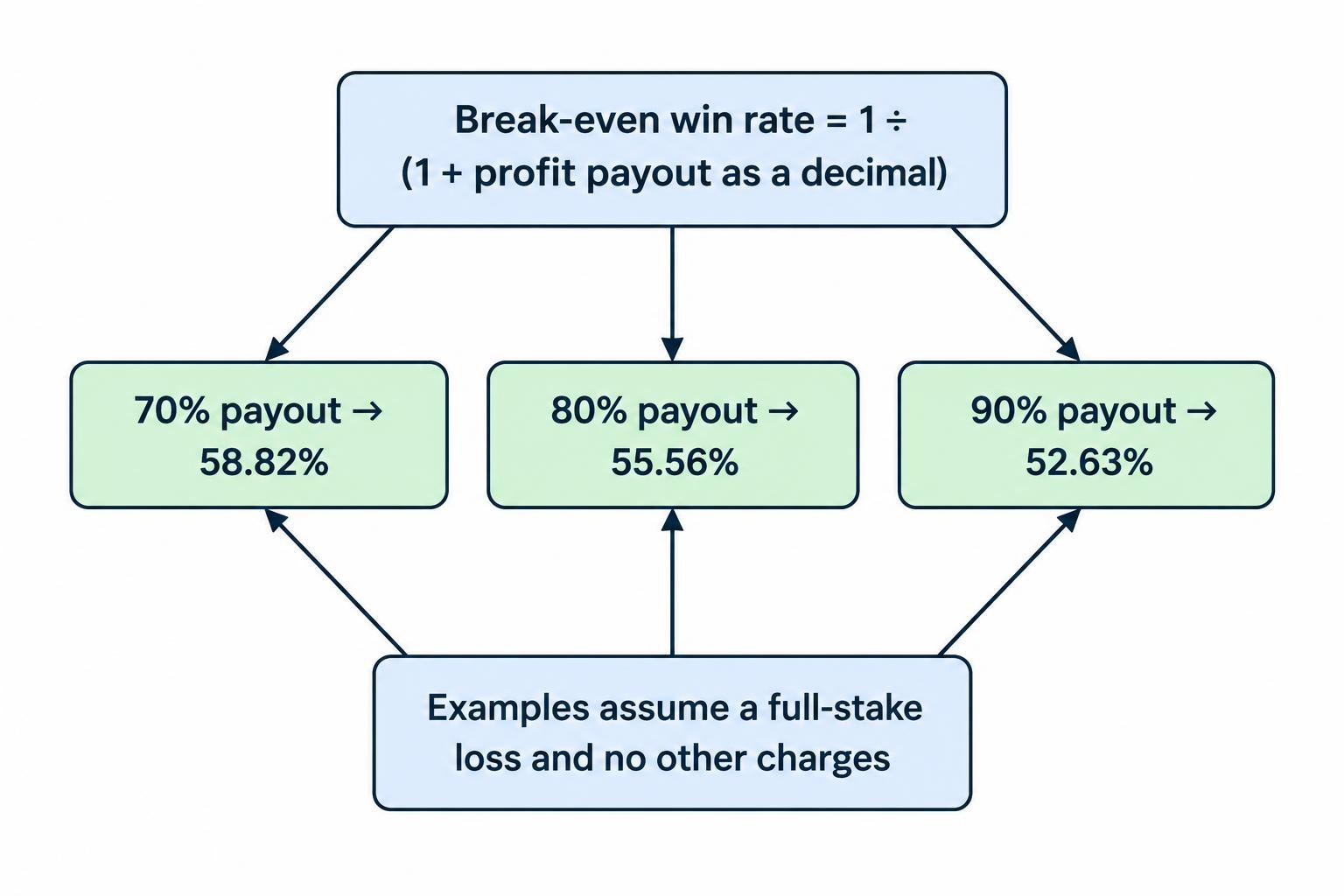
Break-even win rate = 1 ÷ (1 + profit payout expressed as a decimal).
At an 80% profit payout, that is 1 ÷ 1.80, or approximately 55.56%. At 70%, it rises to approximately 58.82%. At 90%, it falls to approximately 52.63%.
Consider 100 hypothetical contracts, each with a $50 stake, producing 55 wins and 45 losses. At an 80% payout, the wins earn $2,200 and the losses cost $2,250: a $50 net loss. At a 90% payout, the same results earn $2,475 against the same $2,250 loss: a $225 net profit.
That example isolates the effect of the payout. It does not establish that a 55% win rate is achievable or repeatable. It also assumes identical stakes, no ties, no refunds and no fees. The broader relationship between payout, win probability and expected results belongs in probability and expected value in binary options.
For contracts with changing payouts, calculate the actual monetary results rather than judging performance from the win count alone. A high percentage of wins can still conceal poor returns if those wins pay little and the losses cost the full stake.
The Contract Terms That Decide Whether You Win
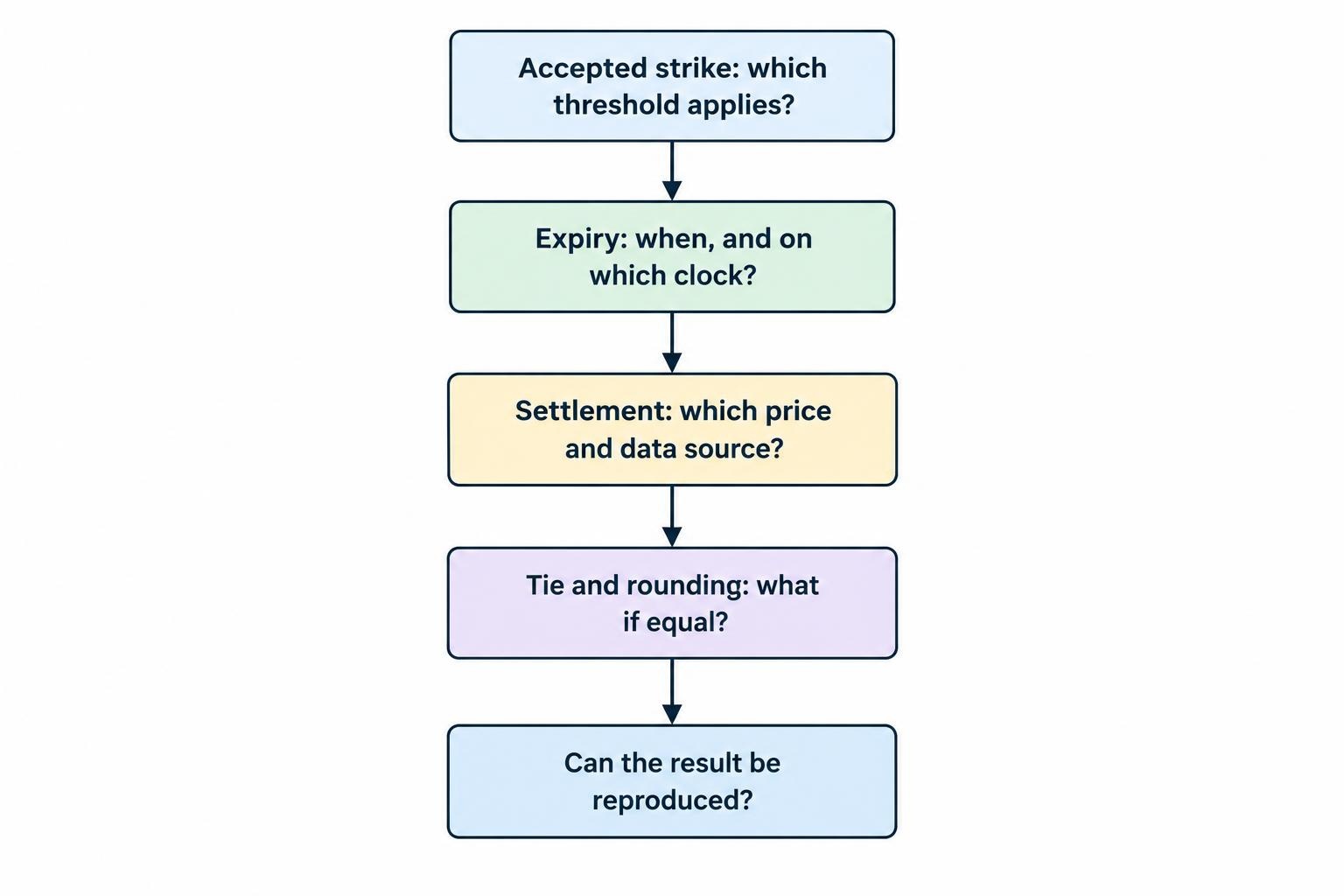
A payout rate has meaning only after the contract defines a winning outcome. Four areas deserve close attention.
The accepted strike price
The strike is the threshold against which the result is measured. Check whether it comes from the price shown when the order is submitted, the price when the order is accepted, or another stated calculation.
Suppose a screen shows AUD/USD at 0.65000 when an order is submitted, but the confirmation records a strike of 0.65003. For a contract requiring the expiry price to finish above the strike, those are different thresholds. The trade record needs to show which one applies.
Also check whether an order can be rejected or requoted. A button press, an order request and an accepted contract are separate stages; the documents should identify when the commitment begins.
The expiry time and clock
“One minute” is incomplete without a starting point. Does the period begin at submission or acceptance, or does the order enter a contract with a fixed expiry time?
The terms should identify the relevant clock and time zone. A countdown on a device should not be the only record of expiry. An absolute timestamp makes the event easier to reconstruct, especially where an order arrives close to a fixed cutoff.
The settlement price and data source
Check the reference feed, the price used and the selection method. Settlement might depend on a bid, ask, midpoint, last traded price or a calculated observation. Those are not interchangeable near a strike.
Historical ESMA guidance on speculative products and execution disclosures addressed strike and expiry price calculations, feed identification, rounding and access to historical settlement records. These remain useful document checks, rather than a statement of Australian permission to offer the product.
A chart from another provider may help investigate a discrepancy, but it does not establish the contractual settlement price on its own. First identify the benchmark that the contract actually names.
Ties, rounding and equality
“Above” and “at or above” produce different outcomes when the expiry price equals the strike. Do not assume equality means a refund.
Check whether the comparison uses the full underlying data or a rounded display value. Two prices can look identical on screen while differing at a decimal place that the interface does not display.
A complete rule should let you calculate the result when the final price equals the strike exactly. The guide to binary options settlement and tie rules covers those edge cases without treating one provider’s convention as universal.
Early Close and Loss Refunds Need Separate Calculations
An early close quote is not the same thing as the payout promised for a win at expiry. A $50 contract with a possible $90 settlement might receive an early close offer of $32. Accepting that offer would realise an $18 loss.
ESMA’s analysis of binary options product structures distinguishes the fixed contractual payoff from arrangements allowing a customer to sell the option back before expiry. The availability and price of that buyback are separate features of the offer.
Check whether early close is available throughout the contract, whether it stops before expiry and whether a quote can be rejected. Do not build a comparison around an exit feature that the documents leave entirely discretionary.
Loss refunds also change the arithmetic. If a $50 losing contract returns $5 in withdrawable cash, the net loss is $45. With an $80 profit for every $100 staked and a 10% cash loss refund, the break-even calculation becomes 90 ÷ (80 + 90), or approximately 52.94%.
That calculation does not apply if the “refund” is a restricted credit rather than cash. Check what the credit can actually be used for and whether it can be withdrawn.
A Winning Payout Is Not the Same as a Completed Withdrawal
Contract settlement and account withdrawals answer different questions. Settlement determines the trade result and account credit. Withdrawal terms determine how funds can leave the account.
Read those provisions separately. Check minimum withdrawal amounts, stated processing periods, charges, currency conversion, verification requirements and payment destination restrictions. A processing period should also say when its clock starts: when the request is submitted, when documents are accepted, or after another review.
For a hypothetical $100 withdrawal, a $5 charge reduces the amount received to $95 before any conversion cost. That does not change the contract’s quoted payout percentage, but it changes the cash result. The guide to broker deposits and withdrawals examines those account mechanics separately.
Bonus conditions require another check. Suppose an illustrative offer adds a $100 bonus to a $400 deposit and requires turnover of 30 times the combined balance. The stated turnover would be $15,000, not $3,000. Different wording produces a very different obligation.
Identify whether a turnover condition affects the bonus alone, profits attributed to it, or the entire balance. Also check what happens if the bonus is cancelled. A larger balance on screen is not necessarily unrestricted money.
Withdrawal restrictions are not just a paperwork concern. The joint SEC and CFTC alert on binary options fraud records complaints involving refused withdrawals and alleged software manipulation. A displayed profit does not prove that funds will be paid.
Cancellation and Price Error Clauses Can Change the Result
Read clauses covering erroneous prices, interrupted feeds, platform outages, cancelled trades and account termination. The practical question is what happens to an accepted contract when something goes wrong.
A clearly written provision should identify the triggering event and its consequences. Does the contract become void with the stake returned? Does settlement use a replacement feed? Is there a correction window, and what evidence supports a recalculation?
Broad wording such as “any abnormal trading” deserves closer examination if the document does not define abnormal. So does a clause that permits profit removal without identifying affected contracts or providing a calculation.
Ask whether the stated correction process addresses both favourable and unfavourable errors. A comparison is incomplete if it counts a generous winning payout but ignores broad powers to cancel that win.
Also examine how amendments take effect. Distinguish changes applying to future contracts from provisions affecting existing positions. Save the dated terms and any amendment notice; a later version may not show what the documents said when a disputed contract was accepted.
How to Compare Two Sets of Contract Terms
Reduce each offer to a short written specification. Avoid comparing a complete order quote from one provider with a marketing headline from another.
- Money: stake, net winning profit, total winning return, losing outcome and any charges.
- Event: underlying asset, contract type, direction, strike and exact winning condition.
- Timing: acceptance point, expiry timestamp, time zone and order cutoff.
- Settlement: data source, price selection, rounding, equality and error handling.
- Account restrictions: bonus obligations, withdrawal conditions and the contracting legal entity.
Use the same hypothetical stake to compare cash outcomes. Then test a win, a loss, an exact tie and a feed interruption. If the documents do not let you work through those cases, the payout percentage alone cannot support a meaningful comparison.
Include minimum and maximum stakes, aggregate exposure caps and any payout cap. If an advertised percentage stops applying above a stated stake, multiplying that percentage by a larger amount gives the wrong result.
The broker evaluation checklist provides a wider framework for recording these findings. Keep missing answers visible rather than filling them with assumptions.
Keep Records That Can Reconstruct a Disputed Payout
For an existing transaction, useful records include the contract ID, accepted stake, quoted payoff, strike, expiry timestamp, settlement value and account ledger entry. Keep the applicable terms and written correspondence alongside them.
A complaint should identify the mismatch precisely. “The chart looked higher” is less useful than stating that the confirmation required a price above a recorded strike, while the settlement record used a different timestamp or calculation.
Ask for the relevant contractual clause, the price observation used and the arithmetic behind any adjustment. Do not treat an unsupported support message as a substitute for a settlement record.
The sound comparison is not “Which banner shows the highest percentage?” It is whether the documents define the promised payment, make the result reproducible and disclose the restrictions attached to receiving the money. A higher percentage cannot compensate for an unclear contract—or make a prohibited retail offer acceptable.
This article was last updated on: October 22, 2026