Client money protection matters most when a broker stops paying. A platform balance may show what the business says it owes you, but it does not establish where the money sits, whether it is held on trust, or how much you could recover after insolvency.
Segregation can protect client funds from a broker’s ordinary business liabilities. It cannot guarantee that every dollar is present, every record is correct, or withdrawals will resume promptly. The practical questions are whose money it is, which legal entity holds it, and what happens if that entity fails.
The Australian starting point: binary options are banned for retail clients
Australia’s client money rules should not be mistaken for permission to offer retail binary options. ASIC’s prohibition on issuing and distributing binary options to retail clients took effect on 3 May 2021 and has been extended until 1 October 2031. A claim about segregated accounts does not override the ASIC binary options product intervention order.
This distinction matters when an overseas platform advertises Australian banking arrangements, an Australian office, or connections with a licensed company. Those statements do not answer the central question: which company has contracted with you, and what protections apply to that contract?
The discussion below concerns Australian client money and insolvency principles. It can help readers assess historical accounts, claims against failed firms, and statements made by offshore providers. It is not a route around the retail ban, nor a recommendation to deposit money. An existing dispute needs assessment against the actual agreement, payment records and applicable law.
What segregated client money protects
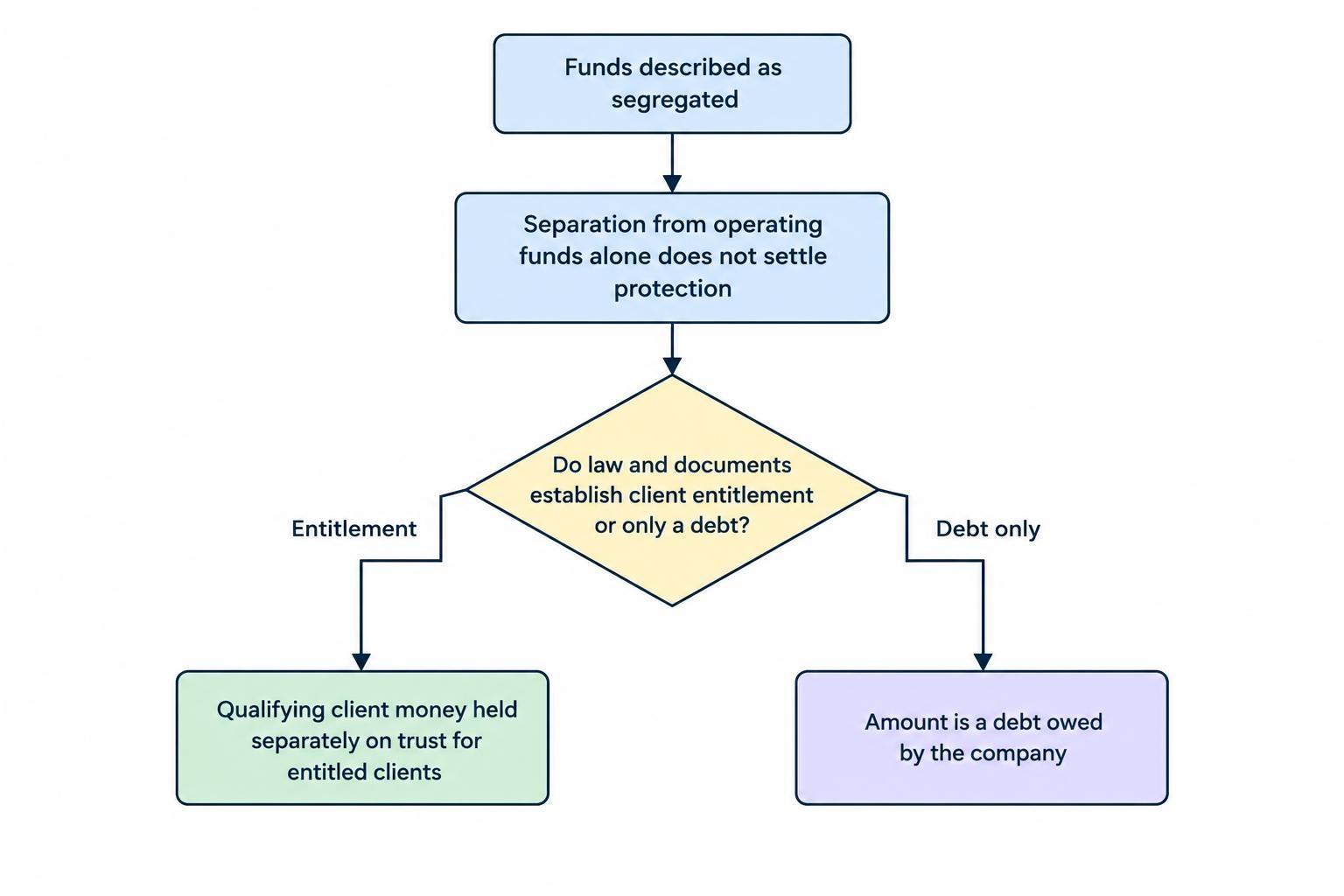
Segregation means keeping client money apart from the broker’s own operating funds. A statutory trust goes further: qualifying money is held for the people entitled to it, rather than simply becoming the broker’s money. Sections 981A–981H of the Corporations Act establish the relevant Australian client money framework, including its scope, account requirements and trust protection.
The qualification is important. Not every payment to a financial services business is statutory client money. The Act excludes certain payments, including remuneration payable to the licensee and money paid to acquire a financial product from it. A deposit, an amount committed to a contract and a debt arising from a completed contract therefore need separate examination.
A useful way to approach protection is to ask two questions. Does the law give you an entitlement to identifiable client assets? Or does the company simply owe you a debt? Those are different starting points when a business fails.
Neither question can be answered by the word “segregated” in an advertisement. Request the contractual explanation, the account arrangements and the legal basis for the claimed protection. A reassuring label is not a substitute for those documents.
Segregation does not necessarily mean an account in your name
Do not assume that each customer has an individual bank account. Ask whether funds are pooled, how the firm records each customer’s entitlement, and which accounts receive deposits. If several customers share a pool, the records connecting each customer to that pool become central to any recovery assessment.
Also distinguish a bank account from a platform wallet. A screen showing A$5,000 is evidence worth preserving, but it is not independent confirmation that A$5,000 sits in a protected bank account for you.
Separate the parts of your account balance
Before assessing recovery, break the displayed balance into its components. Do not bundle unused cash, disputed trading profits and promotional credits into one figure and assume they all receive identical treatment.
| Account component | What needs checking |
|---|---|
| Unused deposited cash | Whether it was received, where it was placed and whether it remains client money. |
| Money committed to an open contract | How the agreement treats the payment and how the contract will be valued or settled. |
| Settled trading profit | Whether the amount is accepted, funded and included in any client money entitlement. |
| Pending withdrawal | Whether funds actually left the account or the request was only recorded internally. |
| Bonus or promotional credit | Whether it creates an enforceable cash entitlement under the applicable terms. |
Consider a hypothetical account showing A$6,000: A$4,000 of unused deposits, A$1,500 of settled profit and A$500 of bonus credit. The correct claim is not established by adding those figures. Each amount needs supporting records and a legal basis.
Preserve the full statement rather than only the final balance. Transaction dates, contract identifiers and withdrawal references help explain how the number was reached. A screenshot without that history leaves more room for disagreement.
How Australian client money safeguards operate
For derivative retail client money covered by the Australian regime, a licensee cannot rely on a client’s written direction or its own contractual entitlement to use that money as working capital, meet obligations unrelated to that client, or fund transactions hedging its exposure to the client. These restrictions appear in regulation 7.8.02A on permitted uses of retail derivative client money.
The distinction between client funds and business funding is the point. Ask whether any proposed movement of money is a permitted withdrawal, a payment for a product, or a transfer into the firm’s own resources. Avoid treating broad wording such as “we may transfer funds to counterparties” as a complete explanation.
Records provide another layer of protection. A bank balance alone does not show how much belongs to each customer. The firm needs records that connect money held with the amounts it should hold.
Under the reporting rules, licensees holding reportable client money must maintain individual and aggregate records and perform daily and monthly reconciliations. Reconciliation failures and identified differences trigger reporting obligations. The scope and requirements are set out in ASIC’s client money reporting guidance.
These are controls, not guarantees. A reconciliation requirement cannot by itself replace missing money. For due diligence, ask how discrepancies are investigated and resolved, rather than accepting “regularly reconciled” as the end of the discussion.
What changes when a broker becomes insolvent?
Once a firm enters external administration, focus on the appointed practitioner’s notices rather than ordinary customer support assurances. Identify the affected legal entity, the type of appointment and the process being used to assess customer claims.
In liquidation, the liquidator collects and realises company assets, investigates its affairs and distributes available funds under the applicable priorities. An ordinary unsecured creditor receives a dividend only if funds remain after liquidation costs and higher priority claims. ASIC’s liquidation guide for creditors also explains proof of debt procedures and the need for supporting evidence.
Keep that company asset process separate from questions about client trust assets. Ask whether the practitioner recognises your claim as an entitlement to client money, an unsecured debt, or a combination. Do not assume that one classification covers the entire displayed balance.
Why available money may not be paid immediately
Even where bank funds have been located, ask what remains unresolved before distribution. Relevant questions include whether customer records agree with bank statements, whether account ownership is disputed, and whether open contracts still need valuation.
Request written information about proposed distributions, outstanding work and any costs proposed to be charged against client assets. Ask for the legal basis of those costs rather than assuming the company’s ordinary liquidation cost rules automatically answer the trust question.
A delayed payment does not, by itself, establish that the money has disappeared. Equally, confirmation that an account exists does not establish that it contains enough to meet all claims. Keep those two possibilities separate.
What happens if the client money pool is short?
A trust protects an entitlement; it does not manufacture missing cash. The distribution provisions address what happens when a licensee ceases to be licensed or enters relevant insolvency proceedings. Where the available account money cannot meet the applicable category of entitlements in full, the rules provide for proportionate payment. The distribution order and shortfall treatment are covered in ASIC Regulatory Guide 212, section F on client money distributions.
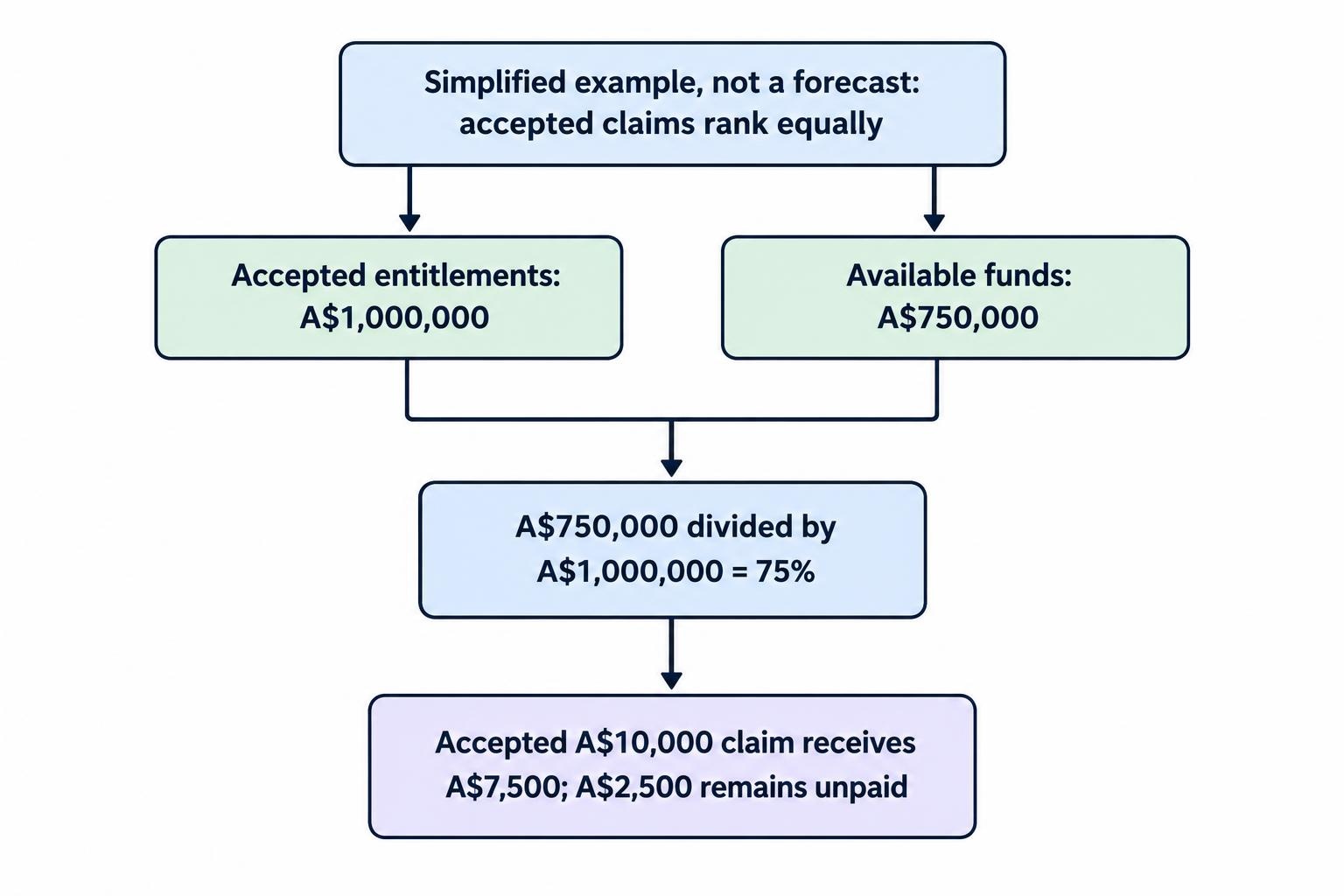
Here is a simplified illustration. Assume one client pool has A$1 million of accepted, equally ranking entitlements but only A$750,000 available for those claims. Assume there are no competing allocation questions or further deductions.
The pool can meet 75% of those entitlements. A customer with an accepted A$10,000 entitlement would receive A$7,500 from that distribution. The A$2,500 gap does not disappear because the account was described as segregated.
This is arithmetic, not a forecast for a real liquidation. Before applying a percentage to your own balance, confirm the accepted claim amount, the relevant pool and whether the proposed distribution is interim or final.
Ask separately how any unpaid amount should be claimed against the company. Do not submit the same amount twice as though each claim could produce full recovery. Explain the relationship between your client money entitlement and any remaining debt, and have the practitioner confirm how they should be recorded.
Do government guarantees or compensation schemes cover the loss?
The Financial Claims Scheme concerns eligible bank deposits
The Financial Claims Scheme is not general insurance for trading accounts. It protects eligible Australian dollar deposits at Australian incorporated authorised deposit taking institutions, up to A$250,000 per account holder per institution. The account and currency conditions matter; they are set out in APRA’s explanation of accounts covered by the Financial Claims Scheme.
Separate the failure of the bank from the failure of the broker. The existence of an eligible bank deposit does not establish that the scheme will pay a broker’s trading debts or replace money missing from its records.
For any claim that customer money is “government guaranteed”, request a written explanation identifying the account holder, the protected deposit and the event that would trigger payment. Do not accept the headline amount without the conditions.
Pooled trust accounts do not automatically give every trader A$250,000
APRA’s technical guidance treats the trustee as the account holder for a pooled trust account and applies a single A$250,000 limit to the whole pooled account. Trust accounts outside that category require assessment of their designation and ownership capacity. The distinction appears in APRA’s technical guidance on trust and pooled trust accounts.
That makes account structure a practical question, not a footnote. Ask whether the advertised protection applies to the pool or to you individually, and request the basis for the answer. Do not assume a platform’s customer ledger creates a separate bank deposit for every person listed on it.
The Compensation Scheme of Last Resort excludes derivatives trading
The Compensation Scheme of Last Resort does not provide blanket cover for failed financial firms. Its covered activities include eligible personal financial advice, retail securities dealing, credit provision and credit intermediation. Foreign exchange and derivatives trading are excluded from its stated coverage. Check the CSLR eligibility criteria and excluded products before assuming an unpaid broker claim qualifies.
A separate complaint about eligible personal financial advice needs its own assessment. Do not confuse a possible advice complaint with automatic protection for the underlying trading account. Nor should compensation be included in a recovery estimate before eligibility has been established.
Offshore accounts require a separate assessment
An Australian resident should not assume that Australian client money protections follow a deposit overseas. Start with the contracting company and ask which law governs the agreement, where proceedings would occur, and which regulator supervises that entity.
The location of a payment processor or receiving bank does not answer all those questions. Trace the chain from your payment to the company responsible for the account. Where different businesses handle payments, operate the platform and issue contracts, ask each party’s role to be documented.
The separate guide to offshore binary options brokers covers the wider jurisdiction issues. For client money purposes, concentrate on the evidence supporting the promised protection and the practical route for enforcing it.
Useful questions include whether customers have a trust entitlement, how a shortfall would be allocated, and who would administer a failed firm. If the provider cannot identify the governing rules, its reassurance is not enough for a recovery assessment.
What to check before relying on a protection claim
Identify the legal entity in the customer agreement, not just the trading brand. Compare its name and registration details with the payment instructions and regulatory records. Investigate any mismatch before treating a licence number as relevant to your account.
The guide to checking a broker’s licence covers that verification process. Keep the licence question separate from the product question: a client money arrangement does not remove Australia’s retail binary options prohibition.
Request the client money policy, account terms and withdrawal provisions in a form you can retain. Ask what happens to unused deposits, contract payments and settled profits. If the answers change between the marketing page and the agreement, seek clarification in writing.
For an existing lawful financial services relationship, retain statements independently of the platform. Keep payment confirmations and copies of the terms that applied when you opened the account. Those records make it easier to explain an entitlement later; they should not depend on continued access to the business’s login page.
What to do if your broker has already failed
Contact the appointed receiver, administrator or liquidator directly and provide evidence of your claim. An AFCA complaint does not replace participation in the insolvency process. AFCA’s factsheet on complaints against insolvent firms explains the distinction and how complaint records can support a proof of debt.
- Verify the appointment. Confirm the affected company and the practitioner’s contact details independently before sending identity documents or bank information.
- Preserve your evidence. Save agreements, statements, deposit receipts, contract history, withdrawal requests and correspondence. Record when each file was obtained.
- Ask how your entitlement is classified. Request clarification of the client money amount, any unsecured debt and any disputed balance. Use the required claim forms and retain acknowledgement of receipt.
- Track notices and deadlines. Read distribution proposals and claim decisions. Seek prompt legal advice if your entitlement is rejected or materially reduced.
Keep a simple reconciliation of your own claim: deposits, withdrawals, trading results and disputed adjustments. Explain discrepancies rather than silently changing the amount to match the latest platform screen.
If there is also a complaint about the firm’s conduct, check whether AFCA can consider it and what steps remain available. The guide to broker complaints and AFCA covers that separate process. Do not wait for a complaint outcome before responding to insolvency notices.
Be equally careful with unsolicited offers to retrieve the money. Do not pay an advance fee simply because someone knows the failed broker’s name or your account balance. Check any proposed assistance against the warning signs covered in the guide to trading fund recovery scams.
The strongest recovery assessment starts with documents: the correct company, the correct entitlement and evidence of the assets available to meet it. “Segregated funds” is a claim to examine, not a promise of repayment.
This article was last updated on: October 22, 2026