A verified binary options scam warning should lead to an identifiable regulator notice, enforcement record or court outcome. A review calling a platform a scam is not enough. Neither is a screenshot of an alleged warning with no original document behind it.
This page brings together selected official warnings and established fraud cases relevant to binary options research. It separates warnings about unauthorised firms from findings of fraud, identifies the names and domains involved, and explains how to compare those records with an offer you have received. Inclusion does not mean every entry has the same legal status.
The Australian Position Comes First
ASIC’s prohibition on issuing and distributing binary options to retail clients took effect on 3 May 2021 and has been extended until 1 October 2031. That restriction is separate from whether an individual business appears on a scam warning list. The relevant starting point is ASIC’s announcement extending the retail binary options ban.
For an Australian retail client, checking scam warnings is therefore not a route to finding an approved binary options provider. A clean search result does not override the product ban. Nor should you treat an overseas address, foreign certificate or working deposit button as evidence that an offer is permitted.
The distinction matters: a product restriction addresses what firms can offer, while a fraud finding addresses conduct established in a particular case. Neither should be confused with an ordinary trading loss.
What Does “Verified Warning” Actually Mean?
Here, verified means that the underlying official record can be checked directly. It does not turn every regulatory concern into a criminal conviction. Read the record’s wording before drawing a stronger conclusion than it supports.
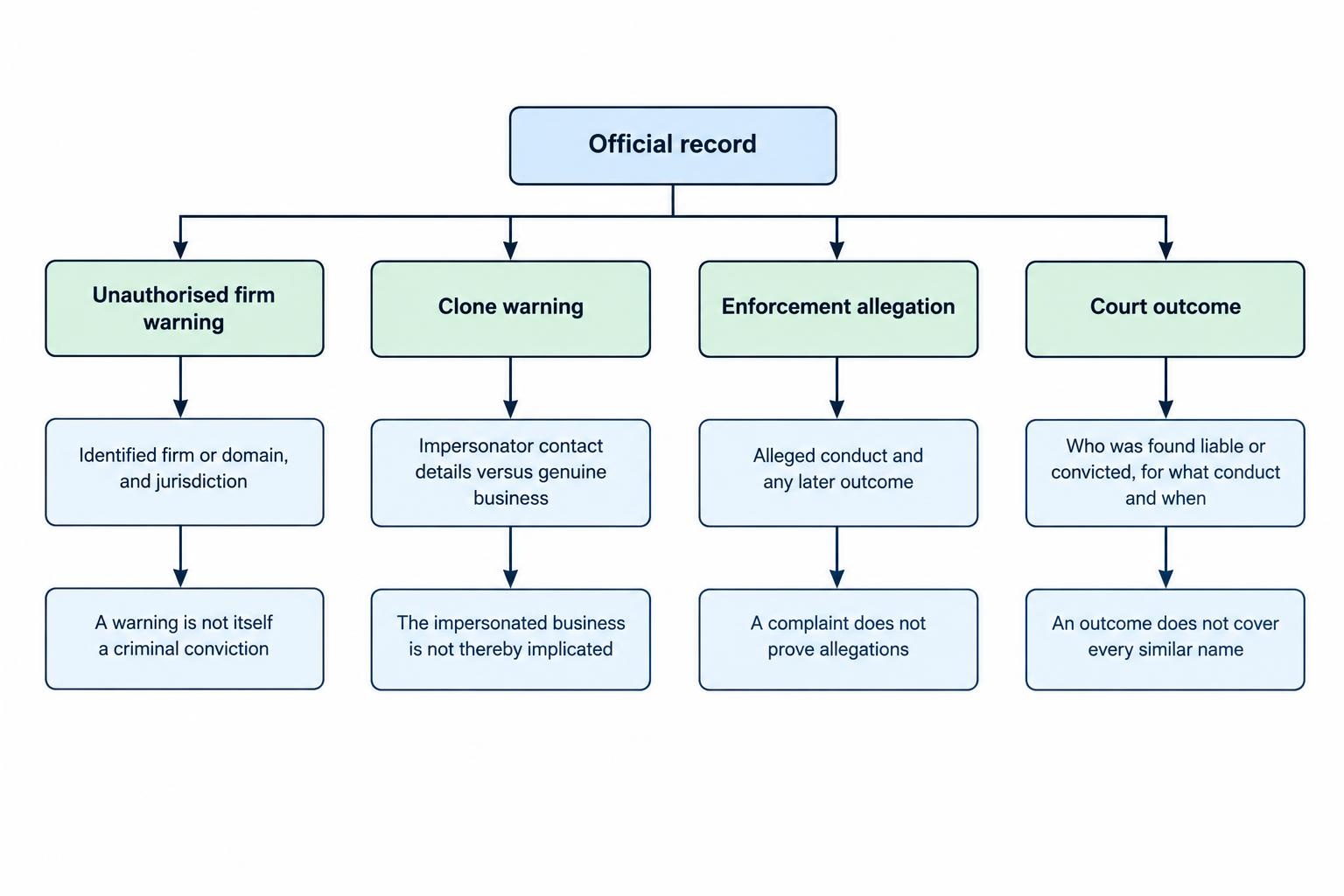
| Record type | What to establish | What not to assume |
|---|---|---|
| Unauthorised firm warning | Which firm or domain the regulator identifies, and in which jurisdiction. | That the warning itself is a criminal fraud conviction. |
| Clone warning | Which contact details belong to the impersonator rather than the genuine business. | That the genuine business being impersonated committed the scam. |
| Enforcement allegations | What conduct is alleged and whether a later outcome exists. | That filing a complaint proves every allegation. |
| Court outcome | Who was convicted or found liable, for what conduct, and when. | That the outcome covers every similarly named business. |
Keep these categories intact when saving or sharing a warning. “Not authorised by this regulator” and “convicted of fraud” are different statements, even when both are good reasons to stop and investigate.
Selected Official Binary Options Warnings and Cases
The records below are selected examples, not a complete blacklist or a ranking. The UK warnings concern UK authorisation; the US cases establish conduct and outcomes in those proceedings. Their territorial scope should not be rewritten as an Australian regulatory decision.
PocketOption: FCA Unauthorised Firm Warning
The UK Financial Conduct Authority first published its PocketOption warning on 29 September 2021 and updated it on 10 February 2026. The notice identifies pocketoption.com, potrade.com, trader-pockethub.com and a mobile address under pocketoption.com. It states that the firm is not FCA authorised and may be targeting people in the UK. These details appear in the FCA’s PocketOption warning.
This is an authorisation warning, not a criminal conviction. Its practical value is that it provides identifiers you can compare with the platform, advertisement or message in front of you.
Do not stop at the brand name. Check whether the address you were sent matches one in the notice, and save the exact spelling. A matching name is useful evidence; a matching domain makes the comparison much clearer.
IQCent: Check the Domain in the Notice
The FCA published its IQCent warning on 26 June 2025 and updated it on 27 June 2025. The entry names IQCent and identifies iqcent.digital as its website. It states that the firm is not FCA authorised and may be targeting UK consumers. The precise record is the FCA warning identifying IQCent and iqcent.digital.
The domain detail deserves attention. This notice should not be silently rewritten as a finding about every address containing “IQCent”. Equally, a different address is not evidence of safety.
If your contact uses another domain, treat the identity question as unresolved. Compare the claimed legal entity, contact details and account documents before asserting that two operations are the same. A shared logo alone does not settle that question.
BinaryBook and BigOption: Established Criminal Fraud
BinaryBook and BigOption provide a different category of evidence. On 7 August 2019, a US jury convicted Lee Elbaz, former chief executive of Yukom Communications, of conspiracy to commit wire fraud and three counts of wire fraud. The case concerned fraudulent binary options marketing through those two brands. The US Department of Justice’s Elbaz case announcement records the conviction and describes the evidence.
The established conduct included misleading investors about expected returns, representatives’ identities and locations, and access to withdrawals. Supposed benefits such as bonuses and risk free trades were also used deceptively.
This is more than an unresolved customer complaint. It is a historical criminal outcome involving identified people and operations. It should still be described within that scope, rather than used to accuse an unrelated business with a similar name.
BinaryOnline and Related Entities: Civil Fraud Findings
On 29 January 2025, the US Commodity Futures Trading Commission announced a default judgment against five offshore entities and three individuals connected with operations using the BigOption, BinaryBook and BinaryOnline names. The court found fraud and other violations, ordering US$112.9 million in restitution and a US$338.7 million civil monetary penalty, payable jointly and severally. The findings are set out in the CFTC’s announcement of the binary options fraud judgment.
The findings included misappropriating customer funds, obstructing withdrawals through misleading statements, and manipulating platform risk settings to restrict winning trades.
Keep the figures in perspective. Restitution and civil penalties are different obligations. A judgment ordering payment is not evidence that every victim has received money, and it does not authenticate an unsolicited refund offer.
Recovery Impersonators Targeting Binary Options Victims
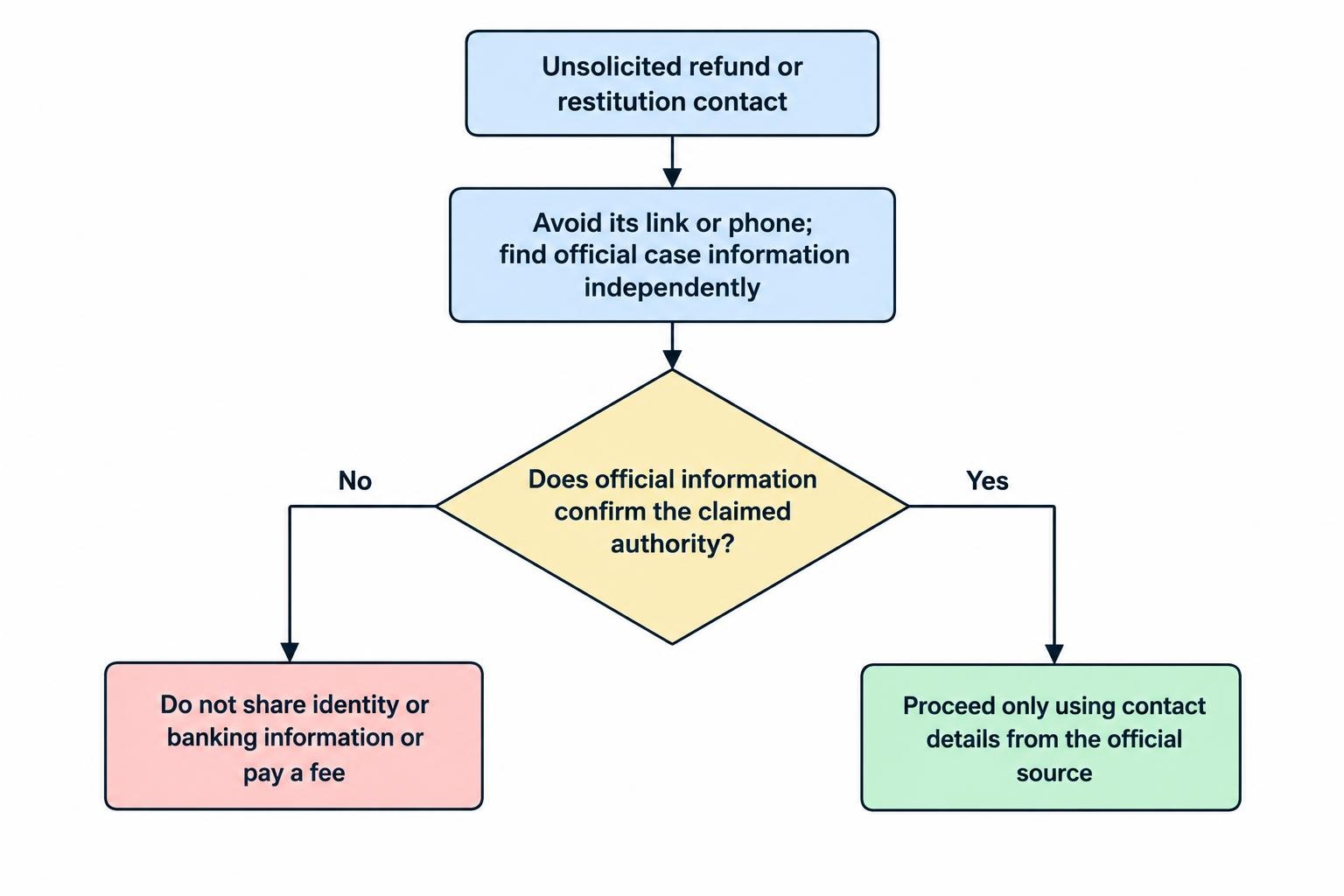
The DOJ and FBI have also issued a warning aimed particularly at people who sent money to BinaryBook, BigOption or other binary options operations. Callers falsely claimed to represent the agencies or accounting firms hired by law enforcement, offering refunds while requesting identity and banking information. The DOJ’s warning about fraudulent binary options refund contacts states that it did not authorise those businesses’ employees or affiliates to contact investors on its behalf.
This warning concerns the recovery approach, not a newly verified trading platform. It shows why a caller knowing your previous broker’s name does not establish authority.
If someone contacts you about restitution, find the official case information independently. Do not use the caller’s link or telephone number to verify the caller. That is verification going round in a circle.
How to Match a Warning to Your Offer
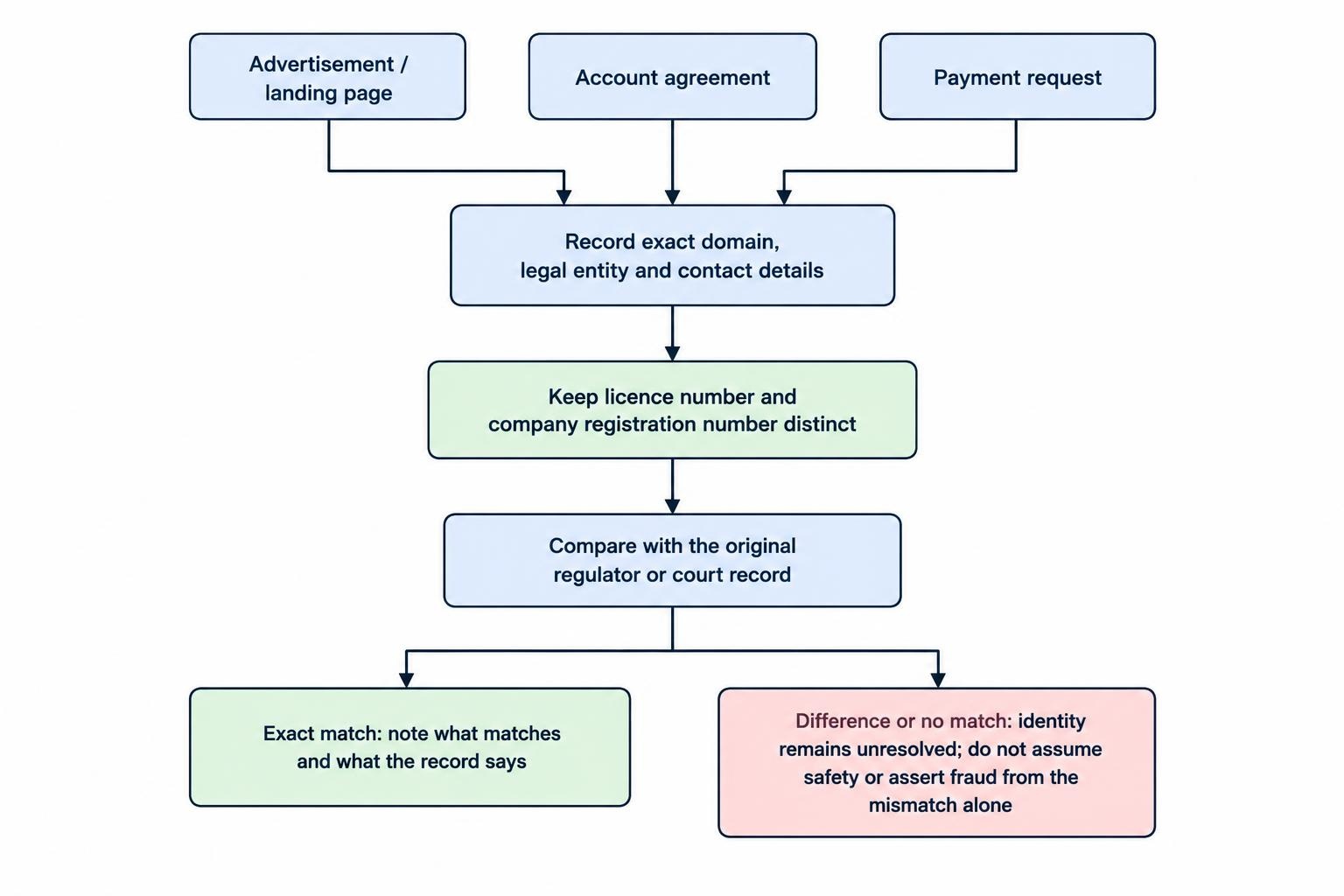
A useful check compares identities, not appearances. Start with the material you actually received: the advertisement, landing page, account agreement, payment request and messages. Do not rely only on the name displayed above a trading chart.
- Record the complete address. Save the website address, including its subdomain, and note any address changes between the advertisement, registration page and payment screen.
- Identify the claimed operator. Copy the legal entity name from the agreement or footer. Record any licence number separately from a company registration number.
- Compare the warning’s identifiers. Check domains, email addresses, telephone numbers and named entities. Note exact matches and unresolved differences rather than assuming a connection.
- Check the original record’s status. Read its publication date, updates and any linked outcome. An old allegation should not be presented as the final position if a later decision exists.
Where an offer claims an Australian financial services licence, use the process in how to check a broker’s licence. The task is to connect the business contacting you with the relevant official record, not simply find a licence number somewhere on a page.
For example, suppose an advertisement displays one company name, the agreement names another, and the deposit request names a third. That does not, by itself, prove fraud. It does leave questions unanswered. Do not let a salesperson replace documentary checks with “that’s just how our payments work”.
A Familiar Name Does Not Prove a Familiar Operator
Treat branding and identity as separate questions. If a website claims to represent an established business, compare the contact details independently rather than assuming that matching colours, logos or registration details establish the connection.
This distinction is especially useful when reading a clone warning. Record both identities clearly: the legitimate organisation being impersonated and the suspicious contact or domain. Our guide to clone broker scams covers that comparison without treating the impersonated business as the offender.
Use the same discipline when reporting your own experience. “This address claimed to represent Company A” is more precise than “Company A contacted me” if you have not established who controlled the address. Precision helps preserve the evidence and avoids pointing the complaint at the wrong party.
What if the Name Is Not on a Warning List?
ASIC’s investor alert list is not exhaustive. Its entries reflect information available at publication, and names or contact details may change. Absence from the list does not establish that an operation can be trusted. Those qualifications appear on ASIC’s investor alert list on Moneysmart.
Search the trading name, claimed legal entity and exact domain separately. If you find no match, record the result accurately: no matching warning found in the records checked. Do not upgrade that to “verified legitimate”.
You also do not need to wait for a warning before declining an offer. Unanswered identity questions are enough reason to stop. For Australian retail clients, the binary options prohibition remains the starting point regardless of the search result.
Save Evidence That Someone Else Can Check
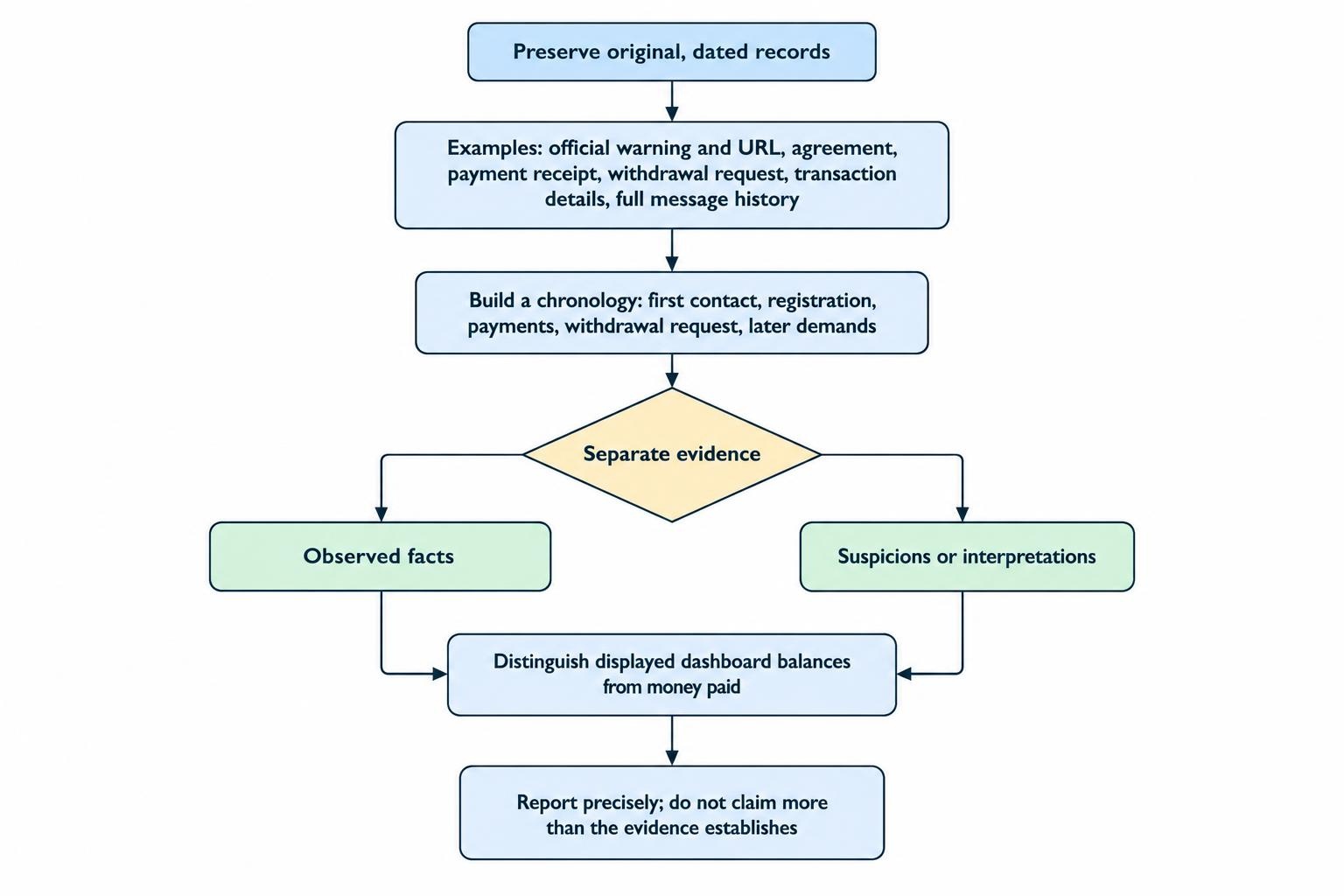
Keep a dated copy of the official warning and its address, alongside the material connecting it to your experience. Useful records include account agreements, payment receipts, withdrawal requests, transaction identifiers and complete message histories.
Separate money paid from amounts displayed on a dashboard. If you deposited A$2,000 and the account later showed A$9,000, record both figures and explain what each represents. Do not present the displayed balance as independently established cash held for you.
A short chronology also helps: first contact, registration, each payment, withdrawal request and subsequent demands. Preserve original files where possible. Avoid editing screenshots in ways that remove dates, addresses or surrounding context.
When describing the issue, distinguish what you observed from what you suspect. A rejected withdrawal is an observable event; deliberate price manipulation requires different evidence. You can report concerns without claiming to have proved every part of the operation.
If You Have Already Sent Money
Stop sending money and contact the bank, card provider or payment service used. Explain that you suspect a scam, ask whether transactions can be stopped, and ask what other action is available. If you paid with cryptocurrency, contact the exchange or service used to send it. These steps are covered in Moneysmart’s guidance for people who have been scammed.
Report the matter to Scamwatch. If you shared identity documents or account credentials, tell your financial institutions and secure affected accounts. These actions address immediate exposure; none should be treated as a promise of reimbursement.
Keep your response proportionate to the evidence, but do not keep paying while trying to resolve the uncertainty. A further deposit is not a verification method. Preserve any demand for a release payment or refund processing charge without paying it to “test” whether the withdrawal will arrive.
For the wider response process, use what to do after a binary options scam. The immediate aim is to prevent further loss, protect your information and give your payment provider a clear account of what happened. You do not need to finish your investigation before asking for help.
This article was last updated on: October 22, 2026