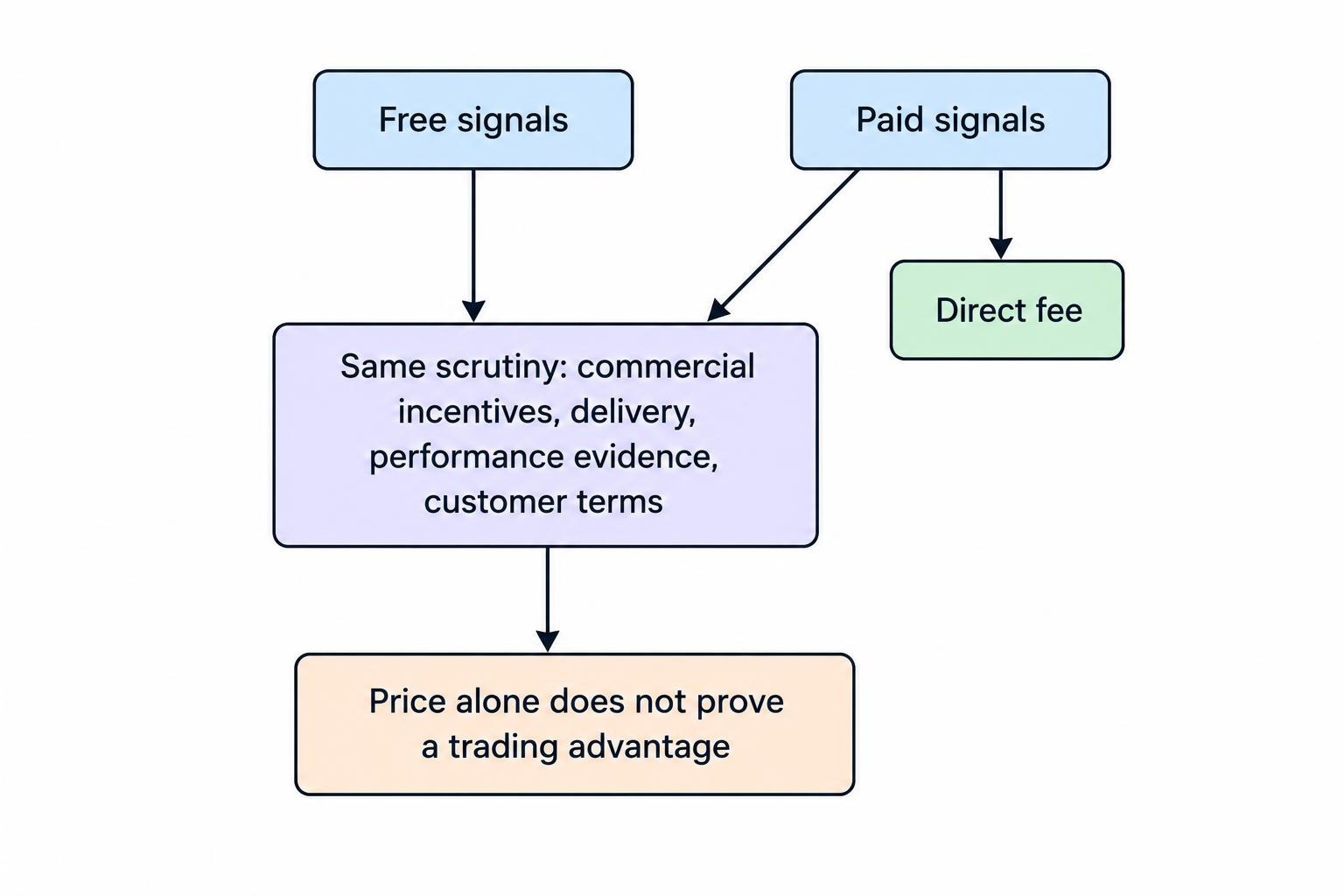
Free trading signals avoid a subscription bill. Paid signals add one. Neither pricing model tells you whether the recommendations are accurate, whether the published results are complete, or whether a subscriber could reproduce them. The useful comparison is between evidence, delivery, commercial incentives and results after costs.
For Australian readers, there is a prior restriction: ASIC’s ban on issuing and distributing binary options to retail clients took effect on 3 May 2021 and extends until 1 October 2031. Buying signals does not create an exception. This article examines signal services and their claims, not ways to access prohibited retail products.
Free vs Paid Trading Signals: What Actually Changes?
A trading signal proposes an action under stated conditions. For a binary option, that might include the asset, direction, entry time, expiry and minimum acceptable payout. Without those details, a prediction such as “EUR/USD will rise” is not a complete, testable instruction.
The broader guide to binary options signals covers how these recommendations work. Here, the question is whether paying changes what a subscriber receives enough to justify the extra cost.
| Comparison | Free signals | Paid signals |
|---|---|---|
| Direct charge | No subscription, though access conditions may apply | Subscription, access fee or another stated charge |
| Commercial incentives | Check advertising, referrals and paid upgrades | Check subscriptions, referrals and further upgrades |
| Delivery | Check timing, completeness and availability | Check whether promised delivery benefits are measurable |
| Performance evidence | Require a complete, checkable record | Require the same record, with fees deducted |
| Customer terms | Check data collection and access requirements | Also check renewal, cancellation and refund terms |
Price can establish what the service costs. It cannot establish a trading advantage. Apply the same evidence standard to both columns.
Free Signals Can Still Carry Commercial Costs
Start with a plain question: who pays the provider? A free educational channel needs no trading profits to justify its existence. A commercial channel, however, deserves a closer look at its funding and what it asks followers to do next.
Check whether access requires a referral link, a new account, a deposit or purchase of another product. A channel can charge nothing for messages while earning money from the actions those messages encourage. Moneysmart’s finfluencer checklist recommends checking whether a promoter receives commission or another benefit when followers sign up.
A disclosed referral arrangement does not, by itself, prove that recommendations are poor. It does create a separate question about incentives. Would the provider recommend the same platform without payment? Can subscribers examine results without opening an account? Does access depend on continued deposits or activity?
Do not treat a compulsory deposit as the price of obtaining evidence. If the provider refuses to share a sample record until money changes hands elsewhere, the service has not passed a basic transparency check.
What Could a Paid Service Justify Charging For?
A paid service could offer useful research, clear explanations, searchable records, dependable delivery or responsive support. Assess each feature separately. Paying for organised educational material is a different purchase from paying for a claimed ability to predict profitable trades.
If the sales page promises earlier alerts, ask how much earlier and how delivery is measured. If it promises detailed analysis, inspect a representative sample rather than a polished promotional post. If support is included, check its hours and scope. Technical assistance is not the same as individual financial advice.
Read the payment terms before considering the advertised performance. Establish the billing currency, renewal interval, cancellation deadline and whether the quoted price includes applicable charges. The guide to trading signals and software costs covers these expenses separately.
Prefer a clearly defined service over an open ended promise of “VIP access”. A VIP badge is not an audit. Nor does a money back promise replace a readable refund policy.
How Subscription Fees Change the Break-Even Point
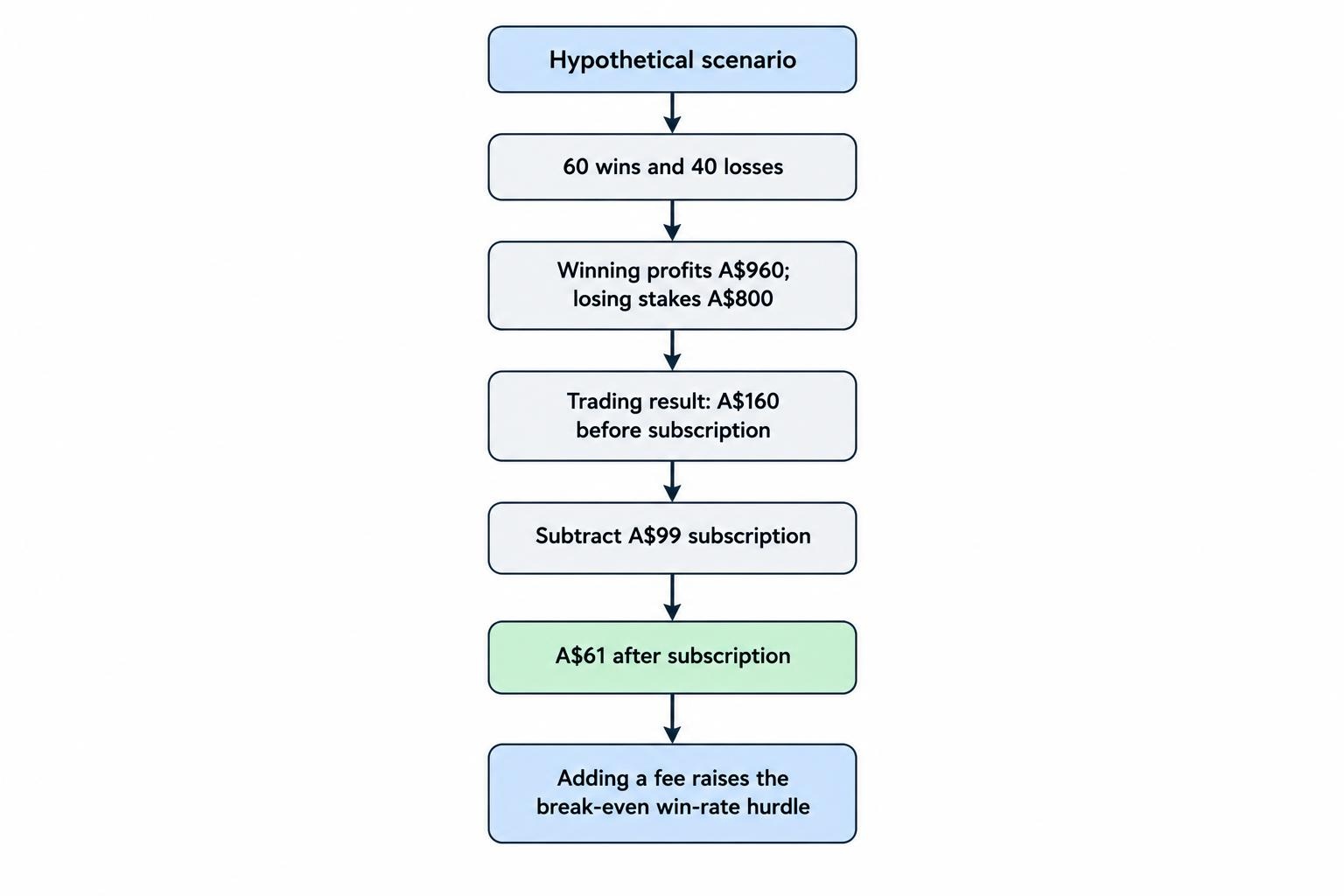
Consider a constructed example, not a provider’s results or a forecast. Assume 100 binary option trades, each with an A$20 stake. A winning trade returns the stake plus A$16 profit, an 80% profit payout. A losing trade loses A$20. There are no ties, refunds, other charges or stake increases.
At 60 wins and 40 losses, the arithmetic is:
- Winning profits: 60 × A$16 = A$960.
- Losing stakes: 40 × A$20 = A$800.
- Trading result before a subscription: A$160 profit.
- Result after an A$99 subscription: A$61 profit.
A service charging A$199 would turn that same trading result into a net loss of A$39. Nothing about the recommendations changed; only the bill did.
Before subscription costs, the break-even win rate in this example is approximately 55.56%. Including an A$99 fee across 100 trades raises it to approximately 58.31%. In a batch of exactly 100 trades, at least 59 wins would be needed to cover that fee under the stated assumptions.
The calculation is: break-even win rate = [1 + subscription fee ÷ (number of trades × stake)] ÷ (1 + profit payout rate). Use 0.80 for an 80% profit payout. The underlying payout relationship is covered in probability and expected value in binary options.
Trade frequency also changes the burden. Across just 25 trades, 15 wins and 10 losses produce A$40 before fees under the same assumptions. Subtracting A$99 leaves a loss of A$59. That is not a reason to trade more or raise stakes to recover a subscription. It is a reason to question whether the purchase makes economic sense.
Demand the Same Evidence From Both Services
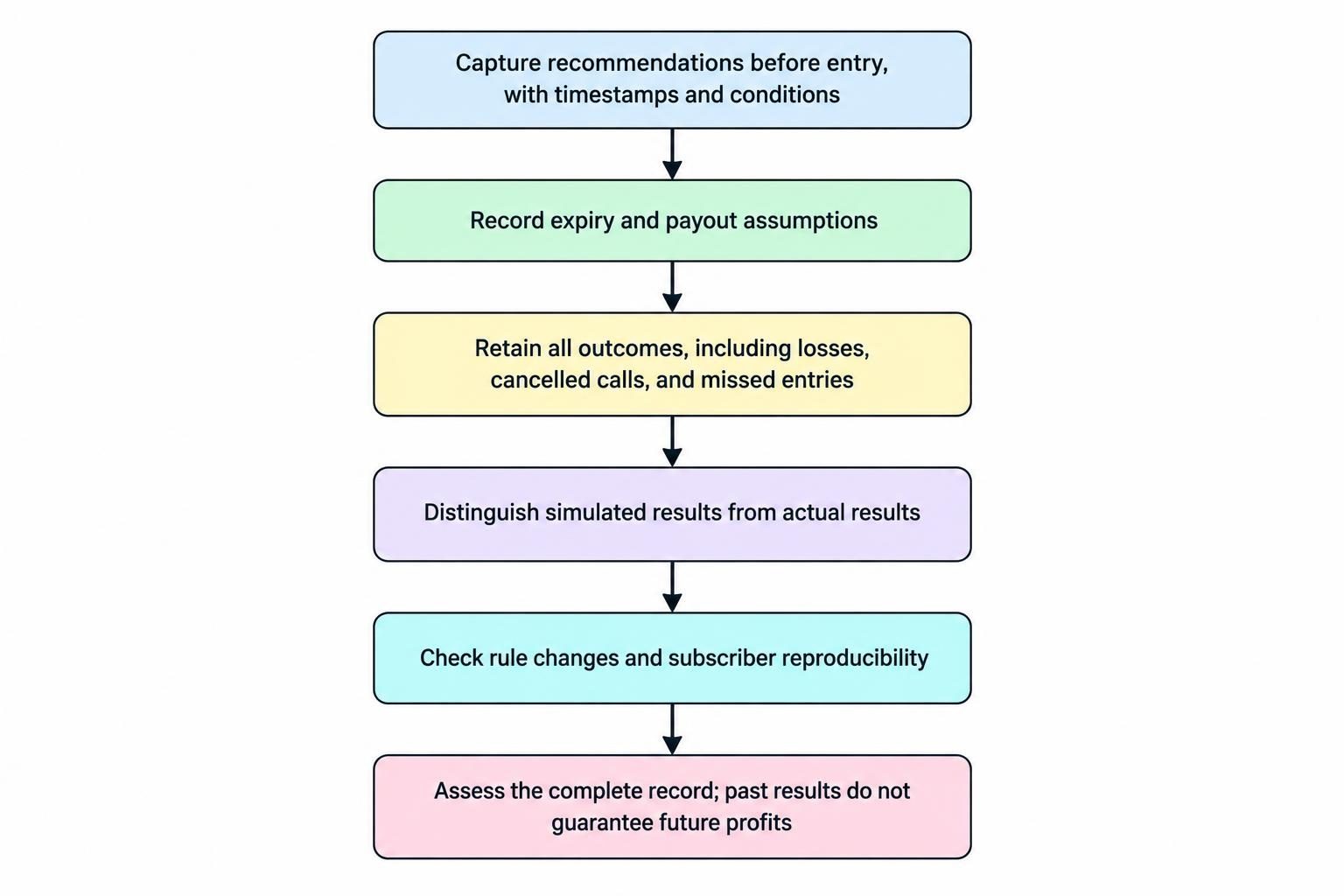
A claimed win rate needs a complete record behind it. Ask for recommendations published before the proposed entry, with timestamps, entry conditions, expiry, payout assumptions and every outcome. The record should distinguish simulated results from actual transactions and identify any changes to the rules.
Keep the signal provider and the trading platform separate in your assessment. A claimed forecasting record does not establish that a platform will settle trades fairly or return funds. The SEC and CFTC alert on binary options fraud documents complaints involving withdrawal refusals, identity theft and alleged software manipulation.
For the signals themselves, examine losing periods as closely as winning ones. Check whether deleted messages, cancelled calls and missed entries remain visible. Ask whether the advertised record uses the same service, publication timing and rules that subscribers receive.
Pay particular attention to “recovery” sequences. Suppose a provider issues three losing recommendations followed by one winner, then records the sequence as one success. That presentation does not tell you the money lost or the stakes required along the way. Results need accounting in currency, not celebratory ticks.
The separate guide to evaluating trading signal track records covers the audit process in more detail. For this comparison, the principle is straightforward: a paid service should not receive a softer examination because it charges for access.
Delivery Quality Matters More Than Message Volume
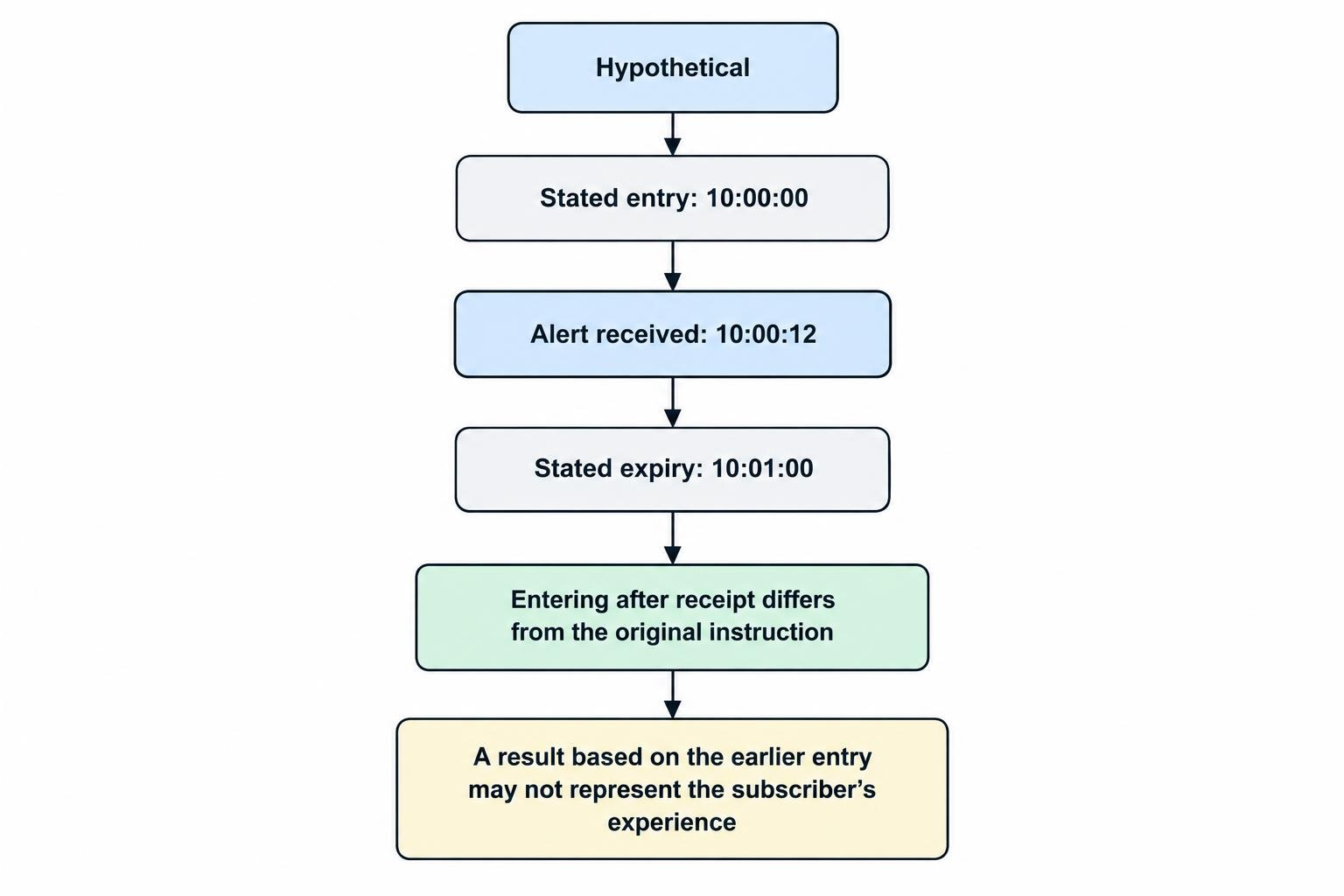
Compare recommendations as a subscriber would receive them, not as they appear in a later results summary. A complete alert should leave no ambiguity about its intended entry and expiry. It should also state when the opportunity is no longer valid.
Consider a hypothetical alert that specifies entry at 10:00:00 and expiry at 10:01:00, but reaches the reader at 10:00:12. Entering then would not reproduce the original instruction. If the provider’s reported result uses the earlier entry, it is not a fair measure of that subscriber’s experience.
A paid channel claiming a delivery advantage should supply evidence of that advantage. Compare publication timestamps with receipt times during observation. Do not assume that a private group, a dedicated app or an automated notification guarantees timely receipt.
Historical charts also need care: check whether an indicator displayed the recommendation at the time, or changed it afterwards. The guide to signal repainting and latency addresses these issues. More alerts are not automatically more useful; reject volume as a substitute for clear, reproducible instructions.
Free Advice Is Not Automatically Outside Licensing Rules
In Australia, the relevant question is what the provider does, not simply whether access is free. Recommendations intended to influence decisions about financial products can constitute financial product advice. Carrying on a financial services business requires an AFS licence, appropriate authorisation or an applicable exemption. These distinctions appear in ASIC’s guidance on discussing financial products online.
Do not accept “educational purposes only” as proof that a service falls outside those rules. Examine the actual messages and conduct. A general explanation of a product differs from repeated instructions telling followers what transaction to make and when.
Request the provider’s legal identity and any claimed licensing or representative details. Match those details independently rather than relying on a logo or screenshot. Keep this check separate from performance: authorisation and profitable forecasting are different questions, and neither overrides the Australian retail binary options ban.
Compare Claims Without Funding a Trading Account
For educational assessment, observation is more useful than a rushed purchase. Ask for a representative archive or a genuinely accessible sample. Do not open or fund a trading account just to obtain the material needed to judge the sales pitch.
Set comparison rules before reviewing outcomes. Use the same observation period, hypothetical stake and payout assumptions for both services. Record every qualifying recommendation, including ambiguous or late alerts. Keep those categories visible rather than deleting inconvenient entries or automatically labelling them wins or losses.
For each service, calculate a result before its fee and another after its fee. Also record how much time the assessment requires. A service that needs constant attention should not be evaluated as though it were a passive information subscription.
A trading journal can keep the comparison consistent without placing trades. Record what was received at the time, not what a provider later says was sent. Even a favourable observation period cannot establish that future recommendations will remain profitable or be executable on the same terms.
When to Stop Evaluating a Signal Service
Guaranteed profits, pressure to act immediately and promises of high returns with little risk are reasons to stop, not reasons to upgrade. These are among the warning signs in Moneysmart’s investment scam guidance. A polished channel or positive reviews should not overrule them.
Walk away if the provider refuses to identify its operator, hides losing recommendations, changes the scoring rules after results arrive, or demands a deposit before showing evidence. Do not grant remote access, disclose account passwords or share security codes to “activate” signals.
If you have already subscribed, preserve the sales claims, payment terms and correspondence. Follow the stated cancellation process and check that renewal has stopped. Do not buy a more expensive tier merely because the first tier failed to meet its promises.
Is Paying for Trading Signals Worth It?
Only a clearly defined benefit can justify a fee. Better organised research or useful educational explanations may have value as information. A claimed trading advantage needs a much higher standard: complete records, realistic delivery assumptions, transparent incentives and results that remain favourable after all charges.
Free signals avoid a subscription expense but still require scrutiny. Paid signals add a measurable hurdle without providing automatic assurance of quality. If two services offer equivalent evidence and delivery, the cheaper service has the cost advantage. If neither supplies adequate evidence, neither deserves your money.
For Australian retail readers, the binary options restriction comes before that comparison. No free channel, premium membership or impressive results page changes it.
This article was last updated on: October 22, 2026