EUR/USD binary options link a fixed outcome to the euro’s exchange rate against the US dollar. In a standard high/low contract, the question is whether the settlement price will finish above or below a stated strike at expiry. Getting the broad direction right is not enough: the price must satisfy the contract’s condition at the required moment.
For Australian readers, the regulatory position comes first. ASIC’s order banning the issue and distribution of binary options to retail clients took effect on 3 May 2021 and has been extended until 1 October 2031. The ASIC announcement extending the binary options ban sets out the restriction. The examples below explain the product and support paper research; they are not a recommendation to open a trading account.
Reading the EUR/USD quote
EUR/USD expresses how many US dollars buy one euro. At an illustrative rate of 1.0800, €1 equals US$1.08. A rise to 1.0850 means the euro has strengthened against the dollar. A fall to 1.0750 means it has weakened.
A conventional pip in EUR/USD is 0.0001. Moving from 1.0800 to 1.0805 is a five pip increase. A fifth decimal place represents a fraction of a pip, which can matter when a binary contract settles close to its strike.
The pair’s name describes the underlying exchange rate, not the account currency or payout method. A hypothetical account denominated in Australian dollars could still reference EUR/USD. The broader guide to forex markets for binary options covers how currency pairs differ from other underlying markets.
A worked EUR/USD binary options example
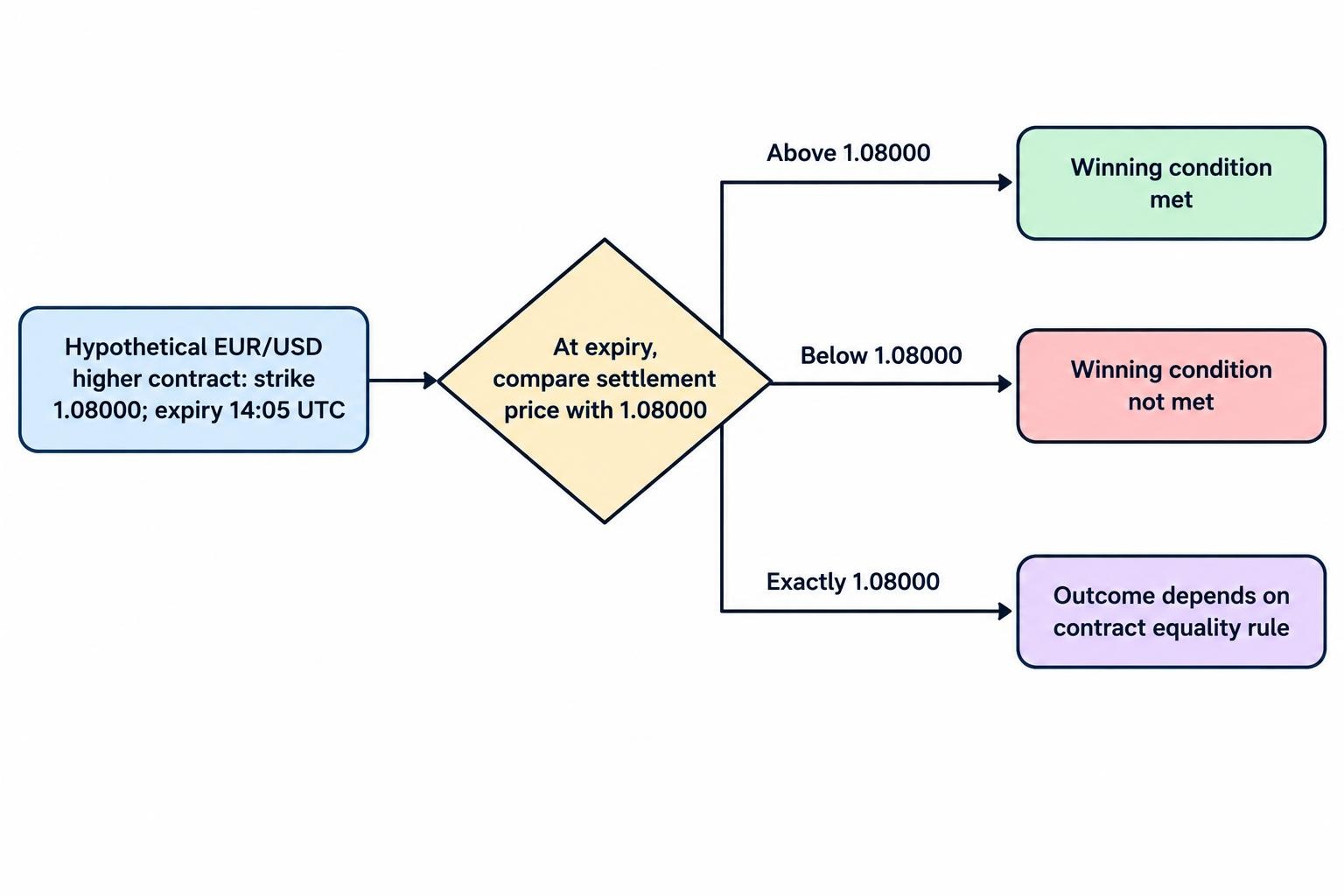
Suppose a hypothetical high/low contract has a strike of 1.08000, an expiry of 14:05 UTC and a stake of A$50. It offers an 80% net profit on a winning “higher” prediction, with the stake returned separately. These figures are illustrative, not a current quote or an available offer.
| Settlement price | Result | Net account change |
|---|---|---|
| 1.08010 | Above the strike: winning condition met | +A$40 |
| 1.07990 | Below the strike: winning condition not met | −A$50 |
| 1.08000 | Exactly equal to the strike | Depends on the contract’s equality rule |
The winning outcome returns A$90 in total: the original A$50 plus A$40 profit. A one pip winning move earns the same fixed profit as a much larger winning move under these terms. Unlike a position whose profit grows with the distance travelled, this contract pays for satisfying a condition.
Equality needs its own rule. A contract might require the price to be strictly above the strike, or provide another treatment for an exact match. “Higher” on a button is not a complete settlement policy.
Why expiry matters more than a directional forecast
A view that the euro will strengthen over the next week says little about where EUR/USD will stand five minutes from now. Even a correct longer term forecast can contain several short moves in the opposite direction.
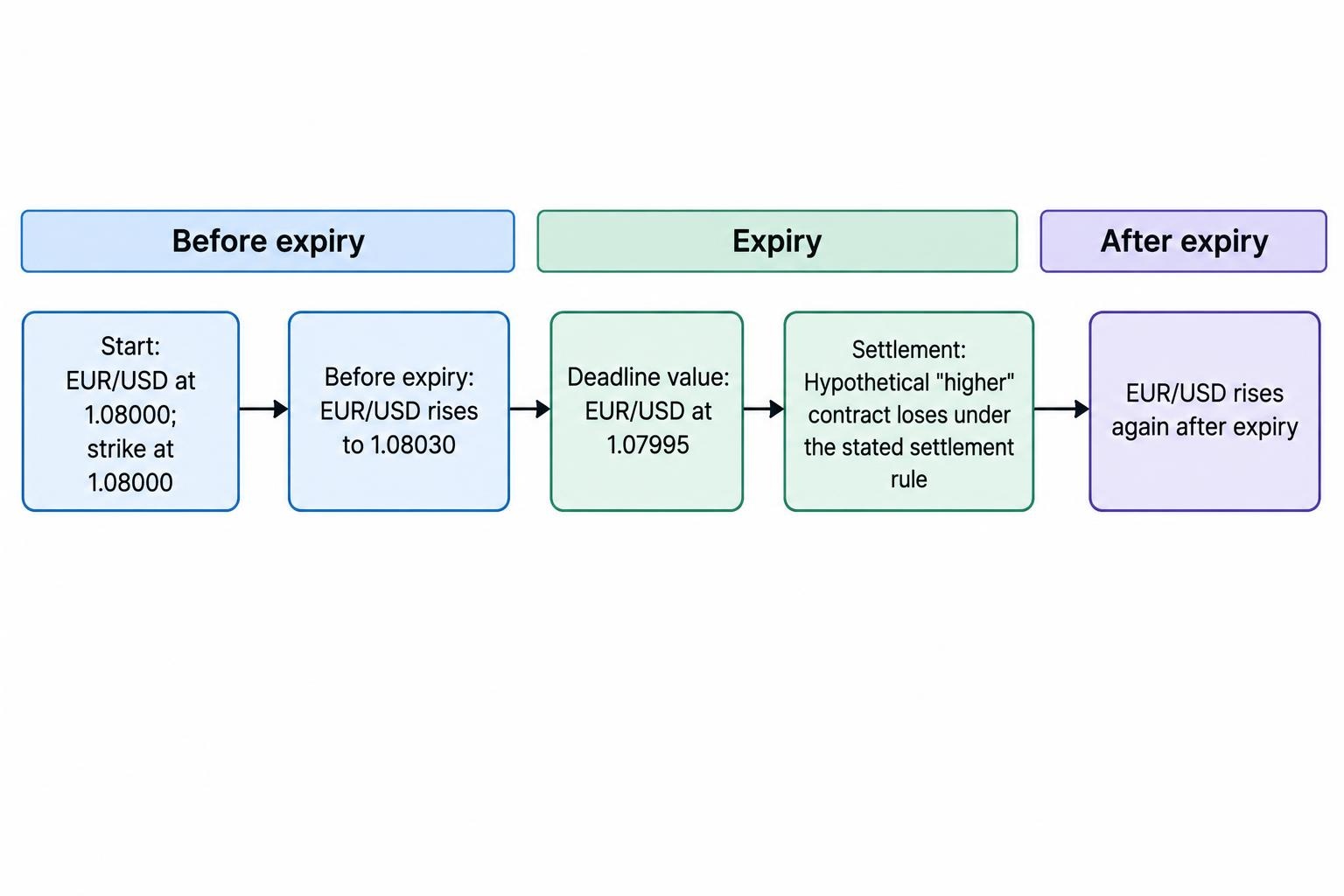
Consider a paper example where EUR/USD rises from 1.08000 to 1.08030, retreats to 1.07995 at expiry, then resumes its rise. A “higher” contract struck at 1.08000 loses under the stated settlement rule. The earlier rise does not rescue it, and the later recovery arrives after the deadline.
That distinction also separates standard high/low contracts from touch contracts. Reaching a level during the observation period and finishing above a level at expiry are different events. Results from one contract type should not be used to validate the other.
Choose the observation horizon before examining results. Otherwise, it is easy to find a winning deadline after seeing the chart. The guide to binary options expiry times covers the difference between a fixed clock deadline and a duration measured from entry.
What moves EUR/USD?
Interest rate expectations
EUR/USD analysis involves both the euro area and the United States. Changes in expected monetary policy can alter interest rates, financing conditions and exchange rates through the ECB’s monetary policy transmission channels. Studying the euro alone leaves half the comparison missing.
A useful research question is what changed relative to expectations. A rate announcement that matches expectations may carry less new information than an unexpected change in guidance. Even then, there is no dependable rule that a particular announcement must produce a particular five minute result.
For a binary contract, separate the economic argument from the timing argument. A reason for the euro to strengthen does not establish that it will be above a chosen strike at a chosen second.
Inflation and employment releases
US consumer price and employment reports belong on a EUR/USD research calendar. The Bureau of Labor Statistics release schedule lists CPI and Employment Situation publication times in US Eastern Time, commonly at 8:30 a.m. Check the date and time directly rather than relying on an old calendar screenshot.
In a paper study, record whether each observation crosses a scheduled release. Combining ordinary periods with announcement periods can disguise how differently a rule behaves around news.
A headline is also not a finished trading rule. Define whether the study uses the first price response, waits for a completed candle, or excludes the release altogether. “React quickly” is an instruction to hurry, not a testable method.
EUR/USD market hours for Australian readers
EUR/USD has shown higher average volatility during the London–New York overlap, with spikes around US data releases and the London fix, documented in the RBA study of intraday currency volatility. That historical pattern supports studying different sessions separately. It does not establish a profitable entry signal.
More movement is not automatically better for a high/low prediction. A sharp move can cross the strike in either direction, and an active period can contain abrupt reversals. A quieter period presents another problem: a small movement near the deadline can still decide the entire result.
For Australian research, store timestamps in UTC and display local time separately. Check the applicable time zone and daylight saving setting for each date. A calendar labelled “Eastern Time” also needs a country attached; US Eastern Time is not Australian Eastern Time.
Use consistent session labels when comparing results. The forex trading sessions guide provides the wider timing framework. There is no reason to assume that a rule tested during European activity will behave the same way during an Australian morning.
The price feed can decide the result
“EUR/USD price” is not a complete settlement specification. Identify the reference provider, whether the contract uses bid, ask or midpoint, the timestamp applied, the decimal precision and any rounding rule. Also check what happens if the required quote is missing.
A daily reference rate is not a substitute for an intraday settlement feed. The ECB’s euro foreign exchange reference rates are published for information purposes, usually updated around 16:00 CET on working days. The ECB strongly discourages their use for transaction purposes.
Suppose an analysis chart displays a midpoint of 1.08001 while a hypothetical contract uses a bid of 1.07999. Against a strike of 1.08000, those values sit on opposite sides. This example shows why matching the instrument name is not enough to match the outcome.
A candle screenshot may also omit the exact quote used at expiry. Its closing value is useful only if its timing and price basis match the contract’s rules. The chart does not get the deciding vote.
Keep the settlement method attached to every research result. The guide to price feeds and benchmarks covers the distinction between a chart used for analysis and a price used to determine payment.
Payouts set the required accuracy
Recognising EUR/USD patterns is only part of the arithmetic. In the earlier example, a win earns A$40 while a loss costs A$50. Winning half the observations would therefore lose money before any other costs.
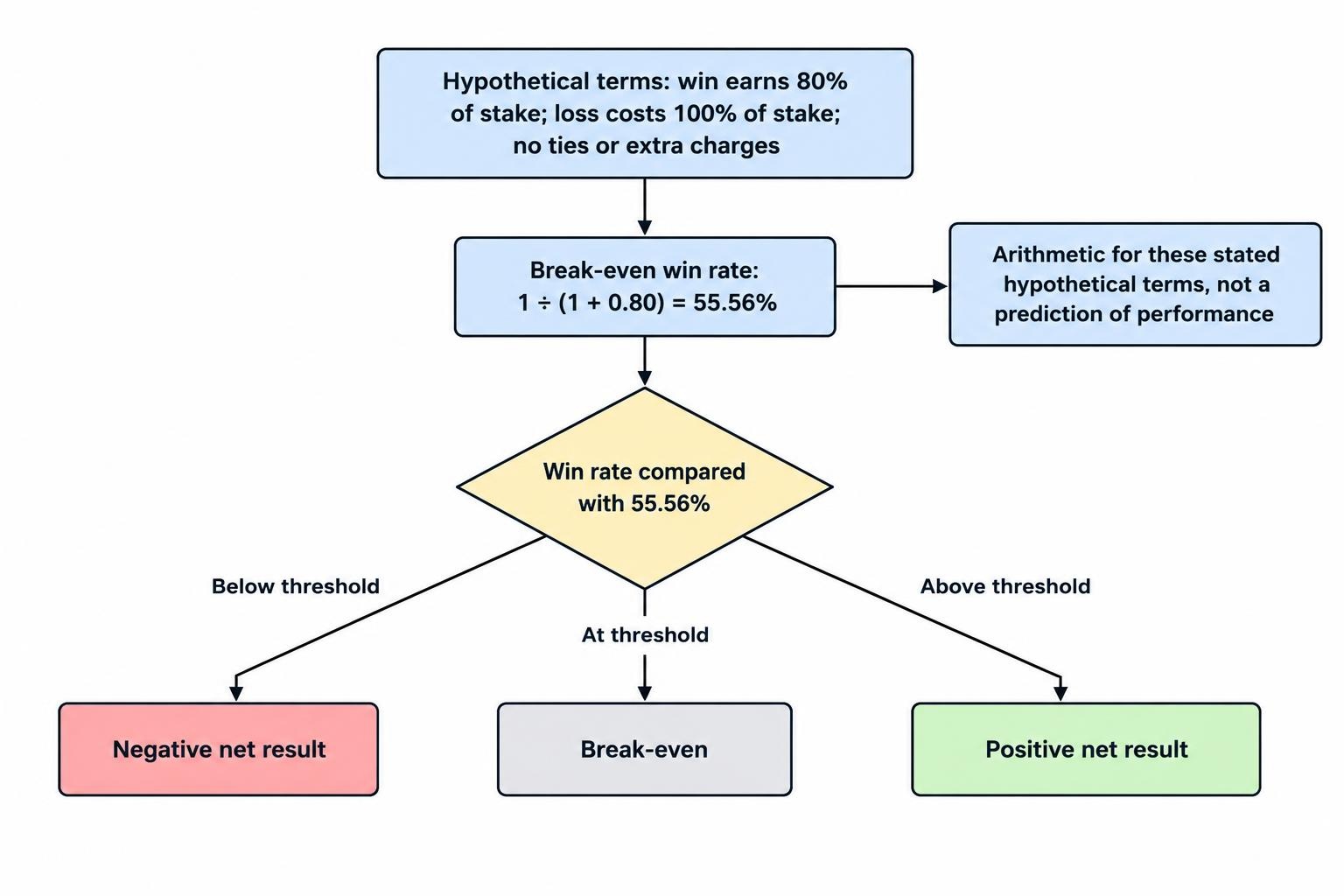
With an 80% net winning payout, a full stake loss on unsuccessful outcomes and no ties or additional charges, the break even win rate is:
1 ÷ (1 + 0.80) = 55.56%
Across 100 hypothetical A$50 observations, 55 wins earn A$2,200 while 45 losses cost A$2,250. The net result is a A$50 loss. At 56 wins and 44 losses, the net result becomes a A$40 profit under the same assumptions.
The threshold changes with the payout. A lower payout demands higher accuracy if the losing outcome still costs the full stake. A method that clears one threshold may fail another, so a historical win rate without its payout assumptions is incomplete.
The guide to probability and expected value develops this calculation. Clearing the mathematical threshold in a small paper sample is not proof of a repeatable advantage; it is a result that still needs testing.
How to build a useful EUR/USD paper study
Start with one question rather than a collection of indicators. An example might be: after EUR/USD closes above a previously defined range during the London session, how often is it above that closing price five minutes later? This is a research question, not a claim that the pattern works.
Set the range definition, candle interval, observation window and news exclusions before collecting results. Record every qualifying observation, including awkward ones. Removing losses because the chart “looked messy” after the event makes the result unreliable.
A compact record should contain:
- The timestamp, time zone and EUR/USD data provider.
- The rule that generated the observation and the assumed entry price.
- The expiry, settlement value and treatment of equal prices.
- The assumed payout and net hypothetical result.
- The session and proximity to scheduled news.
Keep a later period untouched while developing the rule, then assess it without changing the conditions. Report both the win rate and the net result under the payout assumptions. Separate results by session and news status where the sample permits it.
For very short observations, ask whether the data can support the claimed result. A one minute candle does not reveal every quote inside that minute. If both sides of the strike appear within its range, the exact outcome may remain unresolved without more detailed data.
The paper trading guide provides a broader recording method. Paper research can test the logic of a rule, but it cannot demonstrate how an actual provider would accept, price or settle a contract.
Is EUR/USD an easier binary options market?
EUR/USD offers a clear two currency comparison, but a familiar currency pair does not make a binary contract forgiving. The deadline, settlement feed and payout can matter as much as the market forecast.
The useful question is not whether EUR/USD looks readable on a chart. It is whether a precisely defined rule produces repeatable results at a stated horizon, using appropriate prices and realistic payout assumptions. If those details are missing, a confident prediction is still just a prediction.
This article was last updated on: October 22, 2026