Currency conversion costs can reduce the money credited to a binary options account and the Australian dollars received when funds return. The charge may appear as a separate fee, sit inside the exchange rate, or involve both. A trading balance expressed in US dollars does not tell you what the same money is worth after conversion back to AUD.
For Australian readers, the legal position comes first: ASIC’s binary options product intervention order bans the issue and distribution of binary options to retail clients until 1 October 2031. The examples below explain cost calculations and account reconciliation, not a route around that restriction.
Where Currency Conversion Happens
Start by separating three currencies: the currency leaving your bank, the currency held in the trading account, and the currency received when money returns. If all three are AUD, there may be no currency exchange. If an AUD bank payment funds a USD account, at least one conversion is required somewhere in the payment chain.
The organisation performing that conversion matters. It could be the card issuer, a payment service, a digital wallet or the account provider. Do not assume the company displaying the deposit screen also sets the exchange rate.
A possible route is AUD bank balance to USD account balance, followed later by USD account balance back to AUD. Another route might pass through an intermediary currency. When reviewing an existing payment, write down each currency change rather than treating the transfer as one event.
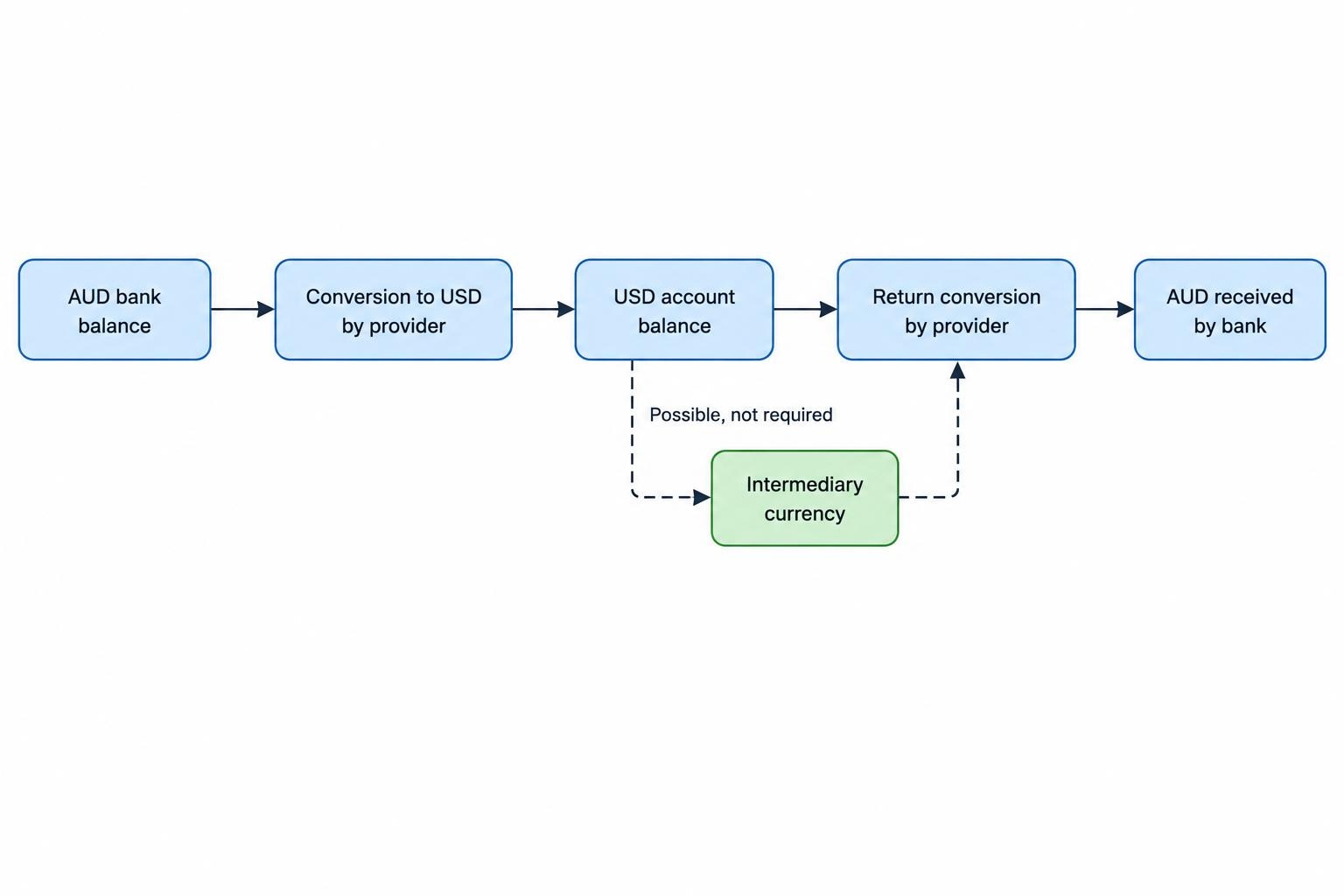
The underlying market is a separate issue. A contract referencing a US share or EUR/USD does not, by itself, mean the customer exchanges money into that asset’s currency. Check the currency in which the stake is debited and the contract settles.
Conversion is only one part of binary options trading costs. Keep it separate from contract losses, account charges and payment fees so the same deduction does not enter your calculations twice.
Exchange Rate Markups Versus Visible Fees
A conversion provider can charge through an exchange rate margin, an explicit fee, or a combination. “No conversion fee” is not the same as receiving an exchange rate without a markup. Compare the total amount paid with the amount delivered, not just the fee label. The ACCC’s foreign currency guidance identifies both retail exchange rates and fees as parts of the price.
The Exchange Rate Margin
The margin is the difference between a chosen reference rate and the customer’s rate. It reduces the currency received without necessarily producing a separate statement entry.
All exchange rates and charges in the examples below are hypothetical. Suppose the reference rate is AUD 1 = USD 0.6500, but a conversion delivers USD 0.6370 per AUD. An AUD 1,000 payment then produces USD 637 rather than USD 650. The missing USD 13 represents 2% of the reference value.
Percentage and Fixed Fees
A percentage fee changes with the transfer amount. A fixed fee takes a larger proportion from smaller payments: an AUD 5 charge is 5% of AUD 100, but 0.5% of AUD 1,000.
Also check whether a fee is deducted from the amount being converted or charged on top. A payment described as “AUD 1,000 plus AUD 5” has a total cash cost of AUD 1,005. A payment described as “AUD 1,000 including AUD 5” leaves only AUD 995 available before conversion.
Separate these deductions from deposit and withdrawal fees. A withdrawal processing charge is not automatically a currency conversion charge, even if both reduce the same payment.
How to Calculate the Effective Conversion Cost
For an AUD payment converted into USD, calculate the effective rate using the full cash outlay:
Effective USD per AUD = USD credited ÷ total AUD debited.
If AUD 1,005 leaves the bank and USD 637 reaches the account, the effective rate is approximately USD 0.63383 per AUD. This includes the effect of both the customer exchange rate and the additional AUD 5 charge.
To estimate the total shortfall against a reference rate:
Conversion shortfall (%) = [1 − USD credited ÷ (total AUD debited × reference USD per AUD)] × 100.
Using the hypothetical reference rate of 0.6500, the shortfall is approximately 2.49%. That is an estimated cost against the selected benchmark, not necessarily a fee that appears on a statement.
Match the reference currency pair, direction and timing as closely as possible. The Reserve Bank of Australia’s exchange rate table expresses rates as foreign currency units per Australian dollar and states that its data should not be relied on for regulatory or commercial purposes. A published reference is not an executable customer quote.
Keep the units visible. At AUD 1 = USD 0.65, converting AUD to USD means multiplying by 0.65. Converting USD back to AUD means dividing by 0.65. Reversing that operation can make a poor rate look excellent. The arithmetic has no sympathy.
Worked Example: Conversion in Both Directions
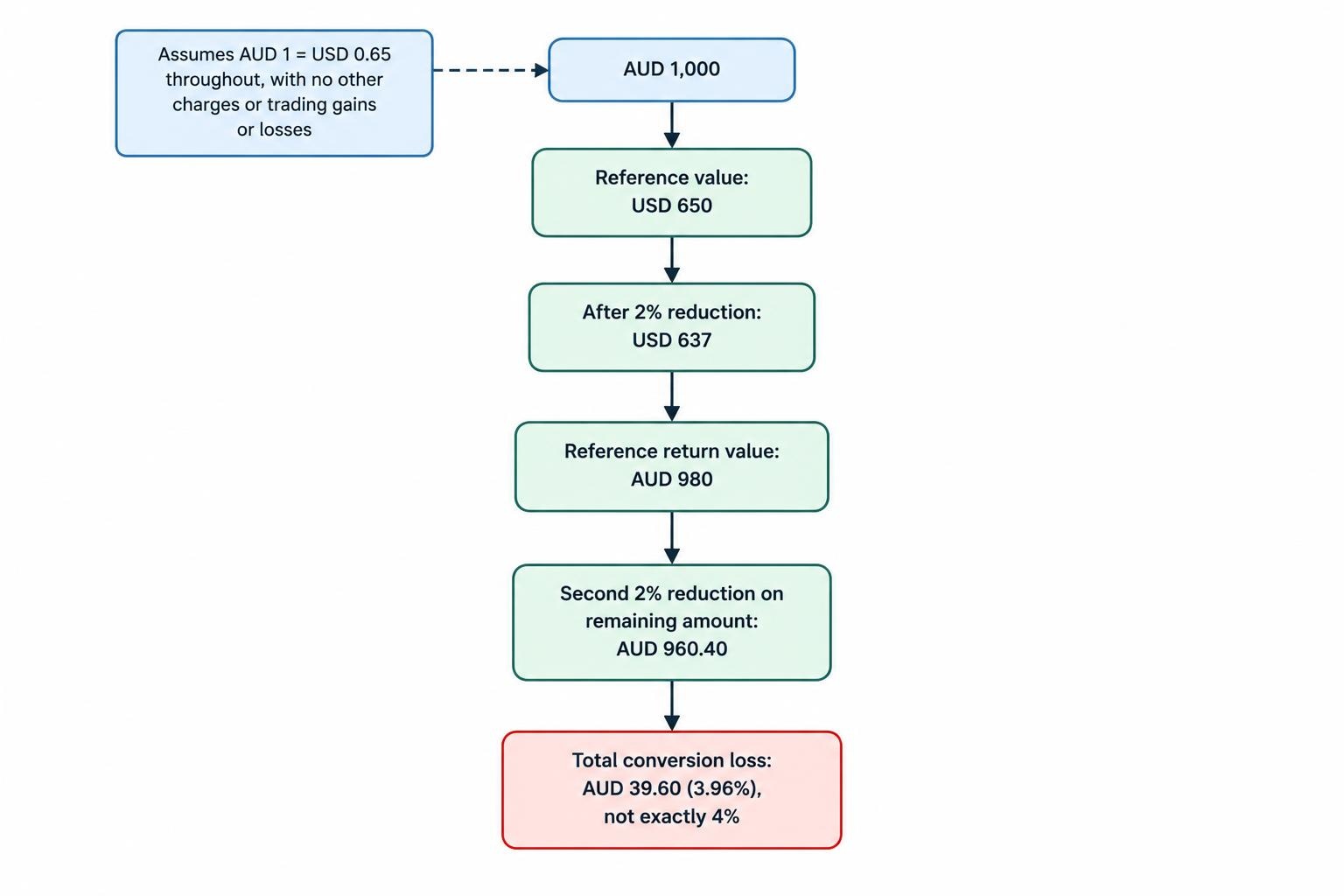
Consider an AUD 1,000 payment into a USD account. Assume the reference exchange rate remains at AUD 1 = USD 0.65 throughout, and each conversion delivers 2% less than the reference amount. There are no other charges and no trading gains or losses.
| Stage | Calculation | Result |
|---|---|---|
| Reference USD value | AUD 1,000 × 0.65 | USD 650.00 |
| USD credited after conversion | USD 650 × 0.98 | USD 637.00 |
| Reference AUD value on return | USD 637 ÷ 0.65 | AUD 980.00 |
| AUD received after return conversion | AUD 980 × 0.98 | AUD 960.40 |
| Total conversion loss | AUD 1,000 − AUD 960.40 | AUD 39.60, or 3.96% |
The combined reduction is 3.96%, not exactly 4%, because the second 2% applies to the amount remaining after the first conversion. This example defines each charge as a reduction in the currency delivered. A provider applying a markup to the quoted rate may calculate the result differently.
Now suppose the USD 637 balance grows by 10% to USD 700.70. With the same reference rate and return conversion cost, the customer receives AUD 1,056.44. The account shows 10% growth, but the gain against the original AUD 1,000 outlay is only 5.64%.
Under these assumptions, the foreign currency balance must grow by approximately 4.12% just to recover the conversion costs. That is a funding cost hurdle, not a binary option win rate calculation. Contract payouts and losses require separate treatment.
For a broader reconciliation that includes other deductions, use the total trading cost examples rather than treating currency exchange as the entire cost of the account.
Currency Movement Is Not a Conversion Fee
An unfavourable conversion can reflect two different things: a provider’s charge and a movement in the exchange rate. They should not be lumped together.
Suppose AUD 1,000 converts into USD 650 without any fees. If the balance stays at USD 650 but the Australian dollar strengthens to AUD 1 = USD 0.70, converting back produces approximately AUD 928.57. The AUD loss comes from currency movement, not a conversion charge.
If the Australian dollar instead weakens to AUD 1 = USD 0.60, that same USD 650 converts into approximately AUD 1,083.33 before charges. The higher AUD value is not trading profit within the account.
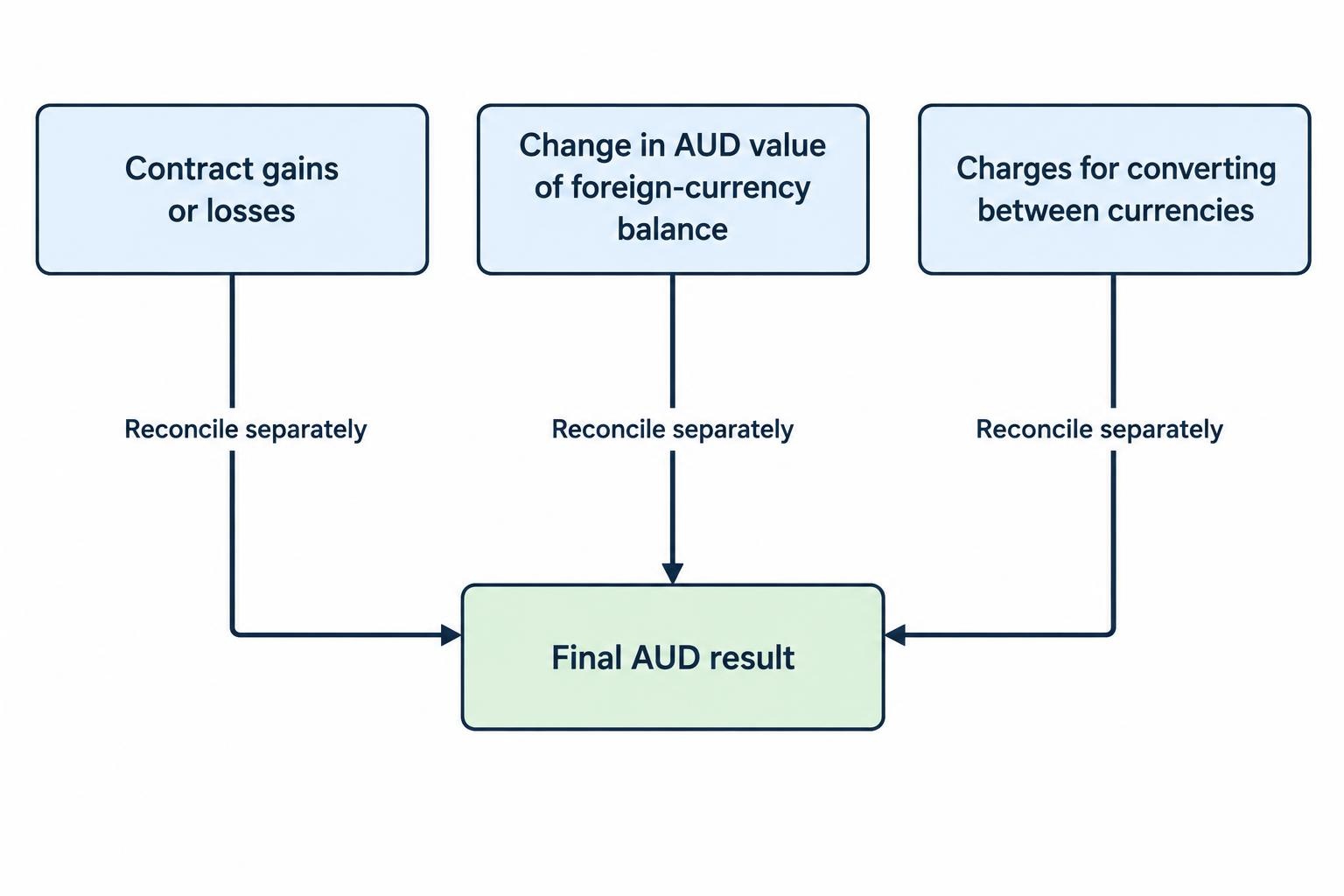
This distinction matters when reviewing results. There are three separate components: the gain or loss from contracts, the change in the AUD value of the foreign currency balance, and the charges paid to move between currencies. A single AUD profit figure combines them, but does not explain them.
Does an AUD Account Remove Conversion Costs?
An account genuinely funded, held and paid out in AUD can remove the need for the customer to exchange account cash. An AUD display alone proves much less. Check whether AUD is the actual account currency or just an approximate display value for a balance held elsewhere.
Review the payment confirmation and account statement. They should let you identify the currency charged, the currency credited and any conversion between them. For a withdrawal, check the currency sent by the provider as well as the currency received by the bank.
An AUD payment can also attract an international transaction fee without a customer currency conversion. Overseas processing is a separate issue from the currency shown at checkout. The ACCC’s guidance on international transaction fee disclosure addresses unexpected charges where prices appear Australian but payment facilities are overseas.
For an existing account review, ask two separate questions: “Was currency exchanged?” and “Was an international payment fee charged?” A yes to one does not automatically mean a yes to the other.
Card Currency Choices and Dynamic Currency Conversion
A card payment may offer a choice between the merchant’s currency and the cardholder’s home currency. Where dynamic currency conversion applies, accepting the home currency option means accepting the conversion offered through the merchant’s payment arrangement.
The familiar AUD total can feel reassuring, but it still needs scrutiny. Identify the exchange rate and markup before comparing that offer with the card issuer’s conversion terms. Do not assume either route is free, or that one is always cheaper.
Visa’s dynamic currency conversion requirements call for participating merchants and ATMs to display both currency amounts, the exchange rate, and additional fees or markups. Cardholders must have a choice to accept or decline the conversion; the merchant should not choose on their behalf.
Keep this distinction clear when reviewing a statement. A merchant conversion and a card issuer conversion are alternative arrangements for that currency change, not charges that should automatically both be assumed.
Avoid Cost Savings That Create Larger Risks
Fewer transfers can reduce fixed charges in a hypothetical payment comparison. They do not automatically reduce a percentage markup. Ten conversions of AUD 100 at the same 2% rate cost the same in percentage terms as one conversion of AUD 1,000, before fixed fees and rounding.
That does not justify depositing more money or leaving a larger balance with a provider. A small reduction in transfer charges should not drive a much larger decision about how much money remains exposed.
Keeping money in USD also postpones conversion rather than abolishing it. If that money will eventually be spent in AUD, its future AUD value remains uncertain. Holding it solely to wait for a better rate adds a currency decision to the account review.
Treat conversion pricing and counterparty and platform risk as separate checks. An attractive exchange rate does not establish that funds are safe or recoverable. Nor does a cheaper payment route change the Australian retail restriction on binary options.
Reconcile the Money That Actually Moved
For an existing account, use completed transactions rather than the amount initially requested. A deposit request is not proof of the amount credited, and a withdrawal approval is not proof of the AUD received.
Keep a compact record of:
- The total AUD debited, including separately posted fees.
- The foreign currency amount credited or withdrawn.
- The exchange rate, quote time and conversion provider.
- The final AUD received and any later bank deductions.
Save statements and payment confirmations alongside these figures. A trading journal can keep funding movements separate from contract results, making it harder to mistake a deposit for profit or a currency gain for successful trading.
For a fully closed account, the basic cash result is total AUD received minus total AUD paid, including charges posted separately. If money remains in the account, label its AUD value as an estimate and allow for the cost of converting it. The useful measure is not the largest balance displayed on screen. It is the money that reaches the bank after every deduction.
This article was last updated on: October 22, 2026