Binary options payouts determine how much a winning contract returns and how much a losing contract costs. The distinction that matters is profit versus total money returned. If a contract offers an 80% profit payout on a $100 stake, a win produces $80 profit plus the original $100 stake. The total returned is $180, not $80.
For Australian readers, the regulatory position comes first. ASIC banned the issue and distribution of binary options to retail clients from 3 May 2021, and extended that prohibition until 1 October 2031. The examples below explain payout arithmetic, not how to bypass the ban. All amounts and rates are hypothetical; dollar amounts use the same account currency unless stated otherwise.
What Does a Binary Options Payout Mean?
A binary option links a predetermined payment to a stated condition. That condition might require a market price to finish above a strike price at expiry. The winning payment does not increase simply because the price finishes further beyond the strike.
The payment can be expressed as a cash amount or a percentage of the initial stake, while a losing outcome generally means losing the entire amount committed. Both structures appear in the CFTC advisory on binary options payoffs. However, the word “payout” alone does not tell you whether a displayed figure includes your original money.
Three figures need separating:
- Stake: the amount committed to the contract.
- Net trading profit: the gain after recovering that stake, but before any separate charges.
- Gross return: the total amount credited back when the contract settles, including any returned stake.
Consider two descriptions of the same winning payment. “80% profit” on $100 means $80 profit and $180 returned. “180% total return” on $100 also means $180 returned. By contrast, a literal “80% total return” would mean receiving only $80 back, leaving a $20 loss. Labels matter more than the size of the number beside them.
Read the contract definition rather than assuming that “return”, “profit” and “payout” mean the same thing. An impressive percentage can become considerably less impressive once your own money is removed from it.
How to Calculate a Binary Options Payout
For a contract that quotes profit as a percentage of the stake, the calculation is straightforward:
Winning profit = stake × profit payout rate
Total returned on a win = stake + winning profit
Convert the percentage to a decimal before multiplying. An 80% rate becomes 0.80. On a $100 stake, the winning profit is therefore $100 × 0.80 = $80, and the total returned is $180.
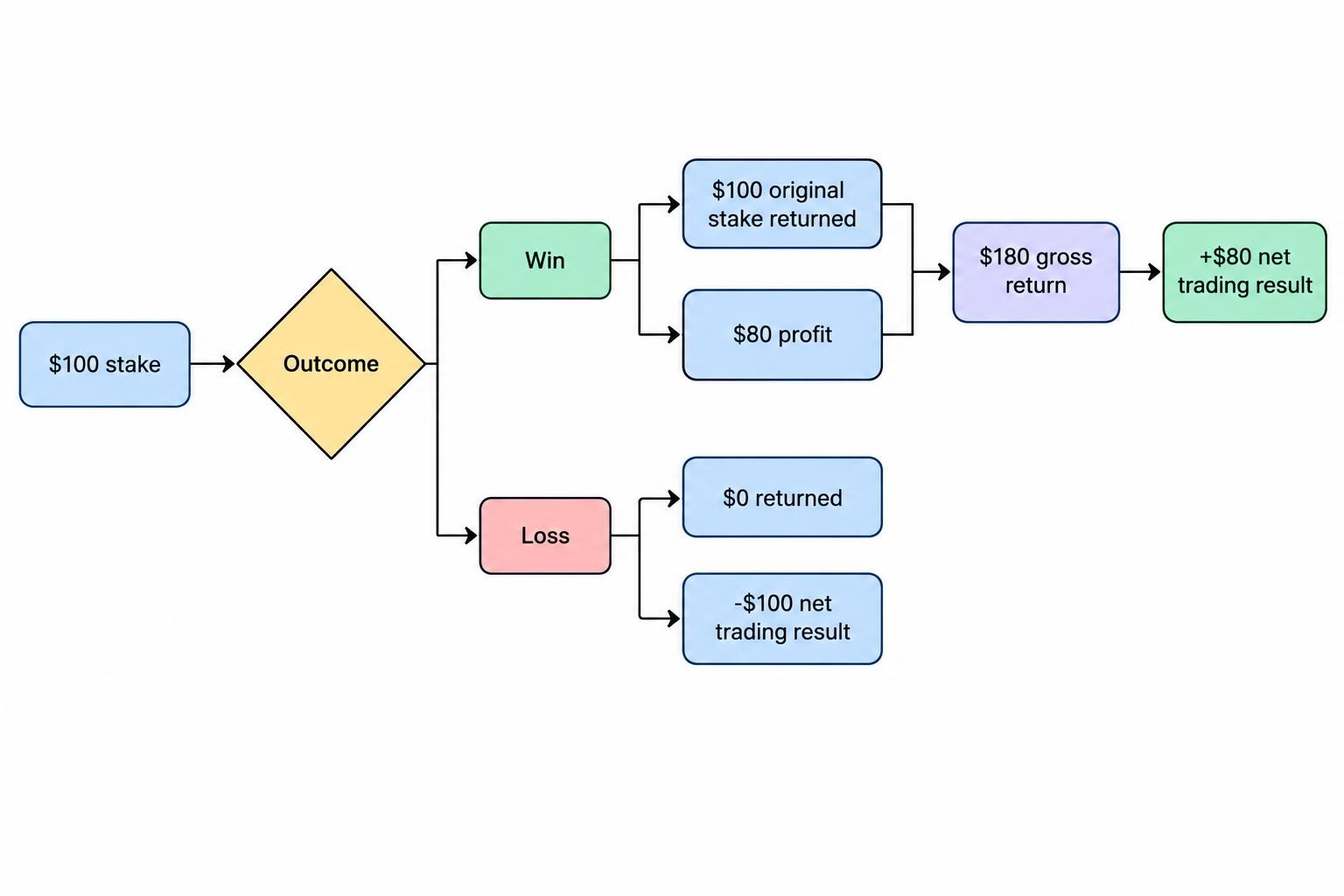
| Outcome | Amount returned | Net trading result |
|---|---|---|
| Winning contract | $180 | $80 profit |
| Losing contract | $0 | $100 loss |
| Contract cancelled with a full stake refund | $100 | $0 |
The cancellation row applies only if the contract terms provide that refund. It is not a universal rule for ties, pricing errors or disrupted markets.
Follow the account balance, not just the winning credit
Suppose an account starts with $500. Committing $100 leaves $400 outside the position. If the contract wins and returns $180, the account finishes at $580. The gain is $80.
If the contract loses without a refund, the account finishes at $400. This balance check prevents a common accounting mistake: treating the full $180 winning credit as earnings while forgetting the $100 deducted earlier.
The same method works with other stakes. At an 80% profit payout, a $25 winner produces $20 profit and returns $45. A $250 winner produces $200 profit and returns $450. Increasing the stake changes the cash amounts, not the relationship between reward and risk.
Why an 80% Payout Does Not Mean an 80% Return on Every Trade
An advertised profit percentage describes the winning outcome. It says nothing by itself about how often that outcome will occur. It is not an interest rate, an account growth forecast or a probability of success.
When the winning profit is smaller than the amount lost on a losing contract, an equal number of wins and losses produces a loss. This payout imbalance is addressed in the SEC warning about overstated binary options returns. Two possible outcomes do not automatically mean equal probabilities, either.
For a simple illustration, take ten $100 contracts with an 80% profit payout. Five winners generate $400 profit. Five losers cost $500. The result is a $100 trading loss before separate charges.
There is no contradiction between winning half the time and losing money. Each winner earns $80, while each loser costs $100. Counting green and red results without counting their cash values misses the point.
The break even win rate
With equal stakes, a constant profit payout, complete stake losses on unsuccessful contracts and no fees or refunds:
Break even win rate = 1 ÷ (1 + profit payout rate)
| Profit payout | Profit on a $100 winner | Total returned on a win | Break even win rate |
|---|---|---|---|
| 60% | $60 | $160 | 62.50% |
| 70% | $70 | $170 | 58.82% |
| 80% | $80 | $180 | 55.56% |
| 90% | $90 | $190 | 52.63% |
| 100% | $100 | $200 | 50.00% |
The percentages are rounded to two decimal places. Profit requires a win rate above the exact threshold, before allowing for costs.
At an 80% payout, 55 winners and 45 losers across 100 equal $100 stakes produce a $100 loss. With 56 winners and 44 losers, the result becomes an $80 profit. That thin difference leaves little room for charges or a weaker run of results.
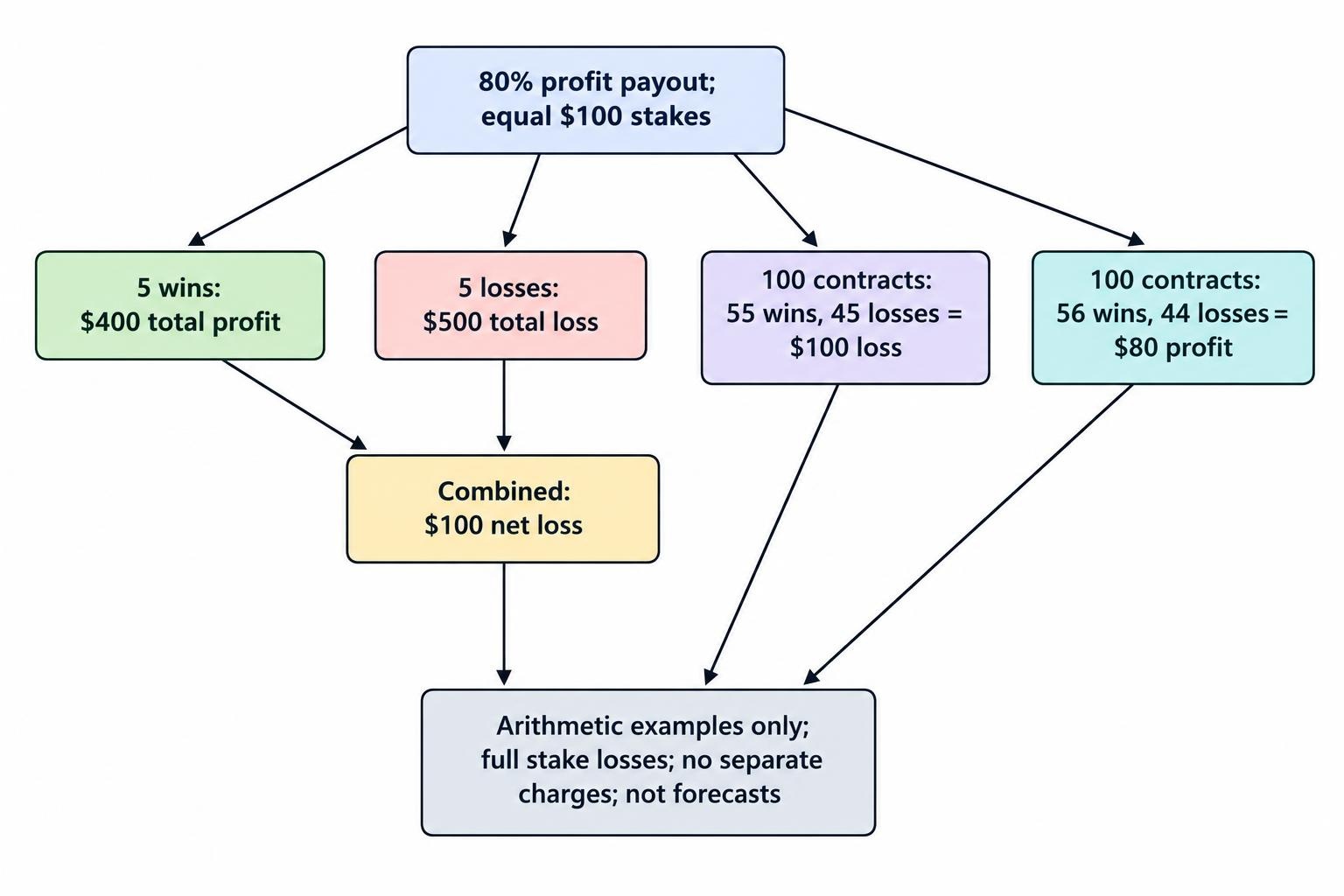
These thresholds describe arithmetic, not achievable performance. The separate guide to probability and expected value in binary options covers how outcome probabilities affect the calculation.
Comparing Payout Rates Without Comparing Different Contracts
A higher profit payout improves the reward for a winning contract when everything else stays unchanged. The difficulty is establishing that everything else really is unchanged.
Two quotes should be compared against the same event condition, strike, expiry, settlement benchmark and treatment of unsuccessful outcomes. A 90% quote attached to one condition is not automatically better value than an 80% quote attached to another. The higher paying condition could be harder to satisfy.
Expiry deserves particular attention. A contract requiring a price to finish higher after one minute is not the same proposition as one requiring it to finish higher after an hour. Their payout percentages cannot settle that comparison on their own. The mechanics of binary options expiry times belong alongside the quoted reward, not underneath it in small print.
A banner advertising “up to 95%” establishes only a ceiling in that advertisement. It does not establish the rate attached to every market, every expiry or every accepted contract. For a calculation, use the rate recorded on the relevant contract confirmation.
Also separate a quote seen before acceptance from the terms of an accepted position. If a later screen shows a different percentage, that later display is not enough to reconstruct the earlier contract. Keep the original confirmation and any applicable settlement conditions.
A small rate change can reverse the result
Take ten equal $100 stakes with six winners and four losers. At an 80% profit payout, the winners earn $480 and the losers cost $400, leaving $80 profit. At a 60% payout, the same six winning outcomes earn $360, leaving a $40 loss.
The directional results did not change. The contract economics did. This is why a performance claim without the payout rates used to produce it is incomplete.
Calculating Results When Payouts and Stakes Vary
A single headline payout cannot accurately describe a record containing several rates. Calculate the cash result of each position, then add the results.
Suppose ten hypothetical contracts each risk $100. Three winners pay 90% profit, three winners pay 60%, and four contracts lose the full stake. The winning profits total $270 + $180 = $450. The losses total $400. Net trading profit is $50 before charges.
Applying the highest displayed rate of 90% to all six winners would incorrectly report $140 profit. That overstates the result by $90.
Different stake sizes make simple averages less useful. A 90% payout on a $20 winning stake produces $18 profit; a 60% payout on a $200 winning stake produces $120. Averaging the two percentages to 75% and applying it indiscriminately to the combined stake would give the wrong result.
For accurate records, retain the stake, quoted profit rate, amount returned, net result and any separate fee for each position. A trading journal can keep those fields separate rather than reducing the record to wins and losses.
When reviewing a statement, reconcile the closing balance with the opening balance, deposits, withdrawals and trading results. Depositing another $500 increases the account balance, but it does not create $500 of trading profit. Bonuses and transfers should also remain separate from earned results.
Refunds, Rebates and Ties Change the Calculation
A full stake loss is an assumption, not a substitute for reading the contract. If a contract provides a partial cash refund after an unsuccessful outcome, the amount actually lost is smaller than the original stake.
Suppose a $100 contract pays $70 profit on a win and returns $10 on a loss. The winning result is positive $70; the losing result is negative $90.
The corresponding calculation is:
Break even win rate = loss per unsuccessful contract ÷ (winning profit + loss per unsuccessful contract)
Here, $90 ÷ ($70 + $90) = 56.25%, before fees. Without that $10 refund, a 70% profit payout requires about 58.82% wins to break even.
That improvement does not make the contract protected against loss. Ninety dollars of the hundred is still at risk. Also check whether a promised rebate is withdrawable cash or a conditional account credit; those are not interchangeable for cash accounting.
A tie is not automatically a refund
A settlement exactly at the strike needs an explicit rule. “Above the strike” and “at or above the strike” assign equality differently. A contract may instead contain a separate tie provision.
If a position receives a full stake refund, its trading result is zero before separate charges. It is neither a profitable win nor a full stake loss. Keep that category separate when reviewing results, and consult the guide to binary options settlement and ties for the role of equality rules and settlement prices.
Early Closing Is Not the Advertised Expiry Payout
An advertised winning payout applies to the stated settlement outcome. If an early closing facility exists, the amount offered for ending the position is a different figure.
For example, a $100 position might offer $180 back if it wins at expiry, but a hypothetical early closing quote might return only $72. Accepting $72 after committing $100 produces a $28 loss. Receiving money back does not necessarily mean making money.
Equally, an early closing payment of $125 would produce $25 profit before charges, not $125 profit. Always subtract the original commitment when the quoted closing amount includes it.
Do not assume early closing will be available, or that a displayed quote will remain available until accepted. The relevant terms and accepted execution determine the result. The separate article on early close, rollover and double up covers these features without treating them as guaranteed escape routes.
Increasing a stake also does not improve the payout ratio. Doubling a $100 stake at an 80% profit payout doubles both the possible winning profit and the amount exposed to loss. It changes the size of the outcome, not its economics.
Fixed Cash Settlement Versus Percentage Profit
Some binary structures quote a purchase price against a fixed cash settlement amount rather than advertising a percentage profit on a stake. The same accounting distinction still applies: settlement value is not net profit.
A $1 fixed payout is used in the CFTC explanation of event contract pricing. If a hypothetical position costs $0.40 and settles successfully for $1, the profit is $0.60 before fees. Its profit relative to the purchase price is 150%.
If it settles unsuccessfully for zero, the loss is the $0.40 purchase price. Paying $0.80 for the same $1 successful settlement would leave only $0.20 profit, or 25% of the purchase price.
“Pays $1” therefore does not mean “earns $1”. The purchase cost remains part of the calculation. This is an arithmetic comparison, not a statement that different products have identical rules, protections or availability.
Trading Payouts Before and After Costs
A payout calculation can be correct and still overstate the money retained. Separate charges must be deducted at the appropriate level.
Return to the example of 56 winners and 44 losers, each staking $100 at an 80% profit payout. Trading profit is $80. If the associated charges total $100, the result after those charges is a $20 loss.
Do not subtract the stake twice. It is already accounted for when a winning gross return is converted into profit and when an unsuccessful stake is recorded as a loss. Separate fees are an additional deduction, not another version of the stake.
Currency conversion needs the same care. A profit expressed in one account currency does not establish the amount received in Australian dollars. Compare amounts in the same currency and record conversion charges separately. The guide to binary options trading costs covers costs beyond the quoted contract reward.
For percentage returns across several positions, name the denominator. Profit divided by total stakes measures something different from profit divided by the opening account balance. Reusing money across contracts can make total stakes much larger than the original deposit, so an unexplained “return percentage” can be misleading even when its arithmetic is correct.
A Credited Payout Is Not the Same as a Completed Withdrawal
Contract settlement, an account credit and money received outside the platform are separate events. A screen showing a winning balance establishes what the screen displays; it does not establish that a withdrawal has reached a bank account.
Delayed withdrawals and demands for more money to obtain fewer withdrawal restrictions are documented warning signs in the SEC investor alert on fraudulent binary options platforms. A larger advertised payout does not compensate for money that cannot be recovered.
Keep contract confirmations, account statements, withdrawal requests and payment records. If an operator demands another deposit to release an existing balance, do not fold that demand into the payout calculation as though it were an ordinary expense. Stop and verify the demand independently.
A meaningful payout figure must identify what was risked, what the contract returned and what costs remain. Without those three amounts, a percentage is advertising rather than a usable financial result.
This article was last updated on: October 22, 2026