Overtrading in binary options means placing more trades than your rules, evidence or risk budget justify. The problem is not simply a busy session. It is the point where taking another position matters more than having a valid reason to take it.
For Australian readers, the legal position comes first. ASIC prohibits the issue and distribution of binary options to retail clients. The prohibition took effect on 3 May 2021 and was extended until 1 October 2031 under ASIC’s binary options product intervention order. The examples below are educational and can be examined on paper; they are not a recommendation to find an offshore provider.
What Counts as Overtrading?
There is no universal number of trades that separates discipline from excess. Five trades can be too many if only one met the entry conditions. Twenty hypothetical entries might follow a research protocol, but that does not establish that the strategy is profitable or suitable for real money.
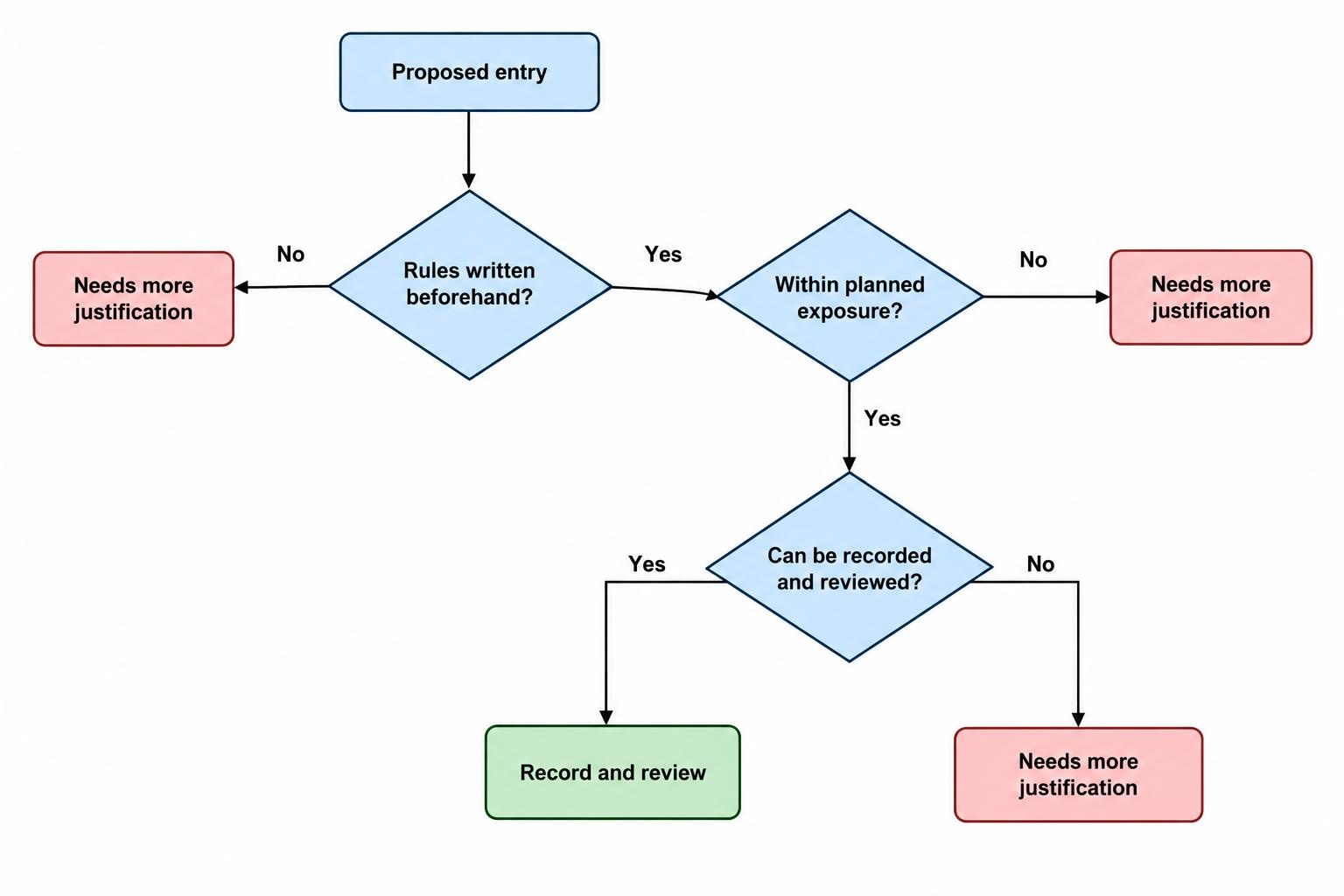
A more useful test is whether each decision passes three checks: it meets rules written beforehand, it fits within the planned exposure, and it can be recorded and reviewed properly. If any answer is no, the trade needs more justification than “the chart looked promising”.
Overtrading can involve repeated entries on one market, switching between markets to find something to trade, or opening several contracts on the same price movement. It can also mean continuing beyond a planned finishing time because the session has not produced the desired result.
This makes trade frequency part of binary options risk management, rather than a separate productivity target. Counting trades tells you how active a session was. Checking those trades against the plan tells you whether that activity had a defensible purpose.
A losing trade is not automatically an unnecessary trade. A winning trade is not automatically a good decision either. Judge the entry using what was known when it was made, not the colour of the result afterwards.
Why Extra Trades Can Increase Losses
Consider a hypothetical contract with a $20 stake and an 80% net profit payout. A win earns $16 profit and returns the $20 stake. A loss costs the full $20. Assume there are no ties, refunds or other charges.
Ten wins and ten losses would produce $160 in profits and $200 in losses, leaving a $40 net loss. Winning half the trades is not enough to break even under these terms.
The break-even win rate is approximately 55.56%, calculated as $20 divided by the $36 difference between winning and losing. The broader relationship between payout and required accuracy is covered in probability and expected value in binary options.
Now assume the true chance of winning each hypothetical trade is 50%. The expected result is a $2 loss per trade: half of $16, minus half of $20. Increasing the trade count increases the expected monetary loss under those unchanged assumptions.
| Number of trades | Total stakes committed over the sequence | Expected net result |
|---|---|---|
| 10 | $200 | −$20 |
| 50 | $1,000 | −$100 |
| 100 | $2,000 | −$200 |
Total stakes here means cumulative turnover, not the amount needed upfront or the amount lost. Actual results can differ sharply from these averages. The example does not estimate any reader’s win rate, and an advertised payout is not evidence of a profitable strategy.
Trading less does not turn negative expected value into positive expected value. It reduces exposure to the assumed disadvantage. Equally, a genuinely profitable method would not become unprofitable simply because it generated more valid opportunities. The concern is adding entries without evidence that they meet the same standard.
The product risk exists beyond trading habits. In the 13 months before Australia’s ban, 74–77% of active retail binary option investors lost money, as recorded in Moneysmart’s binary options warning. Those figures do not establish that overtrading caused every loss. They also do not support the idea that better self-control makes the product safe.
Warning Signs Before the Trade Count Rises
The clearest warning is a change in the reason for entering. At the start of a session, the reason might be a documented setup. Later, it becomes “I have been waiting long enough”, “I almost caught that move”, or “one more should get the balance back”. None describes a new market opportunity.
Look for changes in standards too. A rule requiring a completed candle becomes permission to enter before it closes. A defined market list expands whenever nothing happens. A planned expiry becomes a shorter one because waiting feels uncomfortable. Each exception deserves a written explanation before, not after, the decision.
Another warning is losing track of open positions. If you cannot state the total amount at risk without searching through several screens, stop adding exposure. Small stakes are not small in aggregate when there are enough of them.
Winning sessions need scrutiny as well. Suppose a paper session reaches its planned endpoint with a profit. Continuing because the next entries feel like “house money” changes the rules. The gain belongs to the account; it is not a free allowance for weaker decisions.
A useful question is: would this entry still qualify if the current session balance were hidden? If the answer changes with the profit or loss display, the balance may be driving the decision.
Repeated Entries Are Not Necessarily New Opportunities
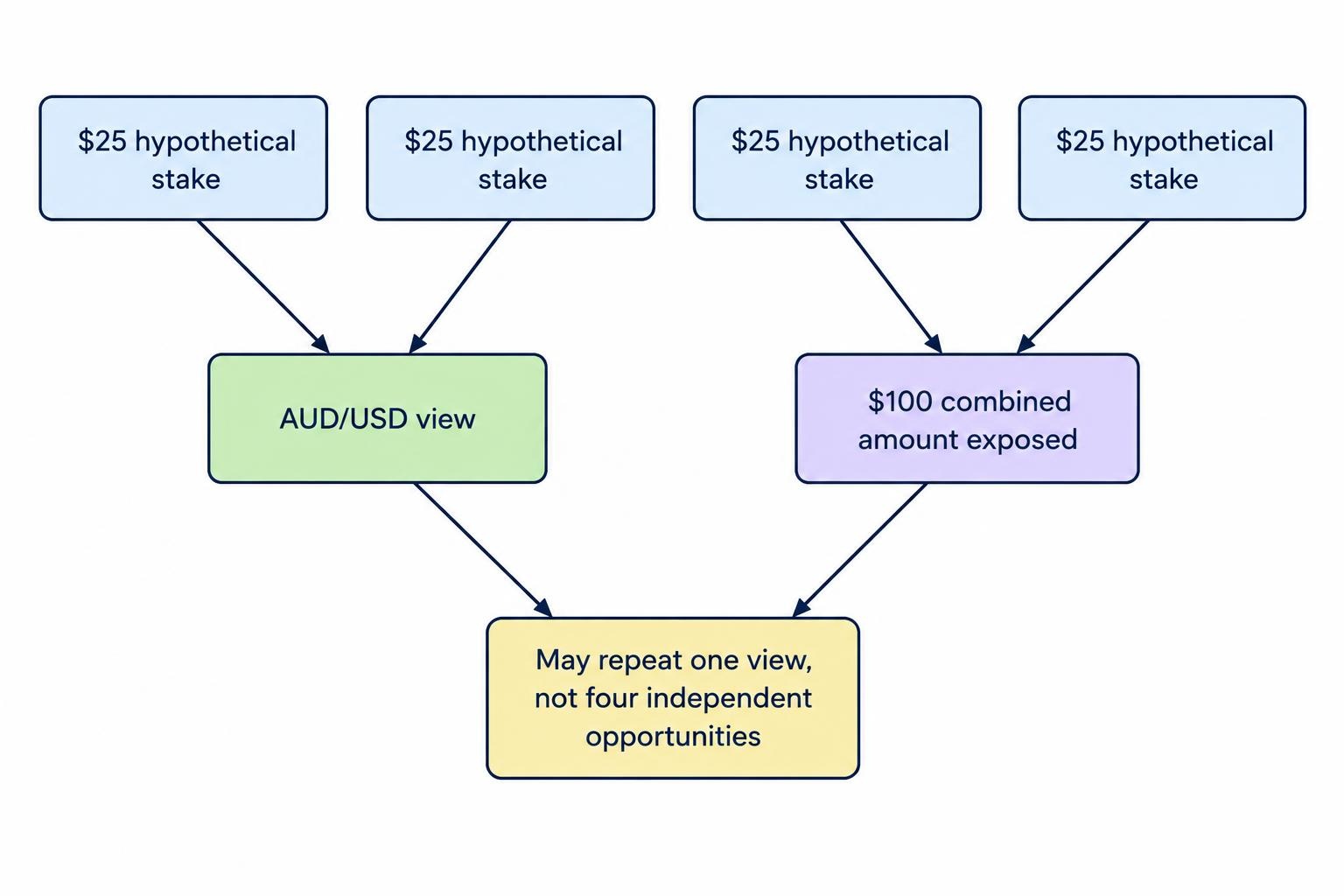
Opening several contracts does not always create several independent ideas. Suppose a paper trader predicts that AUD/USD will finish above a chosen level and records four entries a few seconds apart, all expiring at the same time. The entries may largely repeat one view rather than represent four separate opportunities.
If each hypothetical stake is $25, the combined amount exposed is $100. Calling each entry “only $25” misses the relevant total. Different entry prices can change the outcomes, but they do not remove the concentration.
The same issue can arise across markets. Two contracts may respond to the same underlying event or market move. Treating separate symbols as automatic diversification can hide overlapping risk. The guide to correlation and trading risk examines that distinction.
For an overtrading review, ask whether each additional entry introduced a fresh, documented reason or simply repeated the original position. A second click is not a second analysis.
Separate Opportunity From the Urge to Recover
A previous loss does not, by itself, make the next binary contract more likely to win. Nor does being close to a daily profit target improve the available setup. The account balance is relevant to exposure limits, but it is not an entry signal.
Consider a hypothetical session where two planned trades lose. A third entry appears, but it fails one of the written conditions. Taking it because a win would repair the session replaces the strategy with a recovery goal.
This is where overtrading overlaps with chasing trading losses. Overtrading describes excess activity; loss chasing describes a motive that can produce it. The distinction matters because boredom, overconfidence and pressure to reach a target can also lead to unnecessary entries.
During a review, record the stated reason honestly. “Wanted to finish even” is more useful than inventing a technical explanation afterwards. You cannot examine a pattern accurately if every exception gets renamed as a setup.
Build Limits That Cannot Be Rewritten Mid-Session
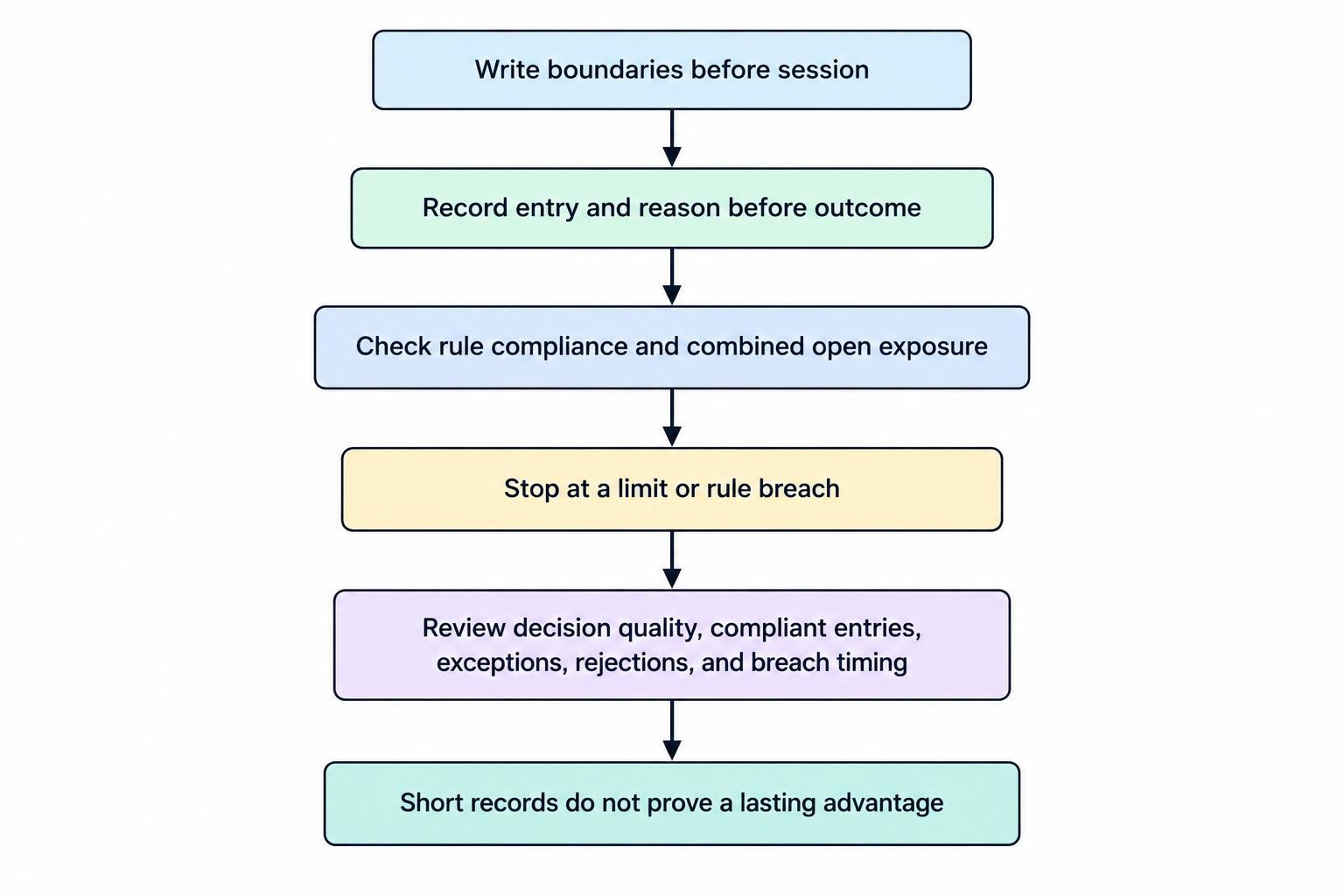
“Be more disciplined” is too vague to audit. A practical paper trading plan needs observable boundaries and a clear response when one is crossed. Write these before opening the charts, when there is no result to defend.
Use a trade ceiling, not a trade quota
A maximum number of entries sets an upper boundary. It does not create an obligation to reach it. If a simulation permits up to five entries and none qualify, recording zero trades follows the plan.
Do not carry unused entries into another session. Otherwise, a control intended to restrict activity becomes a reason to increase it later. The market does not owe you enough setups to fill a worksheet.
Choose a research ceiling that leaves enough time to document every decision. There is no universally safe number, and a low ceiling does not validate the strategy being examined.
Define the pause and stopping conditions
A scheduled break should mean leaving the decision screen, not opening another market. Write down when the session finishes, what triggers an earlier stop, and what happens after a rule breach.
For a paper exercise, a clear rule might be: after an entry that fails the checklist, stop recording new entries and review the breach. That makes process failure a stopping condition even if the entry happened to win.
A session loss ceiling also needs a clear definition. For fully funded hypothetical contracts whose maximum loss equals the stake, include the possible loss on open positions rather than looking only at settled results. Otherwise, several unresolved trades can take exposure beyond the intended boundary.
Remove prompts that encourage extra decisions
During research, close markets outside the written plan and silence promotional notifications. If every alert becomes a reason to reconsider the session, the plan has little practical force.
Apply the same boundary across devices and accounts. Stopping on a laptop and continuing on a phone does not end the session. Switching to another account does not reset its losses or erase its rule breaches.
These controls are constraints, not a formula for profitability. If the rules keep being renegotiated, do not respond by writing an even longer checklist. Stop the activity and examine why the existing boundaries are being ignored.
Audit Decision Quality, Not Just Profit
A useful overtrading review separates compliant entries from entries that broke the plan. Without that distinction, a profitable batch of unnecessary trades can reward exactly the behaviour you intended to stop.
Use a trading journal to record the entry time, market, hypothetical stake, payout, expiry, setup conditions and result. Add whether the entry complied with every rule, and note the reason for any exception. Make the initial record before the outcome is known.
Four measures can make the review more useful:
- Rule compliance: the proportion of entries that met every requirement.
- Unplanned entries: decisions outside the approved setup, market or session.
- Peak open exposure: the largest combined amount at risk at one time.
- Post-limit activity: entries made after the stopping condition had been reached.
Review the timing of breaches. Did they cluster after losses, after wins, near the finishing time, or during long periods without a qualifying setup? Treat those as questions for your own records, not assumptions about what all traders do.
Also record rejected entries, with their rejection reasons fixed beforehand. Do not remove a sensible rejection from the log because the hypothetical trade would have won. That would reward hindsight rather than the decision process.
A short record cannot prove a lasting advantage. It can still show that a session continued after its boundary, that stakes increased without permission, or that several entries repeated the same idea. Those are useful findings even when the simulated balance rises.
When Reducing Frequency Is Not Enough
If you repeatedly break your own stopping rules, hide activity, borrow money to continue, or trade with money needed for bills, treat the problem as more than an inefficient routine. The priority is preventing further harm, not finding a better entry filter.
Stop adding money and step away from the platform. Consider telling someone you trust and getting support with access to funds or outstanding bills. Do not make help conditional on first winning back a loss.
In Australia, the National Gambling Helpline provides free, confidential support on 1800 858 858, 24 hours a day, seven days a week. The Department of Social Services’ gambling support resources also cover online counselling and financial counselling.
The practical standard is not “trade less than yesterday”. It is to reject activity that has no defensible place in the plan, respect stopping conditions, and recognise when stopping altogether is the appropriate decision. Fewer clicks are useful only if the boundary holds.
This article was last updated on: October 22, 2026