The main types of binary options are high/low, one touch, no touch, boundary or range, and ladder contracts. Each uses a different test to decide whether a fixed payment is due. Some depend on the price at expiry; others depend on whether a level was reached during the contract.
That distinction matters more than the product name. A price can rise, touch a target, fall back and finish inside a range, producing different results across contracts on the same asset.
For Australian retail clients, the regulatory position comes first. ASIC’s prohibition on the issue and distribution of binary options took effect on 3 May 2021 and has been extended until 1 October 2031. The examples below explain contract structures, not products available for lawful retail distribution in Australia. See the ASIC announcement extending the binary options ban.
What Separates One Binary Option Type From Another?
A binary option makes a payment conditional on a yes/no outcome. Unlike a conventional option, it does not give its holder the right to buy or sell the underlying asset. Its defining feature is the predetermined payment attached to the qualifying outcome, rather than a profit that keeps increasing with the size of the market move. The SEC’s binary options investor alert sets out this distinction.
Three questions identify the structure: what price level matters, when the price is observed, and what event produces payment. An above/below contract might use one strike and one observation at expiry. A touch contract uses a barrier and observations during a stated window. A range contract uses two boundaries.
The asset and duration are separate choices. “Gold” identifies the reference market. “Five minutes” identifies a period. Neither tells you whether the contract requires a higher closing price, a barrier touch or a finish inside two boundaries.
Binary Option Types Compared
| Contract type | Qualifying condition | What matters most |
|---|---|---|
| High/low | Price finishes above or below the agreed strike | The settlement price at expiry |
| One touch | Price reaches the stated barrier during the observation window | A qualifying touch, even if the price later reverses |
| No touch | Price avoids the stated barrier throughout the observation window | The entire monitored period |
| Boundary or range | Price satisfies an inside or outside condition involving two levels | Whether the test applies at expiry or during the contract |
| Ladder | Price satisfies the condition attached to a chosen strike or rung | The selected threshold and its individual terms |
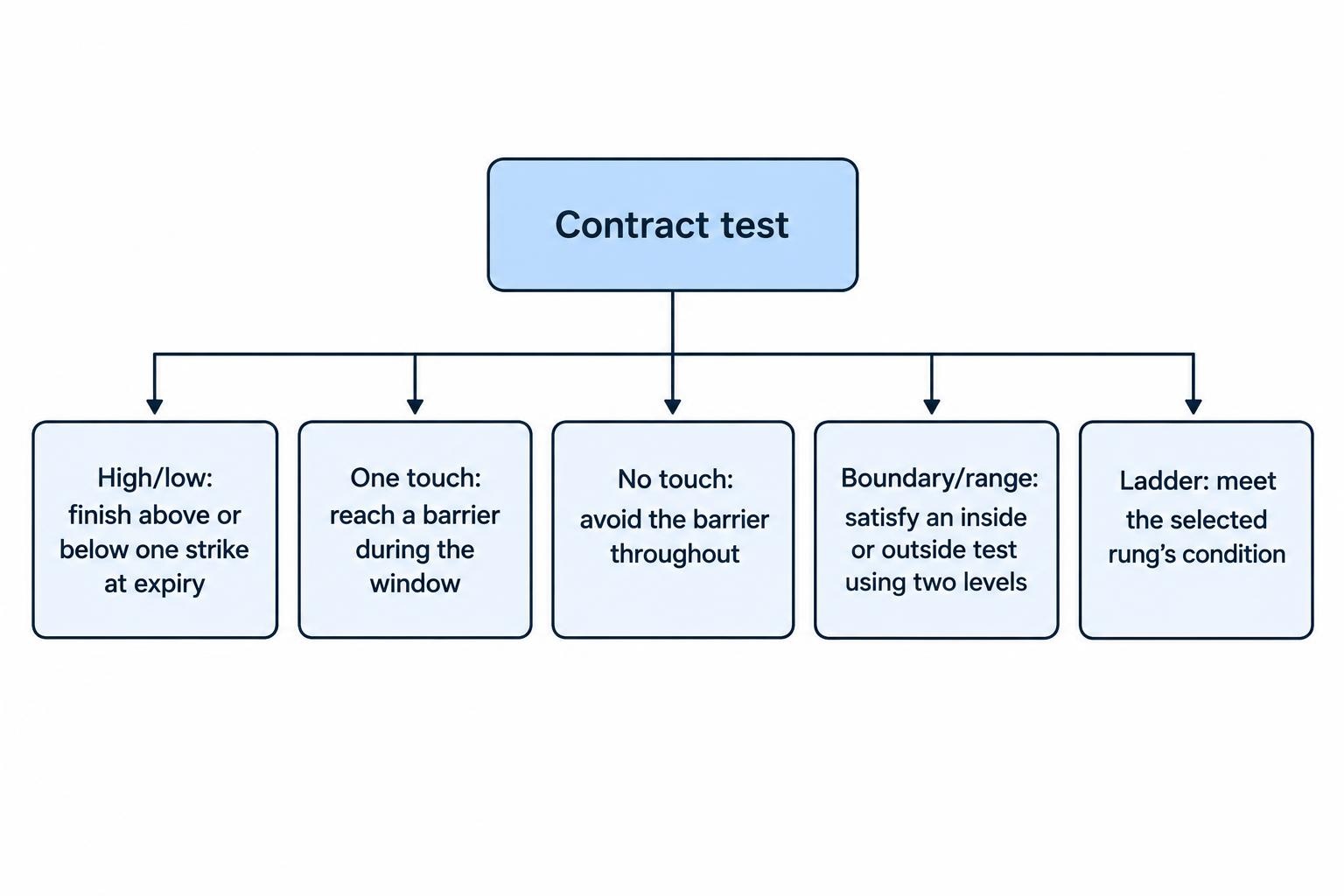
These categories describe payment conditions, not quality ratings. A contract with fewer moving parts can still have unfavourable economics. A larger advertised return does not make a harder condition more achievable.
High/Low Binary Options
A high/low binary option asks whether the settlement price will be above or below a strike at expiry. Names such as up/down and higher/lower can describe the same basic arrangement. The strike may be set near the price when the contract begins, but the accepted contract determines the actual threshold.
Consider a hypothetical AUD/USD contract with a strike of 0.6500. An above contract qualifies if the settlement price is strictly above 0.6500 at the agreed time. A settlement price of 0.6501 meets that condition; 0.6499 does not. A price of exactly 0.6500 needs separate treatment under the contract’s equality rules.
The size of a winning move does not increase the agreed payment. If both 0.6501 and 0.6550 satisfy the same contract, they produce the same gross settlement amount. Getting the direction right by a mile does not earn a mileage allowance.
Earlier movements usually do not decide an expiry based contract. The price could spend most of the period above the strike, then finish below it. The closing test, not time spent “winning” on the screen, controls the result.
The high/low binary options guide covers this structure in more detail, including the difference between the entry quote and the contractual strike.
One-Touch and No-Touch Binary Options
One touch: reaching a barrier
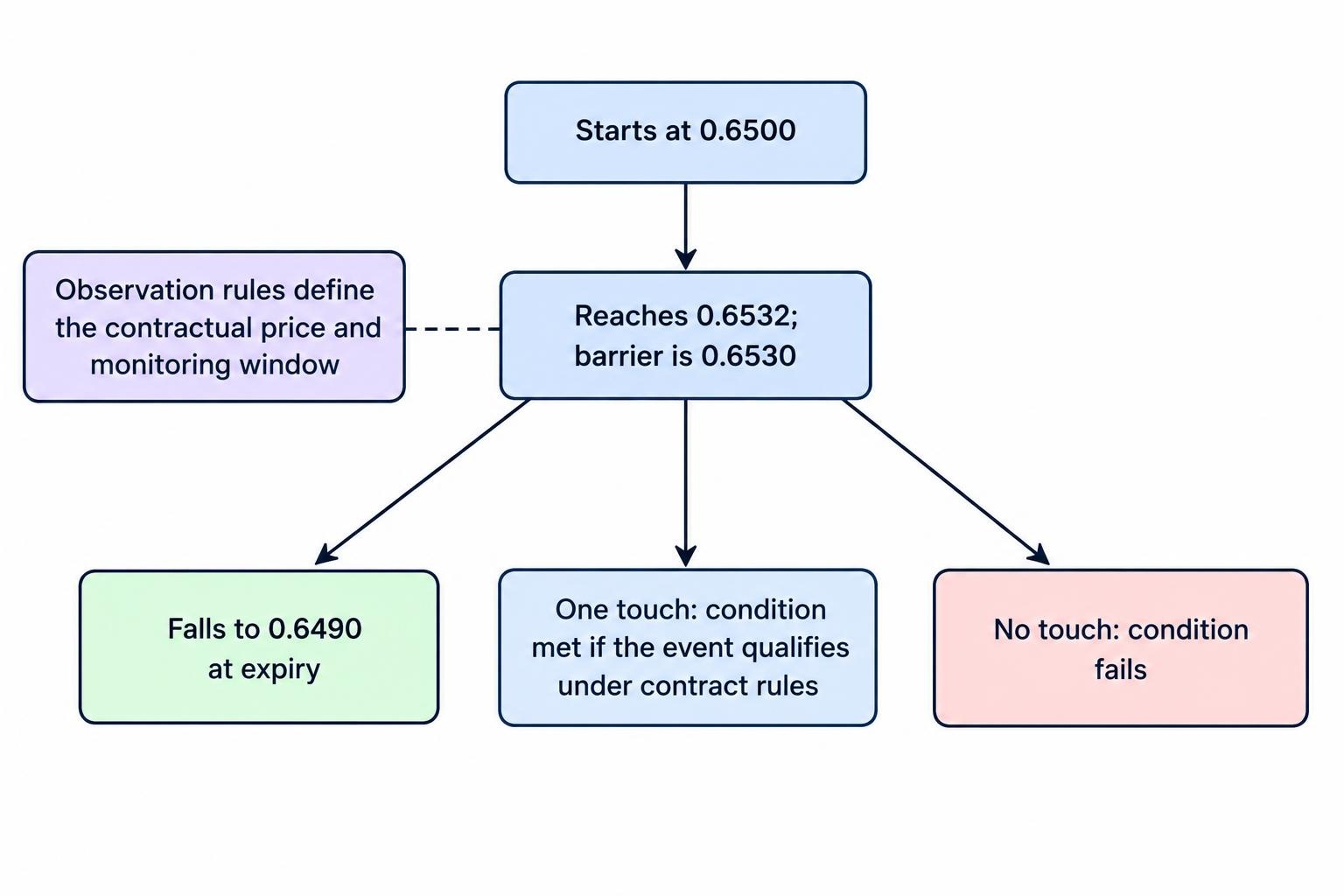
A one-touch contract requires the reference price to reach a stated barrier during an observation window. Unlike high/low, the final price need not remain beyond that level. A qualifying touch can settle the outcome even if the market subsequently reverses.
Suppose AUD/USD starts at 0.6500 and a hypothetical contract has an upper barrier of 0.6530. The reference price reaches 0.6532 halfway through the window, then falls to 0.6490 by expiry. If that movement qualifies under the observation rules, the touch condition has been met despite the lower finish.
The important wording is “qualifies under the observation rules”. The contract must establish which price is observed, when monitoring starts and stops, and whether reaching or crossing the barrier counts. A high on an unrelated chart is not, by itself, proof of a contractual touch.
No touch: avoiding a barrier
A no-touch contract requires the barrier to remain untouched throughout the stated window. With an upper barrier, the price can fall or fluctuate below that level and still satisfy the condition. It is not simply another name for predicting a fall.
Using the previous price path, the move to 0.6532 would defeat a no-touch condition at 0.6530. Returning below the barrier would not undo the earlier event. The distinction is between “never reached” and “finished below”, which are different statements.
Also separate the moment an outcome becomes determined from the moment money is credited. Do not assume that a successful touch means immediate withdrawal availability. The one-touch and no-touch contract guide examines these observation and payment distinctions.
Boundary and Range Binary Options
Boundary contracts use a lower and an upper price level. The selected condition may require the price to finish inside the range, finish outside it, remain inside throughout a window, or reach a boundary during that window. Those conditions should never be treated as interchangeable.
Finishing inside or outside a range
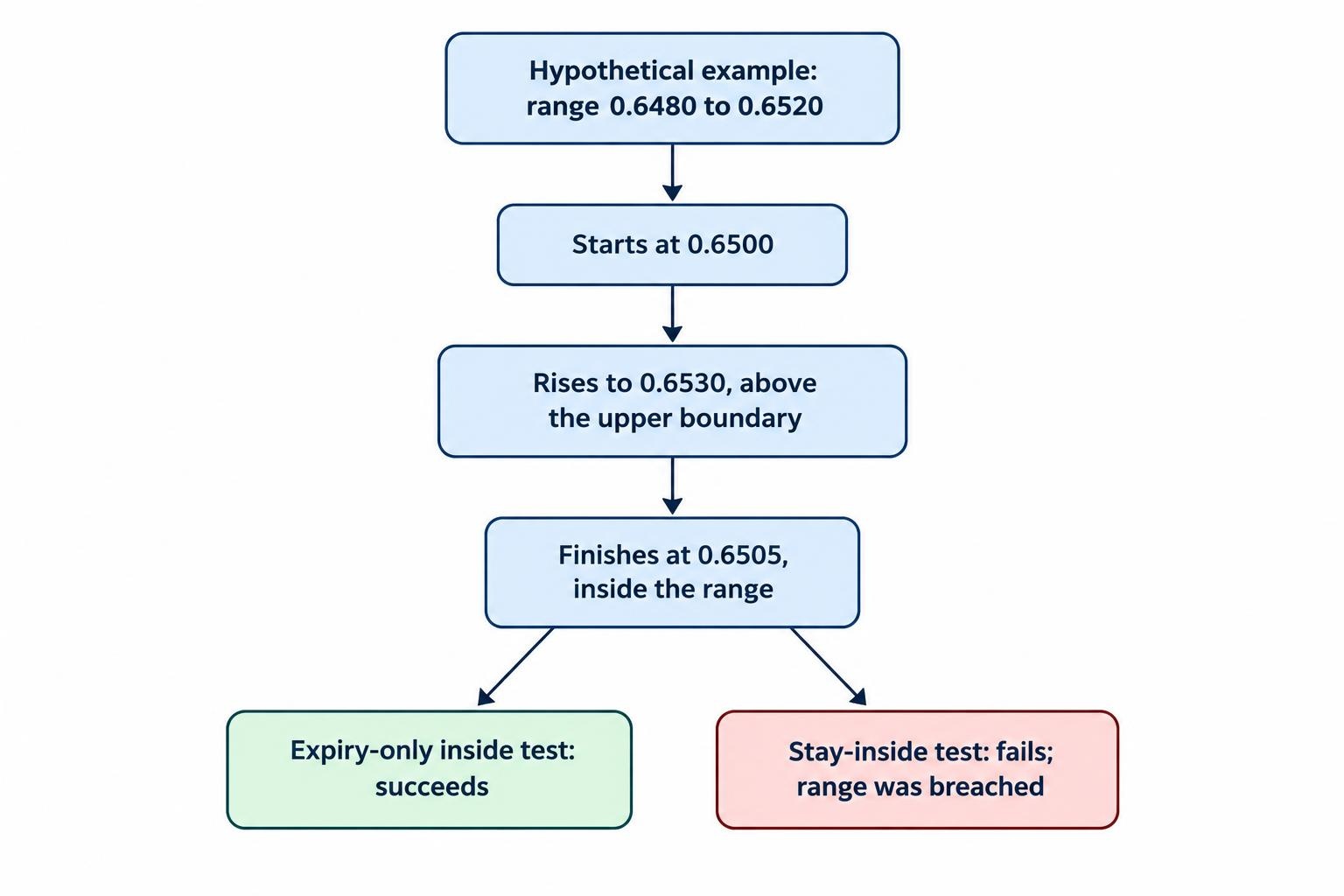
For an expiry based inside contract, the question is where the settlement price stands at the appointed time. Assume a hypothetical range from 0.6480 to 0.6520. A final price of 0.6505 falls inside those boundaries.
If the contract observes only the expiry price, an earlier excursion to 0.6530 does not defeat the inside condition. Conversely, an expiry based outside contract would require a qualifying final price below the lower boundary or above the upper boundary. Exact boundary values still depend on whether the endpoints are included.
Staying inside throughout the contract
A stay-inside condition is different. Here, an excursion beyond a boundary can defeat the contract even when the final price returns to the middle. The New Zealand FMA’s description of range options illustrates this version, where remaining within the range throughout the period is the qualifying condition.
Apply both structures to the same hypothetical movement: the price starts at 0.6500, rises to 0.6530 and finishes at 0.6505. The expiry-only inside test succeeds. A stay-inside test using the same boundaries fails because the price left the range earlier.
This is why “the market will go sideways” is not a complete contract interpretation. A market can finish close to its starting point after making a large excursion in between. The closing location and the route taken answer different questions.
Before comparing quoted returns, establish which version is being described. The boundary and range binary options guide separates expiry tests from conditions monitored during the contract.
Ladder Binary Options
Ladder contracts present a choice of price thresholds, often shown as rungs. In a common expiry based structure, each selected rung works as an individual above/below condition. The term does not establish one universal set of rules: ESMA’s analysis of binary option trigger events identifies ladder contracts whose strike differs from the underlying price when the contract begins.
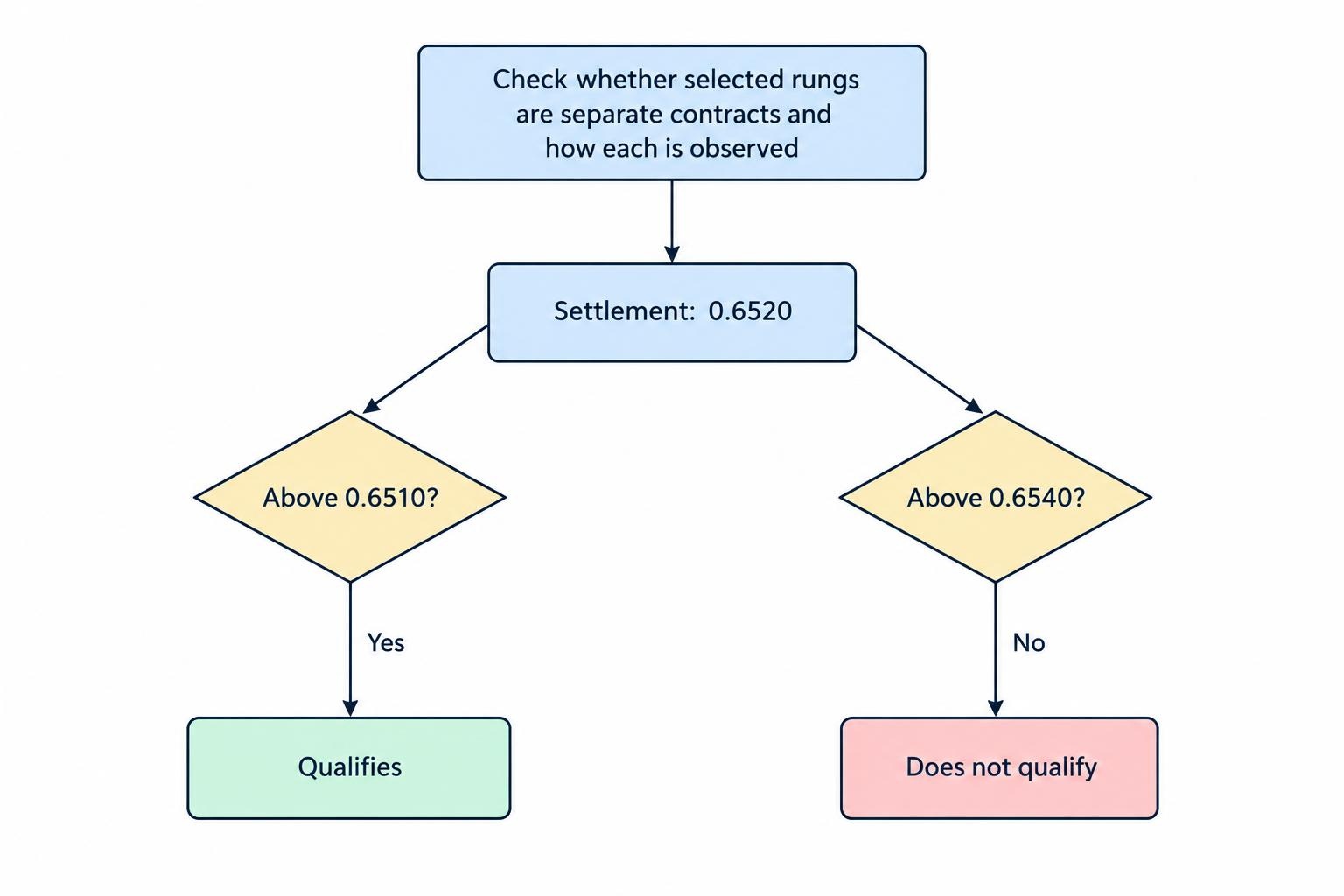
Suppose AUD/USD is at 0.6500. Two hypothetical above contracts use strikes of 0.6510 and 0.6540, with the same expiry. If the settlement price is 0.6520, the lower strike qualifies and the higher strike does not.
The higher upside threshold defines a narrower winning event: every settlement price above 0.6540 is also above 0.6510, but not every price above 0.6510 clears 0.6540. A larger quoted profit at the higher rung does not remove that difference.
Nor does a ladder display necessarily mean one purchase covers every rung. If the thresholds are separate contracts, selecting several creates several stakes and several settlement outcomes. Any apparent combined return must account for all amounts paid, including losing selections.
A ladder should therefore be read as a set of contract conditions, not a staircase of guaranteed payments. Check whether each rung settles independently and whether its event is judged at expiry or during a monitoring window. The ladder binary options guide develops these distinctions without treating every ladder display as the same product.
Labels That Do Not Define the Contract Type
60-second, five-minute and end-of-day contracts
These labels describe timing, not the winning condition. A 60-second contract could use an above/below test; a longer contract could use a touch test. Changing the duration does not automatically change the payment structure.
There is also a difference between a duration measured from acceptance and a fixed expiry shared by multiple contracts. “Five minutes” needs a starting point. The guide to binary options expiry times explains those timing questions separately.
Forex, shares, indices and commodities
These names identify the reference market. An AUD/USD high/low contract and a gold high/low contract can use the same type of settlement test, even though their underlying markets differ. “Forex binary option” alone does not identify the relevant strike, barrier or observation rule.
OTC, weekend and platform features
“OTC” describes an over-the-counter dealing arrangement, not an above/below, touch or range condition. A weekend label likewise does not tell you what event produces payment. Neither label should replace a description of the reference price and settlement test.
Features such as early close, rollover or double up are also separate from the original contract category. If offered, they require their own terms. A button beside a contract is not a definition of the contract itself.
Payout Size Does Not Tell You Which Type Is Better
Comparisons need to distinguish gross payment from net profit. In a hypothetical contract with a A$100 stake and an 80% profit on success, a winning settlement returns A$180: the A$100 stake plus A$80 profit. An unsuccessful settlement returning nothing produces a A$100 loss.
Under those assumptions, ten wins and ten losses produce A$800 in winning profits against A$1,000 in losses. The net result is a A$200 loss before any other costs. A 50% success rate therefore does not break even.
The break-even success rate is A$100 divided by A$180, or approximately 55.56%. That calculation assumes a constant stake, the same winning payment, no refunds and no additional charges. Changing those assumptions changes the required rate.
A touch or ladder contract with a larger advertised return still needs an assessment of how likely its qualifying event is. Comparing payment percentages alone leaves out half the calculation. The guide to probability and expected value explains how the payment and outcome probability work together.
These concerns are not confined to one contract name. ASIC’s 2019 report on consumer harm from OTC binary options identified negative expected returns and a high likelihood of cumulative losses among the product characteristics causing harm. Switching from high/low to a more elaborate condition does not, by itself, establish a favourable expected return.
Contract Terms That Can Change the Result
The category gives you the broad test. The written terms determine how that test operates. Two contracts bearing the same label may not be equivalent if they use different price references, observation windows or equality rules.
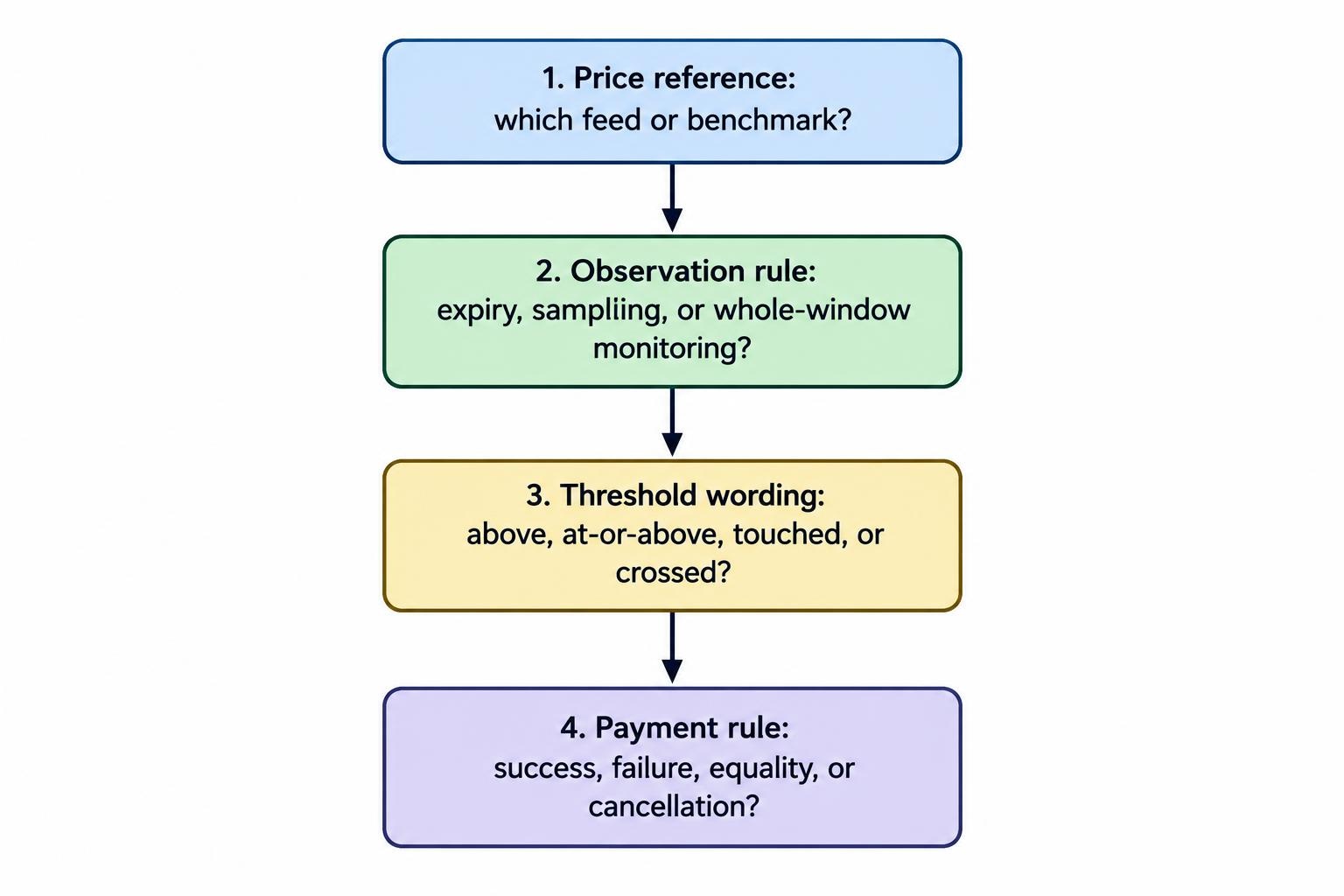
Before interpreting any worked example, establish four things:
- Price reference: Which feed, benchmark or calculation supplies the contractual price?
- Observation rule: Is there one expiry observation, repeated sampling, or monitoring throughout a window?
- Threshold wording: Does the price need to be above, at or above, touched, or crossed?
- Payment rule: What is returned on success, failure, equality or cancellation?
Equality deserves particular attention. “Above 0.6500” and “at or above 0.6500” produce different answers when the settlement price is exactly 0.6500. A refund provision would create another result again. Do not fill that gap with an assumption borrowed from a different contract.
For range contracts, check both endpoints. For touch contracts, check what counts as a qualifying barrier event. For ladders, check each selected rung rather than assuming the display applies one rule to every threshold. The guide to binary options settlement and ties addresses these edge cases.
Which Type Is Easiest to Interpret?
An expiry based high/low contract is usually the most straightforward to express: compare one settlement price with one strike at one time. Touch and no-touch contracts add the price path. Range contracts add a second boundary, while ladder displays add a choice of thresholds.
Simpler to describe does not mean safer, profitable or available to Australian retail clients. The useful test is whether the entire condition can be written in one precise sentence, including the price reference, observation period, threshold and payment. If that sentence still contains an unanswered question, the product label has not told you enough.
This article was last updated on: October 22, 2026