After hours share trading means buying or selling shares outside their regular market session. It lets investors respond to announcements without waiting for the next opening, but the price on a screen may be harder to trade than it looks. Fewer available orders, wider spreads and sudden price changes can turn a straightforward decision into an expensive one.
For anyone studying share based binary options, there is another distinction: trading in the underlying share does not automatically extend a derivative’s availability or change its settlement rules. The share market’s timetable, the chart’s data feed and the contract’s expiry are separate matters.
Australian regulatory context: ASIC’s prohibition on the issue and distribution of binary options to retail clients took effect on 3 May 2021 and remains extended until 1 October 2031. The ASIC binary options ban announcement sets out that restriction. The contract examples below explain mechanics, not a route around the ban.
What counts as after hours share trading?
Extended hours is the broad term for trading outside the regular session. Pre market trading happens before the regular opening; after hours, or post market trading, happens after the regular close. Overnight trading describes a further session that may operate beyond those windows.
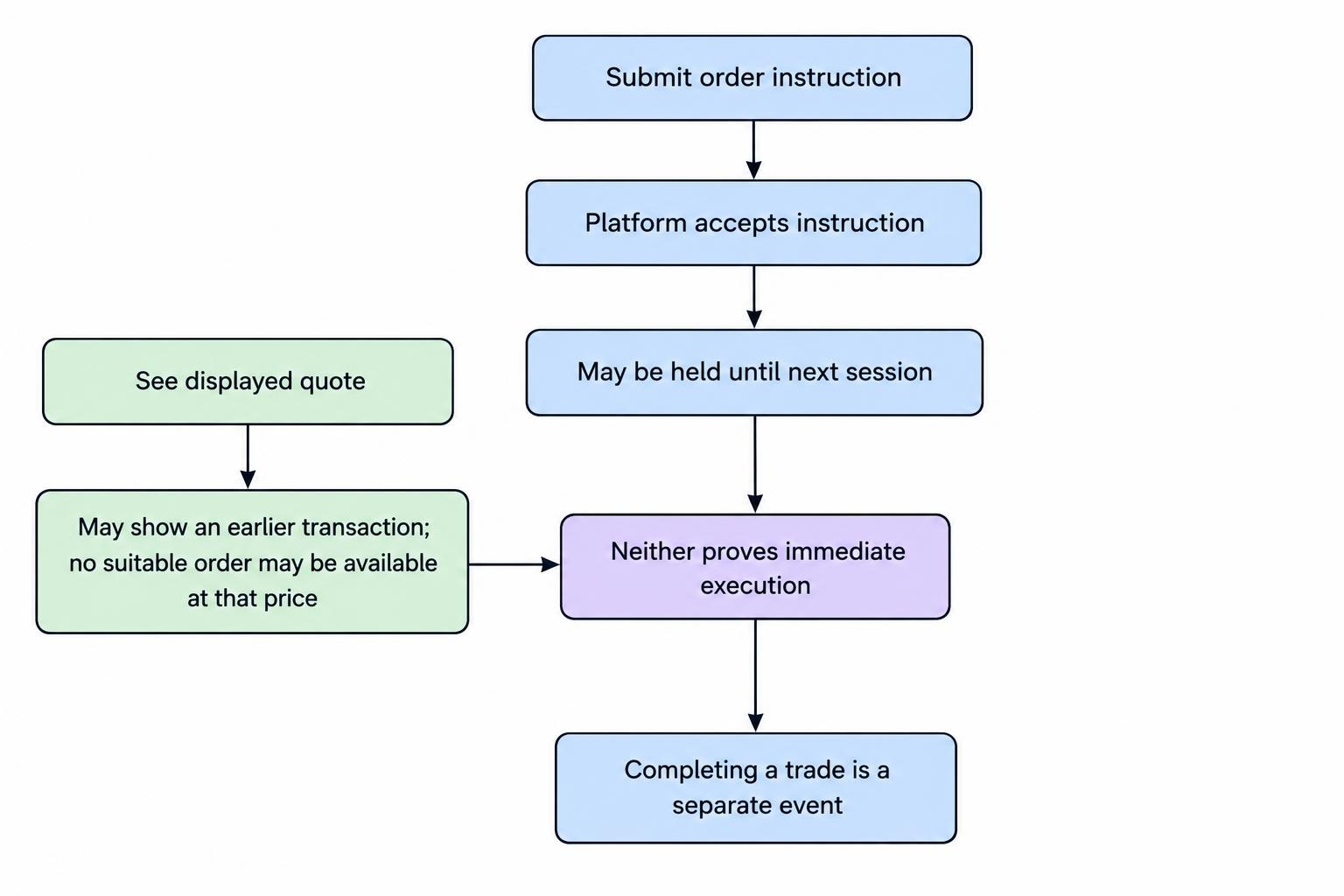
Keep three activities separate: submitting an order, seeing a quote and completing a trade. A platform might accept an instruction at night but hold it until the next session. A chart might display an earlier transaction while no suitable order is available at that price. Neither situation proves that you can trade immediately.
Also distinguish owning shares from holding a contract linked to their price. Buying a share creates a position in that security. A share based binary option instead pays according to a stated condition. The broader guide to share binary options covers that product distinction; here the focus is what changes outside the regular session.
US share trading hours and Australian time
On a normal Nasdaq trading day, the established sessions follow this schedule. These are exchange session times, not a promise that every broker offers access throughout them. Holidays and shortened trading days require a separate check against the Nasdaq trading hours and holiday schedule.
| Session | US Eastern Time | What to check |
|---|---|---|
| Pre market | 4:00 am–9:30 am | Whether the broker supports the full session and the chosen share |
| Regular session | 9:30 am–4:00 pm | Whether a chart includes or excludes surrounding sessions |
| After hours | 4:00 pm–8:00 pm | Eligible order types, routing and order expiry |
For Australian readers, convert the session for your city and the actual trading date rather than saving one permanent alarm. As a calculation example, if Sydney is 15 hours ahead of New York on the chosen date, the 4:00 pm–8:00 pm session becomes 7:00 am–11:00 am the following day. That example is not a year round timetable.
Record both dates when reviewing a trade or announcement. “Monday after the US close” and “Tuesday morning in Australia” can describe the same event. A journal containing only the Australian date can make the sequence look wrong.
Scheduled change: As of 21 October 2026, Nasdaq expects to introduce a further 9:00 pm–4:00 am ET session on 6 December 2026, subject to market data readiness and applicable regulatory changes. Its 23/5 trading information hub distinguishes that planned expansion from the existing schedule. Exchange expansion does not establish that an individual account will receive the same access.
How the ASX closing process differs
Do not apply the US timetable to Australian shares. ASX Trade uses a sequence of market phases rather than an equivalent four hour post market session.
Continuous trading ends at 4:00 pm Sydney time. A preparation phase follows before the closing single price auction, scheduled around 4:10 pm with a randomised start. During the Post Close phase, from 4:11 pm to 4:21:30 pm, orders can match at the closing auction price. The ASX cash market trading phases set out these timings and permitted activities.
That closing price matching period is not the same as a session in which prices continuously respond to fresh buying and selling. Nor does an order accepted later in the evening establish that it has executed.
When reviewing an Australian share after 4:00 pm, identify whether the displayed figure is a closing auction price, an actual later transaction or an indicative quote. Treating all three as interchangeable can produce a misleading account of what happened.
Why after hours prices can behave differently
Thin order books and wider spreads
Extended hours can bring lower liquidity, greater volatility and wider spreads. Orders may fill only partly or not at all. Different trading systems can also display different prices for the same security. These risks appear in FINRA’s extended hours risk disclosure requirements.
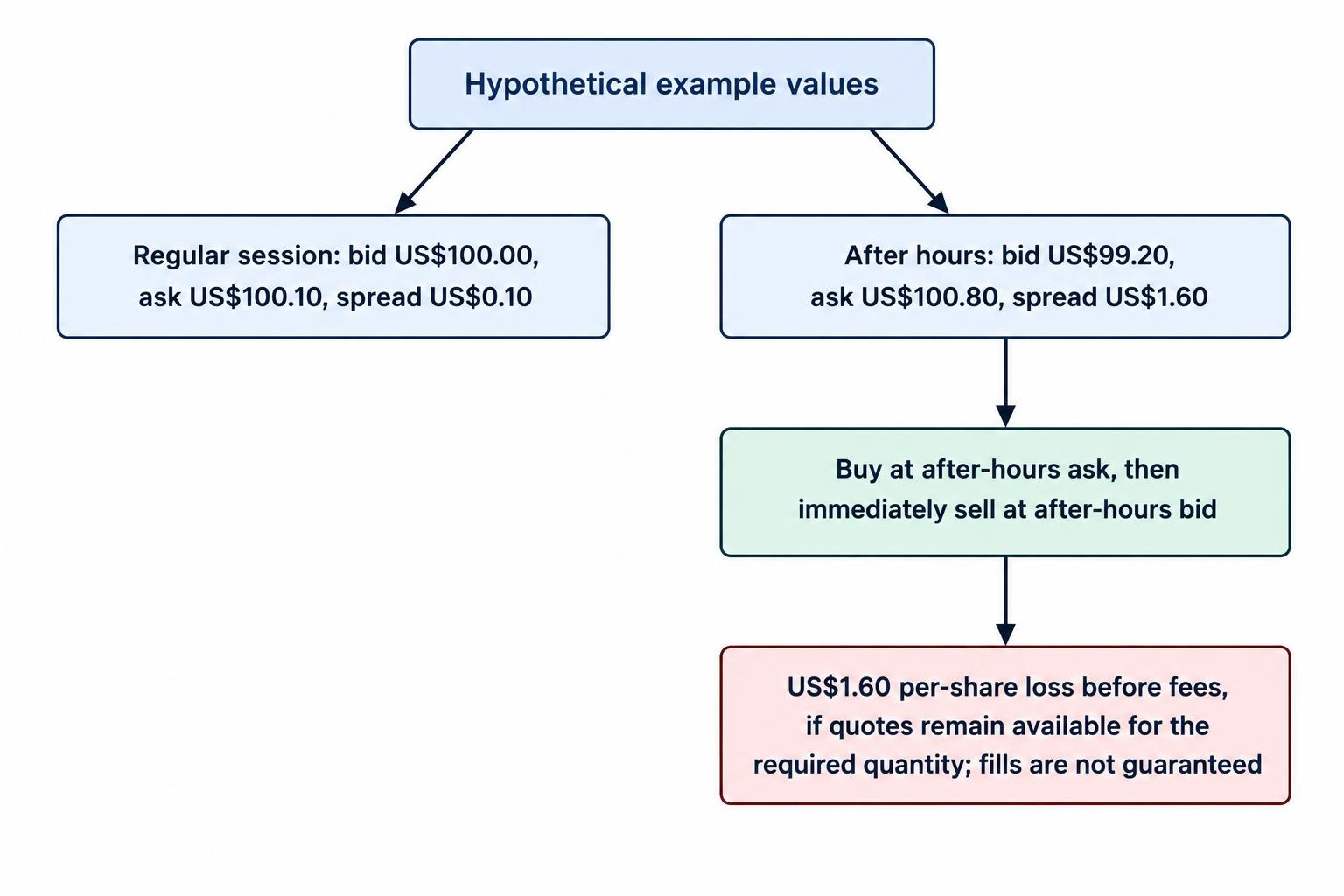
Consider a hypothetical US share with a bid of US$100.00 and an ask of US$100.10 during regular trading. The spread is US$0.10. After the close, suppose the bid falls to US$99.20 while the ask rises to US$100.80. The spread is now US$1.60.
A buyer paying US$100.80 who immediately sells at US$99.20 loses US$1.60 per share before fees, assuming those quotes remain available for the required quantity. A chart showing a last transaction at US$100.00 does not remove that cost. The last price is not a voucher redeemable at the order screen.
For analysis, compare the available quantity with the size of the proposed order. A quote for a handful of shares provides little evidence about the price available for a much larger transaction.
News can produce an unstable first reaction
Company announcements released outside regular hours can have an exaggerated price effect when liquidity is thinner. The initial move need not survive until the next opening.
In a hypothetical earnings release, a share might rise after the headline profit figure, then fall when investors examine weaker forecasts. A chart containing only the first response tells an incomplete story. The separate guide to earnings reports and company news covers the announcements themselves; the session question is whether the observed response occurred in a market that supported meaningful trading.
Which price are you actually looking at?
A share does not have one universal screen price for every purpose. A display may show the last completed transaction, the highest displayed buying price, the lowest displayed selling price or a calculated midpoint. Those figures answer different questions.
The regular session closing price also remains distinct from later transactions. After hours trading does not replace the regular close simply because a newer price appears. The SEC’s explanation of closing prices addresses why market data services can display different closing figures.
Before comparing two charts, check the instrument, timestamp, session settings and price field. One chart might stop at the regular close while another includes extended trading. A disagreement between them does not, by itself, demonstrate an error.
For a settlement review, preserve the relevant data rather than just taking a screenshot of a moving line. Record the named provider, the displayed time zone and whether the figure represents a transaction or a quote. The guide to price feeds and benchmarks examines how those choices affect comparisons.
What after hours trading means for share binary options
For historical analysis and paper exercises, treat the underlying share’s trading session and the binary contract’s terms as separate records. A live share quote does not establish that a binary contract is available, that its reference feed includes that session or that its settlement calculation uses the visible quote.
Take a hypothetical contract that asks whether a share will finish above US$101, using the regular session closing price. The share closes at US$100, then trades at US$103 after an announcement at 4:05 pm ET. Under that stated condition, the later rise does not turn the outcome into an above strike result.
Now change the hypothetical terms: the condition is evaluated at 4:30 pm using a named extended session transaction feed. The regular close alone no longer answers the question. The relevant observation is the one required by that contract at its stated evaluation time.
The guide to binary options settlement and ties covers outcome rules in more detail. For an after hours example, establish these points before calculating a result:
- Observation time: Which date, time and time zone apply?
- Reference price: Does the condition use a transaction, quote or regular closing value?
- Session coverage: Does the named feed include extended trading?
- Missing data: What do the terms require if no qualifying observation is available?
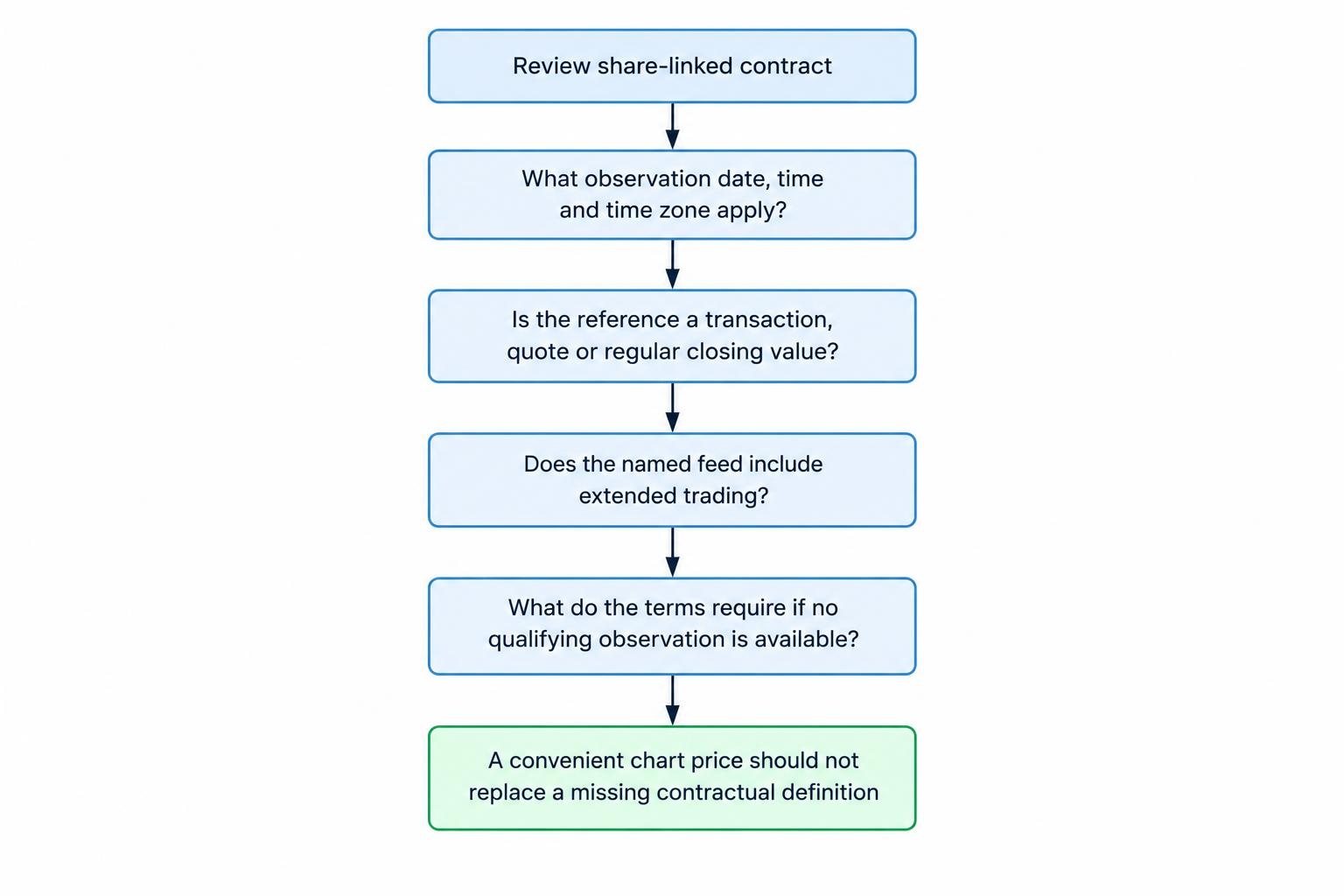
Without those answers, “the share went up” is not enough to verify an outcome. Do not substitute a convenient chart price for a missing contractual definition.
Order controls for ordinary share dealing
For investors buying or selling actual shares, the order instructions deserve as much attention as the price forecast. A limit order sets the highest buying price or lowest selling price you will accept. It controls the acceptable execution price, but does not guarantee a fill.
Check whether the broker accepts only limit orders during the chosen session, whether partial fills are possible and what happens to an unfilled instruction. Do not assume a regular session order carries into extended trading, or that an after hours order survives into the next day. The SEC’s after hours trading risk guide addresses these order handling questions.
A practical approach is to decide your maximum acceptable price before submitting the instruction. If the market moves away, reassess the decision rather than repeatedly lifting the limit just to obtain a fill. Completing a trade is not an achievement if the price invalidates the reason for making it.
Before entering a replacement order, check whether the original instruction has filled, partially filled or been cancelled. Treat an uncertain order status as something to resolve, not an invitation to click again.
How to study an after hours move without risking money
A paper review can test whether your interpretation survives the session change. Choose one share and one dated announcement. Record the regular closing price, the first subsequent transaction you can verify, the bid and ask if available, and the next regular opening price.
Keep observation separate from inference. “The last transaction increased by 2%” is an observation if supported by the data. “I could have bought before that increase” is a different claim, requiring evidence of an available selling price and sufficient quantity.
Use the same discipline in a hypothetical binary exercise. Write the strike, expiry and reference price rule before looking at the outcome. Otherwise it is too easy to select whichever price makes the forecast appear correct. A structured binary options paper trading process helps keep those assumptions visible.
After hours trading provides another period in which prices can form. It does not promise better prices, easier execution or a reliable preview of the next opening. If the session, quote or settlement rule is unclear, waiting is a valid decision. The market does not award attendance points.
This article was last updated on: October 22, 2026