Binary options expiry times set the deadline for a contract’s outcome. For a standard high-low contract, the question is not whether the market moves in the predicted direction at some point. It is whether the contract’s reference price meets the stated condition at expiry. Being right a minute too early, or a second too late, can still produce a losing result.
Australian retail restriction: ASIC’s ban on issuing and distributing binary options to retail clients took effect on 3 May 2021 and remains in force until 1 October 2031. The ASIC announcement extending the binary options ban sets out that restriction. The examples below explain contract mechanics, not an invitation to open an offshore account.
What Does an Expiry Time Determine?
An expiry time identifies when a contract ends, subject to any earlier termination allowed by its terms. For a high-low binary option, it normally fixes when the relevant price condition is assessed. A prediction that AUD/USD will finish above a strike at 12:05 UTC is different from a prediction that it will rise sometime during the afternoon.
Binary options exercise automatically; the holder does not make a separate exercise decision at the deadline or receive ownership of the underlying asset. The SEC’s binary options definition describes that automatic, cash-based outcome.
Three details belong together: the expiry date and time, the price condition, and the method used to establish the outcome. A deadline without a time zone is incomplete. A deadline without a pricing rule leaves another unanswered question: which price counts?
Fixed Duration Versus Fixed Expiry
A duration and an expiry time are related, but they are not interchangeable. Confusing them can change the period being assessed.
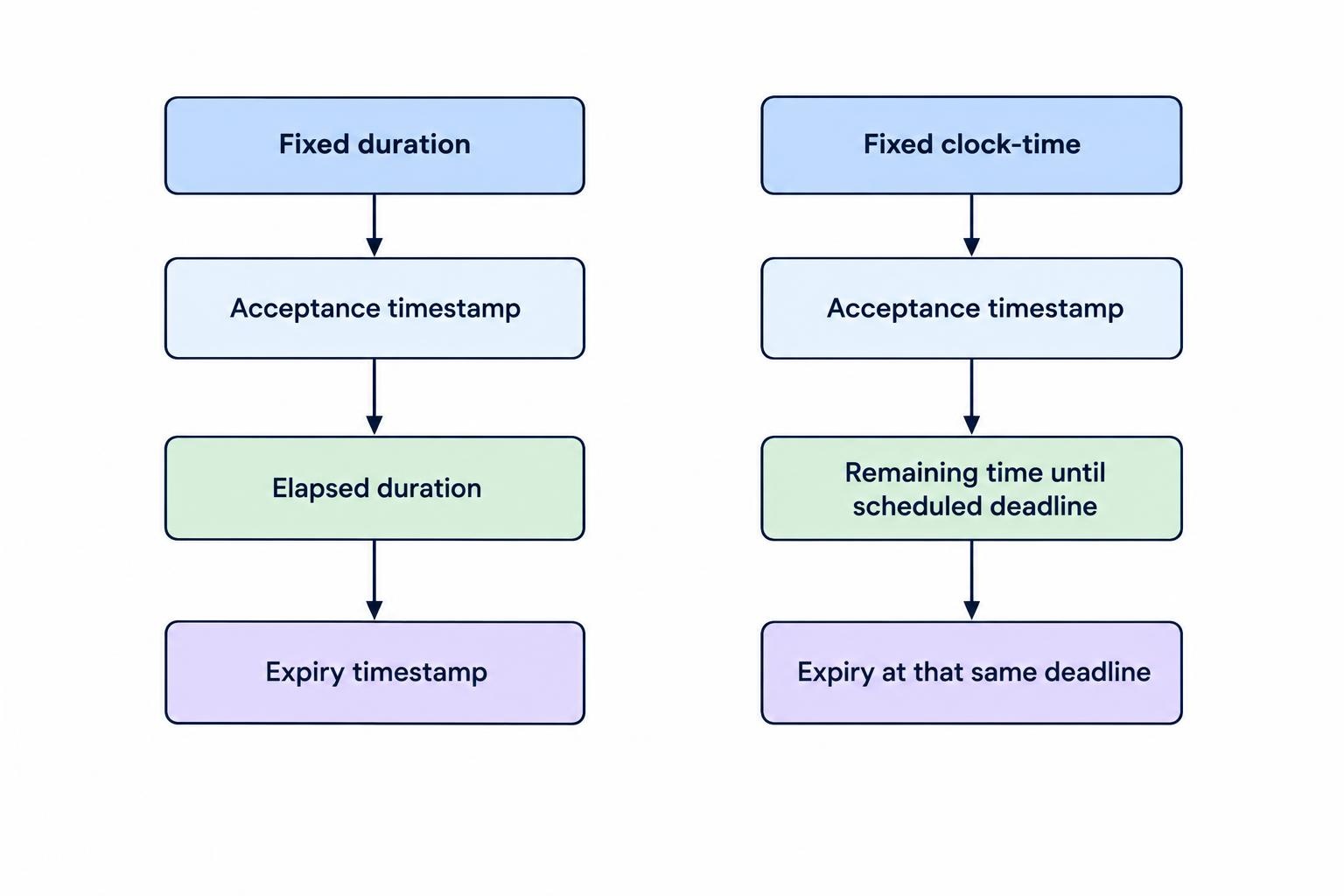
Fixed duration contracts
A fixed duration measures elapsed time from a defined starting point. If a hypothetical contract lasts five minutes from acceptance and is accepted at 10:02:15 UTC, it expires at 10:07:15 UTC.
The starting point matters. It could be the recorded acceptance time rather than the moment someone presses a button. Read the contract’s definition instead of assuming a displayed “five minutes” starts with the click.
Fixed clock-time contracts
A fixed expiry ends at a scheduled time, such as 10:05:00 UTC. Acceptance at 10:01 leaves four minutes. Acceptance at 10:04 leaves one minute. Both positions end at the same deadline.
A platform label can also describe a scheduled interval rather than the remaining life of a position. A contract grouped under “five minutes” might belong to a five-minute expiry cycle. That does not necessarily mean every accepted order remains open for five minutes.
The reliable comparison is the accepted start timestamp against the recorded expiry timestamp. The label is shorthand; those timestamps define the actual period.
The Purchase Cutoff Is Not the Expiry
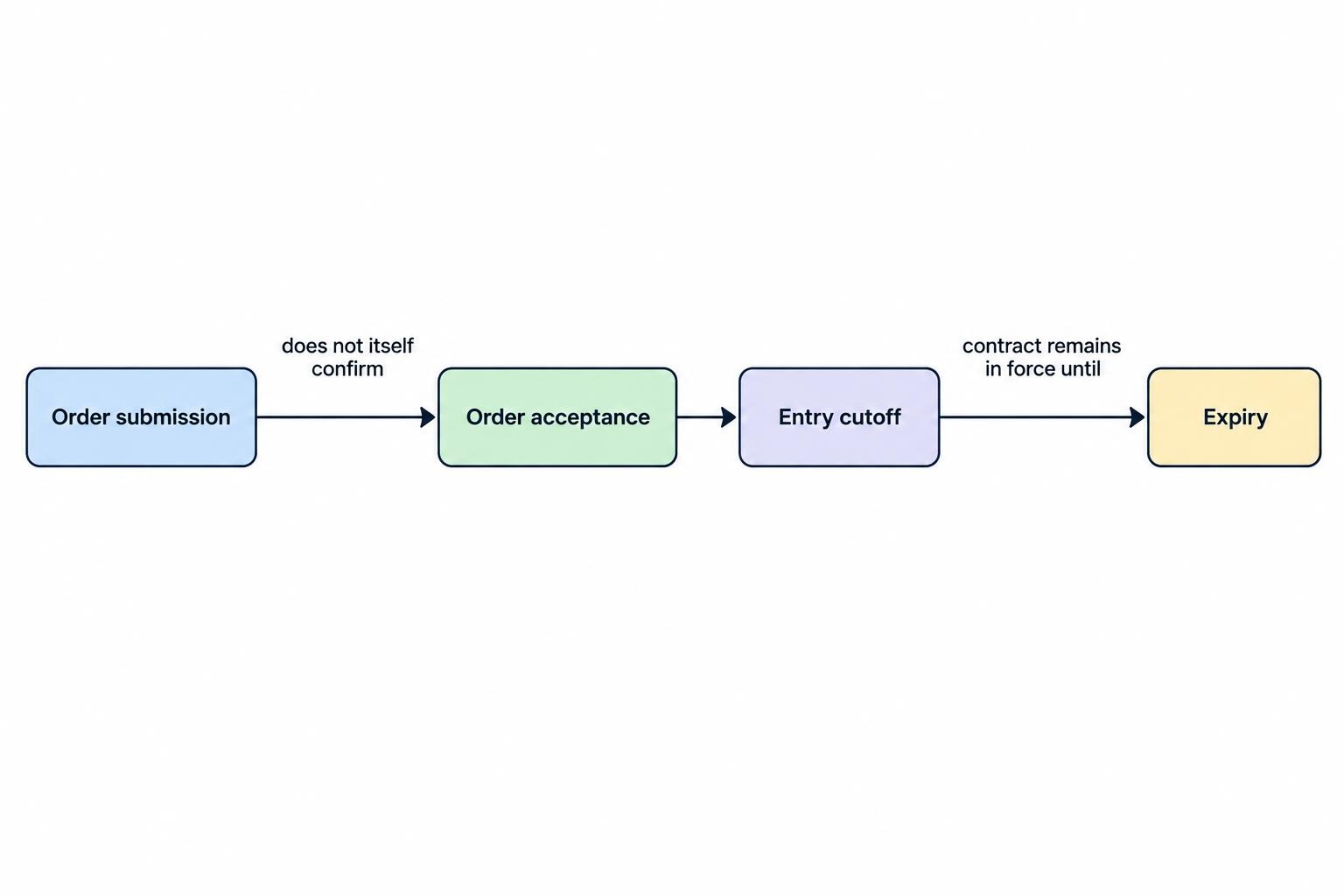
The last opportunity to enter a contract can occur before its expiry. In a hypothetical schedule, entry might close at 14:59:30 UTC while the contract expires at 15:00:00 UTC. Those final 30 seconds remain part of the contract even though new entries are no longer accepted.
Keep four timestamps separate: order submission, order acceptance, entry cutoff and expiry. A submitted request is not proof that a position exists, and a local countdown is not an acceptance record.
This distinction becomes more relevant as the remaining time shrinks. A two-second difference occupies a much larger share of a 30-second contract than a one-hour contract. The guide to binary options execution and latency covers the gap between requesting an order and receiving confirmation.
A Worked Expiry Example
Consider an illustrative AUD/USD high-low contract accepted at 12:00 UTC. Its condition is that the settlement price must be strictly above 0.65000 at 12:05 UTC. Assume the rules use a single observation at that deadline.
| Observation time | Illustrative reference price | Effect on the outcome |
|---|---|---|
| 12:02 UTC | 0.65030 | Above the strike, but the contract has not expired. |
| 12:05 UTC | 0.64998 | The condition fails at the stipulated observation. |
| 12:06 UTC | 0.65040 | The later rise does not change the expired contract. |
The market moved above the strike before expiry and again afterwards. Neither observation rescues this contract. Its condition concerned the price at 12:05, not the highest price reached during the surrounding minutes.
These figures are invented teaching examples, not historical quotes. They show why a broadly correct market view and a correct binary outcome are different things. The forecast needs to fit the deadline, not just the direction.
Chart Timeframes Do Not Set Contract Expiry
A one-minute candle groups price activity into a one-minute period. A one-minute binary option defines a contractual period or scheduled deadline. Matching labels do not make them the same clock.
Suppose a chart candle runs from 10:00:00 to 10:01:00. A hypothetical 60-second contract accepted at 10:00:38 and measured from acceptance would end at 10:01:38. It crosses the candle boundary and continues into the next candle.
This also matters when studying signals. A signal calculated from a completed candle cannot fairly be treated as available before that candle closes. If the analysis uses the closing price, the assumed entry must follow that information becoming available.
There is no universal rule that expiry should equal one candle, three candles or any other convenient multiple. Such a relationship is a testable assumption, not a property of binary options.
Not Every Contract Waits for the Final Price
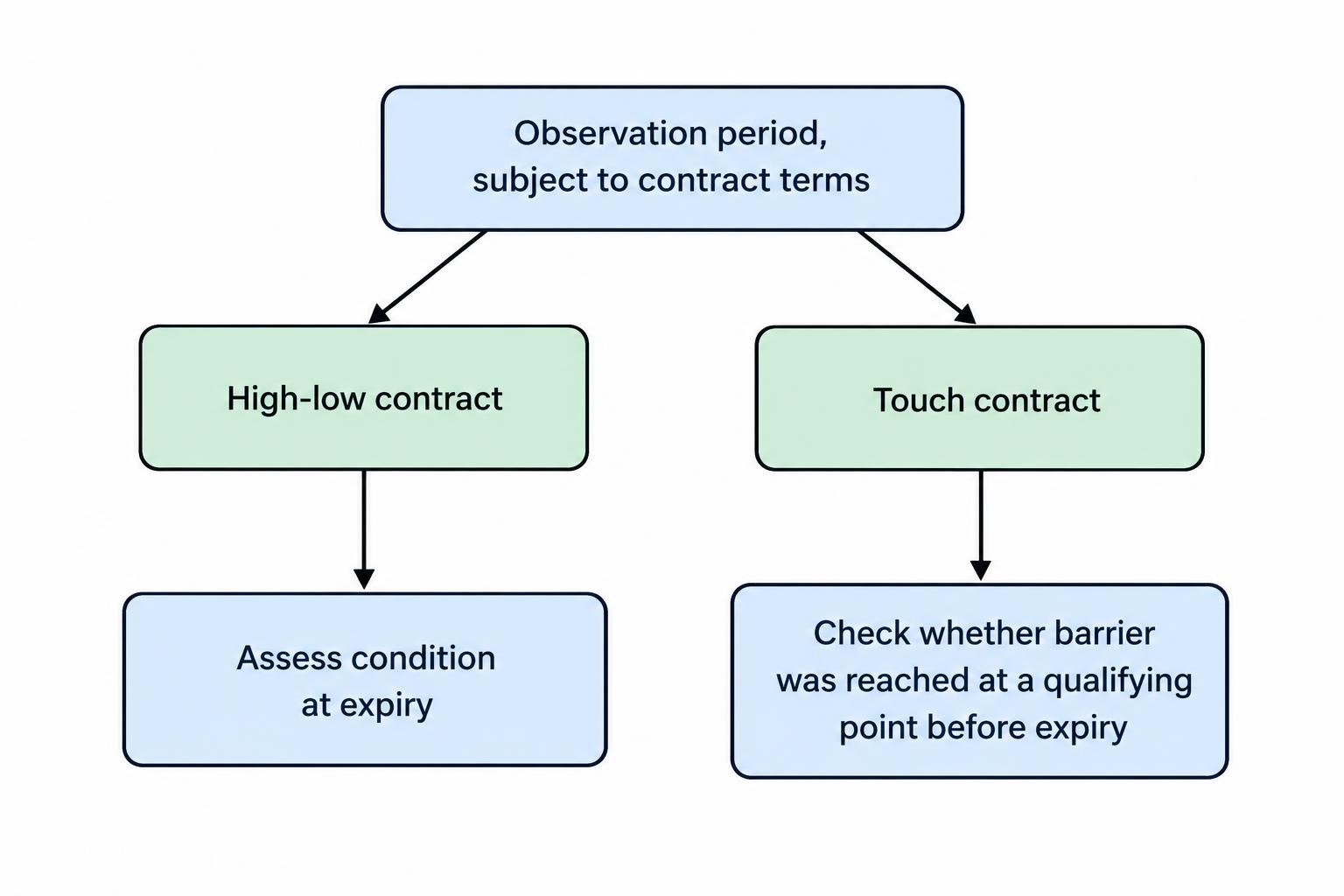
Expiry has a different role in contracts that monitor events throughout an observation period. A high-low contract may assess a condition at the deadline. A touch contract may instead ask whether a barrier was reached at any qualifying point before that deadline.
The distinction between a condition applying at a time and at or before that time appears in ASIC’s public notice defining the covered binary options arrangements.
Do not transfer the worked example’s final-price logic to every product. Check when observation begins, whether it is continuous or scheduled, and whether satisfying a condition determines the result before expiry. Determining an outcome early does not necessarily mean the cash payment arrives immediately.
Time Zones and Daylight Saving
Record the expiry date, time zone and UTC offset together. “Expires at 4 pm” is not enough when the platform, market and account holder use different clocks.
Australia does not follow one shared daylight saving schedule. Queensland, the Northern Territory and Western Australia do not observe daylight saving, while several other states and territories do. Overseas clock changes can occur on different dates. The Reserve Bank of Australia’s daylight saving schedule provides the relevant Australian and overseas dates.
For record keeping, retain both the original timestamp and its UTC equivalent. Include the date, because converting between zones can move an expiry into the previous or following calendar day.
Check whether a platform displays local device time, server time or a selected account time zone. Changing a chart’s display settings should not be assumed to change the contract’s deadline. Confirm the timestamp on the contract record rather than reading it from an axis label.
How Short and Long Expiries Differ
Short expiries compress the decision window
With less time remaining, there is less room for a forecast to develop before assessment. A brief reversal close to the deadline may decide a high-low outcome even if the wider price trend remains unchanged.
Short durations also make timing assumptions harder to ignore. An entry recorded several seconds later than expected, or a signal received after its intended start, can leave a materially different observation period. A faster countdown is not evidence of a better opportunity.
Longer expiries change the exposure
A longer contract gives the price more time to move, but also more time to reverse. Its life may cross an economic announcement, a session change or a market closure. Whether those events matter depends on the underlying asset and the contract’s pricing rules.
Longer does not automatically mean safer or more accurate. A forecast about the next few minutes cannot simply be stretched into a forecast about tomorrow. The entry price, strike, payout and future events all remain relevant.
The useful question is: what should happen before this deadline, and what evidence would contradict that expectation? “More time feels safer” is not a measurable answer.
Expiry Does Not Fix an Unfavourable Payout
Changing the deadline does not remove the effect of an uneven win-and-loss structure. Consider a hypothetical contract that risks A$100 to earn A$80 in net profit, with the full stake lost on an unsuccessful outcome.
Ignoring fees and ties, its break-even success rate is 100 divided by 180, or approximately 55.56%. That arithmetic applies whether the contract lasts one minute or one hour. Expiry matters only through its effect on the outcomes and terms being assessed.
A higher observed success rate at one expiry may still be less attractive if the offered payout is lower. Compare both rather than ranking durations by wins alone. The guide to probability and expected value in binary options develops that calculation.
Nor does an expiry create an edge by itself. “Five minutes” describes a deadline. It says nothing about whether the prediction has an advantage.
How to Assess an Expiry in Historical Research
Define the timing rule before reviewing results. Otherwise, it is easy to select whichever deadline would have worked after seeing the price path. That tests hindsight rather than the original idea.
A useful research record identifies the signal time, earliest realistic entry, strike, expiry rule, outcome reference and assumed payout. It should also state how missing observations and exact ties are handled.
Test a small, justified set of durations rather than searching hundreds until one looks impressive. Then assess the chosen rule on data that did not influence its selection. The guide to backtesting binary options strategies covers the wider research process.
Match the data resolution to the question. Minute-level closing prices cannot establish every second-by-second expiry result. A candle’s high and low also do not reveal the order in which those prices occurred.
If the available data cannot reproduce the contract’s observation method, mark the result as unresolved. Filling gaps with favourable assumptions makes a spreadsheet look healthier, not the evidence.
Expiry, Settlement and Account Credit Are Separate
Expiry ends the contractual period. Settlement establishes the outcome and amount payable under the agreed rules. Account credit records the resulting balance change. These events need not appear simultaneously on a screen.
Check whether the rules use one observation, a defined averaging period or another published method. Also check what happens when the reference value equals the strike exactly. A rounded chart label may hide precision used in the contractual calculation.
The guide to binary options settlement and ties addresses those outcome rules. For expiry analysis, the practical point is narrower: comparing the wrong price or timestamp can invalidate the result, even when the time calculation itself is correct.
Can an Expiry Time Change?
Do not assume an accepted expiry can be extended. Any early-close, rollover or amendment feature needs its own disclosed terms. A change may require another payment, alter the payout or create a different exposure; it is not simply extra time at no cost.
An unexplained moving deadline is a separate concern. The joint CFTC and SEC alert on binary options fraud records complaints alleging that platforms arbitrarily extended winning trades’ countdowns until they became losses.
That warning does not mean every delayed display proves manipulation. Preserve the accepted contract details, timestamps and transaction history. Those records provide a firmer basis for assessing a discrepancy than memory of a disappearing countdown.
Before Interpreting Any Expiry
A short contract specification should answer five questions:
- What exact date, time and time zone define the deadline?
- Does the period run from acceptance or end at a scheduled time?
- When does entry close?
- Is the condition assessed at expiry or throughout an observation period?
- Which reference value and equality rule determine the outcome?
If any answer is missing, the expiry is not fully defined for analysis. Resolve the contract terms before judging the forecast. A countdown tells you how long remains; it does not tell you what will happen next.
This article was last updated on: October 22, 2026