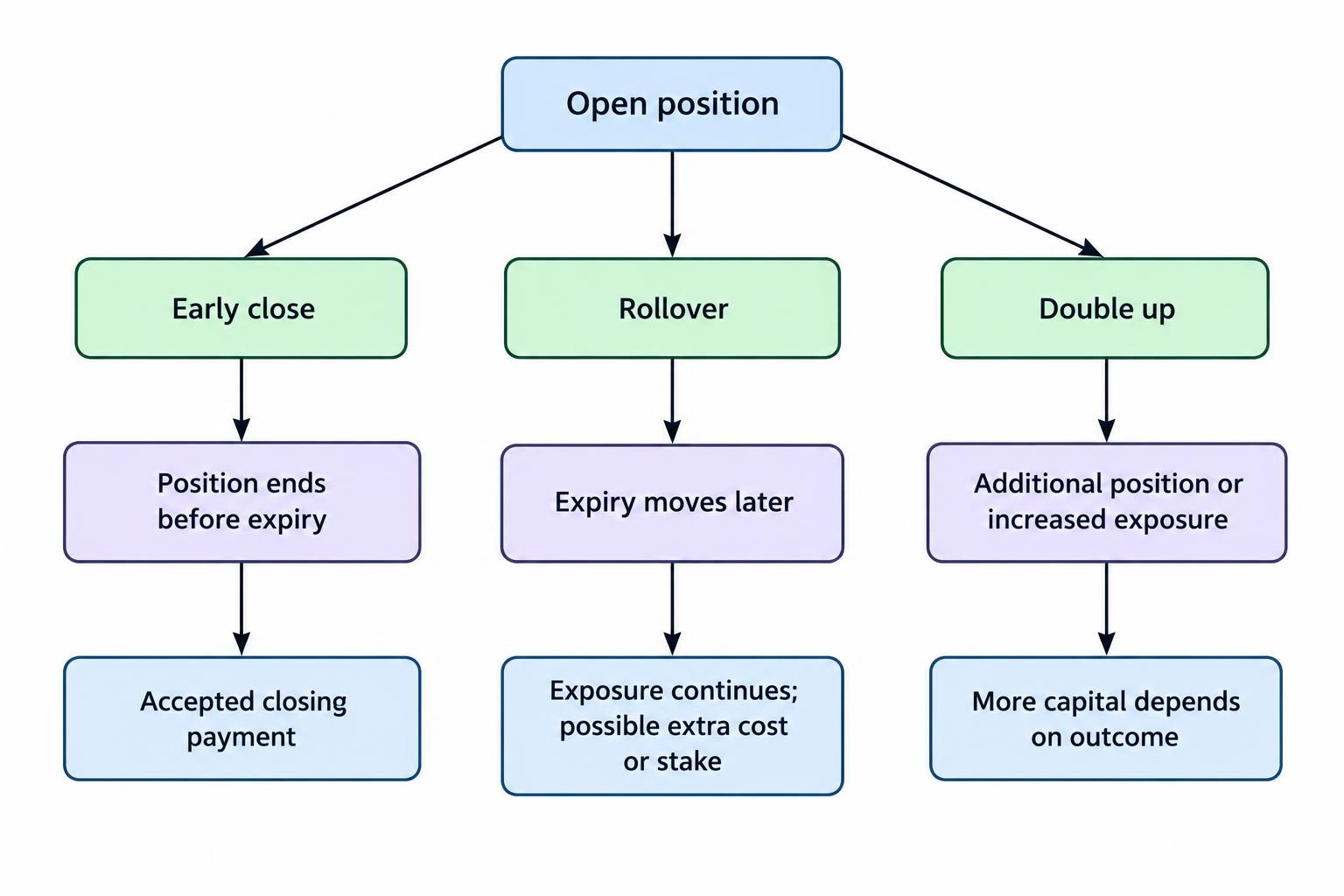
Early close, rollover and double up change what happens after a binary option has been opened. Early close ends the position before expiry. Rollover moves the expiry later, potentially with an extra charge or stake. Double up adds another position, increasing the amount exposed to the outcome.
These features are not interchangeable risk controls. One can remove exposure; the other two can extend or increase it. The label on the button matters less than the contract terms behind it.
For Australian readers, the regulatory position comes first: ASIC’s prohibition on issuing and distributing binary options to retail clients took effect on 3 May 2021 and runs until 1 October 2031. The ASIC announcement extending the retail binary options ban confirms those dates. This article explains contract mechanics, not a route around that restriction.
How the three features differ
| Feature | What changes | Main financial consequence |
|---|---|---|
| Early close | The existing position ends before its scheduled expiry. | An accepted closing amount replaces the uncertain expiry payment. |
| Rollover | The expiry moves to a later time under the provider’s terms. | The position remains exposed, potentially with more money committed. |
| Double up | Another position is opened or exposure is otherwise increased. | More capital depends on the market outcome; the new entry terms may differ. |
These are platform labels, not standardised contractual rights. A feature may be absent, available only during a stated window, or subject to conditions. Never assume that an explanation for one platform applies to another.
All cash examples below use Australian dollars and hypothetical terms. They illustrate the arithmetic, not current offers or available Australian retail products.
Early close: ending the position before expiry
Early close, sometimes labelled sell out or cash out, replaces the remaining contract exposure with an agreed closing payment. Once the close is confirmed, subsequent market movements no longer determine the payment on that position.
The closing amount is not necessarily the original stake, the advertised winning payout, or a percentage of the underlying asset’s price movement. It is the amount offered under the closing mechanism.
Separate the closing payment from profit
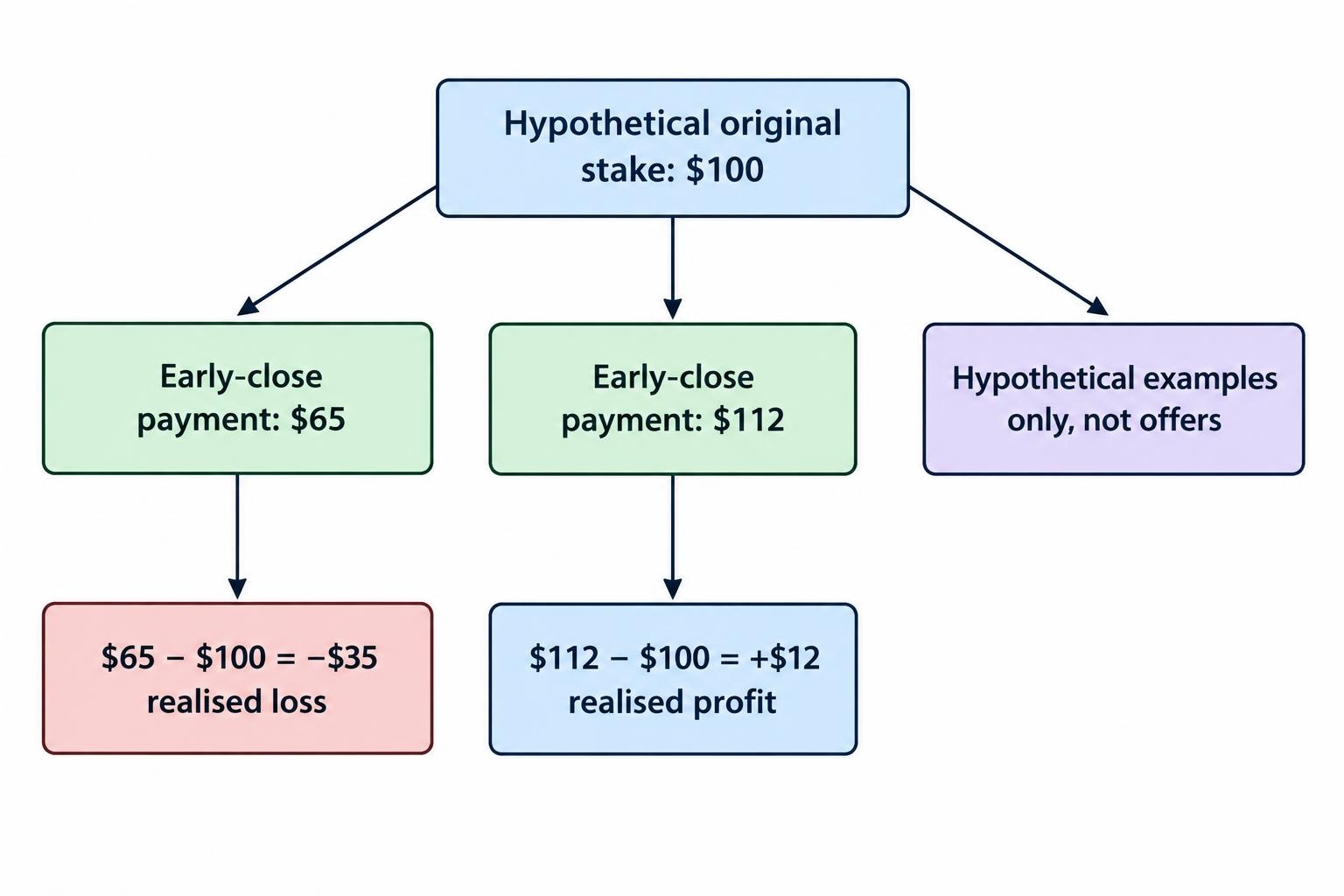
Suppose a hypothetical binary option costs $100. A successful expiry returns $180 in total: the $100 stake plus $80 profit. An unsuccessful expiry returns nothing.
If an early close returns $65 to the account, the realised result is a $35 loss. Recovering part of the stake is better than losing all of it, but it is still a loss. If the closing payment is $112, the realised profit is $12, not $112.
This distinction also applies when the underlying price is currently on the favourable side of the strike. A position can be “in the money” at that moment without having a profitable closing quote. It still has time to finish unsuccessfully, and the closing mechanism may price that uncertainty differently from the displayed expiry payout.
Why the closing quote can disappoint
Distance from the strike, remaining time and uncertainty about the final result all affect the economics of an unfinished binary option. However, a provider’s quote should not be mistaken for a neutral estimate of fair value. Binary option providers control their product pricing, a risk highlighted in ASIC’s warning about binary option apps and provider pricing.
A simple hypothetical comparison helps. If the final payment is either $180 or zero, and the probability of receiving $180 were genuinely 60%, the expected gross payment would be $108 before costs and discounting. A $100 closing quote would offer certainty, but it would be $8 below that estimated expected payment.
The difficult part is not multiplying 0.60 by $180. It is justifying the 60% estimate. A recent price move, a green position indicator or confidence in a chart pattern does not establish a reliable probability. The distinction is covered further in probability and expected value in binary options.
Early close is not a guaranteed stop loss
A discretionary closing facility is different from a standing instruction that triggers an exit under stated conditions. Its usefulness depends on whether a quote is available, how long that quote remains valid, and whether the request is accepted before the cutoff.
Pressing the button is not the same as receiving confirmation. A rejected or expired request leaves the original position open. Any assessment of potential losses should therefore retain the full amount at risk until the close has actually completed.
The separate guide to stop losses and early exit examines that distinction. The practical point here is narrower: an optional exit facility does not guarantee that a $100 position can always be closed for a chosen maximum loss.
Rollover: changing the deadline, not erasing the risk
Rollover extends a binary option’s expiry under the applicable terms. Consider a hypothetical “above” contract opened at 2:00 pm with a 2:05 pm expiry. A rollover might move settlement to 2:10 pm, while retaining the original strike. Whether the strike stays unchanged must be checked, not assumed.
This is an amendment to the timing of the outcome. It is not the overnight financing charge sometimes called rollover in other trading products.
Changing the deadline changes the question being answered. “Will the price finish above the strike at 2:05 pm?” and “Will it finish above the strike at 2:10 pm?” are different propositions. The guide to binary options expiry times covers why that timing matters.
An added stake and a fee have different effects
Suppose the original stake is $100 and the winning return is $180. Now assume that extending the contract requires another $30. What happens to that $30 determines the revised economics.
If it becomes part of a $130 stake that earns the same 80% net winning return, successful settlement returns $234. Profit is $104, while an unsuccessful settlement loses $130.
If the $30 is instead a non-refundable extension fee and the winning payment remains $180, success produces only $50 profit after the original stake and fee. Failure loses $130. The same extra payment has produced a very different contract.
In the fee example, the break-even success rate rises to approximately 72.22%, calculated as $130 divided by $180. By comparison, the original $100 contract paying $180 required approximately 55.56%, assuming no refunds, ties or other costs. These are illustrative calculations, not universal rollover charges.
More time does not automatically improve the position
A later expiry creates another possible settlement outcome. It does not guarantee a recovery. The market could reverse before the original deadline, reverse after it, or continue moving against the position throughout the extension.
Rollover also leaves the original capital exposed for longer. If extra money is required, the amount that can be lost increases as well. Calling it “giving the trade room” does not change that arithmetic.
Distinguish an authorised extension from an unexplained change to the countdown. The joint SEC and CFTC alert on binary options fraud records allegations of platforms arbitrarily extending winning trades until they became losses. That is not the same as a customer accepting disclosed rollover terms.
Double up: another position, not a better original entry
Double up generally describes adding exposure in the same direction, often through a second contract. The original position does not become more likely to win because another one has been opened.
The new contract may match the asset, direction, stake and expiry while using the price available at the new entry time. Its strike and payout therefore need checking independently. “Duplicate” can describe the order settings without meaning that the two contracts have identical settlement conditions.
Two similar contracts can settle differently
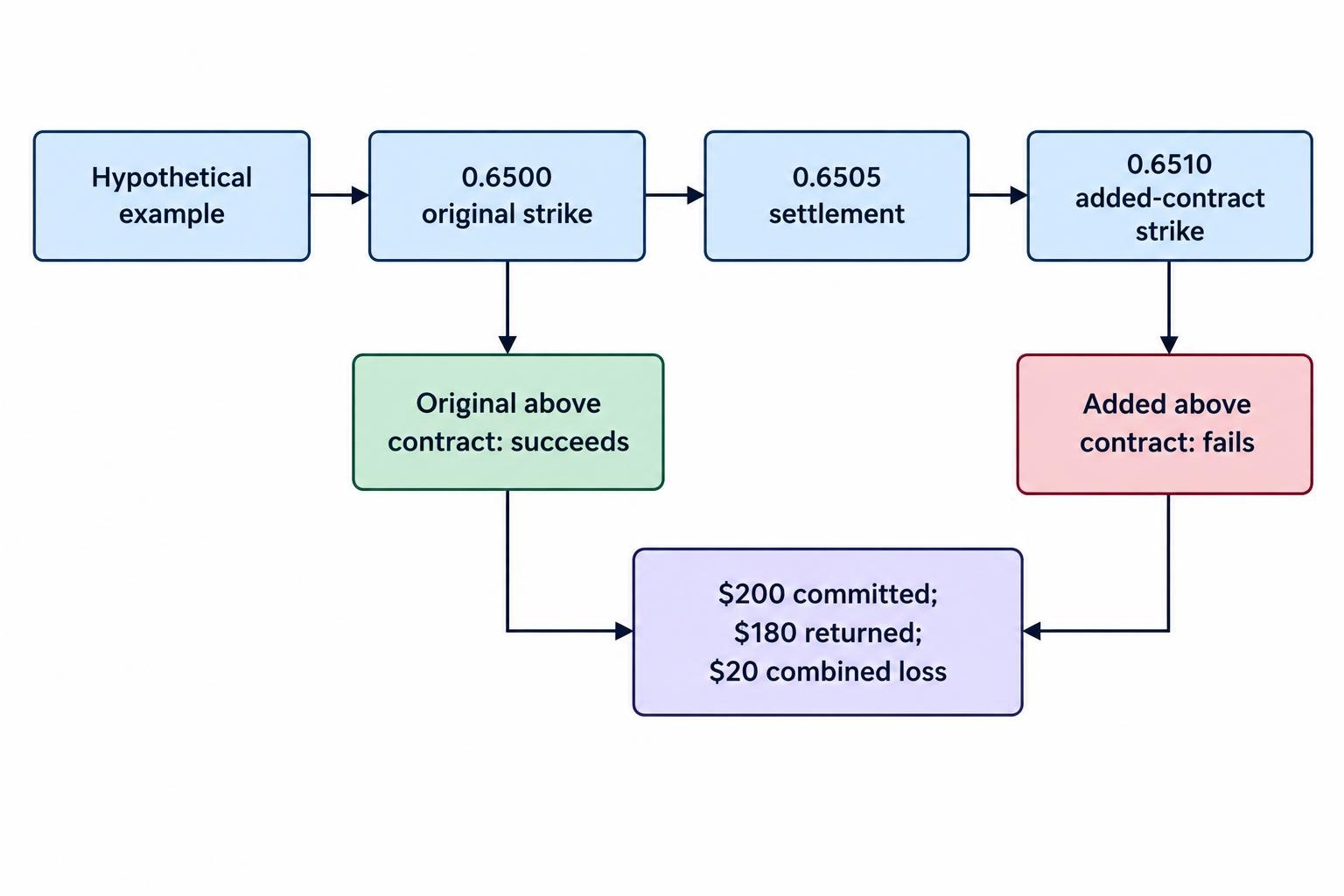
Consider two hypothetical AUD/USD “above” contracts, each costing $100 and paying $180 on success. Both expire at 2:05 pm:
The first opens with a strike of 0.6500. After the exchange rate rises, a double up action opens the second with a strike of 0.6510. At expiry, the settlement rate is 0.6505.
The original contract succeeds because 0.6505 is above 0.6500. The second fails because 0.6505 is below 0.6510. Across both contracts, $200 was committed and $180 was returned. The combined result is a $20 loss, even though the original trade won.
If both succeeded on those assumed terms, combined profit would be $160. If both failed, the loss would be $200. The larger possible profit comes with a larger possible loss, it is not an improvement delivered free of charge.
Related positions do not provide diversification
Two contracts tied to the same asset, direction and expiry depend heavily on the same price movement. Different strikes can produce different outcomes, but that does not make them independent risks.
A useful assessment therefore considers the combined amount exposed, rather than treating each ticket as a separate small commitment. The guide to correlation and trading risk develops this point across related positions and markets.
Double up also differs from a Martingale sequence. It can add exposure while an earlier position remains open; Martingale usually refers to increasing stakes after losses. Either approach can enlarge losses, but their order structure and timing are different.
How these features change performance figures
Early close changes the amount actually won or lost. Rollover can change costs, capital committed and settlement time. Double up adds another result. A performance record that ignores those changes can make a method look better than its cash results justify.
Suppose a hypothetical record has an average realised profit of $40 per winning position and an average loss of $100 per losing position. Its break-even win rate is approximately 71.43%: $100 divided by $140. An advertised 80% expiry profit does not describe that realised record if positions were regularly closed for smaller gains.
That calculation does not prove early closing is harmful. Early exits might also reduce average losses. It shows why both sides of the record matter. Win rate alone cannot reveal whether these features helped.
A trading journal should preserve the original contract and each later action. Useful fields include:
- Original stake, strike, expiry and winning payment.
- Closing amount requested and the amount actually confirmed.
- Rollover charges, added stake and revised contract terms.
- Each additional position’s entry price and amount committed.
- Total cash committed, total cash returned and final net result.
For analysis, group related positions as well as recording them separately. Otherwise, one winning original contract and one losing duplicate can appear as a respectable 50% win rate while concealing a negative combined return.
Does early close change the Australian restriction?
No. The possibility of receiving a payment before expiry does not, by itself, take an otherwise covered contract outside the Australian binary options definition. Section 4 expressly includes qualifying arrangements that allow early termination and a payment to the holder. The wording appears in the ASIC binary options product intervention instrument.
An early close button should therefore not be treated as evidence that a product is permitted for Australian retail distribution. Nor do rollover and double up establish regulatory approval. Platform functionality and legal authorisation are separate questions.
Assess the revised commitment, not the button label
The useful question is what remains at risk after the action. A confirmed early close ends the position for the accepted payment. Rollover keeps capital exposed until a later deadline and may require more money. Double up increases exposure through an additional or enlarged commitment.
Before interpreting any historical example or performance claim, establish the revised stake, strike, expiry, total winning payment and maximum loss. If those figures are unclear, the effect of the feature is unclear too. A convenient button does not make an uncertain contract easier to value.
This article was last updated on: October 22, 2026