Deposit and withdrawal fees reduce the money available to trade and the amount returned to your bank account. The advertised platform charge is only part of the calculation. Payment providers, banks and currency conversion can add costs elsewhere in the transfer.
For Australian readers, the regulatory position comes before any fee comparison. ASIC’s prohibition on issuing and distributing binary options to retail clients took effect on 3 May 2021 and has been extended until 1 October 2031. A cheap payment method does not change that restriction. See the ASIC announcement extending the binary options ban.
This guide explains how to assess payment charges, reconcile existing account transactions and distinguish disclosed fees from suspicious demands for more money. It does not recommend depositing with an offshore provider.
What Deposit and Withdrawal Fees Actually Cover
A deposit fee is a charge associated with adding money to an account. A withdrawal fee applies when money leaves it. Neither label tells you who collects the charge, whether it is deducted from the transfer or billed separately, or what happens after the payment reaches another provider.
Separate the possible charges before comparing totals:
| Cost layer | What to check | Where to look |
|---|---|---|
| Platform deposit charge | Does the full payment become available account cash? | Deposit terms and transaction confirmation |
| Platform withdrawal charge | Is the fee deducted from the requested amount or charged on top? | Withdrawal schedule and payment receipt |
| Bank or card charge | Does the payment attract an international transaction or other fee? | Issuer’s fee schedule and account statement |
| Intermediary or receiving charge | Could another institution deduct money during the transfer? | Transfer quote and receiving bank’s terms |
| Wallet or crypto transfer cost | What does it cost to fund, send, receive and cash out? | Provider’s quote and transaction record |
| Currency conversion | What exchange rate applies, and is there a separate conversion charge? | Conversion quote and completed payment record |
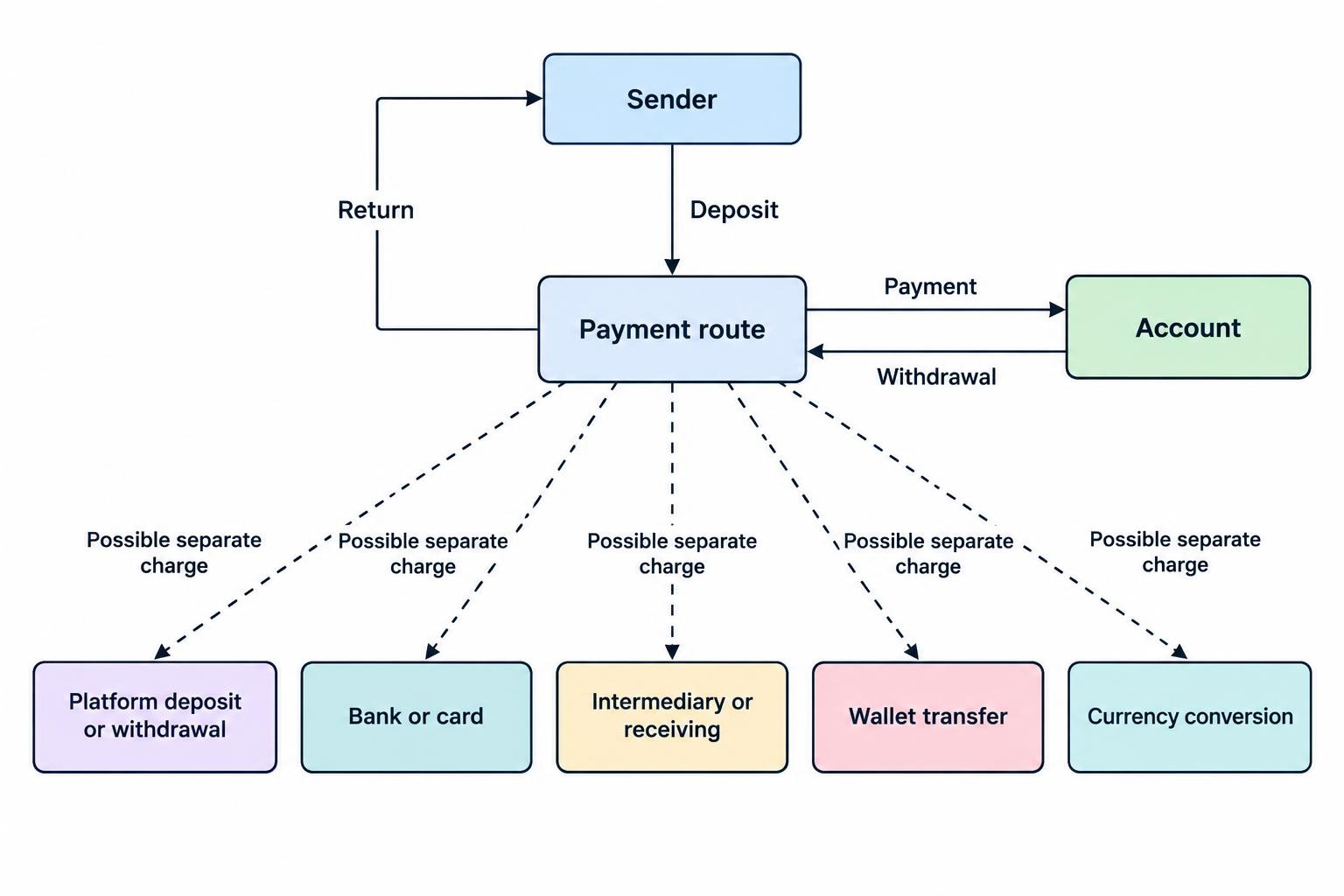
“No deposit fee” may describe only the platform’s own charge. It is not a promise that every organisation handling the payment will work for nothing.
These payment expenses sit alongside contract economics and other account charges. The broader binary options trading costs guide separates those categories so that the same expense is not counted twice.
How Fee Structures Change the Calculation
Fixed fees
A fixed fee takes a larger percentage from a smaller transfer. Under a hypothetical A$10 withdrawal charge, withdrawing A$100 costs 10% of the requested amount. Withdrawing A$1,000 costs 1%.
That arithmetic can make fewer, larger withdrawals appear cheaper. It does not justify depositing more money or leaving funds with a provider you do not trust. Saving a transfer fee is a poor trade if it increases the amount exposed to a withdrawal dispute.
Percentage fees, minimums and caps
A percentage charge scales with the transfer amount, but minimum fees can change the result. Suppose a hypothetical schedule charges 2%, subject to a minimum of A$5. A A$100 withdrawal would cost A$5 rather than A$2, making the effective rate 5%. A A$1,000 withdrawal would cost A$20.
A maximum fee can work in the opposite direction by capping the charge on a larger payment. Check whether the cap covers the complete transaction or only one provider’s portion.
For overseas payments, the comparison should include the exchange rate, flat or percentage charges, and any receiving fees. These are separate checks in Moneysmart’s guidance on comparing international money transfers.
Charges added versus charges deducted
If a A$500 withdrawal carries a A$10 fee, two different outcomes are possible. The account could be debited A$500 and the recipient receive A$490. Alternatively, the account could be debited A$510 and the recipient receive A$500. Confirm which interpretation applies before reconciling the transaction.
How the Payment Route Affects the Bill
Card payments
An amount displayed in Australian dollars does not automatically avoid international transaction fees. Card providers may charge them for payments involving overseas merchants or overseas processing, even when the transaction uses AUD. Moneysmart’s definition of an international transaction fee makes that distinction explicit.
Ask the card issuer how it would classify the payment rather than relying on the platform’s description. Confirm the applicable fees and whether any cash advance terms would apply. The platform’s deposit receipt cannot establish what your card issuer will charge separately.
When reviewing an existing payment, match the transaction amount, currency and posting date against the bank statement. Keep any separately posted fee attached to that payment in your records.
International bank transfers
An international bank payment can pass through one or more correspondent banks before reaching its destination. Those additional steps can increase both cost and delivery time, as set out in the RBA’s review of cross-border payments.
Ask whether the quoted receiving amount is guaranteed or estimated. Also establish who bears any intermediary charges. A sending confirmation showing the original amount does not, by itself, prove that the recipient received that amount.
Digital wallets and cryptocurrency
For a wallet payment, calculate the complete sequence: funding the wallet, transferring to the platform, receiving a withdrawal and moving the balance back to your bank. Compare the sequence rather than one attractive fee in the middle.
For a crypto payment, request or record the cost at each step: acquiring the asset, sending it, receiving it, selling it and withdrawing cash. Keep transfer charges separate from changes in the asset’s price. A fall in value during the process is not a withdrawal fee, although it still affects the amount recovered.
A Worked Example: Account Profit Versus Cash Profit
The following example uses an invented fee schedule, not a current broker offer. All amounts are in Australian dollars, there is no currency conversion, and the entire account balance is withdrawn at the end.
You pay A$1,000 from your bank account. A A$20 deposit fee is deducted from that payment, leaving A$980 available in the trading account.
The account then records A$100 of net trading profit. Its balance becomes A$1,080. A A$10 withdrawal fee is deducted when the account is emptied, so A$1,070 reaches your bank.
Cash result = A$1,070 received − A$1,000 paid = A$70 profit.
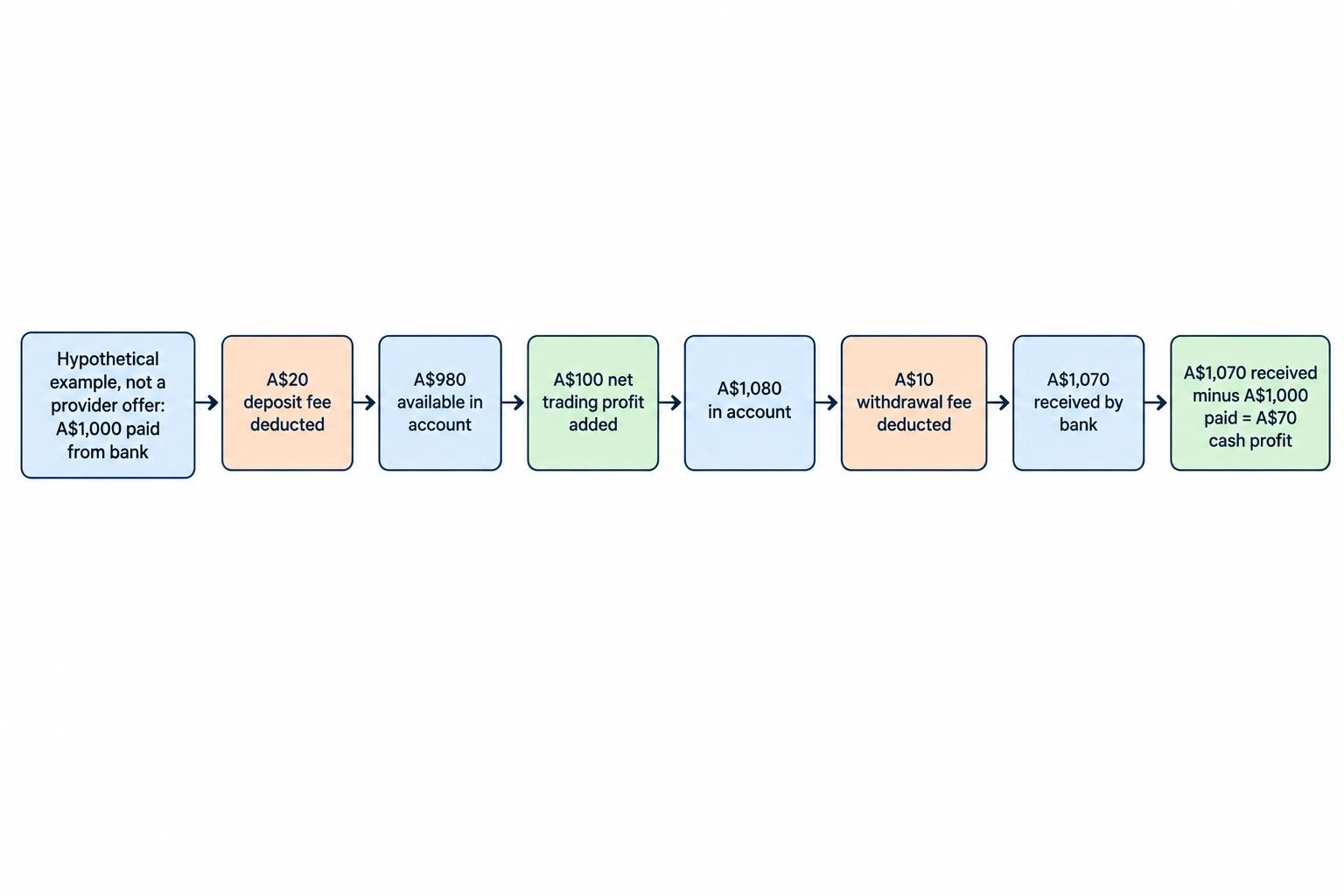
The account’s trading result was A$100, but payment fees reduced the cash profit by A$30. Those fees equal 3% of the original payment.
The account would need A$30 of trading profit just to return the original A$1,000 after both charges. That is approximately 3.06% of the A$980 that actually reached the account, before allowing for any other costs.
Do not subtract the A$20 and A$10 again from the A$70 cash result. They are already reflected in the money paid and received. For a fully closed account, comparing total cash outflows with total cash inflows provides a useful reconciliation check.
If money remains in the account, that comparison is incomplete. Record the remaining balance separately rather than treating it as cash already recovered. The total trading cost examples cover how payment expenses fit into a wider account calculation.
Keep Currency Conversion Separate
A transfer fee and an exchange rate margin are different costs. A payment can have no separately listed transfer charge but still deliver fewer dollars because of the conversion rate used.
When reviewing quotes, compare the amount received for the same amount paid, using quotes obtained close together. Comparing a Monday quote with a Thursday transaction mixes provider pricing with market movement.
For an existing transaction, record the original currency amount, the exchange rate applied and the final amount credited. If a conversion fee appears separately, check whether it is already included in the quoted total before adding it again.
Also identify every conversion in the payment route. Converting AUD into an account currency and later converting the withdrawal back into AUD creates two separate pricing points. The currency conversion costs guide covers exchange rate comparisons in more detail.
Read the Conditions Behind “Free Withdrawals”
A headline fee is not enough to calculate the cost of getting money back. Read the conditions attached to it. Check whether a free withdrawal allowance resets each calendar month, applies only to one payment method, or excludes third-party expenses.
Establish whether any minimum withdrawal amount is measured before or after fees. A balance of A$100 does not necessarily support a A$100 payment to your bank if a charge must also come out of that balance.
Look for provisions covering failed payments, returned transfers, incorrect banking details and requests to resend money. Ask whether a fee applies per request or per completed payment. If support gives an answer that differs from the published schedule, request a written explanation identifying the governing term.
Do not place extra trades simply to meet a condition described as necessary for a cheaper withdrawal. Compare the proposed saving with the additional amount put at risk, and question why the condition exists.
Keep payment timing separate from pricing too. For an outstanding withdrawal, request the approval date, dispatch date, payment reference and itemised deductions. The guide to broker deposits and withdrawals addresses the transfer process rather than the fee calculation.
Withdrawal Fees Versus Demands to Release Funds
A disclosed transaction charge is different from an unexpected demand to send more money before an existing balance will be released. Treat that demand as a reason to stop and verify the situation independently.
Fake trading platforms can display invented profits and then demand release fees without returning any assets. Requests for extra withdrawal fees are among the warning signs in Scamwatch’s alert on fake crypto trading platforms.
Do not assume that a document labelled “tax”, “clearance” or “verification” proves a payment is due. Ask who receives the money, what published provision supports the charge, and why it cannot be deducted from the stated balance. Verify any claimed authority through independently obtained contact details, not those supplied in the demand.
If you suspect fraud, stop sending money, preserve the fee requests and transaction records, and contact your bank or payment provider immediately. A new payment should not be treated as a routine administrative step simply because a dashboard shows a larger balance waiting.
The separate guide to fake tax and withdrawal release fees addresses these demands in more detail. Paying another charge is not evidence that the displayed funds exist or that a withdrawal will follow.
What to Record Before Accepting a Fee Calculation
A useful fee record should let someone reconstruct the payment without guessing. Keep the terms that applied when the transaction was requested, not just a screenshot of the headline price.
- Identify the amount and currency: record what left the sending account and what should reach the destination.
- Separate each charge: list platform, bank, intermediary, wallet and conversion expenses without double counting.
- Check deductions: establish whether each fee reduces the payment or creates an additional debit.
- Reconcile the result: match confirmations against the amount actually received and question unexplained differences.
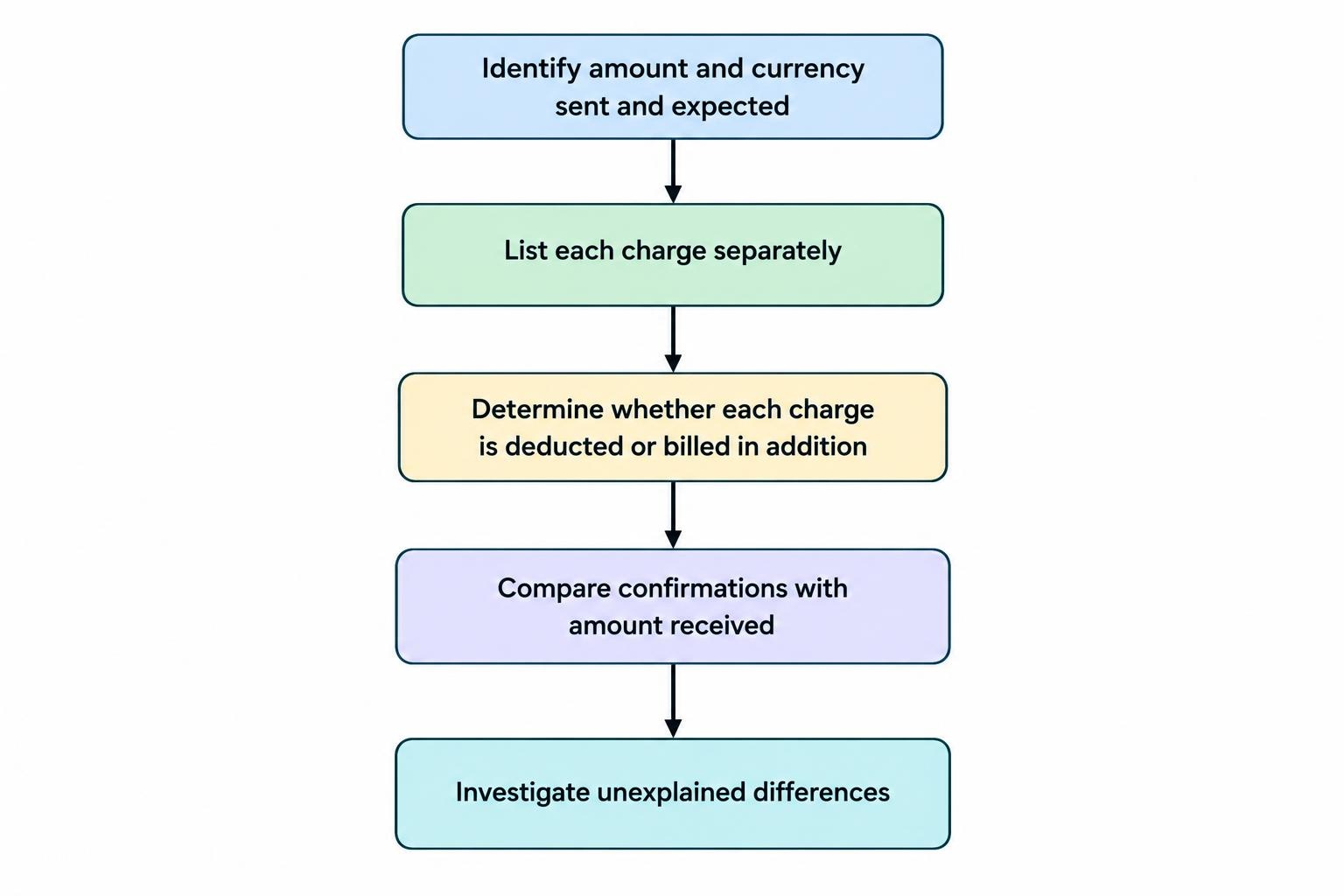
The useful figure is the net amount returned to your control, not the largest balance shown on a screen. Fees should be explainable, traceable and consistent with the applicable terms. If they are not, investigate the discrepancy rather than sending more money to make it disappear.
This article was last updated on: October 22, 2026