Ladder binary options offer a choice of strike prices for the same underlying market, often with a shared expiry time. Each strike forms a separate yes/no contract: will the settlement price finish above or below that level? Different rungs can carry different payouts, so choosing a contract means weighing the required price move against the offered return.
For Australian readers, access comes before contract mechanics. ASIC banned the issue and distribution of binary options to retail clients from 3 May 2021 and extended the restriction until 1 October 2031. The ASIC announcement extending the retail binary options ban sets out that position. The examples below are educational, not instructions for accessing an offshore platform.
What Is a Ladder Binary Option?
A ladder binary option uses a strike price that need not match the market price when the contract begins. A ladder display groups several such contracts at different price levels. Rather than answering only “will the market rise?”, the trader chooses a proposition such as “will AUD/USD finish above 0.6510 at expiry?”
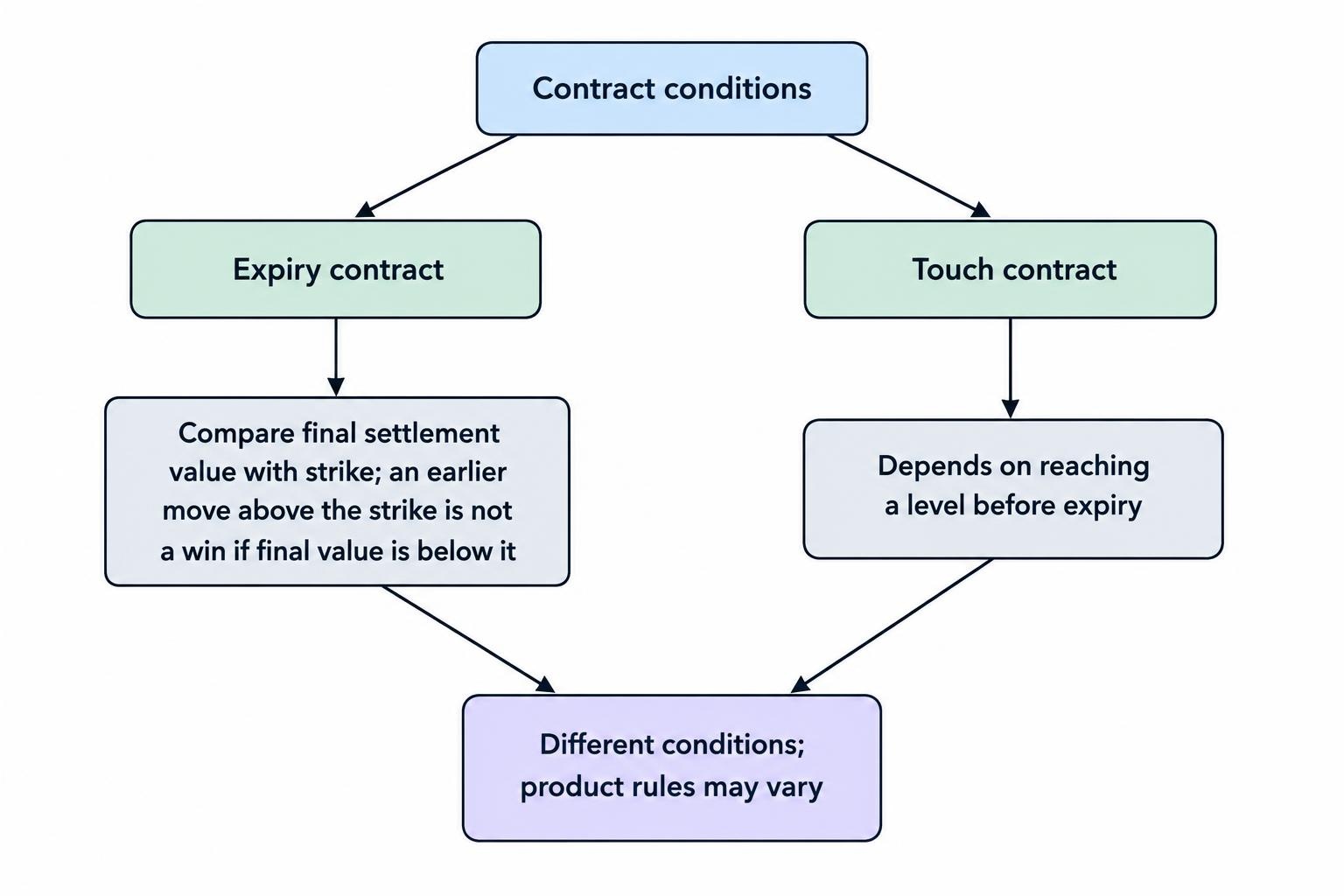
Terminology varies between providers. The ESMA analysis of binary option trigger conditions identifies “ladder” as a name used for expiry contracts whose strike differs from the initial underlying price. It distinguishes these from touch contracts, which depend on reaching a level before expiry.
Each purchased rung has its own stake, winning condition and payment. Buying one rung does not normally buy the whole ladder, and winning a lower rung does not automatically open the next one. The rungs are choices, not stages you must complete.
This guide focuses on separate contracts that settle against the price at expiry. A product carrying the same label might use different conditions, so its written terms take priority over the name. The broader comparison of binary option types places ladders alongside high/low, touch and range contracts without treating them as interchangeable.
Ladder Binary Options Worked Example
Suppose AUD/USD is quoted at 0.6500. A hypothetical ladder offers five “above” contracts, all expiring 30 minutes later. Each requires the final settlement price to be strictly above its strike.
The table assumes an A$20 stake per contract. Every payout percentage means net profit on the stake, with the original stake also returned on a win. A losing contract returns nothing. These are invented teaching figures, not current market quotes or available offers.
| Strike price | Net profit rate | Profit on an A$20 win | Total cash returned on a win |
|---|---|---|---|
| 0.6480 | 40% | A$8 | A$28 |
| 0.6490 | 60% | A$12 | A$32 |
| 0.6500 | 80% | A$16 | A$36 |
| 0.6510 | 150% | A$30 | A$50 |
| 0.6520 | 300% | A$60 | A$80 |
Notice that the first two strikes sit below the starting price. Their “above” contracts could win even if AUD/USD falls slightly. Choosing “above” therefore does not always mean predicting a rise from the entry price. It means predicting a finish above the selected strike.
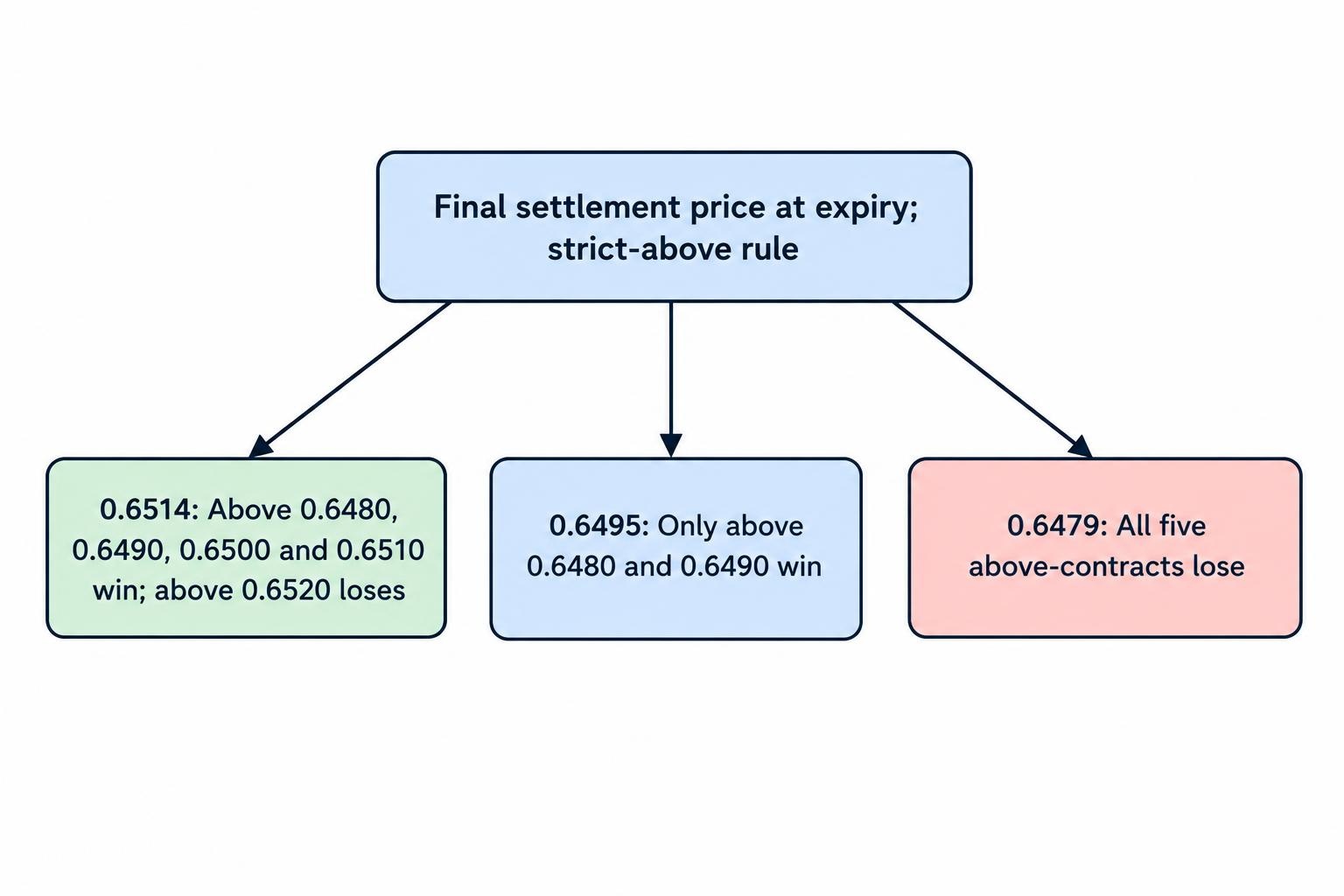
If the Settlement Price Is 0.6514
The first four contracts win; the 0.6520 contract loses. If all five were purchased, their combined net result would be:
A$8 + A$12 + A$16 + A$30 − A$20 = A$46 profit.
The total stake was A$100 and the total cash returned would be A$146. If only the 0.6510 rung had been purchased, the result would instead be A$30 profit on an A$20 stake. The unpurchased rungs would have no effect on the account.
If the Settlement Price Is 0.6495
Only the first two contracts win. Across all five positions, the result becomes A$8 + A$12 − A$20 − A$20 − A$20, or A$40 lost. Some winning rungs do not necessarily produce a profitable basket.
At a settlement price of 0.6479, all five “above” contracts would lose, costing the full A$100. These outcomes show why a ladder must be assessed both contract by contract and as a combined exposure.
Why Ladder Payouts Differ
For otherwise identical “above” contracts, finishing above a higher strike cannot be more likely than finishing above a lower strike. A finish above 0.6520 necessarily clears 0.6510 too, but clearing 0.6510 does not necessarily clear 0.6520.
Ladder pricing can reflect that tradeoff by offering a larger profit for the harder condition. For “below” contracts, the ordering reverses: finishing below a lower strike requires a more demanding outcome than finishing below a higher one.
A large percentage is not evidence of good value. A 300% profit rate sounds attractive, but the contract might still be poor value if its chance of winning is too low. A smaller payout is not automatically safer either: it may offer little compensation for the money at risk.
Check what “payout” actually includes. If a displayed 300% means total cash returned, an A$20 stake returns A$60 and earns A$40 profit. That is a 200% net profit rate, not 300%. Confusing those conventions changes every comparison that follows.
Calculating the Break-Even Win Rate
A winning trade and a losing trade need not have equal financial weight. Binary option contracts can lose money on average even with a 50% win rate when the profit on a win is smaller than the loss on a failure. The joint SEC and CFTC binary options alert illustrates this payout imbalance.
For a contract that loses its full stake on failure, returns the stake on success and has no fees or refunds:
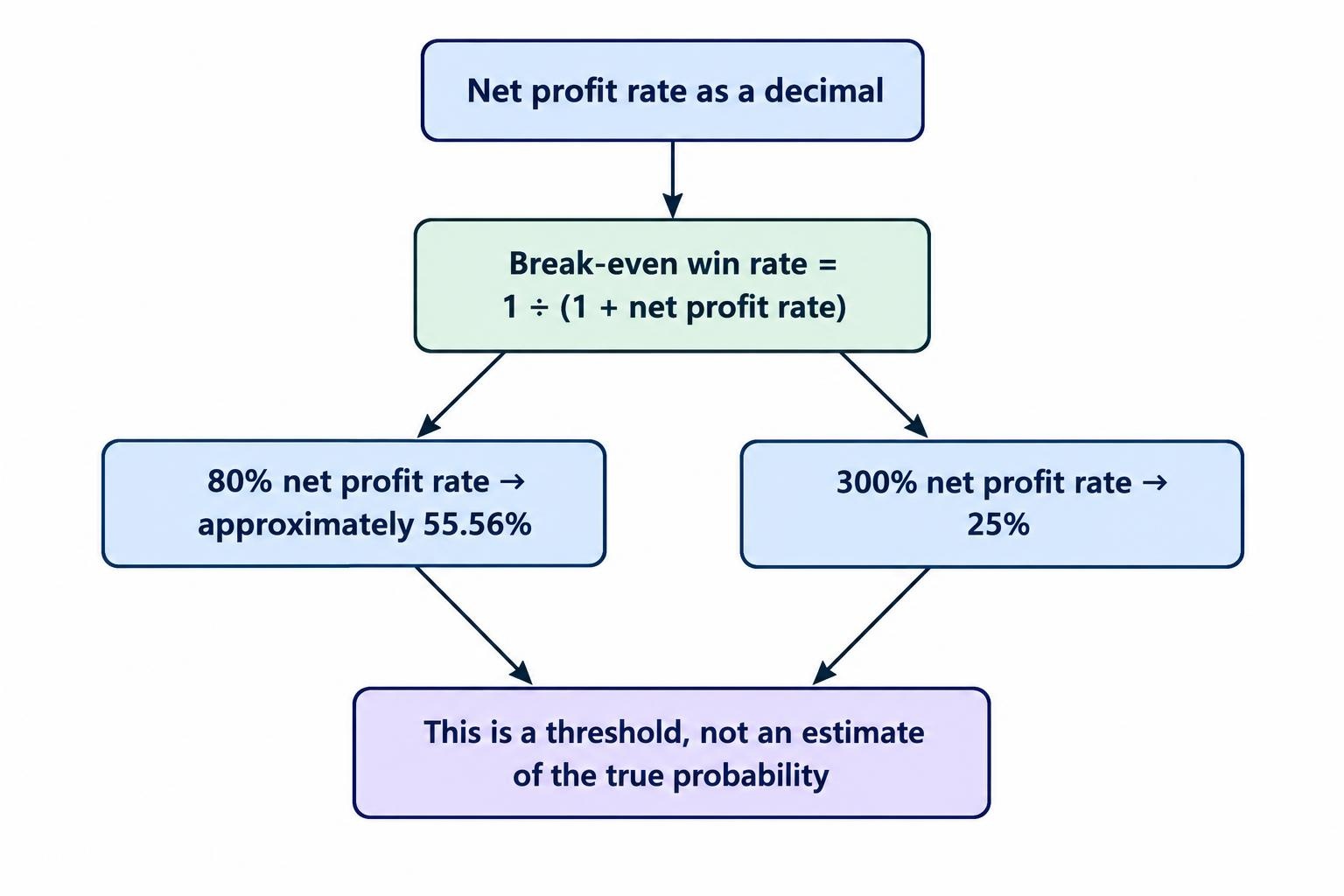
Break-even win rate = 1 ÷ (1 + net profit rate).
Use the profit rate as a decimal. An 80% profit rate gives 1 ÷ 1.80, or approximately 55.56%. A 300% profit rate gives 1 ÷ 4, or 25%. The higher payout requires fewer wins to break even, but that does not tell you how often the condition will actually occur.
Consider the hypothetical A$20 contract paying 300% net profit. If its true winning probability were 30%, its expected net result would be:
(0.30 × A$60) − (0.70 × A$20) = A$4 per contract.
If the probability were only 20%, the expected result would fall to negative A$4. The payout has not changed; the probability assumption has.
These probabilities are assumptions, not forecasts. The hard part is estimating the chance of clearing that strike at that expiry. Repeatedly choosing the largest displayed percentage does not solve it. The guide to probability and expected value in binary options develops the calculation beyond a single contract.
Settlement Rules Matter More Than the Ladder Graphic
An expiry ladder answers a question about the final settlement value. It does not necessarily reward a price level being reached earlier.
Suppose AUD/USD briefly reaches 0.6525, then finishes at 0.6508. Under the example’s rules, the “above 0.6520” contract loses. So does “above 0.6510”. Both levels may have appeared on the chart during the contract, but neither condition holds at settlement.
Equality also needs a written rule. “Above 0.6510” is not the same as “at or above 0.6510”. A settlement exactly on the strike could be a loss, a refund or another outcome under different contract terms. Never assume that all providers handle a tie the same way.
The reference price matters too. Check whether settlement uses a final quote, an average over an interval or another published calculation. A chart from a separate data provider does not establish the settlement result unless the contract names that feed.
The guide to binary option settlement and ties covers those distinctions in more detail. For a ladder, the practical check is straightforward: every rung needs a clear strike, comparison rule, expiry timestamp and settlement method.
Also separate an early exit quote from the expiry payment. If early closure exists, its price and availability need their own terms. A position that currently meets its winning condition is not the same as a settled win.
Buying Several Rungs Does Not Create Diversification
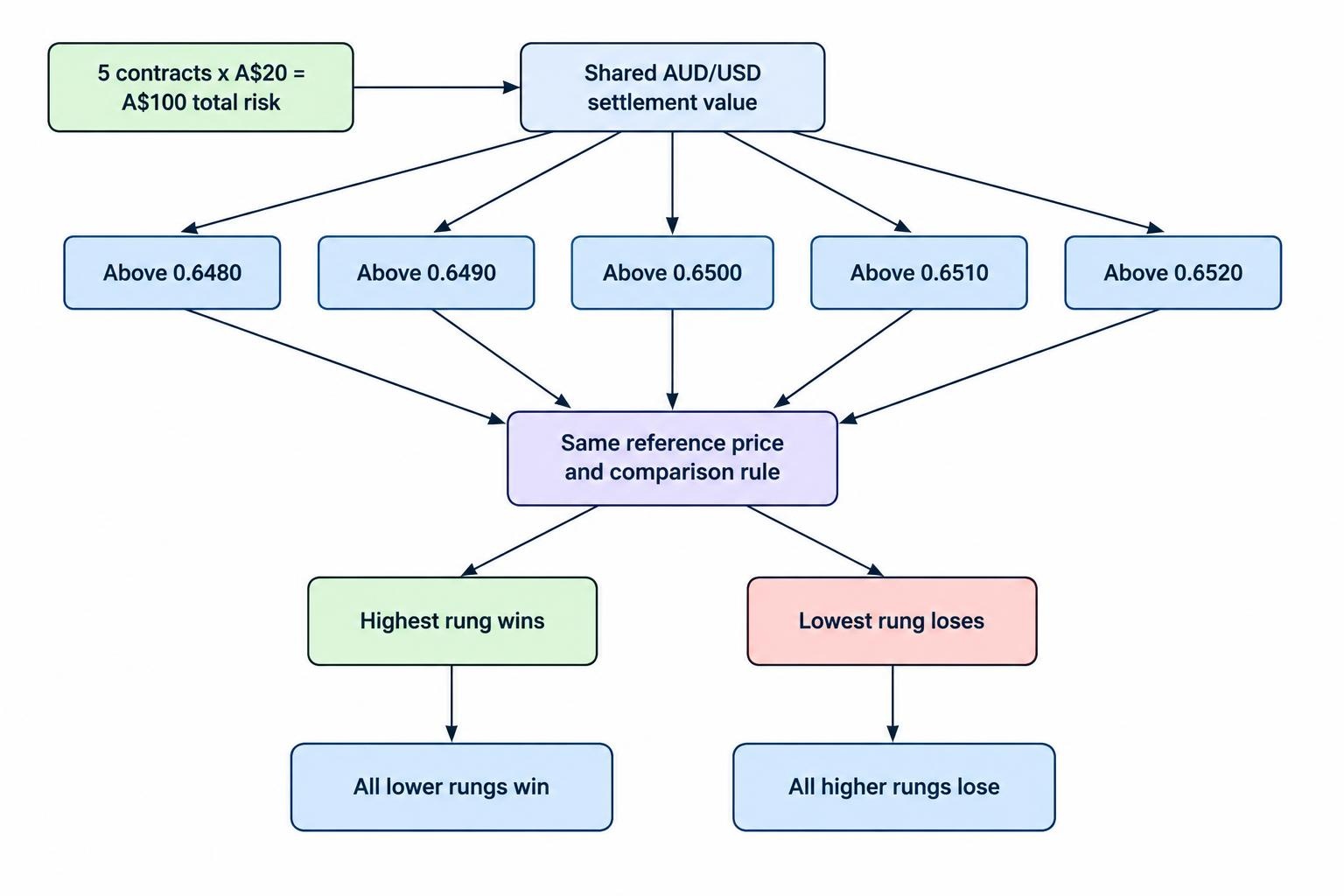
Five contracts can still represent one concentrated market view. In the worked example, every position depends on the same AUD/USD settlement value at the same time.
The winning events overlap. If the highest “above” rung wins, all lower “above” rungs must also win, assuming the same reference price and comparison rule. If the lowest rung loses, every higher rung loses too. They are separate contracts, but their outcomes are not independent.
This matters when estimating risk. You cannot treat each rung as an unrelated chance and multiply probabilities as though the positions came from separate events. One market move can settle the entire basket against you.
Buying more rungs also increases the total stake unless the original budget is divided between them. Five A$20 contracts risk A$100, not A$20. Splitting A$20 across five contracts keeps the total stake unchanged but produces a different pattern of possible returns.
Changing that pattern may alter how often a basket wins or loses, but it does not automatically improve expected value. If every purchased contract has negative expected value, adding them together leaves a negative expected total. The wider discussion of correlation and trading risk explains why counting positions is not the same as spreading exposure.
How to Assess a Ladder Strategy on Paper
A ladder strategy needs to address the strike and the clock, not just market direction. A correct forecast that a currency will rise eventually says little about whether it will finish above a chosen level in 30 minutes.
Start with a written proposition. “AUD/USD above 0.6510 at 14:30 UTC” can be checked. “The chart looks bullish” leaves too much room to reinterpret the result afterward.
A useful paper exercise records:
- The contract: underlying market, selected strike, direction and exact expiry.
- The payment: stake, net profit on success, total cash returned and loss on failure.
- The evidence: information available when the decision was made, without using later prices.
- The result: settlement value, outcome and combined profit or loss across every purchased rung.
For a basket, record one combined result as well as the result of each contract. Otherwise, four winning rungs can make a screenshot look impressive while the account arithmetic tells a less cheerful story.
Keep the proposed payout fixed in the record. Historical price data alone cannot establish historical ladder profitability if the payout available at the decision time is unknown. Filling that gap with a generous assumed return can manufacture an apparent advantage.
A structured paper trading exercise for binary options can help test contract interpretation and bookkeeping without depositing money. It cannot establish that an advertised platform will execute, settle or pay withdrawals as promised.
Australian Access and Risk Warnings
A ladder format does not remove the retail binary options restriction. Nor does an offshore platform accepting a registration establish that its offer is lawful or that Australian protections apply.
Be cautious if access depends on being reclassified as a wholesale client. Wholesale clients do not receive the same consumer protections as retail clients, and Moneysmart’s binary options warning advises against agreeing to wholesale treatment just to access these products. It also warns that binary option offers may be scams.
The useful lesson from a ladder is its arithmetic: each rung pairs a price condition with a payment, and several rungs can concentrate exposure to one settlement event. Judge the condition, payout definition and total amount at risk together. A larger number beside the highest rung does not make the contract a better proposition.
This article was last updated on: October 22, 2026