DAX binary options are fixed outcome contracts linked to a stated level of Germany’s DAX share index. A typical contract asks whether its settlement price will finish above or below a strike at a set time. The result depends on that condition, not on how far the index moves.
The practical challenge is identifying exactly what “DAX” means in the contract. An official index value, a futures price and a platform’s own quote are not interchangeable. Australian readers also need to address the regulatory position before considering any trading platform.
Are DAX Binary Options Available to Australian Retail Clients?
ASIC’s prohibition on the issue and distribution of binary options to retail clients took effect on 3 May 2021 and has been extended until 1 October 2031. Choosing the DAX rather than a currency pair does not change the product’s binary structure. The relevant restriction is set out in ASIC’s announcement extending the binary options ban.
This article therefore explains DAX contracts for education and paper analysis, rather than recommending a route to live trading. A platform accepting an Australian registration or displaying Australian dollar balances should not be treated as evidence that its offer complies with Australian requirements.
What Does the DAX Measure?
The DAX tracks 40 large companies listed on the Frankfurt Stock Exchange’s regulated market that meet its eligibility requirements. It uses free float market capitalisation weighting, so constituents do not contribute equally to its movements. The commonly quoted performance version includes dividends rather than measuring share price changes alone. These features appear in the official STOXX DAX factsheet.
For contract analysis, this creates two checks. Establish which index version supplies the reference value, then establish how the contract obtains that value. Two charts can both carry a DAX label without showing the same instrument.
Weighting also matters when interpreting market breadth. In a hypothetical session, most constituents could rise while a few heavily weighted shares fall enough to pull the index lower. Counting green and red shares is not a substitute for examining their contribution to the benchmark.
How a DAX Binary Contract Works
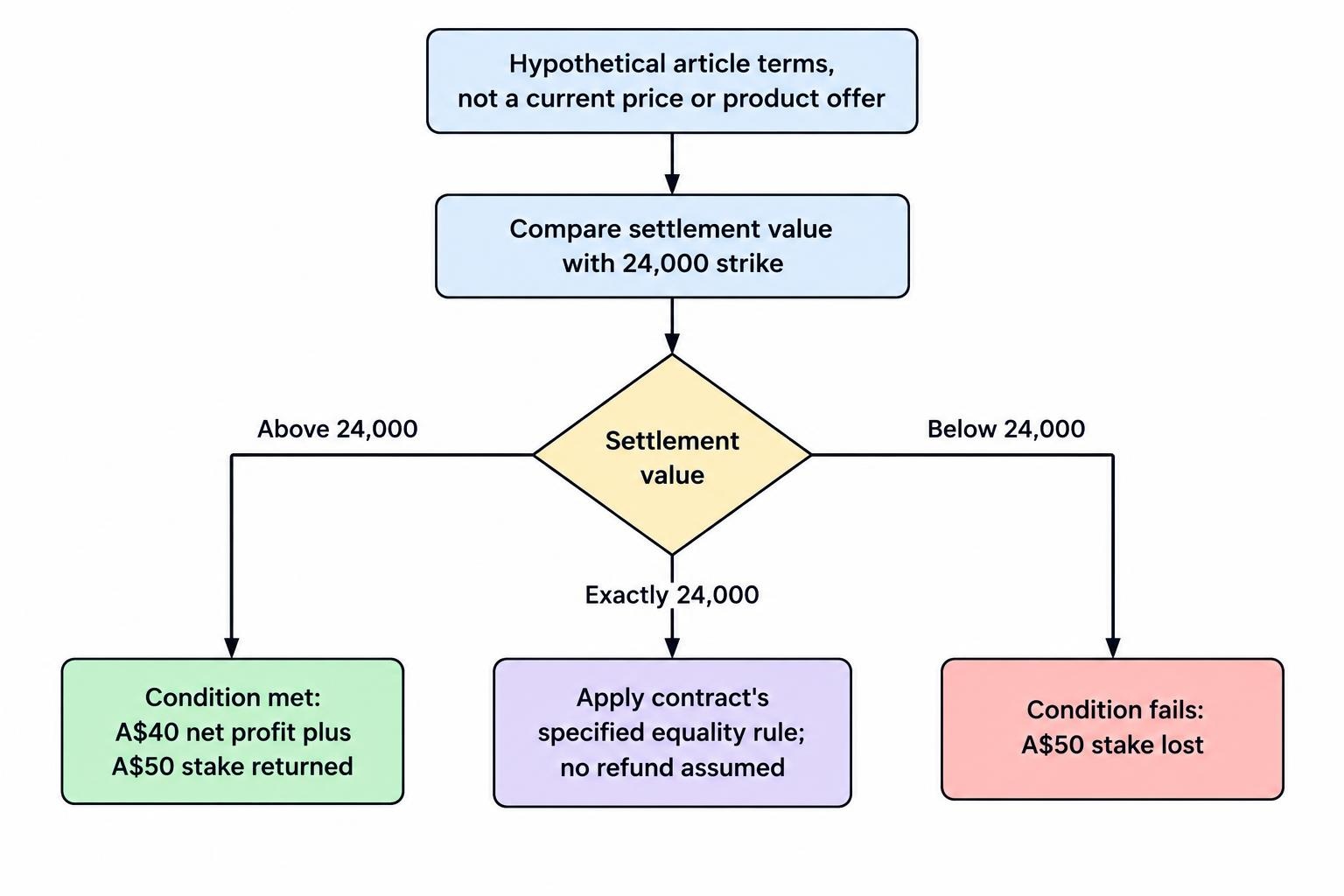
Consider a hypothetical contract with a strike of 24,000 points and an expiry at 10:30 Berlin time. Its condition is that the settlement value must be strictly above 24,000. Assume a stake of A$50, an 80% net profit on a winning contract and a full stake loss on a losing contract.
If the specified settlement value is 24,000.40, the condition is satisfied. The account receives A$90: the A$50 stake plus A$40 profit. If settlement is 23,999.90, the condition fails and the A$50 stake is lost.
A finish at 24,050 produces the same A$40 profit as a finish at 24,000.40 under these assumptions. A larger correct move does not increase the reward. Equally, missing the strike by a fraction of a point does not soften the loss.
A settlement exactly at 24,000 requires the contract’s equality rule. Do not assume it produces a refund. The price condition and the financial treatment of a tie must both be explicit. These figures illustrate contract mechanics; they are not current DAX prices or an available product quote.
Which DAX Price Determines the Result?
Official Index Values and Futures Prices
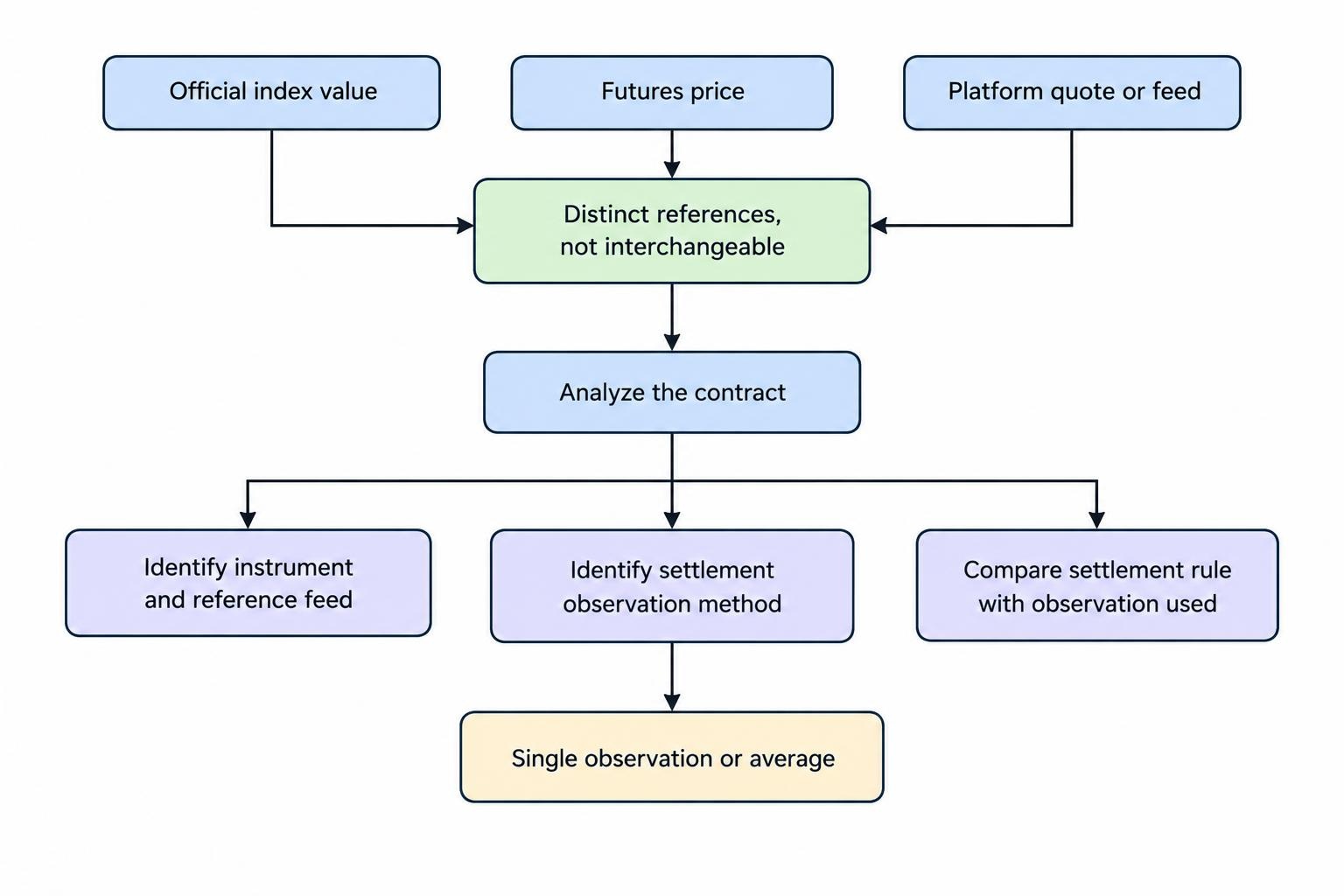
A cash index value represents the calculated benchmark. A futures price belongs to a separately traded contract with its own maturity. Their levels need not match throughout the session. A paper test that takes entry signals from one and settlement values from the other may answer the wrong question.
The distinction extends to settlement rules. Eurex DAX futures have their own expiry arrangements: final settlement normally falls on the third Friday of the maturity month and uses constituent auction prices from the Xetra intraday auction starting at 13:00 CET. Those are Eurex DAX futures specifications, not default rules for a binary contract carrying the DAX name.
Before comparing charts, record the instrument identifier, index version and, where relevant, futures maturity. The guide to cash index prices versus futures prices covers the pricing distinction in more detail.
Platform Quotes and Settlement Observations
For any contract being assessed, identify whether settlement uses a published index observation, a last traded futures price, a bid, an ask, a midpoint or another calculation. Also check whether it takes one observation or an average over a window.
Suppose a reference chart shows 24,001 while the contract’s specified feed records 23,999.80 at expiry. A screenshot of the first chart does not, by itself, establish an incorrect result. The useful comparison is between the contractual rule and the observation actually used. Without those details, the chart is decoration, not an audit trail.
DAX Trading Hours in Australian Time
The core Xetra cash session runs Monday to Friday from 09:00 to 17:30 German local time, subject to the trading calendar. The Extended Xetra Retail Service also has separate early and late sessions. These should not be collapsed into one assumed DAX settlement schedule; use the official Xetra trading calendar and hours to distinguish the sessions.
The table converts the core 09:00–17:30 session under three clock combinations. It is not a schedule for binary contract availability, futures trading or every index publication.
| Clock combination | Sydney | Perth |
|---|---|---|
| Germany on CEST; Sydney on AEST | 17:00–01:30 next day | 15:00–23:30 |
| Germany on CET; Sydney on AEDT | 19:00–03:30 next day | 16:00–00:30 next day |
| Germany on CEST; Sydney on AEDT during transition periods | 18:00–02:30 next day | 15:00–23:30 |
Australian cities do not all follow Sydney’s clock changes. Sydney uses AEST or AEDT, while Perth stays on AWST; Queensland also does not observe daylight saving. The offsets are documented in the NSW Government’s Australian time zone definitions.
For a paper study, store timestamps in UTC and display Berlin time alongside your local time. Record the full expiry date too. A late German session can fall on the following calendar day in Australia, making a journal entry such as “Friday close” surprisingly ambiguous.
Events to Include in a DAX Study
A useful event log should distinguish scheduled announcements from ordinary price movement. The European Central Bank publishes monetary policy decisions at 14:15 and starts its press conference at 14:45 on decision days, using its stated Central European time convention. Check each event’s calendar entry before converting it. The two stages are set out in the ECB announcement and press conference timetable.
That separation matters when defining a hypothetical contract window. An expiry between the decision and the press conference measures a different period from one extending into the questions and answers. Labelling both simply “ECB trades” would conceal that difference.
Other useful entries include German and euro area inflation releases, business surveys, constituent earnings announcements and major US releases. Treat them as variables to investigate, not automatic instructions to choose “higher” or “lower”.
For example, a stronger euro could create different pressures across companies with different revenues and costs. Rather than assuming a permanent inverse relationship between the euro and the DAX, record the response and test whether the proposed relationship holds in the sample.
Matching a DAX Hypothesis to Its Expiry
A directional view is incomplete without a time horizon. “The DAX should rise this afternoon” does not establish that it will finish above an entry strike five minutes from now. The contract can lose even if the broader forecast later proves correct.
Define what the paper test is meant to measure. An opening breakout study might examine whether price finishes beyond a premarked opening range after a fixed interval. A rejection study might examine whether a move through a prior level fails by expiry. Neither should be described as profitable without evidence from a properly specified test.
Keep the entry trigger and expiry rule separate. If entry follows a completed five minute candle, state whether the hypothetical expiry is five minutes after that entry or at the next fixed clock boundary. Those rules can produce different holding periods.
Do not change the expiry after seeing the result. Trying several intervals can be legitimate research, but selecting the best interval from the same sample and presenting it as an established edge overstates the evidence. Preserve a separate period for checking whether the result persists.
Payouts Matter as Much as Direction
A DAX forecast can be correct more often than not and still lose money under an unfavourable payout structure. With an 80% net winning payout and a full stake loss, the break even win rate is:
1 ÷ (1 + 0.80) = 55.56%
For 100 hypothetical A$50 contracts, 55 wins produce A$2,200 in profit, while 45 losses cost A$2,250. The result is a A$50 loss before any other costs.
This is why a chart pattern’s apparent accuracy cannot be assessed separately from its payout. Record the assumed payout for every observation rather than assigning the most attractive rate to the whole sample. The guide to binary options probability and expected value develops the calculation, including how different assumptions change the result.
A Practical DAX Paper Analysis Checklist
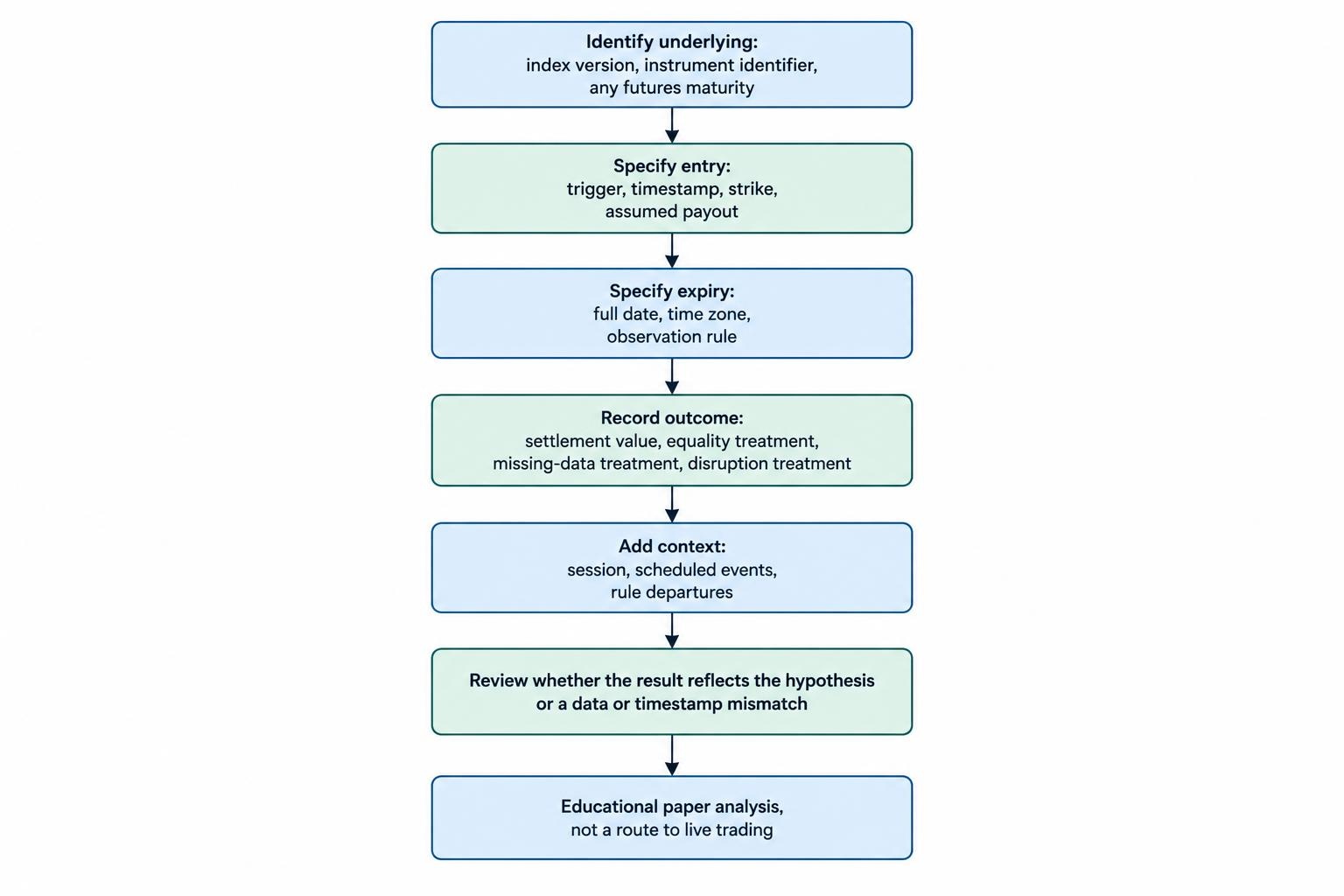
A useful paper record should allow another person to reconstruct the proposed contract without guessing. Before logging an observation, establish:
- The underlying: the index version, instrument identifier and any futures maturity.
- The entry: the trigger, timestamp, accepted strike and assumed payout.
- The expiry: the full date, time zone and exact observation rule.
- The outcome: the settlement value and treatment of equality, missing data or disruption.
- The context: the session, scheduled events and any departure from the test rules.
Use the same reference instrument throughout unless comparing feeds is the purpose of the exercise. If your chart supplies delayed data, do not treat the displayed observation as a live entry price. Keep uncertain observations marked as uncertain rather than resolving them in the strategy’s favour.
Save enough detail to distinguish a weak market hypothesis from a data mismatch. A failed forecast and an incorrect timestamp may look identical in a simple win or loss column, but they require different corrections. The price feeds and benchmarks guide covers the reference data questions behind that distinction.
Also separate hypothetical results from executable results. A paper record does not establish that a live contract would have been offered at the same strike, accepted at the same instant or paid the same return. It is a test of stated assumptions, not proof of a tradable opportunity.
Assess the Contract, Not Just the DAX Chart
The most useful DAX analysis connects three things: the exact reference price, the period being forecast and the payout attached to the outcome. A strong view on German equities cannot compensate for an unidentified settlement feed or an expiry that does not match the view.
For comparisons with other benchmarks, use the same contract assumptions and recording standards. The wider stock index binary options guide provides that broader context. For Australian retail readers, keep the distinction clear: studying the DAX is one activity; obtaining a binary options contract is another, subject to the restriction described above.
This article was last updated on: October 22, 2026