Gold binary options attach a fixed payout to a condition involving the gold price, usually whether a stated reference price finishes above or below a strike at expiry. They do not give the holder ownership of gold. A correct view on gold’s longer term direction can still produce a losing contract if the expiry, strike or settlement reference does not match that view.
For Australian retail readers, the regulatory position comes first. ASIC’s prohibition on issuing and distributing binary options to retail clients took effect on 3 May 2021 and extends until 1 October 2031. Gold contracts do not create an exception to the ASIC binary options product intervention order. The examples below explain the product, not a route around that restriction.
What a gold binary option actually measures
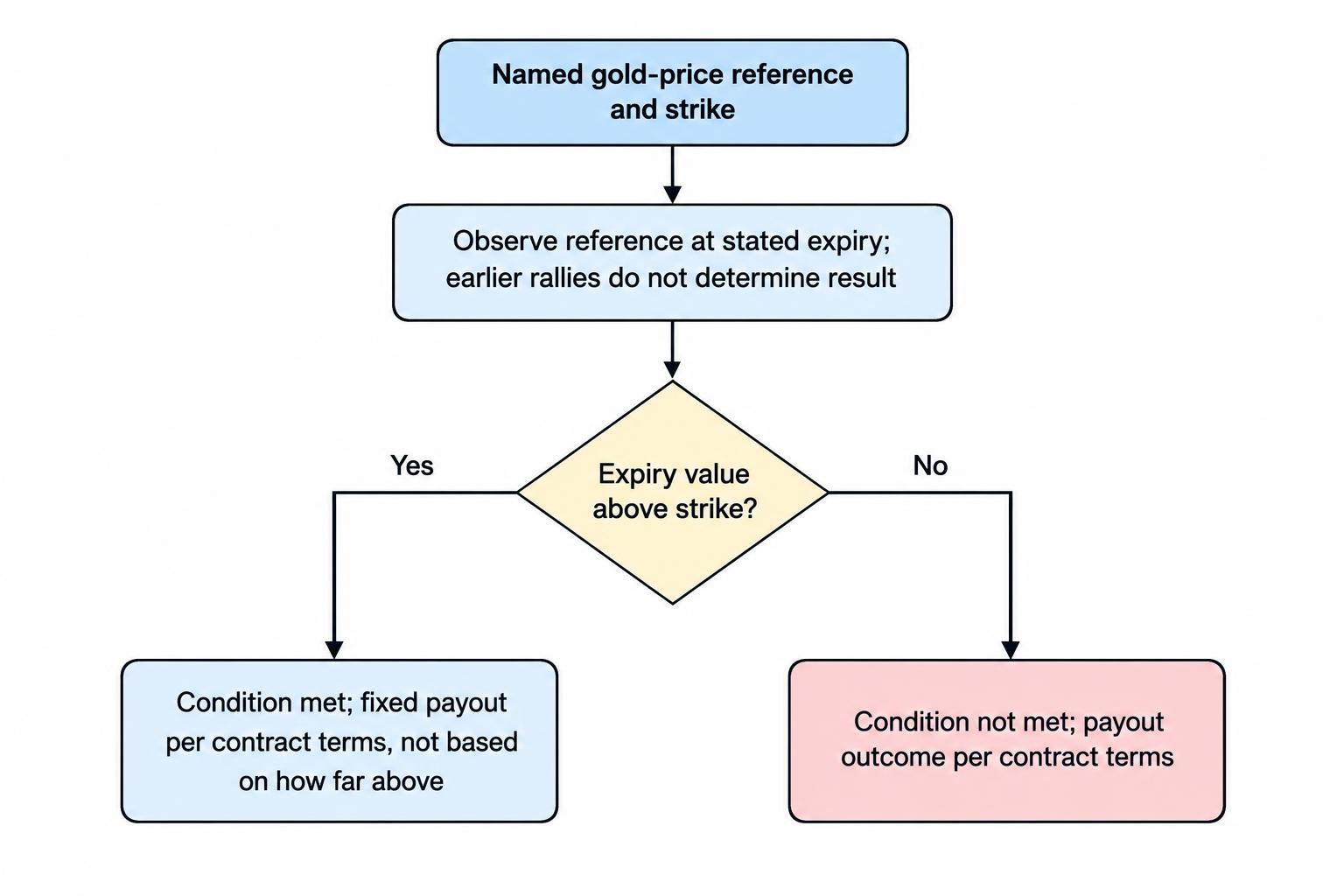
A conventional above/below contract asks a narrow question: will the designated gold price be above or below a stated level at a stated time? The answer determines the payment. The holder does not acquire bullion or the right to take delivery of it, a distinction covered in the joint CFTC and SEC alert on binary options.
Consider a hypothetical condition: “Gold above US$4,000 per troy ounce at 14:30.” A settlement value of US$4,000.10 satisfies a strictly above condition. US$3,999.90 does not. These are illustrative prices, not current market quotations.
Under that contract, a move to US$4,020 would not earn more than a move to US$4,000.10. Both satisfy the same condition. Equally, a price rally during the contract would not secure a payment if gold subsequently finished below the strike.
That is the central distinction between analysing gold and analysing a binary contract on gold. One concerns the market’s direction. The other concerns a condition, a clock and a payment schedule.
Which gold price does the contract use?
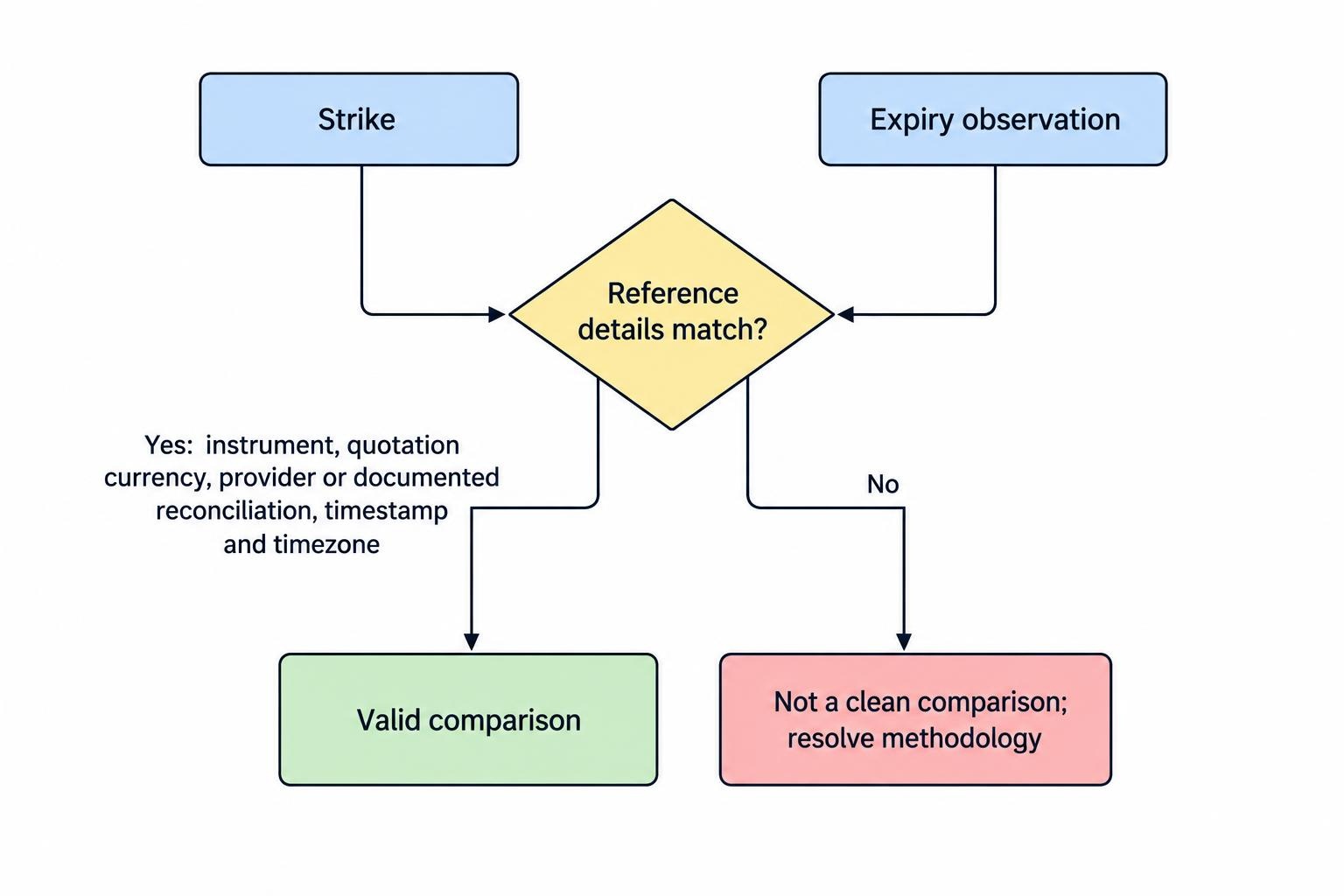
“Gold” is not a complete settlement description. Before interpreting a chart, identify the instrument, quotation currency, price provider and timestamp. Two screens can display different numbers without either necessarily being wrong.
Spot quotations and auction benchmarks
A gold quotation expressed as XAU/USD represents a US dollar price for gold. Do not confuse a continuously updating screen quotation with a scheduled benchmark. The LBMA Gold Price auction benchmark is set twice daily, at 10:30 and 15:00 London time, in US dollars per troy ounce. It is not a new auction result every second.
If a contract expires between those auctions, its documentation must identify the applicable settlement reference. The words “international gold price” are not enough. Ask whether settlement uses a published benchmark, a named live feed or another stated calculation.
Quotation currency matters too. A condition expressed in US dollars is not a condition on the Australian dollar price of gold. The account balance might be in Australian dollars, but that does not change the underlying price test. Keep the gold quotation and the account currency separate when recording an example.
Dated gold futures
A futures quotation belongs to a contract with a delivery month. It should not automatically be treated as interchangeable with spot gold. Financing and other carrying costs help explain differences between the two; the World Gold Council’s gold futures curve resource shows how prices can differ across maturities.
This matters when a chart switches from one futures month to another. A price difference between contracts must not be mistaken for a movement in one unchanged instrument. A continuous futures chart also needs scrutiny: establish which contract it represents and whether its historical prices have been adjusted.
Suppose a paper exercise uses spot gold for entry but a dated futures quotation for the result. That is not a clean test of the proposed rule. It mixes instruments. The same problem arises if the strike comes from one provider and the expiry value from another without a documented reconciliation.
The practical rule is simple: match like with like. The guide to commodity spot prices, futures and rollovers covers these distinctions across commodity markets.
What moves gold, and why that does not predict an expiry
Interest rates and currency movements belong in gold analysis. Gold itself pays no interest, so higher yields on competing assets can increase the opportunity cost of holding it. Inflation expectations also affect how investors interpret nominal yields. These relationships are not fixed trading instructions: gold can rise during a period of rising rates, depending on other conditions. The World Gold Council’s research on rates and gold examines that distinction.
The US dollar deserves attention alongside yields, rather than being treated as a separate, automatic signal. Currency and rate expectations can interact. A rule such as “higher rates mean lower gold” leaves too much out to justify an expiry prediction.
Consider a hypothetical inflation release that exceeds expectations. One interpretation might favour gold because of inflation concerns. Another might favour higher interest rates and put pressure on gold. Before the release, neither interpretation establishes where the settlement price will stand five minutes later.
The useful research question is narrower: under a recorded set of conditions, how often did the chosen gold reference satisfy the stated condition after the chosen interval? That requires timestamped observations, not a persuasive explanation written after the move.
Keep the analysis horizon honest. A view about gold over six months is not evidence for a contract expiring in sixty seconds. The chart can be right about direction, the contract can still lose.
Gold trading hours, news and expiry timing
Gold futures offer near round the clock electronic access, but that does not mean every gold instrument follows an uninterrupted schedule. US employment figures, inflation releases and Federal Reserve announcements also belong on a gold research calendar; these feature among the CME Gold futures contract and economic references.
For any historical exercise, record the underlying market’s actual trading schedule, holiday arrangements and data interruptions. A platform displaying a price does not, by itself, establish which market is producing that price. Weekend availability needs the same scrutiny as weekday availability, not an assumption that every product uses identical hours.
Australian readers should also record the timezone explicitly. “14:30” is incomplete without a timezone and date. When converting an overseas event into Australian time, check the applicable daylight saving settings rather than reusing a conversion from another month.
Expiry timing creates another distinction. A contract ending at a fixed clock time is not necessarily the same as one lasting five minutes from acceptance. If an exercise assumes a fixed 14:30 expiry, an entry recorded at 14:26 leaves four minutes, not five.
For short intervals, do not treat the final candle on an unrelated chart as definitive settlement evidence. Establish whether the contract calls for an individual observation, an average over a window or another documented method. The market does not owe the contract a tidy finish.
A worked gold binary options example
The following hypothetical example isolates the payout mechanics. It assumes an above contract, a fixed A$100 stake, an 80% net profit payment on a win, and no refund on a loss. It excludes fees and currency conversion costs.
| Term | Assumption |
|---|---|
| Underlying reference | A named gold price quoted in US dollars per troy ounce |
| Strike | US$4,000.00 |
| Expiry | 14:30 in the contract’s stated timezone |
| Stake | A$100 |
| Winning result | A$180 total returned: A$100 stake plus A$80 profit |
| Losing result | A$0 returned: A$100 loss |
A settlement value above US$4,000 satisfies the assumed condition. A value below it does not. If settlement equals exactly US$4,000, the result depends on the contract’s equality rule. Do not insert a refund into the calculation unless the terms provide one.
The payout also changes the accuracy required to break even. With an A$80 profit for each win and an A$100 loss for each loss, the break even win rate is:
A$100 ÷ (A$100 + A$80) = approximately 55.56%.
At an assumed 50% win probability, the expected result per A$100 attempt is A$40 minus A$50, or a loss of A$10. This does not estimate anyone’s actual gold forecasting ability. It demonstrates why being right half the time is insufficient under these assumptions.
Knowing gold’s direction is therefore only part of the problem. The forecast must outperform the threshold implied by the available payment terms, after relevant costs. The guide to probability and expected value in binary options develops that calculation without tying it to one commodity.
How to study gold contracts without placing live trades
A paper exercise can examine the relationship between gold analysis and a fixed expiry without depositing money. Its value comes from the quality of the record, not from producing an attractive simulated balance.
Start with one clearly identified gold reference. Use the same quotation currency and price convention throughout. If the exercise changes from spot to futures, or from one provider to another, start a separate record rather than joining the results.
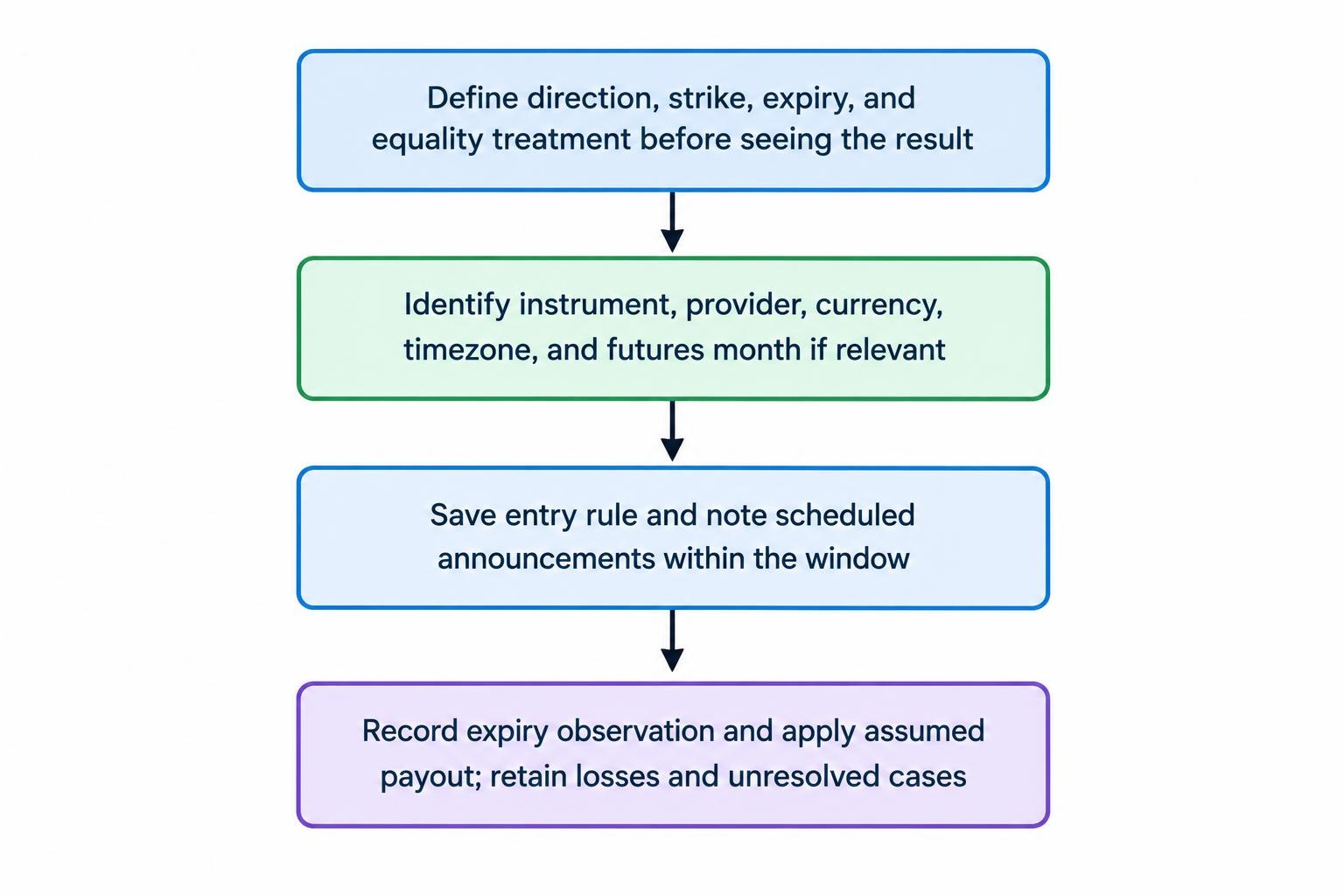
Each observation should contain enough detail for someone else to reproduce the outcome:
- Define the condition: record the strike, direction, expiry and equality treatment before observing the result.
- Identify the data: record the provider, instrument, futures month where relevant, timezone and any known delay.
- Save the context: note the proposed entry rule and whether a scheduled announcement falls inside the observation window.
- Record the outcome: preserve the relevant expiry observation and apply the assumed payout, including losses and unresolved cases.
If two data feeds disagree near the strike, do not select whichever produces a win. Mark the case as unresolved until the methodology explains the difference. The guide to price feeds and settlement benchmarks sets out the questions that need answering.
Keep rule development separate from evaluation. If an entry condition was chosen after inspecting a group of gold charts, those same charts should not be presented as independent evidence that it works. Freeze the rule and examine a later, previously unreviewed period.
A paper result still does not establish live execution quality, withdrawal reliability or legal availability. It answers a smaller question: what would the documented rule have produced using the recorded data and stated assumptions?
Gold binary options are not a substitute for owning gold
A gold binary contract does not become a long term gold holding because its underlying reference is a precious metal. Its purpose is to settle a condition. Once it expires, the holder has no continuing participation in a later gold price recovery.
That makes the intended objective worth stating before studying any contract. “I want exposure to gold over several years” and “I want to predict whether a reference price exceeds a strike at 14:30” are different objectives. A product designed for the second does not automatically serve the first.
Comparisons with other commodity binary options should start with the underlying reference, event calendar, expiry method and payment terms, rather than which chart looks easiest to read.
For Australian retail readers, the prohibition on issuing and distributing binary options remains the starting point. For educational analysis, the useful work is identifying exactly which gold price is being measured, when it is measured and what the resulting payment actually means.
This article was last updated on: October 22, 2026