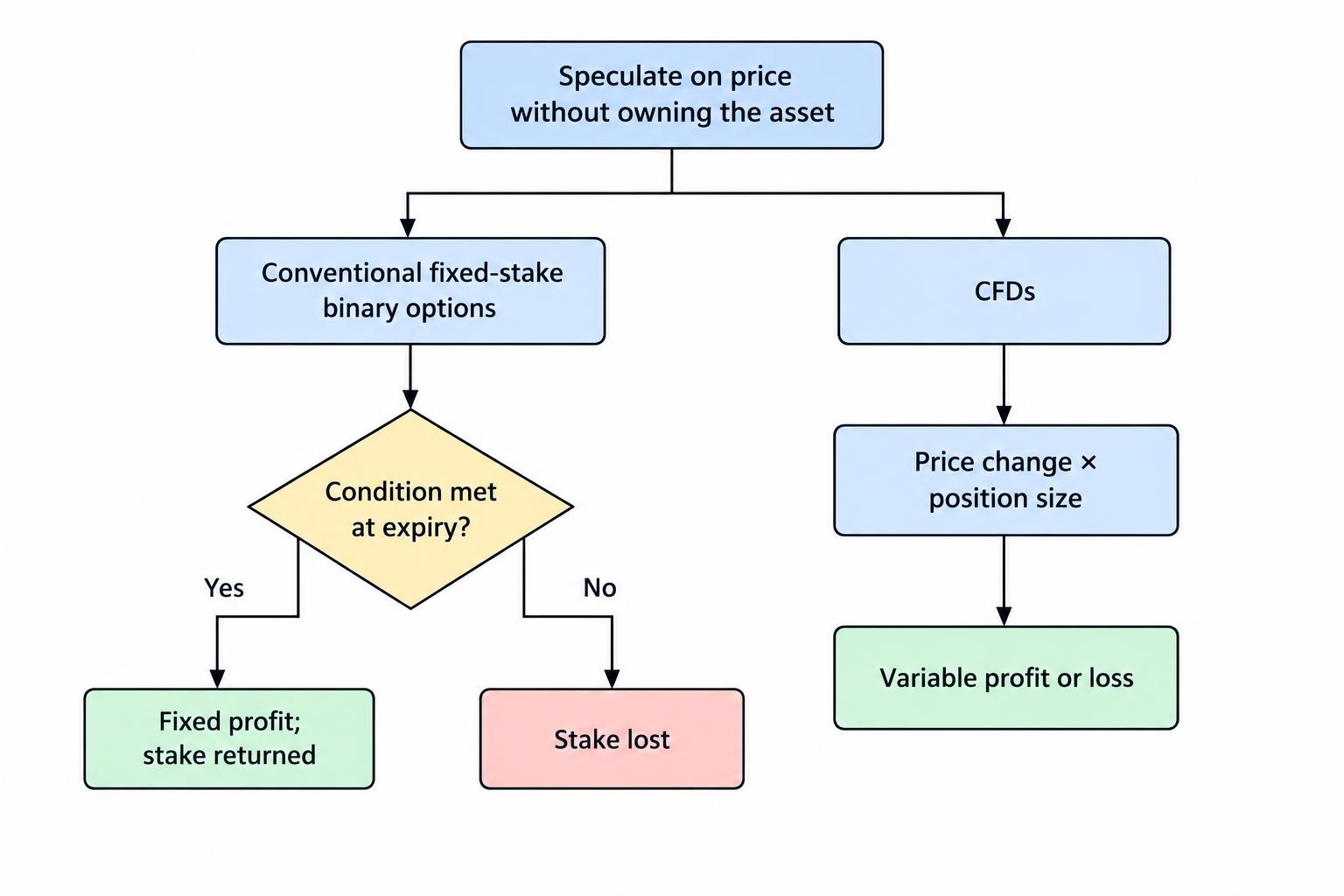
Binary options and contracts for difference (CFDs) both let traders speculate on price movements without owning the underlying asset. Their payoffs work very differently. A conventional binary option pays a fixed profit if a stated condition is met, or loses the stake if it is not. A CFD produces a variable profit or loss based on the price change and position size.
For Australian retail clients, there is also a decisive regulatory difference. ASIC’s binary options prohibition bans their issue and distribution to retail clients until 1 October 2031. CFDs remain available subject to restrictions. This comparison explains their mechanics and risks; it is not a suggestion to access prohibited products through an offshore platform.
Binary options vs CFDs: the main differences
| Feature | Conventional binary option | CFD |
|---|---|---|
| Payoff | Fixed profit or loss determined by the contract outcome | Variable profit or loss determined by price movement and position size |
| Trade duration | A stated expiry or observation period | Often open until closed, although some contracts have expiry dates |
| Money committed | A stake paid for the contract | Margin supporting a larger market exposure |
| Effect of a larger favourable move | Usually no extra profit on a fixed payout contract | Greater gross profit for an unchanged position |
| Exit control | Early closure may be unavailable or conditional | Closure orders, stops and profit targets, subject to execution conditions |
| Cost structure | The payout structure affects the return; other charges may apply | Spread, possible commission, financing and other contract charges |
| Underlying ownership | None | None |
The binary side of this comparison concerns fixed stake contracts commonly promoted online. Exchange traded binary contracts can use different pricing arrangements. Their quoted contract prices should not be confused with the percentage profit offered on a conventional fixed stake binary.
How the payoff changes the trading decision
Binary options: the condition must be met
With a basic higher or lower binary option, the question is whether a settlement price will finish above or below a strike price at expiry. The distance beyond that strike usually does not change the agreed profit.
Suppose the contract requires an index to finish above 8,000. A settlement at 8,001 can produce the same winning payout as a settlement at 8,100. Finishing at 7,999 can lose the entire stake, even though the forecast missed by one point.
That creates a sharp boundary between success and failure. Being broadly right about market direction is not enough if the required condition fails at the contractual observation time.
A rally that arrives after expiry does not rescue the position. Nor does a favourable move earlier in the trade necessarily secure a profit. The relationship between the forecast and binary options expiry times matters as much as the direction forecast itself.
Settlement exactly at the strike needs separate attention. A tie might trigger a refund, a loss or another treatment under the contract. Never assume that an unchanged price automatically returns the stake.
CFDs: the size of the move matters
A CFD tracks the change between its opening and closing prices. For a straightforward long position, gross profit or loss equals the closing price minus the opening price, multiplied by the number of units or the contract value per point. A short position reverses that relationship.
A small favourable move therefore produces a small gross gain. A larger favourable move produces a larger gain, provided position size stays unchanged. Adverse movements work the same way.
The decision is not simply whether the market will rise. The trader must also decide how much exposure to take, where to exit if the forecast fails and whether the expected movement justifies the costs. A correct directional forecast can still produce a net loss if the move is too small.
Worked comparison using the same index
The following examples are hypothetical. All dollar amounts are Australian dollars. They illustrate payoff mechanics rather than available offers, and exclude charges unless stated otherwise.
A $100 binary option
Assume a trader stakes $100 on an index finishing above 8,000 at expiry. The contract offers an 80% net profit on a win, with the original stake also returned.
If the settlement price is 8,001, the trader receives $180: the $100 stake plus $80 profit. If settlement is 8,100, the profit remains $80. If settlement is 7,999, the $100 stake is lost.
The advertised 80% is not an 80% chance of success. It describes the profit relative to the stake when the contract wins. Confusing payout percentage with probability makes the product look rather more generous than the arithmetic permits.
A CFD worth $1 per index point
Now assume a trader opens a long CFD at 8,000, worth $1 per point. The opening market exposure is $8,000. At an illustrative margin requirement of 5%, the required opening margin is $400.
Closing at 8,001 produces a $1 gross profit. Closing at 8,100 produces $100. Closing at 7,999 produces a $1 gross loss. Unlike the binary option, the CFD does not turn a one point miss into an automatic $100 loss.
However, the $400 margin is not the position’s maximum possible loss. It supports the exposure. A planned exit at 7,900 would imply a $100 price loss if executed there, but actual execution and account closeout rules affect the result.
These examples are not matched risk trades. Comparing a $100 binary stake with $100 of CFD margin would be misleading too. A useful comparison separates the money required to open the position from the money that could be lost.
Payouts, trading costs and the break even point
Binary options have an asymmetric win and loss
On the example binary contract, a win earns $80 while a loss costs $100. One win and one loss leave the trader $20 down.
With no ties, refunds or other charges, the break even win rate is:
Break even win rate = 1 ÷ (1 + net profit rate)
At an 80% net profit rate, that is 1 ÷ 1.8, or approximately 55.56%. Winning half the trades would not cover the losses.
Across 100 hypothetical $100 trades, 50 wins earn $4,000 while 50 losses cost $5,000. The net result is a $1,000 loss. This is arithmetic, not a forecast of any trader’s results. The fuller explanation of probability and expected value in binary options shows why a high looking payout can still leave an unfavourable proposition.
CFD profitability depends on more than win rate
A CFD strategy has no universal break even win rate. Its results depend on average winning trades, average losing trades and costs. A strategy can win often and lose money if its occasional losses are large. Another can win less often and still earn a gross profit if its winners are sufficiently larger.
CFD charges can include spreads, commissions and overnight financing. They reduce profits and increase losses. The applicable rates and charging method belong in the comparison, not in the small print after the decision. Moneysmart’s CFD risk guidance also covers pricing and counterparty risk: the issuer sets platform terms and must meet its contractual obligations.
For a short trade, the spread may consume much of a modest price move. For a longer position, financing may become more relevant. Compare the expected net result over the intended holding period rather than looking only at the cost of opening the trade.
Risk control: a fixed loss is not the same as a safe trade
Binary options make the stake visible
A fully paid binary contract generally makes the contractual trading loss clear: the stake can be lost. That removes the need to calculate a changing price based loss for that individual contract.
It does not make repeated trading safe. Ten unsuccessful $100 positions lose $1,000, whether they occur over a month or during one hurried session. Increasing the next stake to recover a previous loss raises the amount exposed without improving the next contract’s economics.
The stake also says nothing about operational losses outside the contract, such as money that cannot be withdrawn from a failed or dishonest provider. Contract risk and account risk are separate problems.
CFDs allow more control, with more decisions
With a CFD, position size and the planned exit price determine the intended price risk. A smaller position reduces the dollar effect of each point of movement. A stop order can define an exit instruction if the market moves against the trade.
An ordinary stop is not a guaranteed execution price. A price gap, poor liquidity or rapid movement can produce a worse fill. Guaranteed stops, where offered, have their own charges and conditions. The distinction between an instruction and a guaranteed outcome also matters when assessing stop losses and early exit arrangements.
More control can help implement a plan, but it also creates opportunities to abandon one. Moving a stop farther away, adding to a losing position or leaving a trade open without reassessing costs can turn a manageable intended loss into something much larger.
Timing risk takes different forms
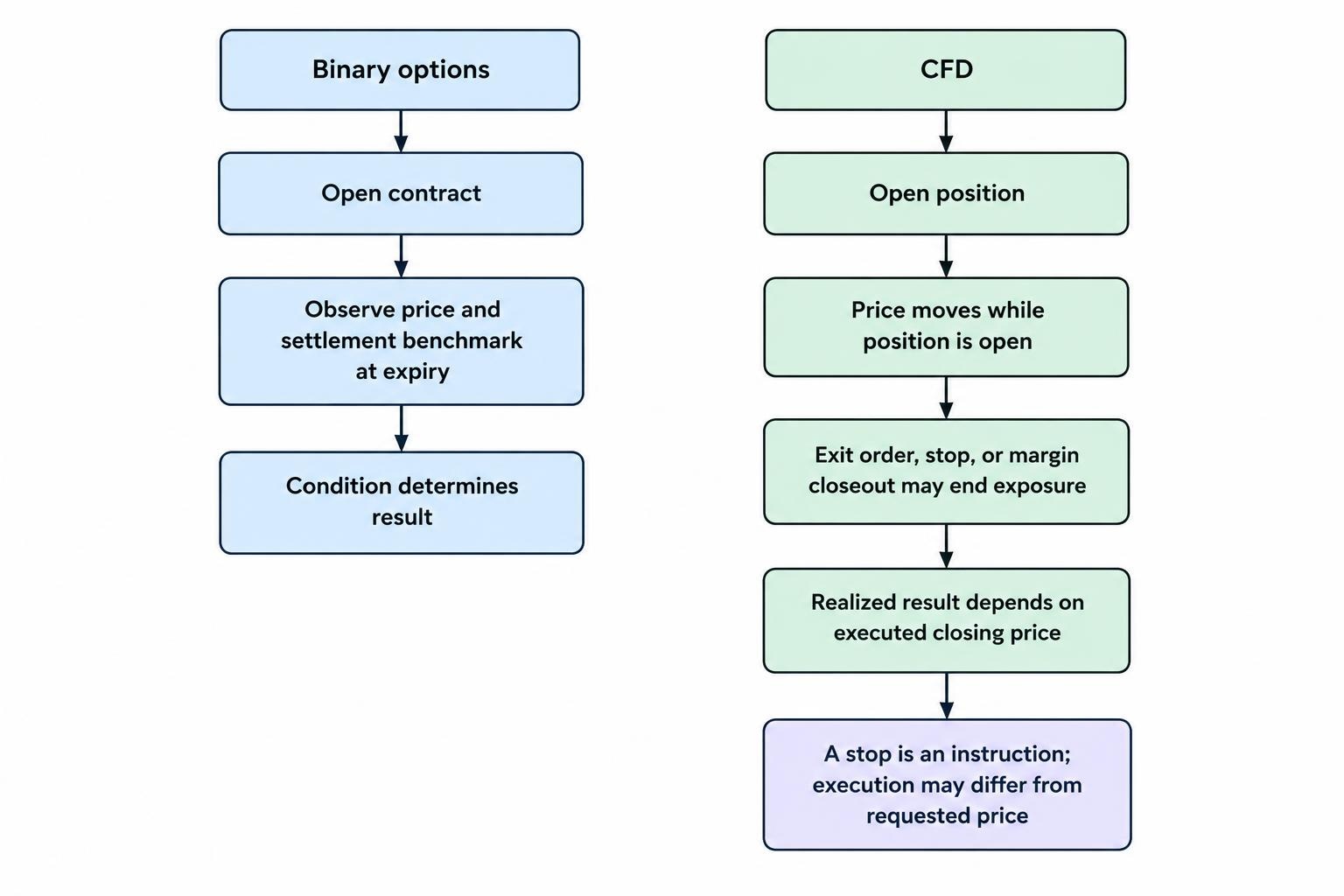
Binary options concentrate risk around the contract’s observation conditions. A small difference in the recorded settlement price can decide the entire result.
CFDs expose the trader to the path between entry and exit. A position might be stopped or closed for insufficient margin before the market later moves in the forecast direction. Waiting for the market to come back is not always an available choice.
Both products therefore require attention to quotes, order acceptance and execution. A chart price is not automatically the executable price or contractual settlement benchmark. The guide to binary options execution and latency examines why small timing differences can matter.
Australian CFD protections and their boundaries
Australian retail CFD restrictions cap borrowing style exposure by asset class. Maximum ratios range from 30:1 for major currency pairs to 2:1 for crypto assets. The intervening caps are 20:1 for minor currency pairs, gold and major stock indices; 10:1 for other commodities and minor indices; and 5:1 for shares and other assets. Section 7 of the CFD product intervention instrument sets the margin requirements, account closeout conditions and negative balance protection.
Negative balance protection operates at the CFD trading account level. It does not mean each position can lose only its opening margin. Other funds in the account can be exposed to losses.
Margin closeout protection is also different from a personal stop order. It requires the issuer to close positions when account equity falls below the applicable threshold, as soon as market conditions allow. It is not a promise that a position will remain open until the trader chooses to exit.
For practical comparison, keep three amounts separate: the opening margin, the intended loss under the trading plan and the money exposed across the account. Treating them as interchangeable is a common calculation error. None of these protections makes a losing strategy profitable or guarantees recovery if an issuer fails.
Current rules versus proposed changes
As at 21 October 2026, the existing CFD intervention order is scheduled to remain in force until 23 May 2027. On 12 October 2026, ASIC opened consultation on extending and amending the protections, with a proposed duration running to 2037 subject to approval. The 2026 CFD protection proposals are not the same as enacted changes.
Check the contract and legal entity, not just the brand
A comparison based only on platform appearance misses the party responsible for holding money, executing orders and paying withdrawals. Before assessing either product, identify the contracting company and the terms applying to the account.
For a CFD provider, examine the product disclosure statement, contract specifications, execution policy and fee schedule. Check how margin is calculated, when financing applies and which events allow the issuer to close a position.
For a binary contract being studied, record the strike, expiry, settlement benchmark, tie treatment and whether early closure is a contractual right or a discretionary feature. A prominent payout number cannot answer those questions.
Use the process for checking a broker’s licence to verify the legal entity rather than accepting a logo or licence number at face value. A familiar brand can have more than one contracting entity. Check the company actually named in the account agreement.
Which product fits the intended task?
For an Australian retail reader, binary options should not be treated as an ordinary available alternative to CFDs. The retail prohibition comes before preferences about expiry, payout or platform design.
At a mechanical level, CFDs offer more flexibility for a forecast that depends on the size of a move or an exit rule rather than one settlement event. A trader can vary exposure and attempt to close when the original reasoning no longer holds. Those controls bring calculation, execution and monitoring demands.
A binary contract is easier to describe at entry, but its simplicity conceals a strict requirement: the condition must be satisfied under the contract’s rules. A known stake and a known winning profit do not establish a favourable expected return.
A demo exercise can help distinguish the mechanics without risking money. Record the same hypothetical market forecast under each payoff structure, including an expiry for the binary and an exit rule for the CFD. Compare outcomes after realistic costs, not just whether the directional forecast was right. The guide to demo versus live binary options trading covers why simulated results should not be treated as proof of live performance.
Common questions
Are binary options cheaper because they have no spread?
Not necessarily. An asymmetric payout creates an economic hurdle even without a separately quoted spread. Compare the amount earned on a win with the amount lost on a loss, then include any other charges. For CFDs, assess explicit costs alongside average gains and losses.
Can a CFD lose more than the opening deposit?
A position can lose more than its opening margin. Australian retail negative balance protection concerns the trading account, not a separate cap for each trade. Do not assume protections described for Australian retail accounts apply to a different jurisdiction or client classification.
Does either product provide ownership of shares or an index?
No. These contracts provide exposure to an outcome or price movement. They do not give the trader ownership of the referenced shares, commodities or index constituents.
The practical decision
The difference is not simply fixed risk versus flexible trading. Binary options exchange a stake for a conditional fixed payoff. CFDs create variable exposure that must be managed through position size, exits, margin and costs.
Neither structure removes the need for sound arithmetic or affordable risk. If the objective is long term asset ownership rather than short term speculation, the comparison should extend beyond these two derivatives. The available alternatives to binary options provide a better starting point for that question.
This article was last updated on: October 22, 2026