Fake celebrity endorsements and AI trading ads try to make an unfamiliar financial offer feel familiar. A recognisable face supplies the trust; promises of automated profits supply the temptation. Neither tells you who controls the money.
The practical test is not whether the video looks convincing. It is whether the endorsement can be verified independently, the business is genuine, and the advertised product can lawfully be offered to you. Treat these as separate questions. This advertising tactic sits within the broader category of binary options scams, but the same checks apply to supposed crypto platforms, forex robots and automated investment accounts.
How a fake endorsement turns into a deposit
The advert is usually the introduction, not the whole scam. It directs attention away from an unknown operator and towards someone the viewer already recognises: a television presenter, business leader, politician or entertainer.
A linked page may imitate a news report and claim the person made money through an automated platform. A registration form then asks for contact details. After registration, a caller posing as an account manager encourages an initial payment, sometimes around $250.
The next stage replaces the celebrity with apparent results. A dashboard displays profits, and a small withdrawal may be allowed before requests for larger deposits begin. Attempts to withdraw more can trigger demands for fees or supposed tax payments. These stages appear in Scamwatch’s warning about fake celebrity investment platforms.
Keep the distinctions clear. An advert is not an endorsement record. A registration page is not proof of a trading business. A balance on a screen is not money held safely for you. Each needs evidence beyond what the promoter supplies.
What “AI trading” does and does not prove
AI can mean two different things in these adverts. It may describe the technology used to fabricate the celebrity’s appearance, or it may be the technology the advertised trading platform claims to use. Evidence of one proves nothing about the other.
A convincing video does not establish that a trading system exists. Equally, a business saying it uses AI does not establish that its results are genuine or repeatable. Promises of high, guaranteed returns with little or no risk remain warning signs, including when the promoter claims to operate sophisticated software. The SEC’s joint investor alert on AI investment fraud addresses this exact sales pitch.
Ask what the system actually does. Does it produce analysis, send signals, place trades or simply display an account balance? Who holds the funds? What losses can occur? An answer made entirely of technical buzzwords is not an explanation.
Do not start by debating whether the algorithm is clever. Establish whether the operator and offer are real. Once that threshold is met, the separate process of evaluating AI trading claims concerns evidence, performance records and the assumptions behind advertised results.
Binary options ads face an Australian retail ban
For Australian retail clients, there is an earlier check than any celebrity endorsement or software demonstration. ASIC’s product intervention order bans the issue and distribution of binary options to retail clients until 1 October 2031. The ban first took effect on 3 May 2021, as recorded in ASIC’s announcement extending the binary options ban.
An advert claiming that an AI robot makes a binary options offer suitable for Australian retail customers does not answer that restriction. Nor does a celebrity image establish an exemption.
Do not accept the promoter’s product label without examining the contract. Ask what determines the payout, when the contract ends and what happens when the prediction is wrong. If the seller cannot provide clear terms, there is no reason to progress to a deposit.
Check the news story, not just the celebrity’s face
A deepfake uses AI to depict a real person doing or saying something they did not actually do or say. Some examples show poor lip synchronisation, blurred facial edges, inconsistent lighting or unnatural movement. More convincing versions can be difficult to identify by sight. The eSafety Commissioner’s guidance on deepfakes covers both these clues and their limits.
Visual inspection should therefore be a warning check, not a permission slip. A video without obvious glitches has not passed an authenticity test.
Instead, leave the advert and visit the supposed publisher independently. Search its own news archive for the interview or article. Compare the headline, publication date and context. If the story claims to come from a broadcaster, look for the original programme or report through that broadcaster’s established channels.
Read the browser address as well as the page. A familiar logo and convincing layout do not establish who operates the domain. If you cannot verify the address, stop rather than trying to reason your way past the uncertainty.
A genuine interview also needs context. Finding the original footage does not establish that the investment recommendation appeared in it. Verify the claimed endorsement, not just the existence of the person or programme.
Why positive search results may give false comfort
Searching the platform’s name is useful, but several favourable results do not necessarily provide several independent checks. ASIC has warned that scammers build connected networks of fake news articles, supportive reviews, websites and AI generated endorsements. These networks target the places consumers use to verify an offer. That pattern is documented in ASIC’s warning about AI supported investment scam networks.
Assess independence, not volume. Do the pages identify accountable publishers and provide evidence outside the promotional material? Can their claims be checked without returning to the seller’s own pages? Ten repetitions of the same unsupported claim still leave the claim unsupported.
Apply that reasoning to comments beneath an advert too. A stranger saying they received a payout cannot verify the operator’s identity, financial position or treatment of your money.
Likewise, failure to find a warning is not a positive finding. “I found no complaint” and “I verified this business” are very different statements.
Checks to make before sharing your details
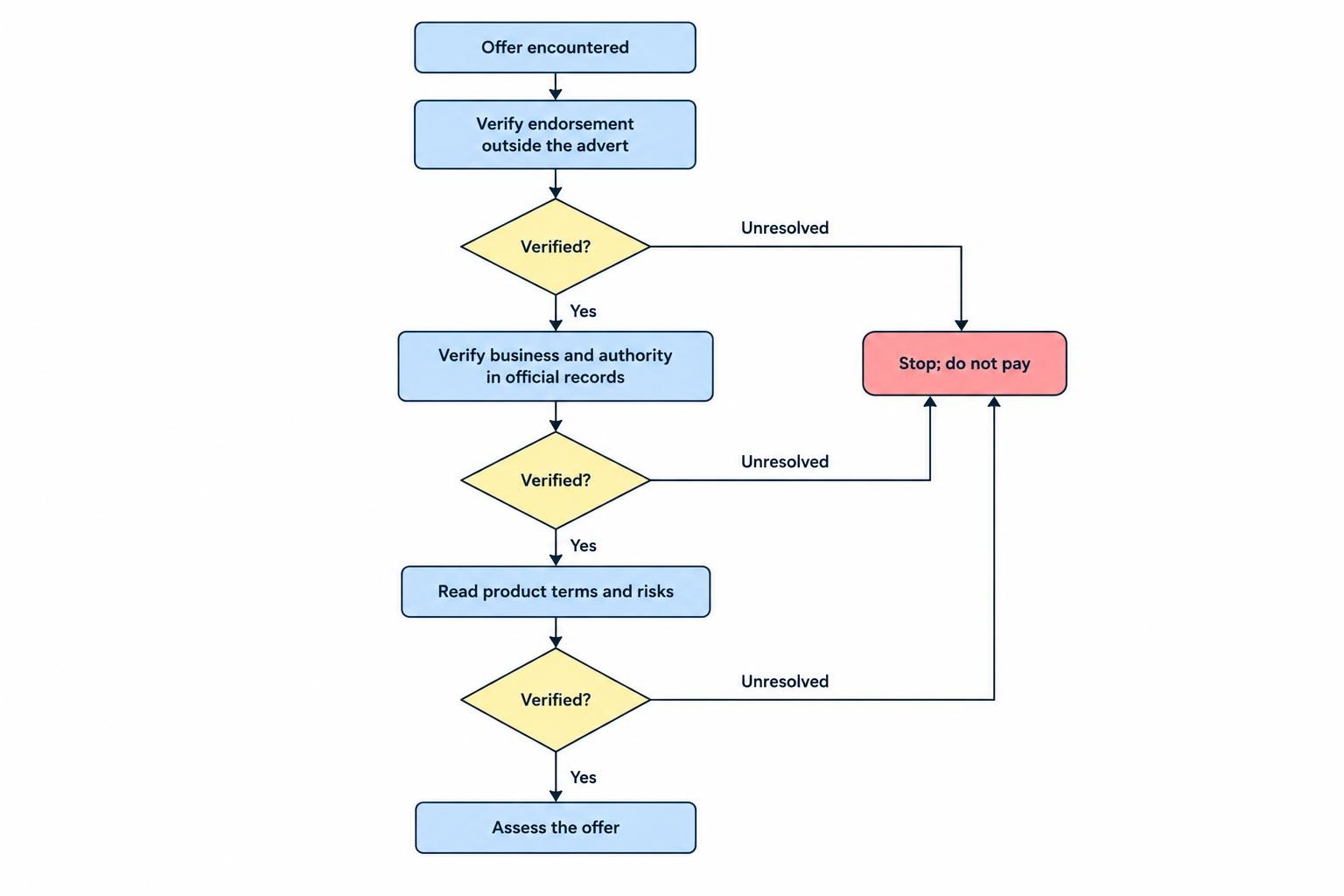
Do these checks outside the advert, registration form and caller’s messages. The promoter should not control both the offer and the evidence used to assess it.
- Identify the business. Ask for its full legal name, claimed licence details and the entity that would receive your payment. A trading brand alone does not answer these questions.
- Verify the claimed authority. Compare the business and licence details against official records. Check the relevant authorisations rather than accepting a licence screenshot.
- Confirm you are dealing with that business. Use contact details found independently. A genuine licence number can be copied by an impersonator.
- Read the offer before discussing payment. Establish the product, risks, charges, withdrawal conditions and where the money goes. Do not substitute a telephone explanation for written terms.
An Australian financial services licence is not an ASIC endorsement or a guarantee against loss. Scammers also misuse genuine licence details. Moneysmart’s investment verification checklist sets out the checks for licence holders, impersonation and independently verified contact information.
Set a firm stopping point: unresolved identity, authority or product questions mean no payment. You do not need to keep talking until the salesperson agrees with your decision.
Do not deposit a small amount as a substitute for checking. That experiment tests whether someone will accept your money, not whether the offer is genuine. Keep personal documents, banking credentials and authentication codes out of the conversation while the business remains unverified.
A hypothetical example: a profit display is not a withdrawal
Suppose an advert appears to show a familiar television presenter recommending an automated platform. You deposit A$250. A week later, the dashboard shows A$2,400, but the operator demands another A$360 before releasing the balance.
Those figures are illustrative, not a reported case. They show why the account display is the wrong reference point for deciding what to do next.
The A$2,400 balance does not establish that trades occurred or that the operator holds withdrawable funds. Paying another A$360 would put your total cash outlay at A$610, without establishing either fact.
Even if you had previously received a small payment, that would prove only that one payment reached you. It would not verify every displayed gain or guarantee access to the remaining balance.
The useful question is not, “How do I protect my A$2,400 profit?” It is, “What independently verified evidence justifies sending any more money?” Do not let an unverified number on a dashboard decide the answer.
What to do if you clicked, registered or paid
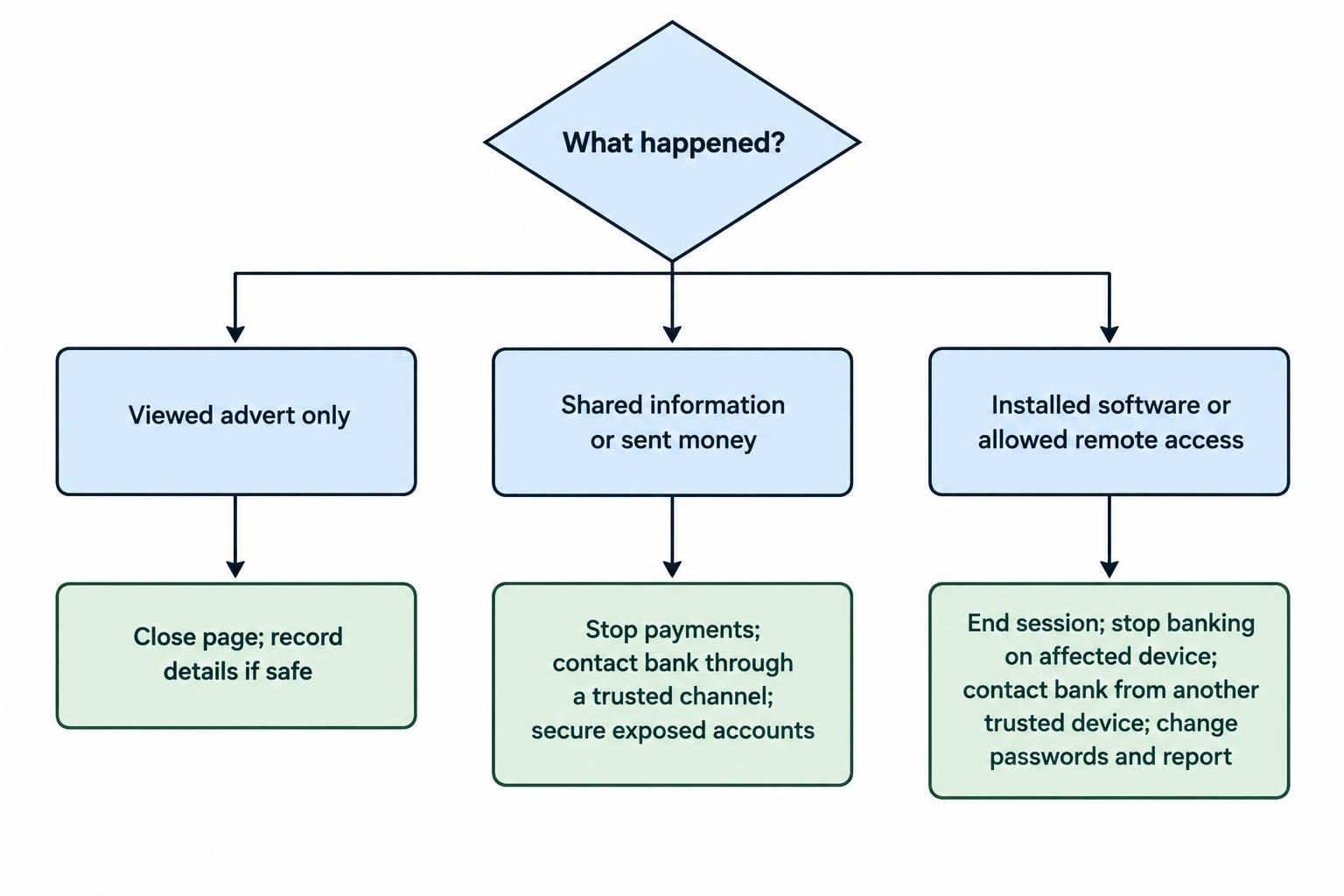
If you only viewed the advert
Close the page rather than continuing through the registration process. If safe to do so, record the advert’s account name, platform and destination address for a report. Do not download anything to investigate it.
A click alone does not tell you that an account or device has been compromised. Base your response on what happened next: whether you entered information, reused a password, installed software, shared access or made a payment.
If you submitted information or sent money
Stop sending money and contact your bank or payment provider immediately through a trusted channel. Explain how the payment happened and ask whether transactions can be stopped or funds recovered. Do not wait for the caller to approve a withdrawal or provide another deadline.
Change exposed or reused passwords and seek identity support if you supplied identity documents. Moneysmart’s guidance for reporting an investment scam covers bank contact, Scamwatch reporting, personal information protection and IDCARE support.
Preserve receipts, messages, payment references and screenshots already available to you. Write a short timeline while events are fresh. Keep the account name and the legal entity claimed by the caller separate in your notes; investigators need what you actually received, not your best guess at who was responsible.
If you installed software or allowed remote access
End the remote session and stop using the affected device for banking until it has been checked. Contact your bank using another trusted device. Change important account passwords from a device you trust, and enable multifactor authentication where available.
Remote access requires a security response, not just a dispute about an investment. The Australian Cyber Security Centre’s remote access scam guidance recommends notifying the bank, changing important passwords, enabling multifactor authentication and reporting through ReportCyber.
For the wider response, use the steps in what to do after a binary options scam. Prioritise stopping further loss and securing accounts before collecting every last piece of evidence.
Do not pay for a second promise
Be cautious of anyone who subsequently promises to recover the money for a fee. A new caller, impressive certificate or claimed connection to an investigation does not establish that they can return your funds.
Keep recovery discussions with independently contacted banks, payment providers and authorities. Review the warning signs of trading fund recovery scams before responding to an unsolicited offer of help.
The same rule applies at both ends of the process: verify the person, the business and the claim outside the material they control. A familiar face cannot do that work for you, and an AI label cannot replace it.
This article was last updated on: October 22, 2026