Trading signals and software costs sit outside the amount staked on a binary option, but they still affect the result. A strategy that shows a small profit before subscriptions can show a loss after paying for charts, indicators, data and signal access. Those bills need their own budget, not a footnote beneath the trading results.
For Australian retail clients, the regulatory position comes first. ASIC’s binary options product intervention order prohibits the issue and distribution of binary options to retail clients until 1 October 2031. Purchasing analysis software or joining an offshore signal service does not create an exception. The examples below explain costs and hypothetical results, rather than recommend access to binary options.
Separate the software bill from the trading result
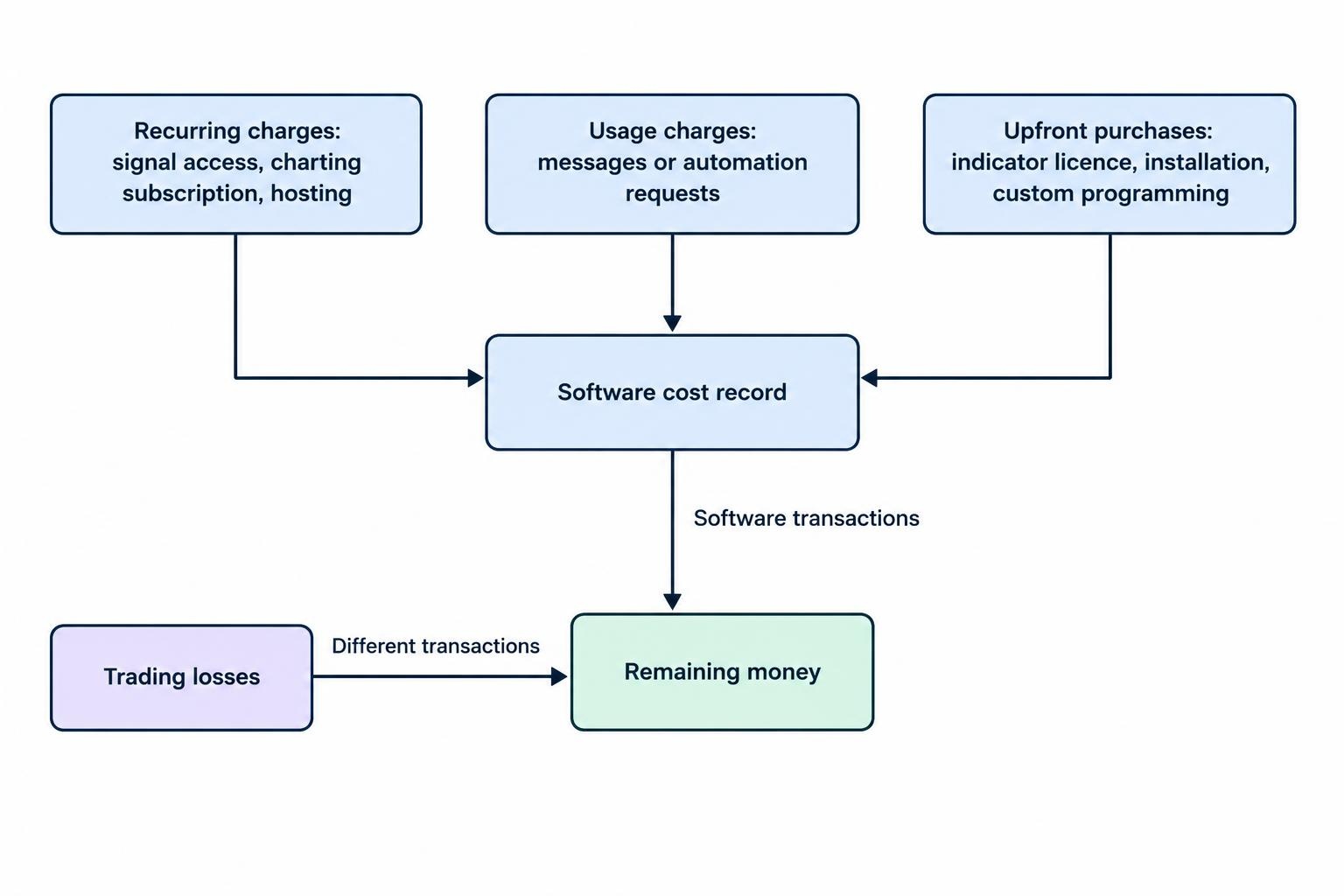
A useful cost review separates three categories: recurring charges, usage charges and purchases paid upfront. Recurring charges include monthly signal access, charting subscriptions and hosting. Usage charges depend on activity, such as messages delivered or automation requests processed. Upfront purchases might include an indicator licence, installation assistance or custom programming.
Keep these costs separate from trading losses. Losing A$20 on a contract and paying A$20 for an indicator are different transactions, even though both reduce the money remaining. This distinction makes it easier to identify whether poor results come from the trading approach, the tools supporting it, or both.
The wider binary options trading costs guide covers expenses beyond signals and software. For this part of the budget, record the supplier, billing currency, payment frequency, renewal date and total commitment. A monthly equivalent is useful for comparison, but it should never hide a larger payment due immediately.
Also distinguish necessary costs from optional purchases. A tool needed to export research data serves a clear purpose. A second indicator that repeats an existing indicator’s output may add expense without adding useful information.
Charting subscriptions and market data are different purchases
Start with the task the software must perform. Do you need historical data exports, several charts on one screen, more alerts, or access to shorter chart intervals? Write down that requirement before comparing subscription tiers.
The TradingView subscription comparison separates plans through features such as chart capacity, alert allowances and historical bars, with monthly and annual billing choices. These are practical capacity differences. Paying for a higher tier does not establish that an analysis method will produce better results.
For research, the useful question is whether the lower tier prevents a defined task. If a project needs more historical observations than the plan provides, an upgrade may address that constraint. If the task already works, the extra capacity needs a separate justification.
Check paid indicators independently of the charting subscription. Establish whether access requires a recurring membership, whether it works on the chosen plan, and whether its licence covers the devices or accounts you intend to use. Ask what happens to saved settings and historical signals when access ends.
Market data can be another bill. TradingView’s market data subscription guidance states that its paid plans do not include the real-time fees charged by most supported stock and futures exchanges. Data package availability and rates also depend on subscriber status and exchange rules.
Before buying data, identify the exact instrument, venue and feed required. A subscription labelled “real time” is not, by itself, evidence that the chart uses the same reference price as a particular contract. Paying for a faster but unsuitable feed does not solve that mismatch.
Compare signal pricing by the full commitment
A signal subscription price tells you what access costs. It does not tell you whether the alerts are useful, whether you can act on them, or whether the supplier’s reported results match the conditions available to a subscriber.
Compare the full commitment rather than the headline fee. Check for joining charges, paid upgrades, minimum subscription periods and separate charges for different markets or sessions. If a service sells several membership levels, establish what the basic subscription actually includes before assuming the advertised features are available.
Where access is described as free in return for opening or funding an account, ask how the provider receives payment. A referral arrangement is different from a subscription funded directly by the customer. Neither arrangement proves that the signals work, and a deposit requirement is not a software fee you can safely ignore.
For any performance fee, request the calculation in writing. Does “profit” mean the result before subscriptions and other expenses? Are previous losses carried forward before another fee becomes payable? Can a fee arise during a profitable month even though the customer remains down since joining?
Price comparisons should follow an evidence review, not replace one. The guide to evaluating trading signal track records covers the records needed to assess performance. A cheaper service with an unverifiable history is not automatically better value than an expensive one. Both may be unsuitable.
Worked example: how subscriptions raise the break-even rate
The following budget uses invented amounts to demonstrate the arithmetic. All figures are Australian dollars, not current supplier quotes. The example assumes the listed charges are the final amounts paid, with no further tax or currency conversion charge.
| Expense | Monthly cost |
|---|---|
| Charting subscription | A$25 |
| Signal subscription | A$60 |
| Market data | A$15 |
| Paid indicator access | A$10 |
| Hosting for a supported automated process | A$20 |
| Total recurring cost | A$130 |
Add a hypothetical A$120 installation charge and the first month requires A$250 in cash. Keeping every subscription for 12 months would cost A$1,680 in the first year, including installation. The recurring bill alone is A$1,560 a year.
Apply the costs to a hypothetical trading record
Assume 100 contracts, each with a A$20 stake. A winning contract returns the stake plus A$16 profit, equivalent to an 80% net payout. A losing contract loses the entire A$20. There are no ties, refunds, early exits or other charges in this example.
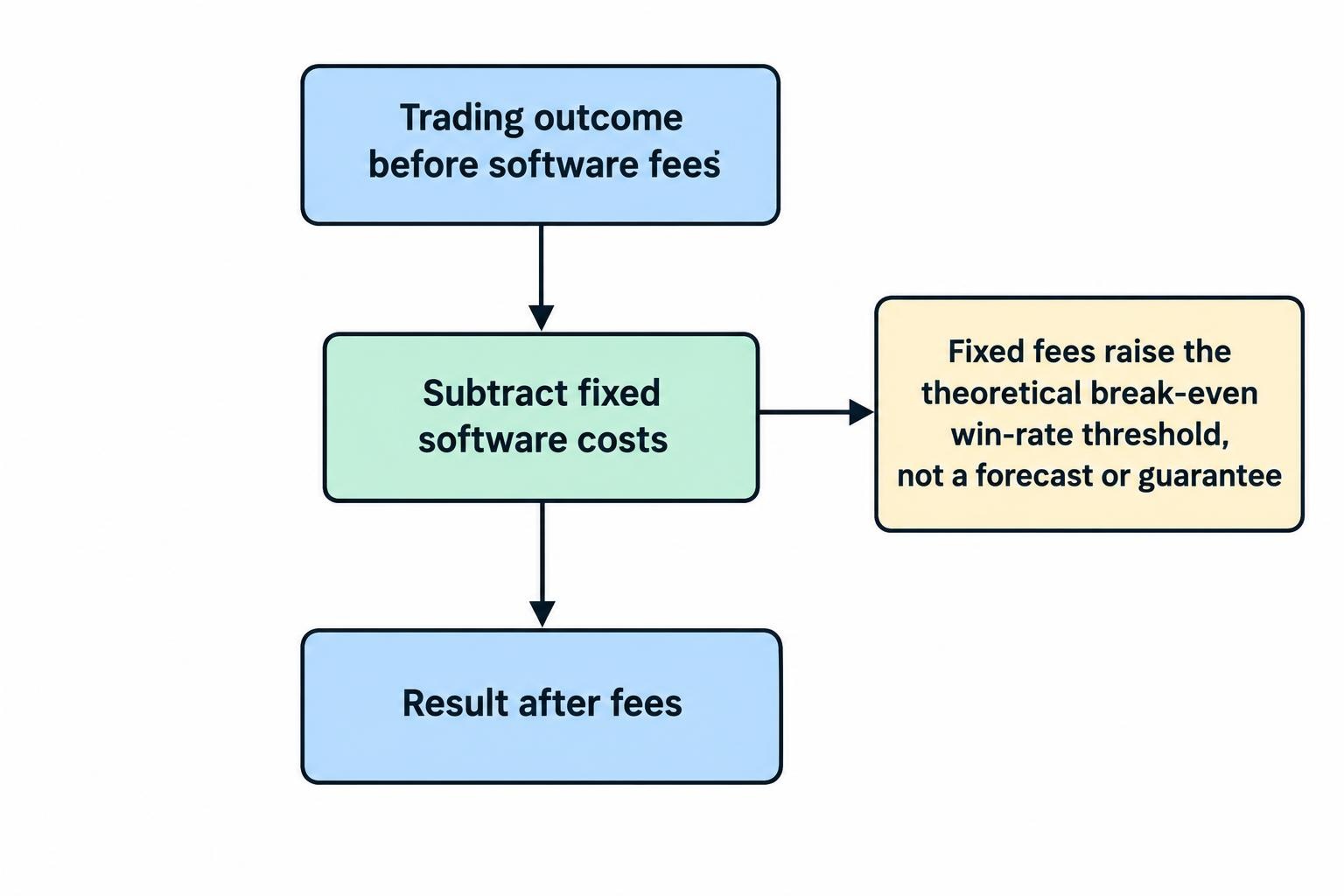
With 58 wins and 42 losses, winning contracts generate A$928 in profit and losing contracts cost A$840. The result is A$88 before subscriptions. Deduct the A$130 recurring bill and the result becomes a A$42 loss. The installation charge would reduce it further if paid during that month.
For equal stakes and a constant payout, the theoretical threshold is:
Break-even win rate = (1 + fixed fees ÷ total amount staked) ÷ (1 + net payout rate)
Without software fees, the threshold at an 80% payout is about 55.56%. Including A$130 of fixed costs across A$2,000 staked raises it to about 59.17%. Across exactly 100 contracts, that means at least 60 wins to finish above zero under these assumptions.
This is an accounting threshold, not a forecast. It does not establish that a service can achieve the required result. The probability and expected value guide explains how payout terms and win probability interact before subscription costs are added.
Fixed expenses also weigh more heavily on a smaller activity sample. With only 40 contracts at A$20 each, the same A$130 bill raises the theoretical threshold to about 64.58%. That is not a reason to place more contracts. Extra activity adds exposure; it does not manufacture a profitable method.
Automation can add hosting, integration and maintenance costs
An automation budget should start with compatibility, not the hosting price. Confirm which software sends the instruction, which system receives it, and whether the intended connection is supported. A chart alert, a messaging notification and an accepted order are different stages.
If a process needs to run unattended, establish whether it requires your computer to remain on or can operate through a supported hosted service. Only then compare hosting costs. A virtual private server has no useful role in a workflow that consists of reading alerts manually.
Custom development needs a written scope. Agree what the quoted price covers: installation, testing, documentation, source files, updates and fault correction. Ask whether a platform change would require a new paid project. An inexpensive script can become expensive if every repair requires the original developer.
Delivery quality belongs in the cost assessment too. A low subscription fee offers little value if alerts arrive after the conditions used in the supplier’s record. The guide to signal repainting and latency covers two issues that can distort comparisons between displayed signals and usable alerts.
For budgeting, record failures rather than assigning them an invented average cost. Note missed alerts, duplicate notifications, outages and manual repairs. These records help distinguish a subscription that saves work from one that creates another job.
Judge value after costs, not by advertised accuracy
A claimed win rate is not enough to price a signal service. The payout, stake assumptions, sample size and complete sequence of results all matter. A record that omits losses cannot support a sensible comparison, however attractive the monthly charge looks.
Ask for results that distinguish the trading outcome from the customer’s result after fees. Keep subscription costs in the assessment even during months when the service produces no usable alerts. Paying for access still costs money when there is nothing useful to act on.
Guaranteed profits, high returns with little risk and pressure to pay quickly are warning signs identified in Moneysmart’s investment scam guidance. A polished dashboard or an “AI powered” label is not evidence that a supplier can deliver its promises.
Avoid treating a larger payment as the answer to disappointing results. If the explanation for failure is always another membership level, another indicator or another activation charge, stop and reassess the original purchase. The next invoice is not proof that the previous one was worthwhile.
Check annual billing, renewals and refund terms
Annual billing can reduce the monthly equivalent while increasing the amount at risk upfront. In a hypothetical comparison, A$25 per month billed annually means a A$300 payment. A genuinely monthly plan costing A$30 would cost A$120 over four months. The annual option only becomes cheaper if you use it long enough.
Compare the initial price with the renewal price. Record when any promotion ends, whether renewal is automatic and which account controls cancellation. Keep a copy of the checkout summary rather than relying on a marketing page that may change later.
Cancellation and refunds are separate questions. Do not assume that stopping renewal returns money already paid. For ordinary change-of-mind purchases, a business generally does not have to provide a refund unless its policy offers one; rights concerning faulty products or services are a separate matter. The ACCC’s refund and cancellation guidance sets out that distinction.
For overseas billing, check the quoted currency, final checkout amount and payment provider’s conversion terms. Keep the original invoice and the Australian dollar amount actually charged. Use the latter in your cost record rather than repeatedly converting an old advertised price.
Before ending access, export any records you need and save cancellation confirmation. Check the next statement to confirm that the expected charge has stopped.
Set a spending rule before adding another tool
Give each subscription one clear job and one review date. A charting plan might be retained because it provides a required export. A journal might be retained because it makes records easier to audit. A signal subscription needs evidence relevant to its stated purpose, not just frequent notifications.
For research projects, compare the proposed purchase with simpler alternatives. The binary options backtesting software guide covers a separate software category, but the spending principle is the same: define the task before paying for capacity. A tool should solve a known problem rather than supply a new reason to keep buying tools.
Set a maximum research budget that does not depend on future trading profits. Track cash paid, monthly allocations and renewal commitments separately. Remove duplicate subscriptions, and do not renew a service solely because time and money have already gone into setting it up.
The useful measure is the total cost of a suitable, verifiable workflow. More alerts, more indicators and a larger software bill do not make the underlying evidence stronger.
This article was last updated on: October 22, 2026