Binary options mobile apps can display prices, simulate contracts, deliver trading signals or connect a user to an account. Those functions are different. An app containing charts or an educational simulator is not necessarily a platform through which real-money binary options can be traded.
For Australian retail clients, the starting point is the product restriction. ASIC’s prohibition on the issue and distribution of binary options to retail clients took effect on 3 May 2021 and has been extended until 1 October 2031. Access through a phone does not create an exception.
This makes older advice about choosing the most convenient binary options app unsuitable for an Australian audience. Device compatibility and interface quality remain relevant when assessing software, but neither establishes that the underlying service can lawfully be offered to the user.
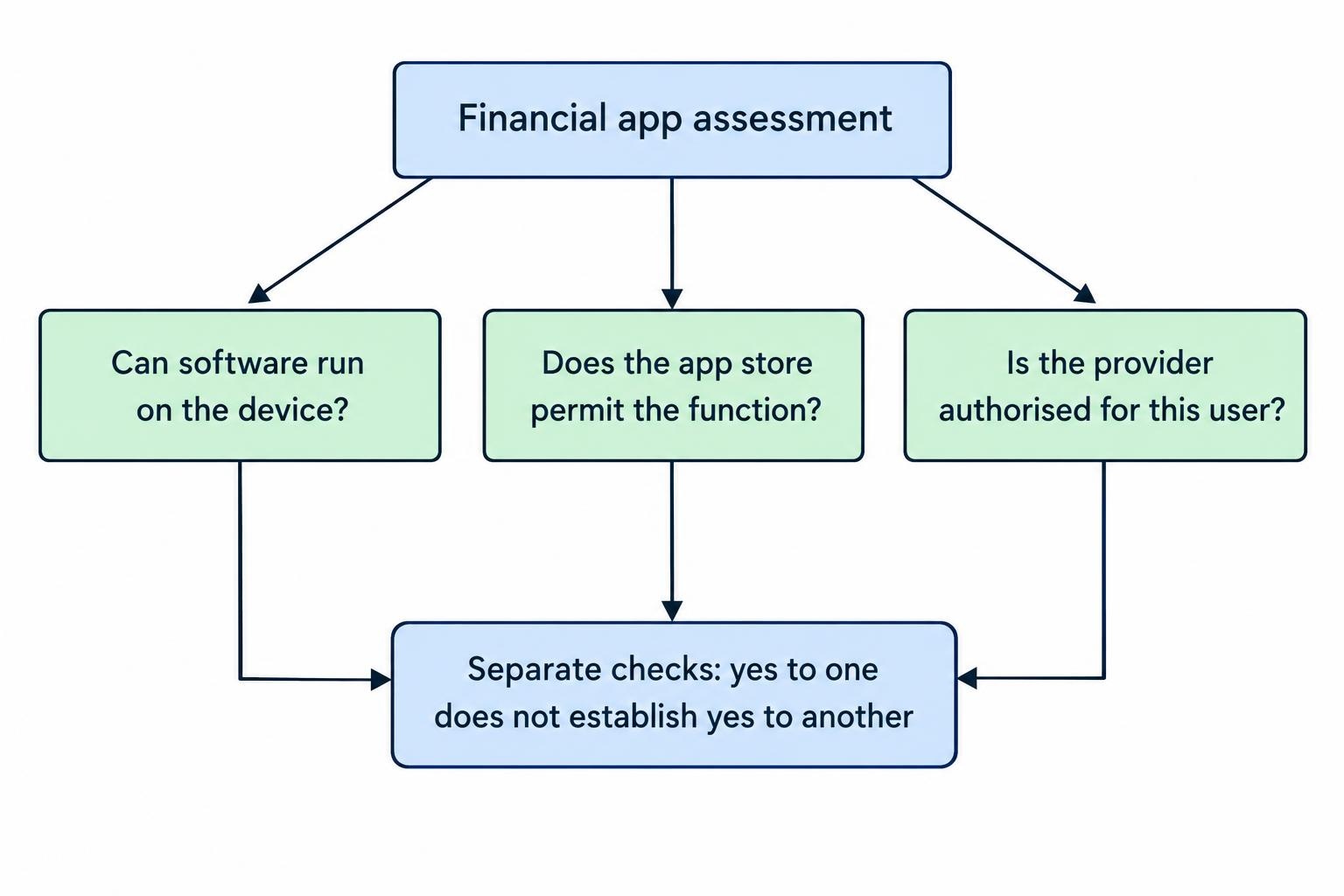
There is a separate distribution issue. Apple and Google prohibit apps that facilitate binary options trading in their respective stores. A search result, old download page or promotional screenshot therefore needs to be interpreted against current store policies, rather than treated as evidence of an available, approved trading service.
The position described here reflects rules and published policies checked on 22 October 2026. The practical distinction is between what software can technically do, what an app store permits and what a financial services provider is authorised to offer.
The operator matters more than the app design
A mobile interface can be developed by the product issuer, a technology contractor, a marketing business or an unrelated third party. The developer’s name does not necessarily identify the company that would hold client money or determine contract outcomes.
An app can also connect users to different legal entities depending on location or account status. A familiar brand and a professional interface do not establish which entity is responsible for the service.
Moneysmart’s guidance on checking an investment provider explains the importance of checking financial services authorisation. A licence reference needs to match the actual provider and relevant service. An Australian company registration, an overseas licence or a licence held by another company in the same group does not answer that question.
For binary options, finding an Australian licence does not override the retail product prohibition. The separate explanation of ASIC’s binary options regulations covers its scope.
Comparing iOS, Android and Windows mobile platforms
Operating-system compatibility determines whether software can run on a device. Store policy determines whether a particular app function is permitted through that store. Security support determines whether the device continues to receive relevant fixes. These should be assessed separately.
| Platform | Binary options app position | Practical strengths for lawful financial apps | Limitations and concerns |
|---|---|---|---|
| iPhone and iPad | Apple prohibits apps facilitating binary options trading on the App Store | Touch interfaces, device authentication and mobile account access where supported | Compatibility depends on the app and OS version; store presence is not financial authorisation |
| Android phones and tablets | Google Play prohibits apps that enable binary options trading | Broad choice of devices and screen sizes; mobile and browser interfaces where supported | Update support varies by device; downloads outside Google Play require separate scrutiny |
| Windows Phone and Windows 10 Mobile | Legacy platforms; Windows 10 Mobile is out of support | An existing device may still run some old software | Unsuitable for sensitive financial access because of obsolete support and compatibility |
| Tablet running a supported desktop version of Windows | A desktop operating system on portable hardware, distinct from Windows Mobile | May run supported desktop browsers and financial software | Touch usability varies; desktop compatibility does not establish product availability or authorisation |
The strengths above concern general financial software. They are not reasons to use binary options or evidence that a binary options provider may serve Australian retail clients.
iPhone and iPad
Apple’s App Review Guidelines prohibit apps that facilitate binary options trading. The policy is about the function offered, rather than whether the interface is attractive or the developer calls the product an investment tool.
A page advertising an “iPhone binary options app” may refer to a browser interface, an educational product or an outdated listing. The description alone does not identify what is actually being supplied.
An iPad also should not be assumed to provide the same experience as an iPhone. Some financial apps offer a tablet layout with more chart space, while others reproduce a phone layout. The device’s larger screen is useful only if the software uses it effectively.
For any legitimate financial app, supported operating-system versions and device requirements need to be checked against its current documentation. The presence of an installation file or an old account login does not establish ongoing support.
Android phones and tablets
Google’s Financial Services policy states that Google Play does not allow apps that provide users with the ability to trade binary options. An app mentioning binary options might instead provide commentary, simulated activity or signals; its actual functions need to be distinguished from its marketing.
Android software can also be distributed outside Google Play. That technical possibility does not remove Australian restrictions or establish that a download is trustworthy.
An APK is an Android application package. A file supplied through a message, advertisement or unfamiliar website is still software requesting access to the device. Its label and branding are not sufficient evidence of its origin.
Google Play Protect checks for potentially harmful apps, including apps from other sources, and can warn about or block harmful behaviour. Google recommends keeping it enabled. A clean scan is a security signal, not a guarantee about a financial business or its treatment of client money.
Windows Mobile and Windows tablets
Windows Mobile is no longer a current alternative to iOS and Android. Microsoft’s Windows 10 Mobile lifecycle notice records the end of support and the cessation of routine security updates.
An old handset may still turn on, display a website or launch an installed app. Those functions do not make it suitable for passwords, identity documents or financial transactions. Browser compatibility and the availability of current app versions are separate problems from whether the device remains operational.
A modern tablet running a supported desktop Windows release belongs in a different category. It should be assessed using that operating system’s support status and the requirements of the relevant desktop software. Describing every Microsoft-based tablet as “Windows Mobile” obscures this distinction.
Installed apps and mobile browser access
An installed app and a mobile website can present the same underlying account through different interfaces. Their appearance does not reveal whether the app contains substantial native software or mainly displays web content.
A browser interface may avoid a separate installation, while an installed app may provide convenient authentication and notifications. Neither format is automatically faster, clearer or more reliable. Those qualities depend on implementation, device performance, network conditions and the provider’s systems.
| Access format | Potential advantages | Practical limitations |
|---|---|---|
| Installed application | Device integration, convenient login and a layout designed for touch | Requires trustworthy distribution, compatible software and ongoing updates |
| Mobile website | Access through a supported browser without a separate app installation | Layout, session handling and features may differ from desktop access |
| Home-screen web app | App-like access to a web service, depending on browser and device support | A home-screen icon does not establish native functionality or store review |
A web app remains a way of accessing a service. It does not change the legal status of a financial product. The Australian retail restriction applies to the underlying issue and distribution of binary options, rather than depending on whether the screen is opened from a browser bookmark or an app icon.
Account integration and synchronisation
Where a financial service provides both mobile and desktop access, the account balance, open positions and transaction history should be consistent. A difference may reflect delayed refreshing, different account selections or another issue requiring investigation.
The interface needs to identify whether the user is viewing a demonstration account or a live account. Currency and account number should also be clear. Similar-looking screens can conceal materially different account settings.
Actions taken on one device should have an observable status on the other. An order marked as pending on a phone should not be assumed to have failed merely because the desktop screen has not updated.
Logging out, closing a browser tab or uninstalling an app generally does not cancel an already accepted financial contract. The account and its obligations exist in the provider’s systems. Software removal and account closure are different actions, with different consequences.
Interface design, contract information and execution
A binary options screen can look simple because it presents a direction, stake and expiry. That simplicity can conceal the information needed to understand the contract. A useful interface makes the contractual terms visible before any commitment.
The standard should be accuracy and clarity, rather than the fewest possible taps. Removing confirmation screens may make software feel faster while increasing the chance of selecting the wrong stake, contract or account.
Stake, payout and possible loss
The stake is the amount committed to the contract. For a common fixed-return binary option, an unsuccessful outcome loses the stake, while a successful outcome returns the stake plus a specified profit. Other settlement terms need to be read rather than assumed.
A payout percentage needs a clear definition. If a hypothetical $100 contract offers an 80% net return on success, the profit is $80 and the total amount returned is $180. A display showing “180% payout” could describe that same gross return. Confusing gross proceeds with profit distorts the apparent reward.
At that assumed payout, a 50% success rate would lose money over repeated equal-sized contracts. Five wins produce $400 of profit, while five losses cost $500, giving a $100 net loss before other charges. The break-even success rate is approximately 55.6%, assuming unchanged payouts, no ties and no additional costs.
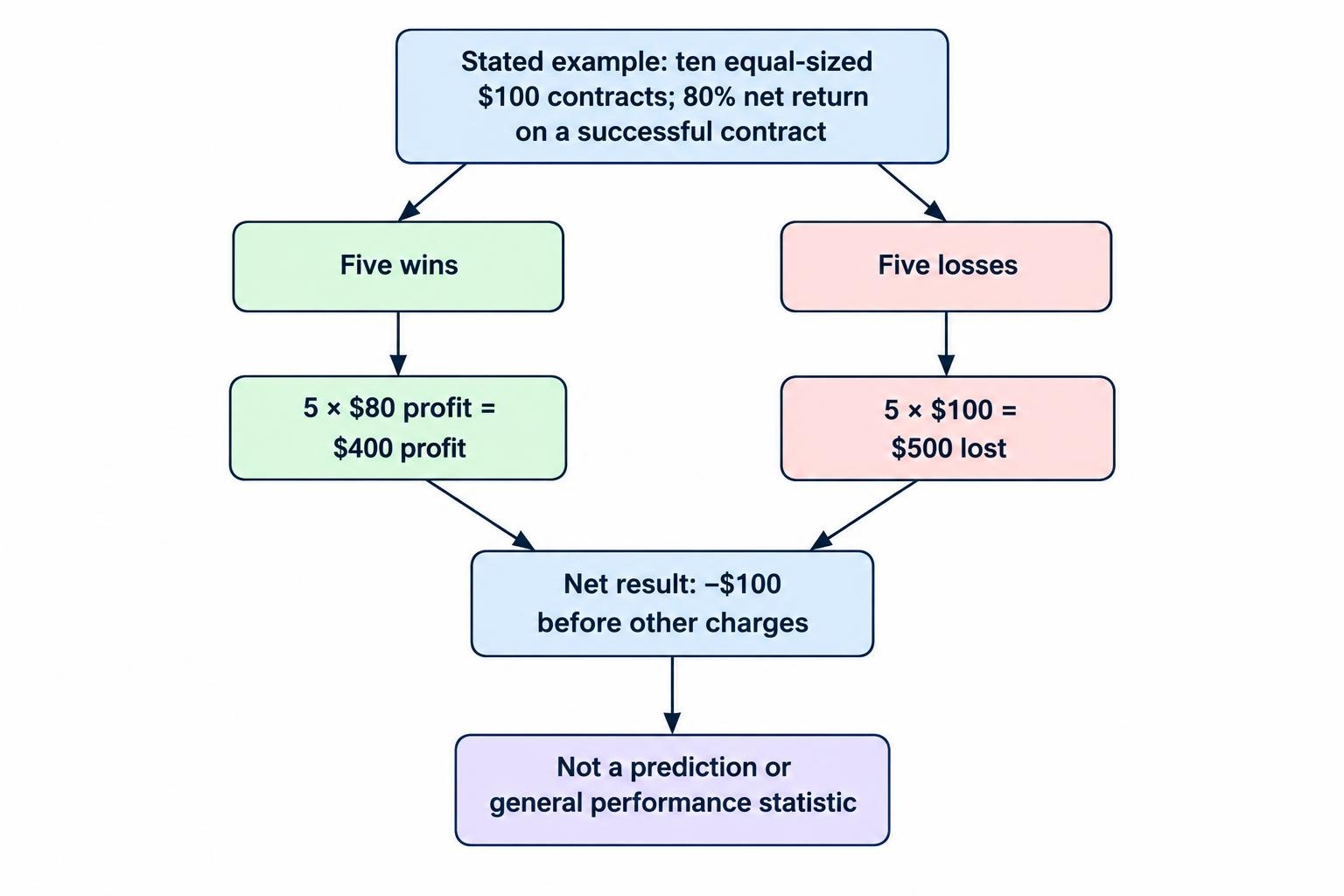
This arithmetic does not depend on the operating system. A clearer interface can reduce misunderstanding, but it cannot change the contract’s economics. The guide to binary options payouts explains the distinction between profit and total return.
The stake field should remain visible when an on-screen keyboard opens. Decimal separators, account currency and the treatment of a previously used stake also matter. A default that silently retains the last amount can produce a different commitment from the one the user expects.
Expiry and settlement
Expiry is the time at which the contract is evaluated under its terms. A short countdown does not necessarily explain when the purchase window closes, which server clock applies or what happens if the order reaches the provider late.
A contract expiring at a fixed clock time is different from one lasting a fixed duration after acceptance. A “60-second” label needs that context. Time zones and daylight saving can create further confusion when the interface displays a local time but records the transaction in another zone.
The settlement rule also needs to identify the reference price and treatment of an exact tie. Some contracts may refund the stake at equality; others use a different rule. The correct result follows the contract terms, not a general assumption about how binary options should work.
A chart is not a complete settlement record. Its display may use a different price series, aggregation interval or number of decimal places. The explanation of settlement and ties covers why these details affect outcomes.
Latency and order confirmation
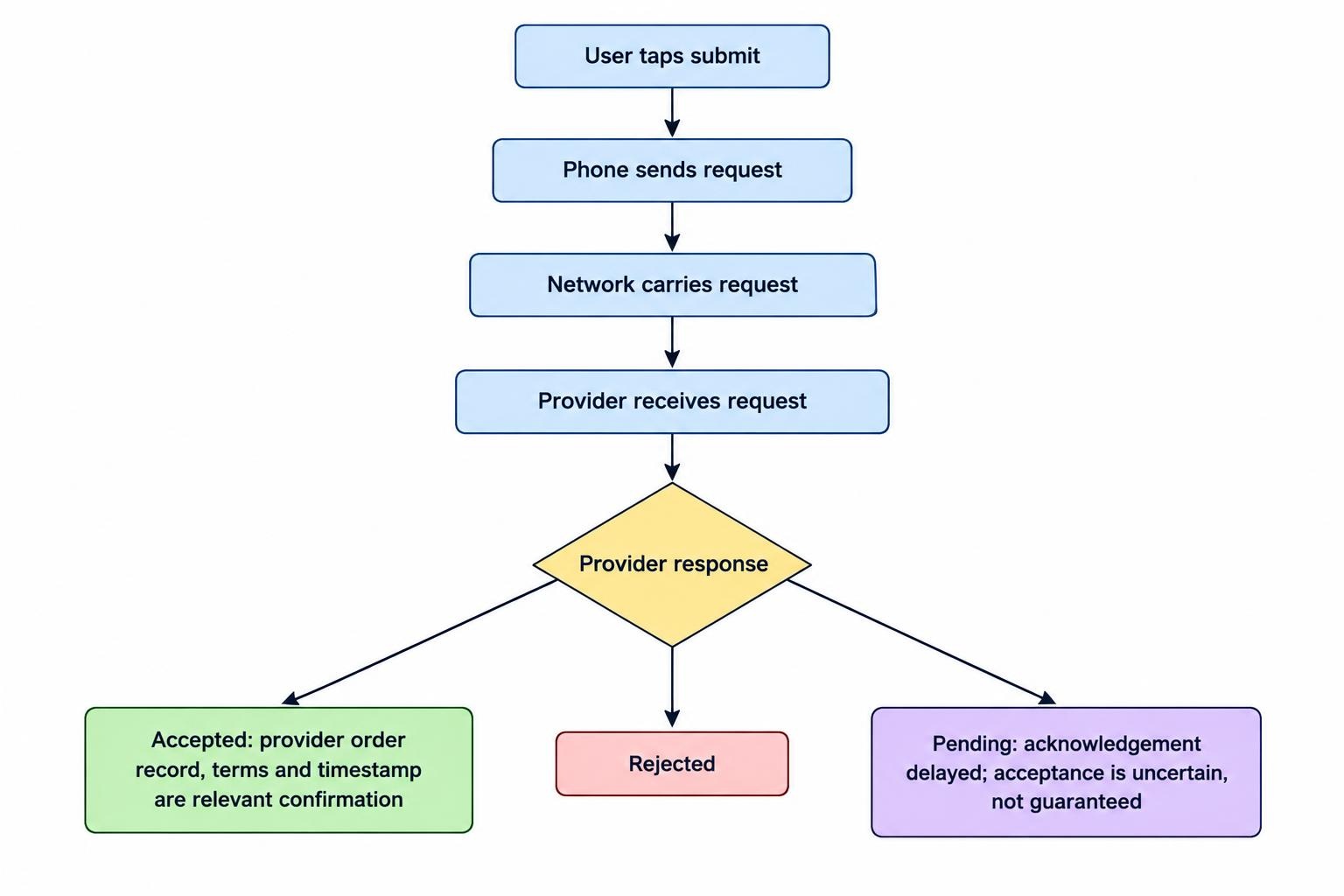
Latency is the delay between an action and the relevant system response. A mobile order passes through the device, network and provider’s infrastructure. A responsive button therefore does not establish immediate acceptance.
Consider a hypothetical order submitted close to a purchase deadline. The phone may display a tap animation while the network request is still travelling. The relevant confirmation is the provider’s accepted order record, including its terms and timestamp.
A frozen screen creates uncertainty about status. Repeatedly tapping a submission button can create duplicate requests if the first request succeeded but its acknowledgement was delayed. Clear pending, accepted and rejected states reduce that ambiguity.
Changing from Wi-Fi to mobile data, receiving a call or moving through an area with poor coverage can interrupt the interface. The contract’s clock does not necessarily pause. The guide to execution and latency explains why a visible screen and an accepted transaction are different stages.
An early-exit button also should not be treated as a guaranteed cancellation right. Its availability and price depend on the contract. An unavailable connection or withdrawn exit quote may leave the original expiry arrangement in place.
Demo accounts, charting and mobile alerts
What a demonstration account can establish
A demonstration account uses simulated funds. It can help a user understand a layout, locate contract information and observe how the interface responds without placing money at risk.
Its strongest use is checking software behaviour. Account labels, stake entry, orientation changes, chart controls and the handling of interruptions can all be examined in a simulated environment.
A demonstration balance is not evidence of withdrawable profit. The simulation may use assumptions about pricing, acceptance and execution that do not reproduce a live account. It also cannot establish how an operator would handle a disputed settlement or a withdrawal request.
ASIC raised these concerns during its 2017 review of binary options mobile apps. It identified more than 330 apps offered by entities or individuals that appeared to be unlicensed. The regulator also found misleading profitability claims, missing risk warnings and examples of education or review services collecting information for sales activity.
That historical review does not mean every current simulator has the same problems. It does show why a smooth demonstration and polished presentation are inadequate evidence about a financial service. The comparison of demo and live trading develops that distinction.
Charts and analytical tools
Mobile charting should be assessed by what can be read accurately on the available screen. The number of indicators is a poor substitute for visible prices, timestamps and clear settings.
A technical indicator is a calculation using price, volume or other inputs. Its output depends on those inputs and the chosen parameters. The same indicator name can produce a different-looking result when the data source or chart interval changes.
An external chart may be useful for market analysis without matching the contract’s settlement feed. This difference is particularly relevant when a very small price discrepancy changes a binary outcome. A visually similar chart is not proof of identical pricing.
Drawing tools also need usable touch controls. An annotation accidentally moved while scrolling can change the apparent level being analysed. Larger screens help with visibility, but they do not resolve inaccurate data or unclear contract definitions.
Alerts, signals and interruptions
Account-security alerts and promotional messages serve different purposes. A service should allow users to distinguish important account events from invitations to trade, deposit or purchase a subscription.
Push notifications should not be treated as guaranteed delivery at an exact second. Device settings, connectivity and software behaviour can affect whether a message appears promptly. A short-lived signal may already refer to conditions that have changed by the time it is opened.
A signal also requires more information than “up” or “down”. Its original timestamp, reference price, contract duration and applicable payout affect what the suggestion means. A subscriber entering later may be taking a different proposition from the one shown in the provider’s result.
Claims about accuracy should be assessed using complete records rather than selected notifications. The guide to evaluating signal track records addresses the effect of omitted losses and unverifiable results.
Constant prompts also make it easier to turn spare moments into repeated financial decisions. Convenience can increase activity without improving judgement. Disabling promotional alerts removes one source of pressure; it does not establish that the underlying product is appropriate.
Security, deposits and withdrawals
Device and account protection
A financial app can expose more than an account password. Depending on its functions, it may handle identity documents, payment details, transaction records and personal contact information.
The Australian Government’s personal cyber security handbook recommends current software, strong unique passwords, multi-factor authentication and passkeys where available. These measures reduce common account and device risks.
Device unlocking and account authentication should be distinguished. A fingerprint that opens an app may simply unlock an existing session. It does not necessarily mean that every new login or withdrawal requires an independent authentication step.
Permissions should have a clear relationship to the function being used. Camera access may be relevant to identity verification, for example, while unrestricted access to contacts requires a separate explanation. An unnecessary request should not be accepted merely because the app presents it as routine.
A secure connection also has a narrower meaning than a trustworthy service. Encryption can protect data in transit without establishing that the recipient is authorised, solvent or willing to honour withdrawals. This distinction is part of counterparty and platform risk.
Payments and account currency
A prominent deposit button is a convenience feature, not evidence that funds are protected. The receiving legal entity, payment destination and account terms need to be identifiable independently of the interface.
Account currency affects both the displayed balance and the cost of moving Australian dollars. A deposit converted into another currency may incur a conversion charge, and a later withdrawal may involve another conversion. A rising foreign-currency balance can also have a different value when measured in Australian dollars.
Payment methods can have different processing arrangements and charges. The method available for funding may not be the method permitted for withdrawal. A mobile interface that displays only deposit options gives an incomplete picture of account access.
The separate guides to deposit and withdrawal fees and currency conversion costs explain those cost categories. They need to be considered alongside contract payouts, rather than after a balance has accumulated.
Withdrawal controls and records
A withdrawal request should create a record showing the amount, currency, destination, submission time and status. “Requested”, “approved” and “paid” describe different stages.
The interface should also explain whether identity verification or other requirements remain outstanding. A generic pending message provides little basis for determining whether the request is progressing or whether the user must supply information.
A balance displayed inside an app is the provider’s representation of the account. It is not proof that funds have reached a bank account or wallet. Even a successful small withdrawal does not establish that a larger future request will be honoured.
Account terms should be available before any funding decision. Conditions attached to promotional credits can affect access to money, while fees or minimum withdrawal amounts can make a small balance difficult to recover economically. A polished payments screen does not resolve those contractual issues.
Sensitive documents should be submitted only through a verified process. An unsolicited support message asking for identification, login credentials or payment details deserves separate checking, even if it uses the same branding as the app.
Support, account records and other mobile financial services
Support needs to resolve account events
Live chat can make support convenient, but response speed is only one measure of quality. A useful response identifies the disputed transaction, explains the applicable terms and provides a record that can be retained.
An account manager encouraging another deposit is performing a different function from a support team investigating an execution or withdrawal problem. The presence of a named contact does not establish independent dispute handling.
Users should be able to retain transaction histories and correspondence outside the app. Useful records include the contract identifier, accepted terms, stake, payout, relevant timestamps and settlement result. Screenshots can supplement this information, but a cropped image may omit the account or transaction details needed to interpret it.
Account closure also requires more than deleting software. Uninstallation may leave an account, stored personal information or a separately billed subscription in place. The relevant closure and cancellation procedures need to be addressed directly with the verified service.
Mobile convenience and product choice
Australian residents who want mobile access to financial markets can assess services offering products available to them, including ordinary share and ETF accounts through appropriately authorised providers. Product structure and account protections should be established before comparing app features.
A share purchase, a CFD and a binary option create different exposures. The fact that each can be represented by a price chart on a phone does not make their ownership rights, loss profiles or settlement arrangements comparable.
The discussion of alternatives to binary options sets out those distinctions. CFDs and other complex derivatives require their own assessment and should not be treated as a default replacement.
For any mobile financial service, the useful questions remain concrete: which entity provides the account, what exposure it creates, how transactions are recorded and how money can be withdrawn. Interface quality matters once those foundations are understood. It cannot substitute for them.
This article was last updated on: October 22, 2026