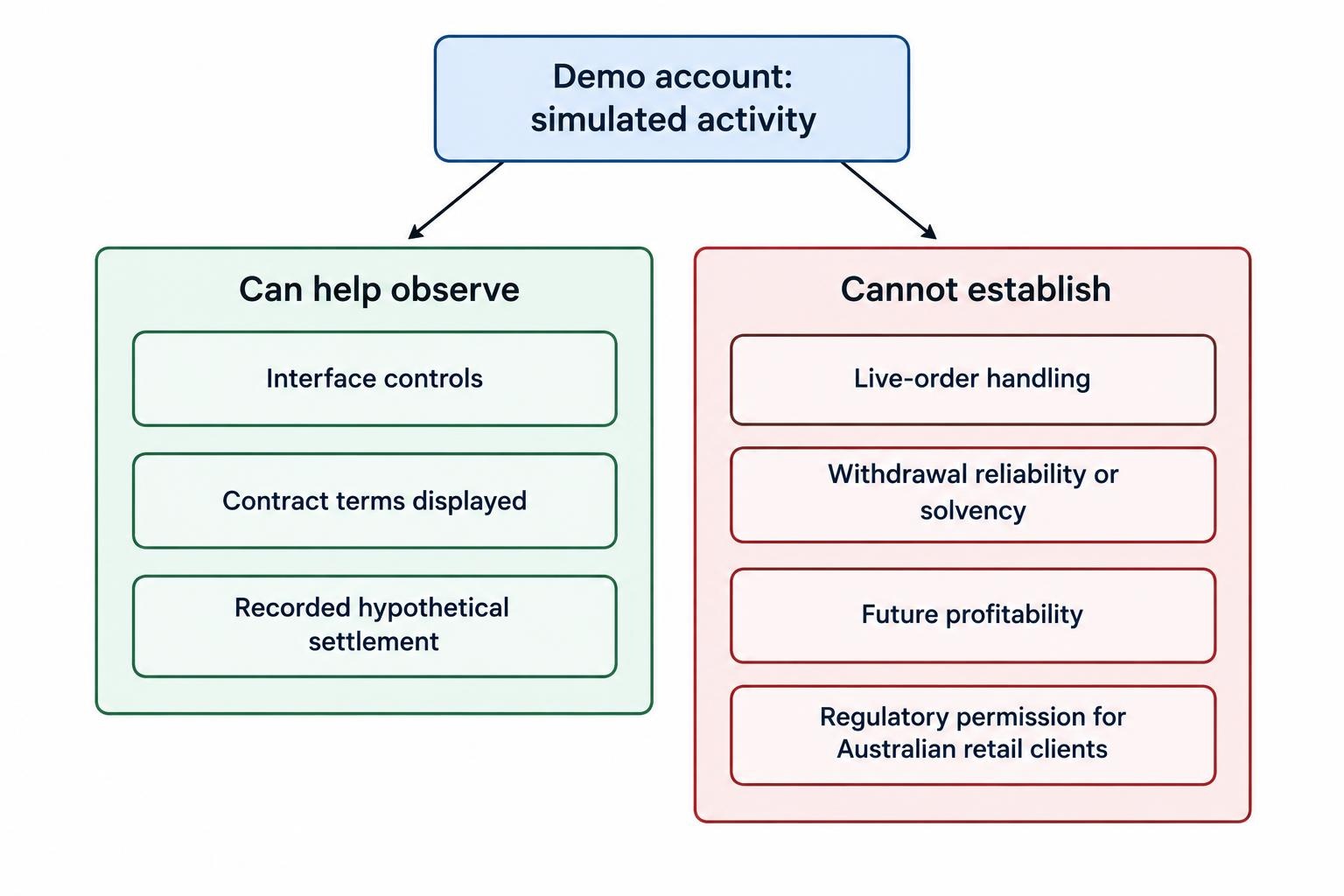
A binary options demo account is a simulated trading account that uses virtual funds instead of deposited money. It lets you examine the trading screen, select contract terms and see how a hypothetical position settles. The balance may look like money, but it is not cash you own or can withdraw.
Demo accounts can help with learning contract mechanics. They cannot establish that a provider is trustworthy, that withdrawals will work or that simulated profits will carry over to real trading. For Australian readers, there is another distinction to make before considering any account: access to a demonstration does not mean the underlying product can lawfully be offered to retail clients.
Binary Options Demo Accounts in Australia
ASIC’s prohibition on issuing and distributing binary options to retail clients took effect on 3 May 2021 and has been extended until 1 October 2031. The dates and scope are set out in ASIC’s announcement extending the binary options ban.
A demo account should therefore be treated as an educational simulation, not an approved route into live binary options trading. A platform loading in your browser, accepting an Australian phone number or displaying prices in Australian dollars does not establish its regulatory status.
This article focuses on assessing a simulation and using it to learn without depositing trading capital. It does not recommend offshore providers or ways around the Australian retail prohibition. You can study the contracts through worked examples or a spreadsheet without opening a broker account at all.
What Can You Learn From a Demo Account?
A useful demonstration makes the relationship between the contract terms and the result visible. Before entering a hypothetical position, you should be able to identify the underlying market, the strike price or other condition, the expiry time, the virtual stake and the return offered.
For a simple higher or lower contract, the task is not just to predict direction. The settlement price must satisfy the contract’s condition at the stated time. A market can move in your predicted direction during the contract and still finish on the losing side of the strike.
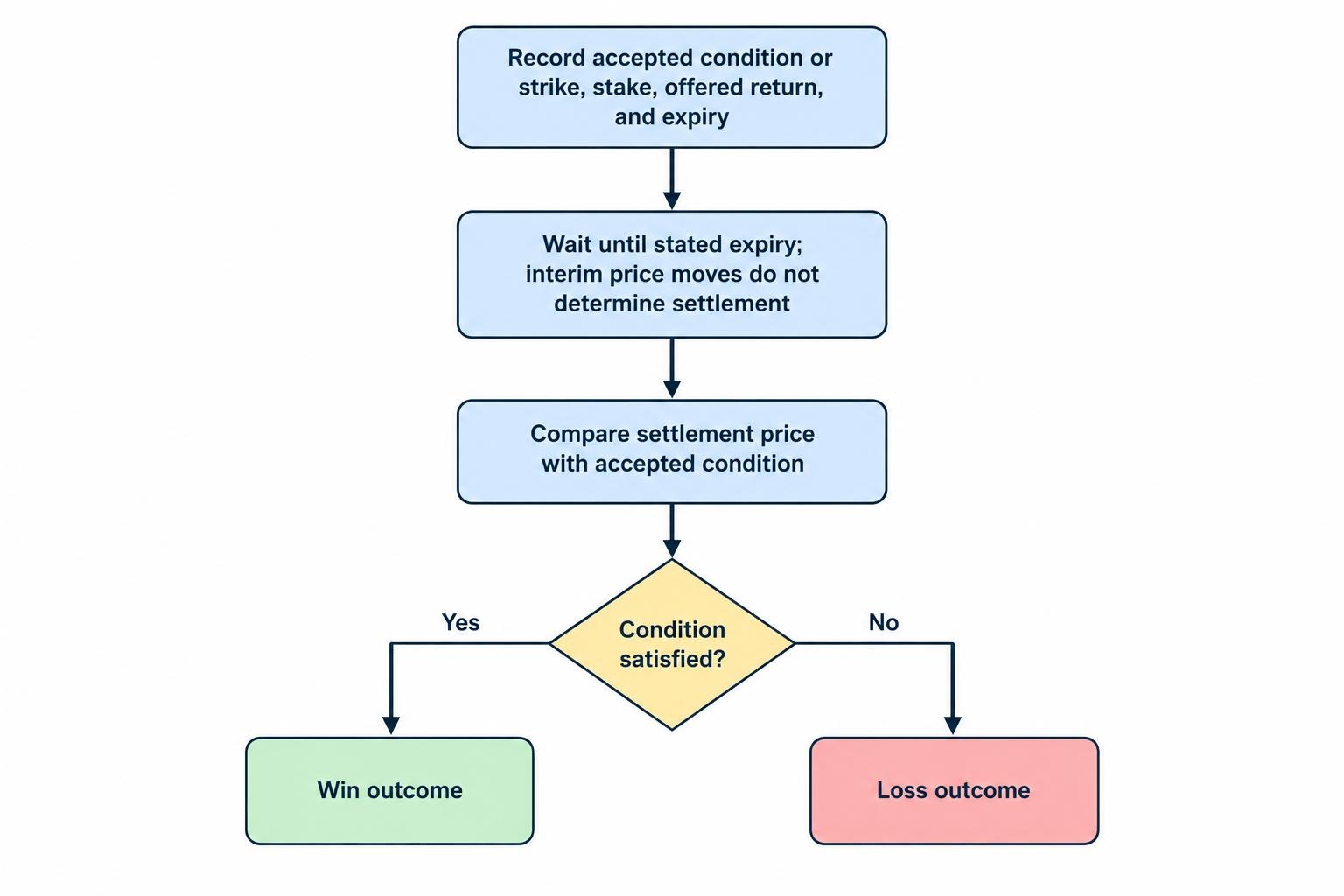
That distinction is easier to follow when you examine individual transactions rather than watch the account balance. The broader explanation of how binary options work covers the contract mechanics; a demo should make those mechanics observable.
Useful learning objectives include recognising the difference between a selected expiry and an order countdown, checking the accepted strike rather than the price first displayed, and matching the settlement result to the written rules. These are operational skills. They are not evidence of a profitable trading method.
How to Assess a Binary Options Demo Account
The headline virtual balance tells you very little. A simulated $100,000 account is not automatically more useful than a $1,000 account. Clear contract records and understandable settlement rules matter more than the number of zeros on the screen.
Assess the following features before spending time on a platform. Where information is missing, record the gap rather than assume the demo behaves like a live account.
| Feature | What to check | Why it matters |
|---|---|---|
| Virtual funds | Whether the balance can be adjusted, replenished or reset, and whether resets erase records. | A large balance or frequent resets can hide the effect of losses. |
| Market prices | The stated price source, timestamps and whether quotes are live, delayed or simulated. | You need to know what the displayed prices represent. |
| Contract terms | The accepted strike, expiry, stake and return for each transaction. | These determine the result, not the appearance of the chart. |
| Settlement rules | The settlement benchmark, treatment of equal prices and handling of missing quotes. | A close result cannot be checked without a clear rule. |
| Transaction history | Whether records include losses, refunds, cancellations and rejected entries. | A complete record is more useful than a profit screenshot. |
| Access conditions | Any expiry date, registration requirement, payment request or restriction on available features. | You should know the conditions before sharing information or relying on the account. |
Check What the Chart Actually Shows
A familiar market label does not identify a price feed. A chart labelled AUD/USD still needs a stated data source and a clear connection to the contract’s settlement price.
Do not assume an external chart must match every displayed tick. Establish whether you are comparing the same instrument, quote type and timestamp. The guide to price feeds and settlement benchmarks covers those distinctions in more detail.
A simulation that does not disclose its pricing basis cannot support a careful assessment of execution or settlement. You may still learn where the buttons are, but that is a much narrower benefit.
Read the Access Terms, Not Just “Free Demo”
Check whether you can use the demonstration without providing payment details or making a deposit. Also check whether the account expires, whether transaction records remain available after expiry, and whether marketing consent is optional.
“Free” should not be treated as a description of every condition attached to an account. If access depends on funding a live account, it is no longer a deposit-free learning exercise. There is no educational need to send trading capital simply to observe hypothetical contract outcomes.
Read Demo Profits Correctly
A rising virtual balance means little unless you know the stakes and payout terms behind it. The following example uses Australian dollars purely as a unit of account. It is an illustration, not a statement about any available provider.
Assume a hypothetical contract risks $10 and offers an 80% net profit on a win. A winning result produces $8 profit and returns the $10 stake, giving a total return of $18. A losing result loses the full $10. These calculations assume no fees, refunds or ties.
Across 100 equal-sized transactions, 55 wins produce $440 profit, while 45 losses cost $450. The result is a $10 loss despite winning more often than losing.
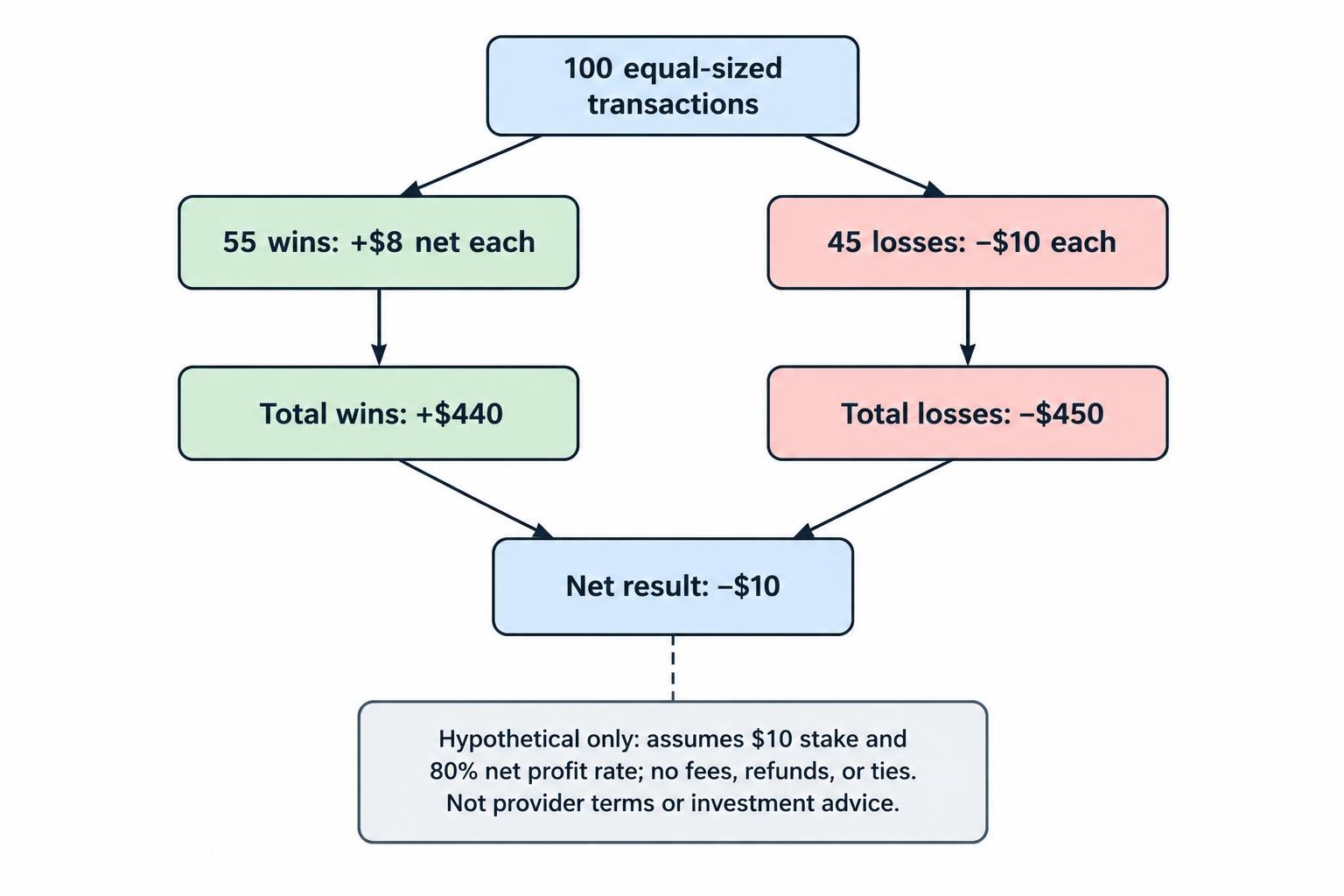
The break-even win rate is:
Break-even win rate = 1 ÷ (1 + net profit rate)
At an 80% net profit rate, that is 1 ÷ 1.8, or approximately 55.56%. Different payout terms change the required rate. The guide to probability and expected value in binary options develops the calculation beyond this simple example.
Record the return offered when each simulated position is accepted. Applying the best return you saw all afternoon to every transaction would overstate the result. Also distinguish net profit from total money returned: the original stake is not a trading gain.
What a Demo Account Cannot Prove
That You Will Respond the Same Way With Money at Risk
A virtual loss does not require you to replace savings or explain a missing household payment. You can record rule breaches during practice, but you cannot assume your behaviour will stay unchanged when losses have consequences.
The distinction between hypothetical results and actual financial risk is addressed in the NFA’s notice on hypothetical trading performance. Its discussion includes the difficulty of accounting for a person’s ability to withstand losses and continue following a method. That is a useful analytical caution, not an Australian rule governing demo accounts.
That Live Orders Would Receive the Same Terms
A demo record establishes what the simulator recorded. It does not, by itself, establish how a funded account would handle an entry request, a change in the offered return, a connection failure or an unavailable contract.
Keep the claim narrow. If you observed that a simulated order was accepted immediately, record that observation. Do not turn it into “live execution is immediate” without separate evidence.
That the Provider Will Return Deposited Funds
Virtual transactions do not test custody, withdrawal processing or the provider’s ability to meet payment obligations. A smooth interface is not a solvency check. Neither is a helpful chat response.
There is also no reason to deposit money to make a demo “more realistic”. That changes the activity from simulation to financial exposure without resolving the questions a demonstration cannot answer.
Use a Demo as a Controlled Learning Exercise
The most useful starting point is a question, not a profit target. You might want to check whether you can distinguish the displayed quote from the accepted strike, or whether the settlement record contains enough information to reconstruct the outcome.
Keep the exercise narrow. Learning the interface while changing markets, expiries, stakes and entry rules makes it difficult to identify what caused an error. A structured binary options practice plan can separate those tasks without treating practice as a countdown to depositing.
Choose a Consistent Virtual Balance and Stake
Use a defined balance for the exercise and keep the virtual stake consistent. For example, a hypothetical $1,000 balance with a $10 stake makes each complete loss equal to 1% of the starting balance. This is a calculation for learning, not a recommended allocation of real money.
Do not replenish the account halfway through and then assess only the closing balance. If you reset, save the earlier record and label the next exercise separately. Otherwise, the reset button becomes an excellent accountant for imaginary profits.
Write Down the Terms Before the Outcome
For each hypothetical position, record the market label, direction, stake, offered return, accepted strike and exact expiry. Note the reason for the entry before settlement rather than writing a persuasive explanation afterwards.
After settlement, add the result and any discrepancy. Separate an operational mistake, such as selecting the wrong expiry, from an outcome that followed your written rules but lost. They call for different lessons.
Preserve the Whole Record
Keep losing sessions, abandoned exercises and rule changes. Screenshots can help document a discrepancy, but a complete chronological record is better than a folder containing only successful trades.
If you change an entry rule, start a separately labelled test. Repeatedly adjusting a method after seeing the results and then presenting the combined record as one unchanged approach makes the exercise difficult to interpret.
There is no universal number of demo transactions that proves readiness. A fixed exercise can expose mistakes or unsuitable assumptions. It cannot certify future profitability, and completing it does not create a reason to trade live.
Free Demo Accounts Still Require Caution
A demonstration removes the need to stake money within the simulation. It does not remove the need to protect your personal information or assess the claims attached to the platform.
The joint CFTC and SEC alert on binary options fraud documents complaints involving withheld customer funds, identity theft and software manipulation. These are reported fraud risks, not evidence that every demo account is manipulated.
For an educational exercise, avoid handing over payment details or identity documents to an unverified operator. A demand to deposit money, pay a release charge or install remote access software is a reason to stop, not a routine stage of learning.
Be equally cautious about sales claims built around demo performance. A screenshot showing a profitable virtual balance does not establish the starting balance, transaction history, resets, payout terms or selection of results. Without those details, it is not a meaningful performance record.
Can You Withdraw Demo Profits?
Not as ordinary trading proceeds. Demo profits are entries in a simulated balance, not money earned through funded transactions. A competition prize, if genuinely offered under separate terms, is a different arrangement and should not be confused with converting a virtual balance into cash.
Do not send a payment to “activate” or release a demo balance. The distinction between virtual funds and withdrawable money should be clear before you use the account.
Does a Demo Account Guarantee Live Access?
No. Demonstration access does not establish eligibility for a funded account or authorisation to offer a product in your jurisdiction. Nor does a successful simulation override the Australian retail prohibition.
Do not agree to wholesale classification simply to continue trading binary options. Wholesale clients lack some retail consumer protections, and Moneysmart’s binary options warning expressly cautions against accepting that classification just to gain access.
Learning Without a Broker Demo
A spreadsheet can answer many of the same educational questions without registration. Write down the hypothetical contract condition, timestamp, price source, expiry, stake and return before observing the outcome. Keep a clear rule for equal prices and missing data. Label the result as a simulation throughout.
This approach does not test a platform’s order handling, but it can help you study payout arithmetic and distinguish a correct market view from a winning contract. Those are separate questions, and neither requires a deposit.
If your aim is broader market education rather than binary contract mechanics, the ASX Options Trading Game provides a simulated environment for options over shares, ETFs and the S&P/ASX 200 index. These are different products, so their rules and risks need separate study.
A binary options demo account is most useful when its purpose stays modest: learn the controls, inspect the terms and identify what the simulation cannot tell you. Virtual success is a result to examine, not a promise to cash in.
This article was last updated on: October 22, 2026