Choosing a binary options market means checking more than whether you recognise the asset. The useful questions concern the price benchmark, trading session, scheduled events, contract expiry and payout. A familiar name on an unclear contract is still an unclear contract.
For Australian retail readers, the legal position comes first. ASIC’s binary options product intervention order bans their issue and distribution to retail clients until 1 October 2031. The comparisons below are for education and paper analysis, not a route around that restriction.
Choose the Contract, Not Just the Asset
“Gold”, “AUD/USD” and “S&P 500” identify markets, but they do not fully identify a binary options contract. You also need the exact reference price, strike, expiry timestamp, settlement rule and amount returned after each possible outcome.
For a standard high/low binary, the question is whether the settlement price finishes above or below the strike under the stated rules. A large favourable move does not ordinarily increase the fixed winning payment. Being right about the broad direction is therefore different from being right about the contract’s result.
Start with a small research shortlist rather than a screen full of symbols. The broader binary options markets guide separates the main asset groups. Your task here is to decide which candidates you can observe, verify and assess consistently, rather than which produces the most dramatic chart.
Compare Market Types by Their Research Demands
Different asset groups call for different checks. The table below is a screening framework, not a ranking of profitability or safety.
| Market type | What to investigate | Reason to reject a candidate |
|---|---|---|
| Forex pairs | The currency pair, quote direction, observation session and economic calendar for both currencies. | You cannot identify the reference feed or explain which currency is strengthening. |
| Stock indices | Whether the reference is a cash index, a named futures contract or another calculated quote. | The chart label leaves the actual benchmark unclear. |
| Individual shares | The listing venue, trading session, company reporting calendar and corporate action treatment. | Your planned observation window falls outside the relevant session without clear pricing rules. |
| Commodities | The commodity grade, spot or futures basis, contract month and rollover method. | A generic label such as “oil” is the only contract description. |
| Cryptocurrencies | The trading pair, reference venue or composite benchmark, timestamps and data availability. | You cannot reproduce the settlement reference independently. |
| Synthetic or weekend quotes | How the quote is produced and whether an independently observable underlying market exists. | The price-generation method and settlement records cannot be checked. |
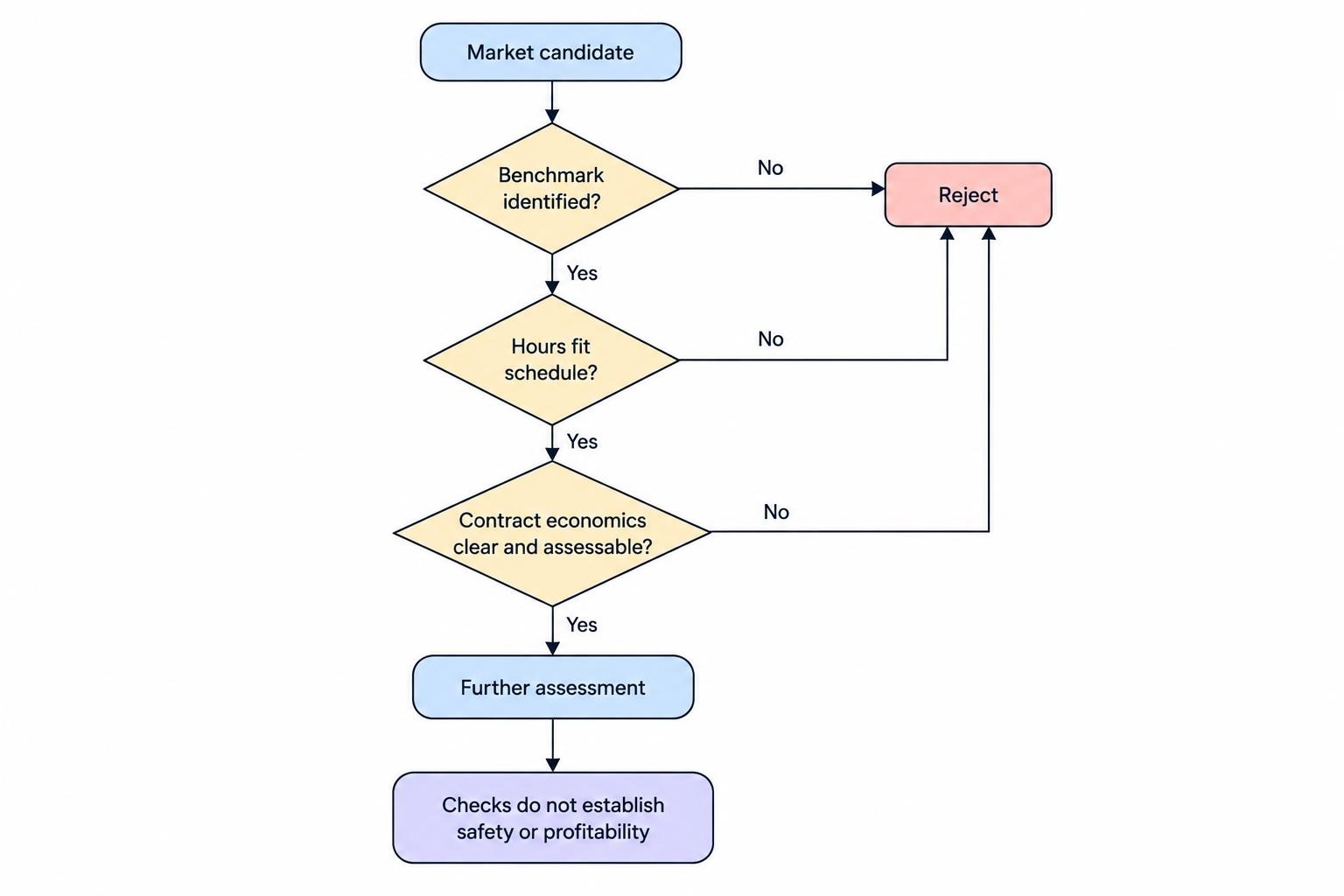
Use these checks as rejection filters. A candidate does not become suitable simply because it survives the first one. Clear hours cannot compensate for an unidentified benchmark, and a recognisable benchmark cannot compensate for unfavourable contract economics.
Match the Market to Your Available Hours
Choose an observation window before choosing a symbol. If you can reliably study markets for one hour after work, assess candidates during that hour. Reviewing attractive charts from sessions you cannot follow creates a research plan that looks better on paper than it works in practice.
Exchange sessions also contain different phases. Continuous trading, opening auctions and closing auctions should not automatically be treated as interchangeable conditions. ASX’s cash market trading schedule distinguishes these phases and states its times in Sydney time. Check the current schedule rather than relying on a remembered opening time.
Record the date, time zone and UTC offset alongside your observations. Check holidays and any clock changes that affect the conversion into your local time. A chart timestamp without a time zone leaves room for avoidable mistakes.
Keep the whole contract interval in view. An entry during continuous trading may have an expiry near an auction, session break or scheduled announcement. Assess the conditions between entry and settlement, not just the moment when the hypothetical position begins.
Reject Markets With Unclear Price Benchmarks
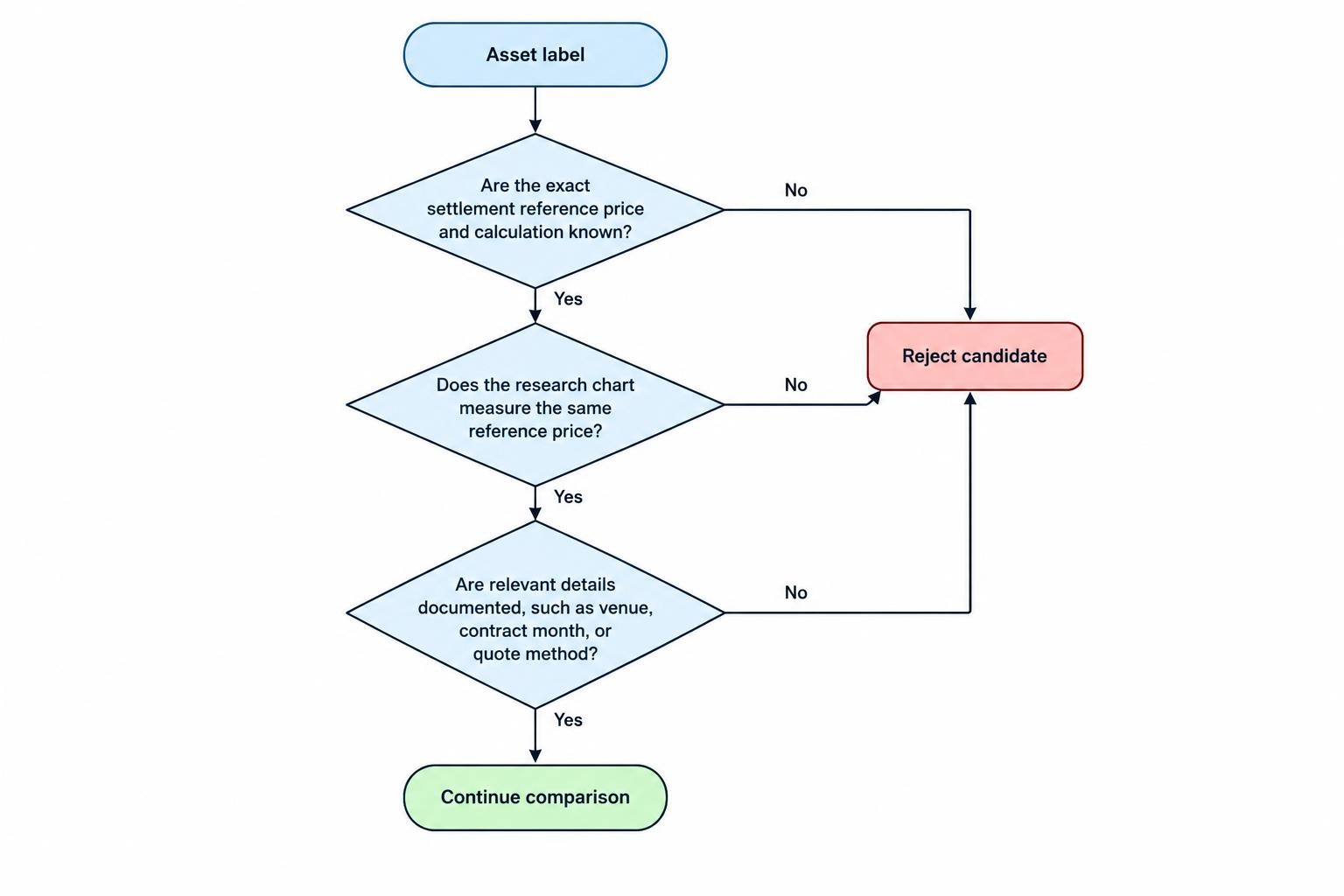
The reference price should be a hard filter. Before comparing chart patterns, establish what would settle the contract: a last traded price, bid, ask, midpoint, published index value or another defined calculation.
Then check whether your research chart measures the same thing. Comparing two prices carrying the same asset name is not enough. Our guide to price feeds and benchmarks covers the distinctions that matter when checking a reference quote.
For an index candidate, write down whether you are studying the cash index or a futures contract. For a share, identify the listing venue. For a commodity, identify the product and delivery month where relevant. For cryptocurrency, record the pair and the named venue or composite methodology.
Futures references need particular care. Futures contracts expire, and rolling a position means moving from one contract month to another. CME Group’s explanation of futures expiration and rollover sets out that process. For a futures-based binary reference, check which month supplies the price and what happens when that reference changes.
Do not assume “OTC” identifies a price-generation method. Establish whether the label refers to a contract traded outside an exchange, a weekend product or a generated quote. If the documentation does not answer that question, leave the candidate out of the comparison.
Choose Markets Whose Drivers You Can Follow
A useful candidate is one for which you can maintain a sensible research calendar. You should know which announcements deserve attention, where their release times are published and whether they fall inside your observation window.
AUD/USD provides a practical example. Interest rate differences, commodity prices and changes in risk appetite can affect the Australian dollar, as covered in the Reserve Bank of Australia’s explanation of Australian dollar drivers. These influences provide research context; they do not supply a reliable prediction for the next short expiry.
Apply the same discipline elsewhere. Before adding a share, check its reporting calendar. Before adding an index, identify the components and announcements you would monitor. Before adding a commodity, decide how you will track the relevant supply, demand and contract information.
Keep the workload realistic. If following a candidate requires more reading than your schedule allows, remove it from the shortlist. Familiarity should mean knowing what needs checking, not simply recognising a company logo or having an opinion about gold.
Separate Volatility From Forecastability
More movement does not establish a better opportunity. A market can move sharply while offering no dependable way to predict its position relative to a strike at a chosen timestamp.
Cryptocurrency illustrates the distinction. Prices can fluctuate heavily over short periods, a risk highlighted in ASIC Moneysmart’s crypto asset guidance. That movement is not evidence that a binary contract on the same asset is easier to forecast.
For paper research, compare movement over the proposed contract duration rather than relying only on a daily chart. A strong daily trend and an uncertain five-minute outcome can coexist. Avoid treating a longer-term opinion as proof of a short-term timing advantage.
Liquidity needs a separate check too. Ask whether there are fresh, verifiable underlying quotes during your observation period and whether the settlement reference is available at the required timestamp. Neither a busy chart nor an actively traded underlying establishes that a particular contract has transparent execution.
Compare Payouts Using the Same Assumptions
A market comparison is incomplete without payout arithmetic. A higher advertised return is not a higher probability of winning. It changes the win rate needed to cover losing stakes.
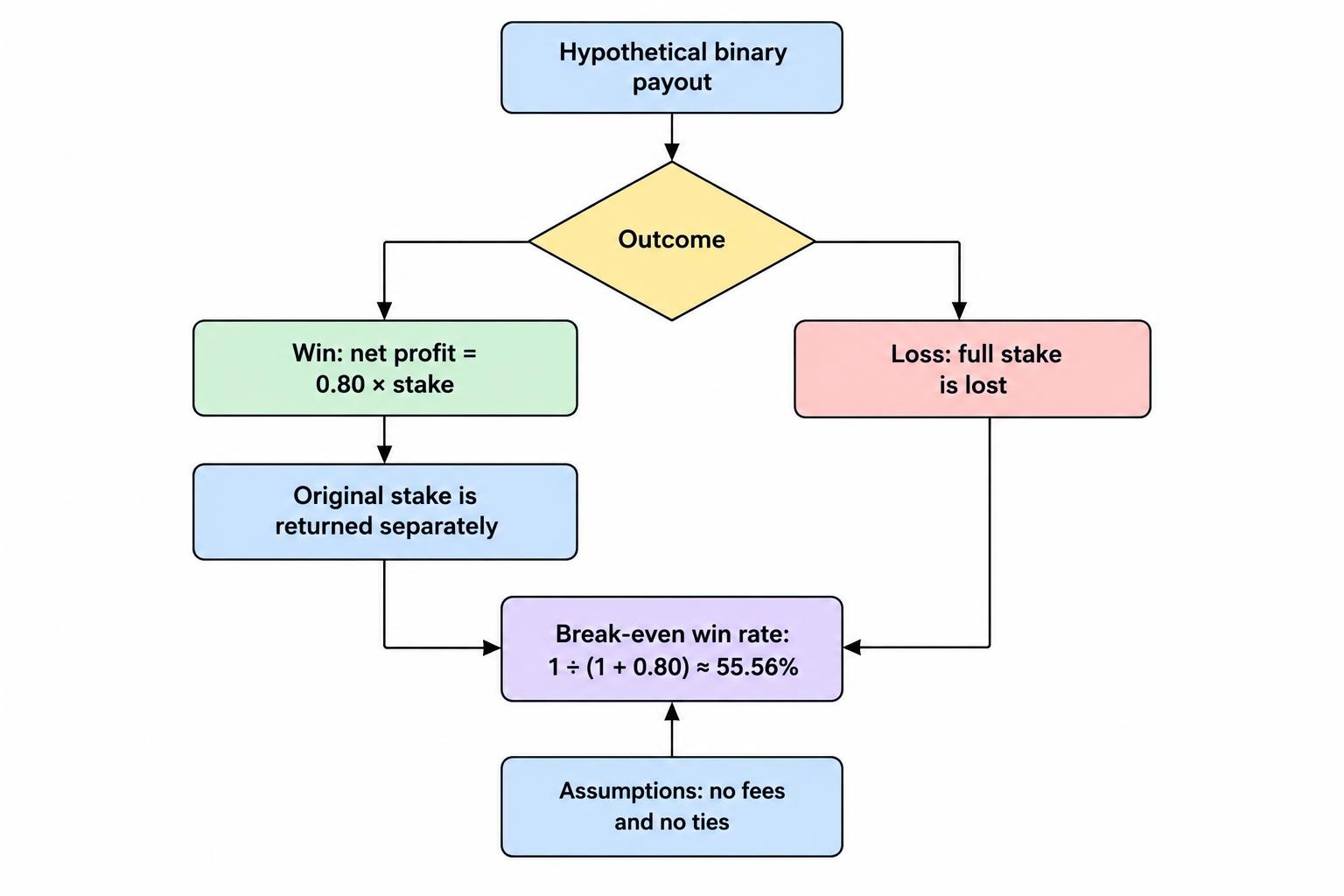
Assume a hypothetical contract pays net profit of 80% of the stake after a win, returns the original stake separately and loses the full stake after a loss. With no fees or ties:
Break-even win rate = 1 ÷ 1.80 = approximately 55.56%.
Across 100 hypothetical contracts at A$10 each, 55 wins would produce A$440 in profit from winning contracts. The 45 losses would cost A$450, leaving a A$10 loss. Winning more often than losing would not be enough under those assumptions.
At a 90% net profit rate, the equivalent threshold falls to approximately 52.63%. That does not make the second market automatically preferable: you still need a defensible estimate of the outcome probability. The guide to probability and expected value in binary options develops that comparison.
Keep expiry duration, strike rules, tie treatment and payout definitions consistent when comparing candidates. A comparison between different contract structures can disguise more than it reveals.
A Practical Comparison: AUD/USD Versus Gold
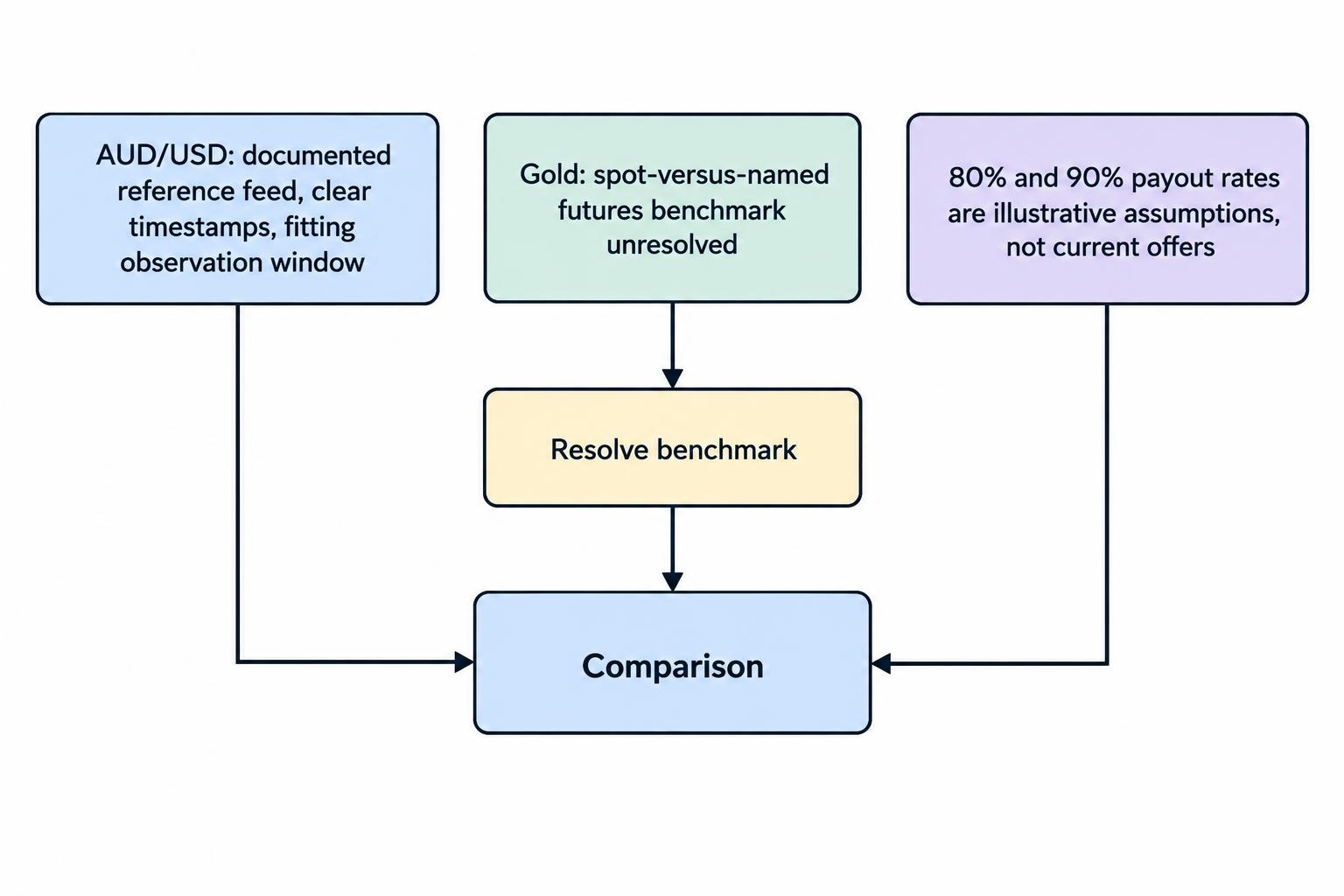
Suppose a paper exercise compares an AUD/USD contract offering an illustrative 80% net profit rate with a gold contract offering 90%. These figures are assumptions, not current offers.
The AUD/USD candidate has a documented reference feed, clear timestamps and an observation window that fits the research schedule. The gold candidate has a higher stated payout, but its description does not establish whether settlement follows a spot quote or a named futures contract.
The correct next step is not to select gold for the extra payout. Resolve its benchmark first. Until then, the two candidates cannot be assessed on equal terms.
If both become fully documented, compare their results using the same prewritten rules and relevant break-even thresholds. The decision should follow the evidence collected, not the attractiveness of either asset’s name.
Build a Shortlist Through Paper Observation
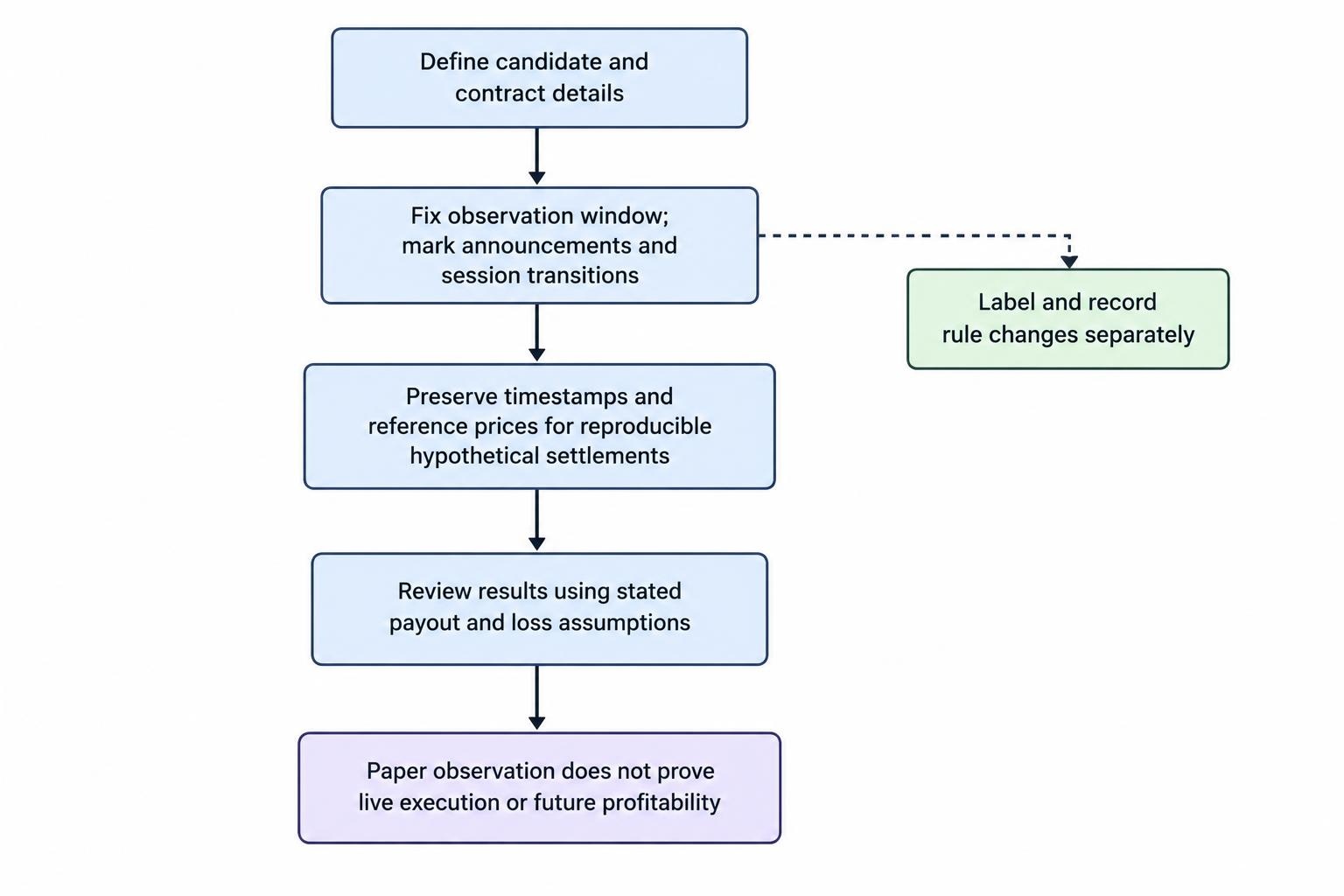
A paper exercise can test whether a candidate is practical to research without placing money at risk. It cannot prove that live execution would match the exercise. Use a structured binary options paper trading process rather than collecting screenshots that happen to support your initial preference.
- Define the candidate. Record the exact symbol, benchmark, session, expiry method, payout assumption and settlement rules before collecting outcomes.
- Fix the observation window. Use times you can follow consistently. Mark scheduled announcements and session transitions rather than removing awkward results afterwards.
- Preserve the evidence. Keep timestamps, reference prices and enough data to reproduce each hypothetical settlement. Record missing observations instead of filling gaps by guesswork.
- Review the contract economics. Calculate results using the stated payout and losing-stake treatment. Do not judge the exercise by win rate alone.
Avoid changing the market, expiry and decision rule after every loss. That produces a moving target rather than a comparison. If you revise a rule, label the revision and start a separate record.
Also avoid choosing the “winner” from a large collection of markets after a short sample. A candidate selected because it happened to perform best needs further observation under unchanged rules. Treat early results as a reason to investigate, not permission to assume an advantage.
When No Market Passes the Checks
Reject a candidate if its benchmark is unclear, its hours do not fit your schedule or its outcomes cannot be reproduced. Do the same if the research record does not support its payout requirements. A shortlist of zero is an acceptable result.
Choosing a binary options market is a screening exercise, not a search for an asset that makes the product safe. Clear documentation, suitable observation hours and consistent analysis can improve a comparison. They cannot remove the contract’s risk, establish future profitability or override Australia’s retail distribution ban.
This article was last updated on: October 22, 2026