Binary options markets are the assets, indices and price series used to determine whether a binary contract wins or loses. The main categories are forex, stock indices, individual shares, commodities and cryptocurrencies. Synthetic prices and provider-labelled weekend markets need separate treatment because their relationship to an independently observable market may be different.
For Australian readers, availability is not the starting point: legality is. ASIC’s prohibition on issuing and distributing binary options to retail clients took effect on 3 May 2021 and has been extended until 1 October 2031. The ASIC announcement extending the binary options ban sets out the restriction. This article explains market references and their risks, rather than recommending providers or ways around that prohibition.
What Does the Market Determine?
A binary option references a market without giving the holder ownership of the underlying asset. A contract linked to a company’s share price does not make you a shareholder. A contract linked to gold does not buy bullion.
The market supplies the price or measurement used to assess the contract’s condition. The contract terms supply the strike, expiry, payout and settlement rules. These are separate parts of the transaction.
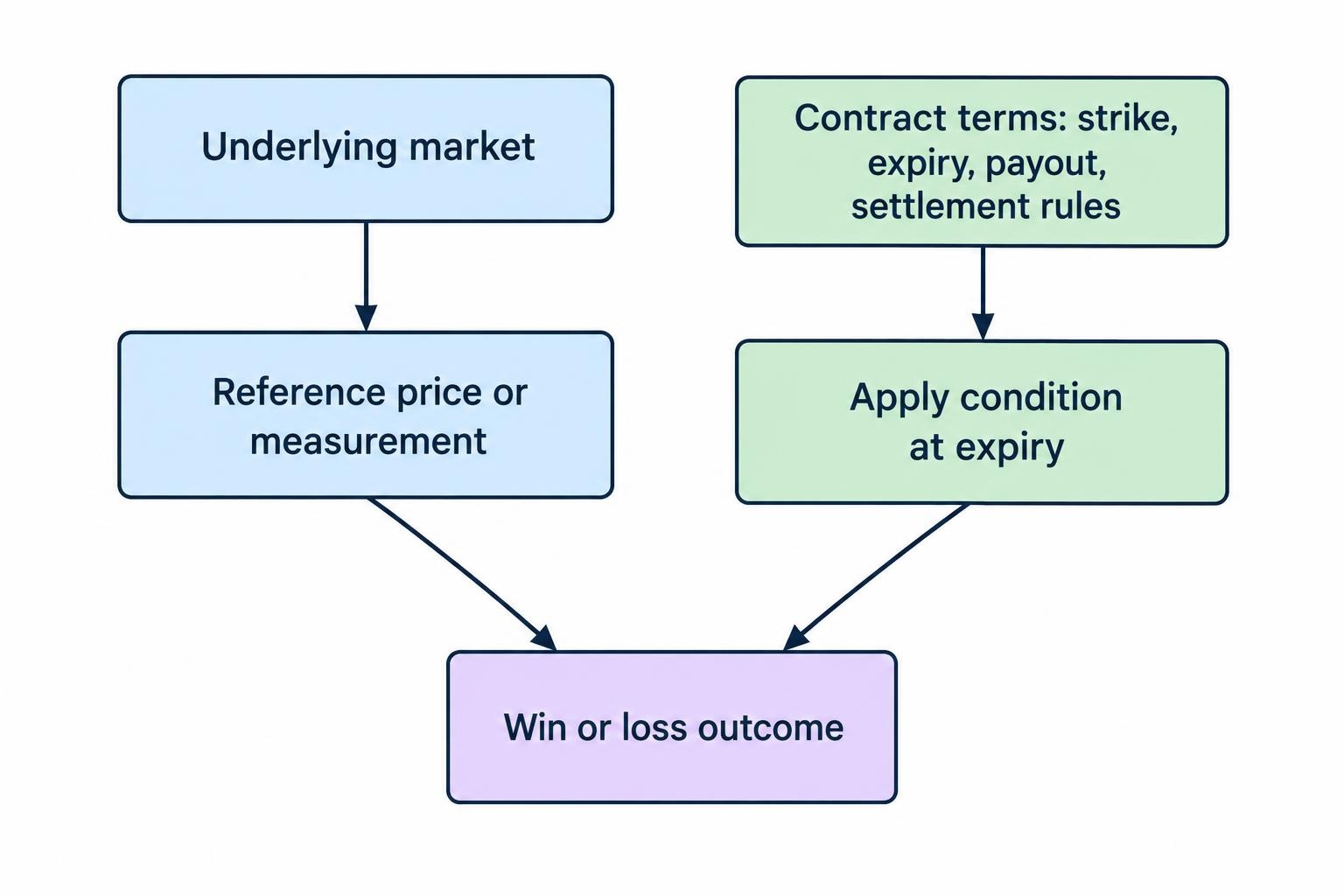
Consider a hypothetical contract asking whether AUD/USD will finish above 0.6600 at an agreed time. The relevant market is the Australian dollar against the US dollar. Whether the contract wins depends on its nominated settlement price at expiry, not whether the Australian dollar rises later that afternoon.
That distinction matters across every category. A reasonable view about an asset’s longer term direction can still produce a losing binary outcome if the condition is not met within the contract’s timeframe.
The Main Binary Options Market Categories
The following examples identify possible reference markets, not products currently available or permitted for Australian retail clients.
| Category | Examples | Main reference-price question |
|---|---|---|
| Forex | AUD/USD, EUR/USD, GBP/USD, USD/JPY | Which currency quote and price feed determine settlement? |
| Stock indices | ASX 200, S&P 500, Nasdaq 100, FTSE 100 | Is the reference the cash index, a futures contract or another derived price? |
| Individual shares | Australian or US listed companies | Which listing, trading session and price type apply? |
| Commodities | Gold, silver, crude oil, natural gas | Does the contract reference spot prices, a benchmark or a dated futures contract? |
| Cryptocurrencies | Bitcoin, Ethereum | Which exchange, currency pair or composite benchmark supplies the price? |
| Synthetic and weekend series | Algorithm-generated indices or provider-labelled weekend quotes | How is the series produced, and can its settlement value be checked independently? |
Forex Markets
Forex references compare one currency with another. In AUD/USD, the Australian dollar is the base currency and the US dollar is the quote currency. A rise from 0.6600 to 0.6610 means one Australian dollar buys more US dollars. The forex markets guide covers the main pairs and their quoting conventions.
Direction needs careful reading. A rising USD/JPY quote means the US dollar is strengthening against the yen, not the reverse. Recognising both currency names is not enough; their order changes what “up” means.
Interest rate differences, commodity prices and changes in investors’ willingness to take risk can influence AUD exchange rates. These relationships are covered in the RBA’s explanation of Australian dollar drivers. They provide context, not a reliable forecast for the next minute.
For contract analysis, separate the economic argument from the settlement question. A view that Australian interest rates support the dollar does not establish where AUD/USD will sit relative to a strike when a short contract expires.
Stock Index Markets
A stock index measures a group of shares using a defined calculation method. Examples include the ASX 200, S&P 500, Nasdaq 100, Dow Jones Industrial Average, FTSE 100 and DAX. They are not interchangeable measures of “the stock market”.
Weighting affects how an index responds to its constituents. The S&P 500 uses float-adjusted market capitalisation weighting, so constituent companies do not contribute equally to its movements. The calculation framework appears in the S&P U.S. Indices methodology.
A broad index reference avoids tying the entire outcome to one company’s share price. It does not remove the possibility of losing the full binary stake.
The other distinction is the instrument behind the quote. A cash index level and a futures price linked to that index are related, but they are not the same number. A familiar index name on a trading screen does not settle that question. The stock index markets guide separates the main benchmarks and their reference instruments.
Individual Share Markets
Share-linked contracts reference the price of an individual company’s listed shares. The identity of that listing matters: company name, ticker, exchange, trading currency and share class should all be clear. Our share markets guide covers Australian and US equity references.
Suppose a hypothetical contract asks whether a share will finish above A$25.00. Its outcome depends on the nominated price and time. It does not give the holder voting rights, dividends or continued participation in the company’s growth.
Trading sessions also matter. Extended-hours share trading can involve less liquidity, wider quote spreads and larger price fluctuations than regular trading. These risks are set out in the SEC’s bulletin on after-hours trading.
For a binary contract, the practical question is how those prices enter settlement. Does the contract use a regular-session trade, an extended-hours trade, a bid, an offer or another calculation? A chart labelled with the correct company can still be the wrong comparison if its session or price field differs.
Commodity Markets
Commodity references include precious metals and energy products, such as gold, silver, crude oil and natural gas. The commodity markets guide separates these products and the price references behind them.
The asset name alone is incomplete. “Oil” does not identify the grade, benchmark, delivery location or contract month. Likewise, a gold spot quote should not automatically be treated as identical to the price of a dated gold futures contract.
Futures contracts expire. Moving exposure from one contract month into another involves closing the earlier position and opening a later one, as covered in CME Group’s explanation of futures expiration and contract rolls. A binary contract referencing futures therefore needs an identifiable contract month and clear rules for any reference change.
Do not confuse that underlying futures roll with an optional extension of a binary contract’s expiry. They describe different events.
For historical analysis, check whether a commodity chart shows one dated contract or joins several contracts into a continuous series. A chart assembled for convenient analysis may not reproduce the exact prices used to settle a binary contract.
Cryptocurrency Markets
Cryptocurrency-linked binary contracts reference a digital asset’s price rather than transferring the asset to the holder. A Bitcoin-linked outcome does not give the holder bitcoin, a wallet balance or withdrawal rights over coins.
The benchmark must be identifiable. A quote from one trading venue and a composite price calculated from several venues represent different reference methods. CME CF cryptocurrency benchmarks, for example, distinguish reference rates from real-time indices and identify their contributing pricing venues.
That does not mean a binary provider uses those benchmarks. It illustrates the level of detail needed before two prices can be compared properly.
Check the quote currency too. BTC/USD and BTC/USDT are different pairs; the second references bitcoin against Tether rather than directly against US dollars. Treating the labels as interchangeable can weaken a settlement comparison. The cryptocurrency markets guide covers Bitcoin, Ethereum and related pricing considerations.
Synthetic Indices and Weekend Quotes
If a contract references an algorithm-generated price series, its subject is that series rather than a conventional share, currency pair or physical commodity. Analysis should start with the published generation method, operating rules and settlement records.
Do not assume that economic announcements or stock exchange sessions explain a synthetic series unless its documentation establishes that connection. A chart can look like a financial market without measuring one.
Weekend labels require the same care. A provider displaying a currency or share name outside the underlying market’s normal activity does not, by itself, establish where the displayed quote comes from.
“OTC” also needs context. In standard market terminology it means over the counter, describing how a transaction is arranged. It does not automatically mean artificial or fraudulent. A provider’s use of “OTC” in an instrument label still needs its own explanation. The guide to OTC and weekend quotes examines that distinction.
Market Hours Are Not Platform Hours
Three clocks may matter: the underlying market’s session, the provider’s contract availability and the contract’s expiry time. They should not be treated as one schedule.
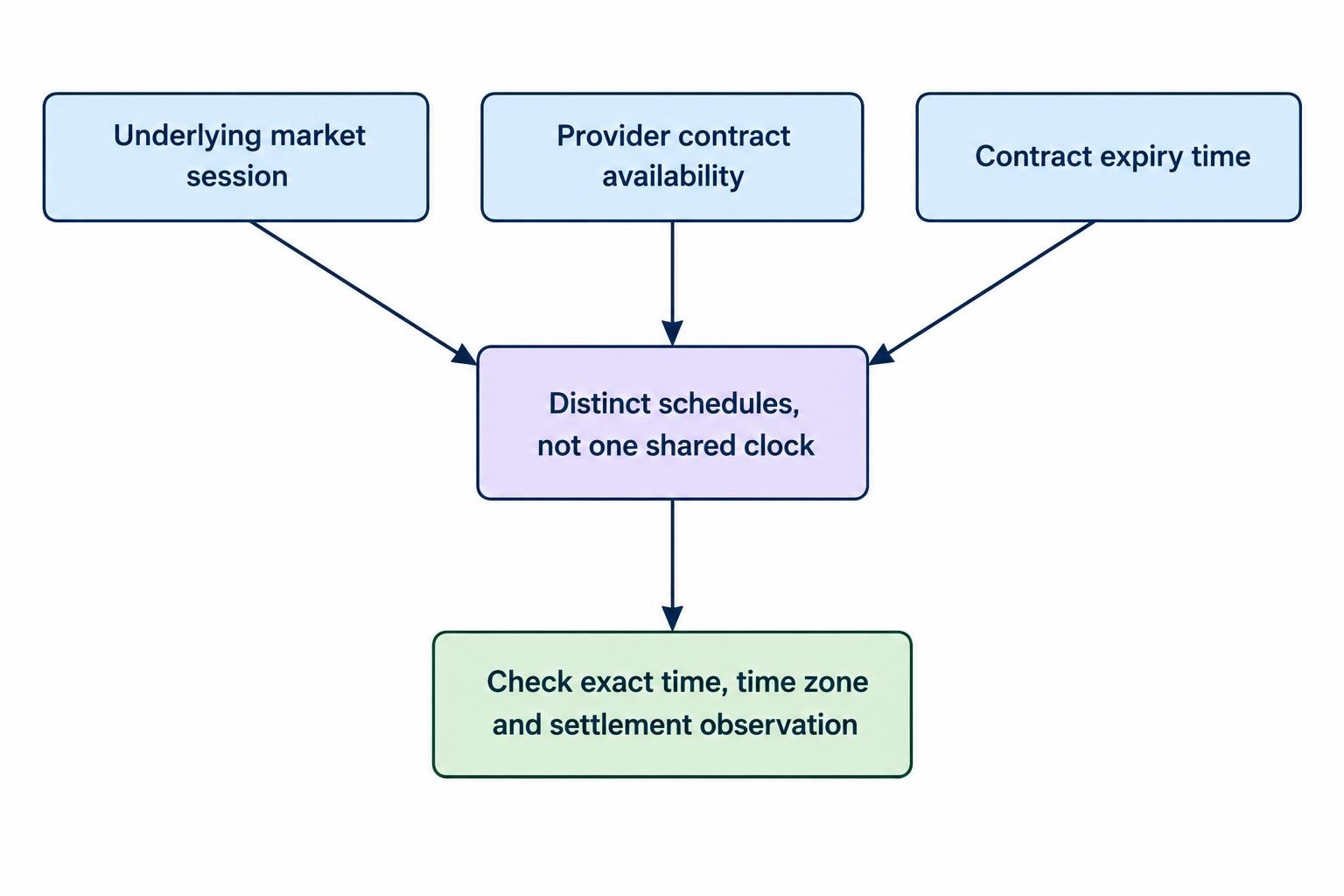
ASX cash trading, for example, has separate opening, normal trading and closing auction phases. Normal continuous trading ends at 4:00 pm Sydney time, with the closing auction occurring later. The ASX cash market trading timetable identifies those phases.
A contract expiring around a market close therefore needs more than a label saying “end of day”. Its rules should identify the exact time, time zone and price observation used.
When recording hypothetical outcomes, store an unambiguous timestamp and the relevant market session. Avoid assuming that a platform clock follows your local time, or that the same local-time conversion works throughout the year.
Price Feeds Can Matter More Than the Asset Name
Two charts can show slightly different values without either being fraudulent. They may use different trading venues, bid or offer prices, update intervals, rounding conventions or delayed data.
For a binary contract near its strike, those differences may determine the outcome. A price disagreement that barely matters to a longer term chart can decide an all-or-nothing settlement.
A useful reference-price description should answer:
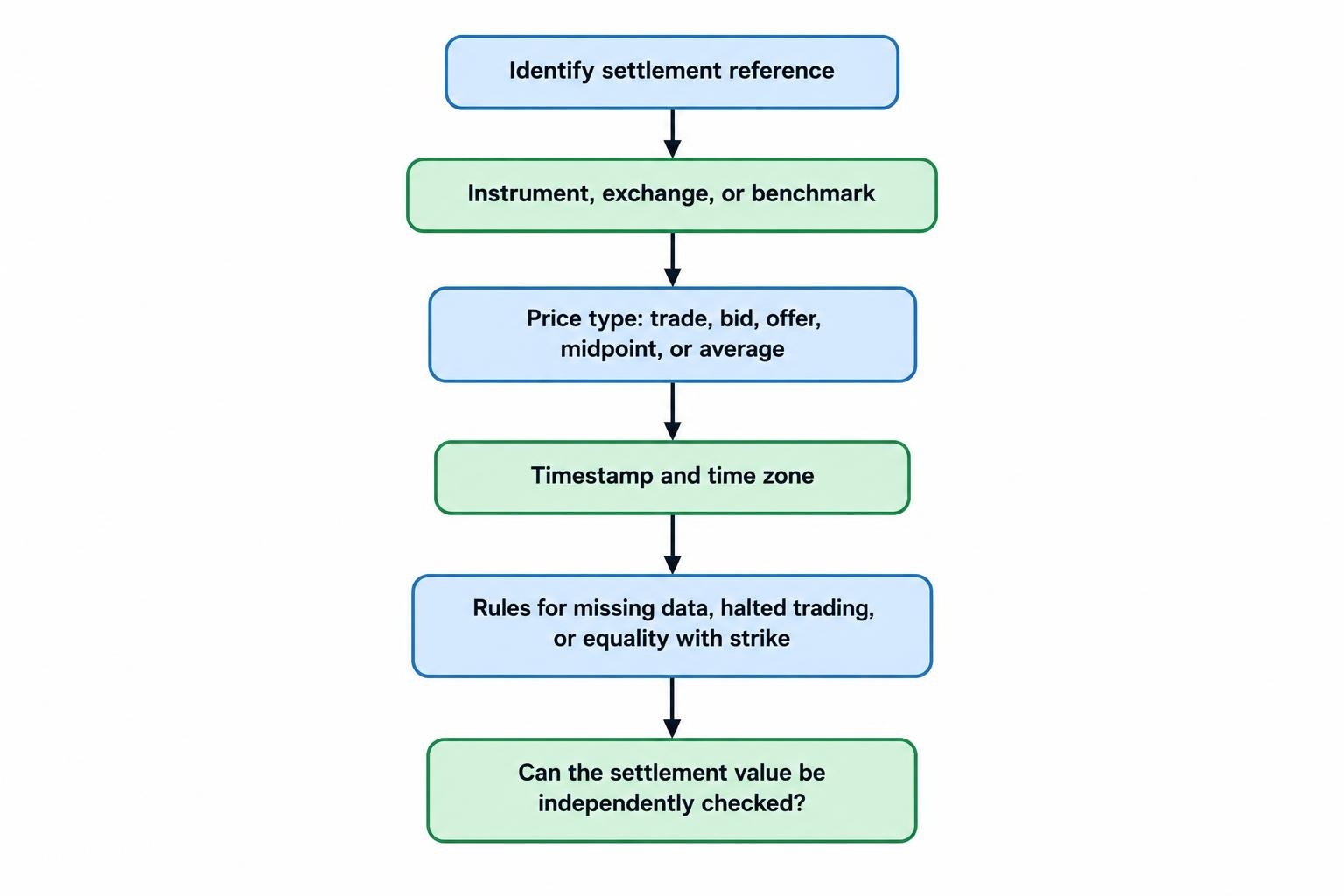
- Which instrument, exchange, data feed or benchmark supplies the value?
- Does settlement use a trade price, bid, offer, midpoint or calculated average?
- Which timestamp and time zone apply?
- What happens if data is missing, trading stops or the price equals the strike?
The price feeds and benchmarks guide covers these checks in more detail. Without that information, comparing a settlement result with an unrelated chart may prove very little.
No Market Removes the Payout Problem
Market selection does not repair an unfavourable payoff structure. A familiar asset, a busy trading session or a convincing chart pattern does not establish that the offered payout compensates for the chance of losing.
Consider a hypothetical A$100 stake that earns A$80 net profit on a win and loses A$100 on a loss. Assuming no fees, refunds or ties, five wins and five losses produce A$400 of profits and A$500 of losses: a net loss of A$100.
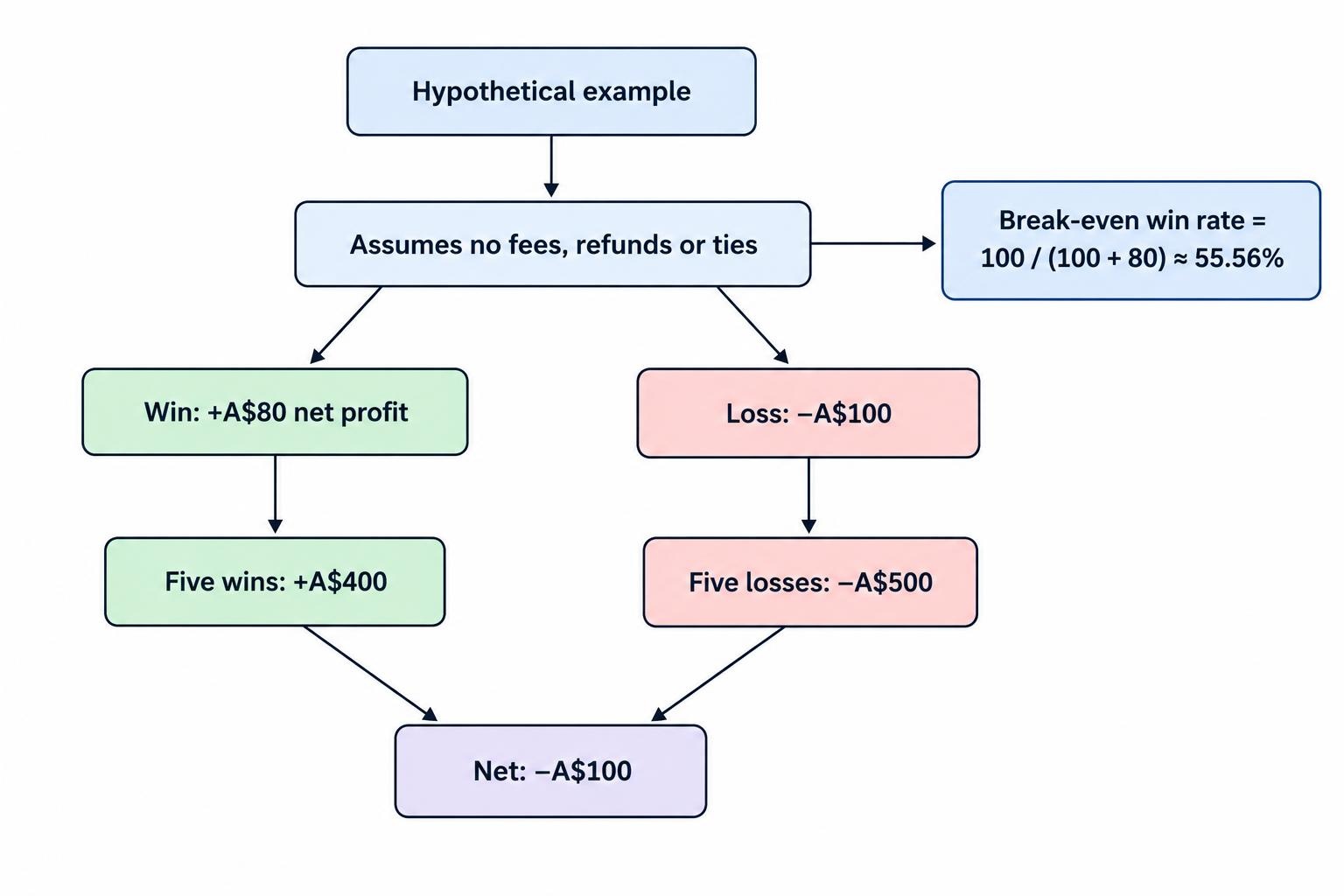
The break-even win rate is approximately 55.56%, calculated as 100 divided by 180. That requirement comes from the contract’s payout, not from whether its reference market is gold, AUD/USD or a share index.
Nor should a higher displayed payout be read as a better opportunity without assessing the condition attached to it. Return and probability belong in the same calculation.
How to Compare Markets for Research
For educational study, favour a reference you can identify and verify. A clear instrument, documented session, accessible historical data and reproducible settlement rule are more useful than a long menu of asset names.
Keep the comparison consistent. Record the underlying instrument, session, observation time, contract condition and assumed payout. Changing several of those at once makes it difficult to tell whether different results came from market behaviour or from different contract terms.
The guide to choosing a binary options market develops that comparison process. No category is automatically safest or most profitable. The useful question is whether the reference price and contract outcome can be checked independently—and, before any real-money consideration, whether the product may lawfully be offered to the client concerned.
This article was last updated on: October 22, 2026