Funding a trading account with Bitcoin, Ethereum or a stablecoin can create tax consequences before the first trade settles. The crypto used for funding, the trading contracts and any crypto received on withdrawal need separate treatment. Combining them into one “deposit versus withdrawal” figure can hide gains, omit losses or count the same money twice.
For Australian readers, the regulatory position comes first. ASIC’s binary options product intervention order bans the issue and distribution of binary options to retail clients until 1 October 2031. Paying with crypto does not create an exception.
This article addresses Australian tax considerations for existing records and historical transactions. It is general information, not a recommendation to use an offshore platform or personal tax advice. The examples assume crypto held as an investment unless stated otherwise.
Separate the Crypto Funding From the Trading Activity
A crypto funded account can involve three different assets: the cryptocurrency you originally owned, your contractual rights against the platform and any cryptocurrency acquired when money leaves the account.
Those assets do not necessarily share the same tax treatment. A capital gain on Bitcoin does not make a later trading profit a capital gain. Nor does calling yourself a trader establish that every cryptocurrency you hold is business trading stock.
Classify the trading activity separately using the contract terms, purpose and circumstances. The distinction between income and capital tax treatment matters because it affects how gains, losses and expenses enter the return.
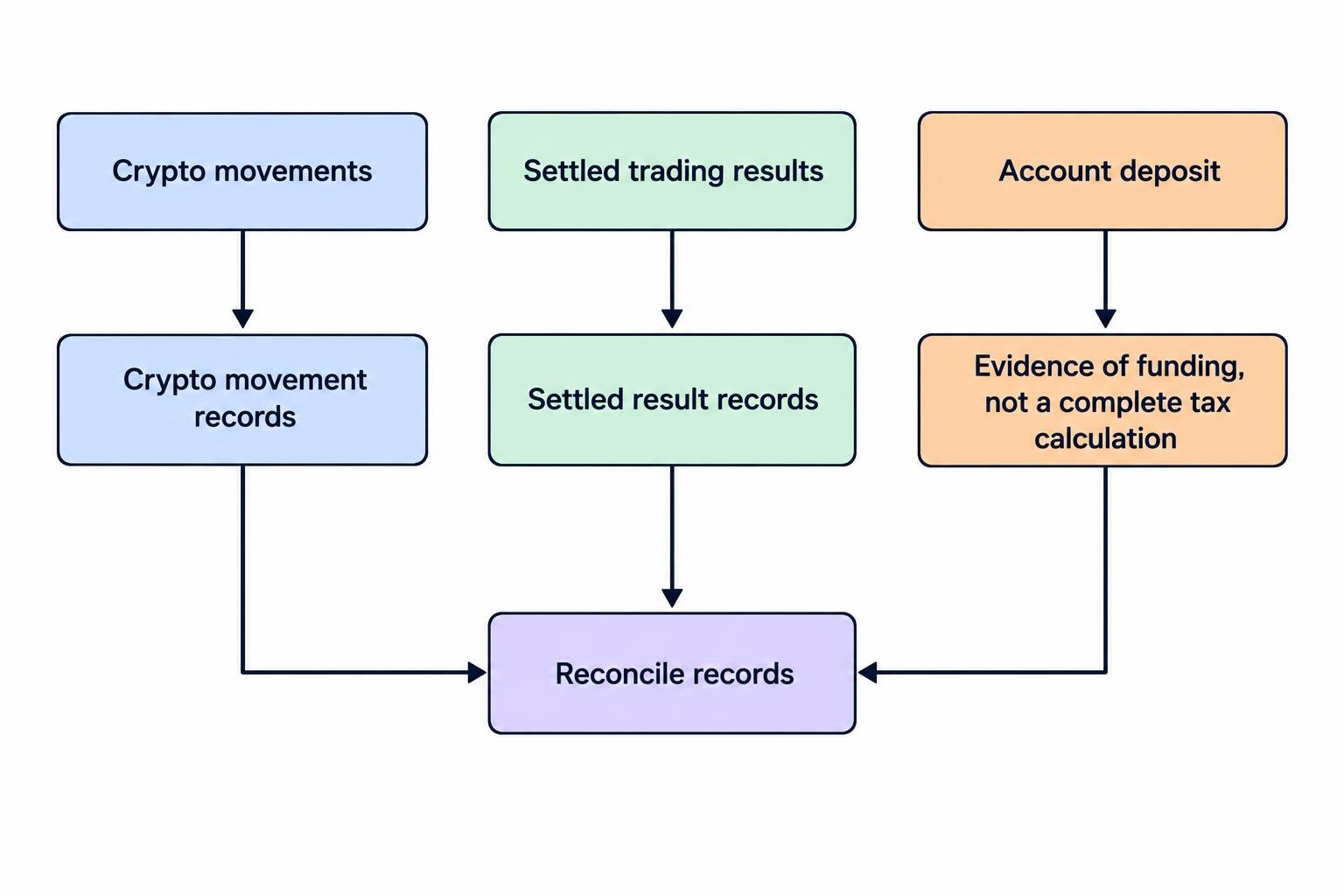
For record keeping, maintain separate calculations for crypto movements and settled trading results, then reconcile them. An account statement showing a deposit is evidence of funding. It is not, by itself, a complete tax calculation.
Does Depositing Crypto Trigger a Disposal?
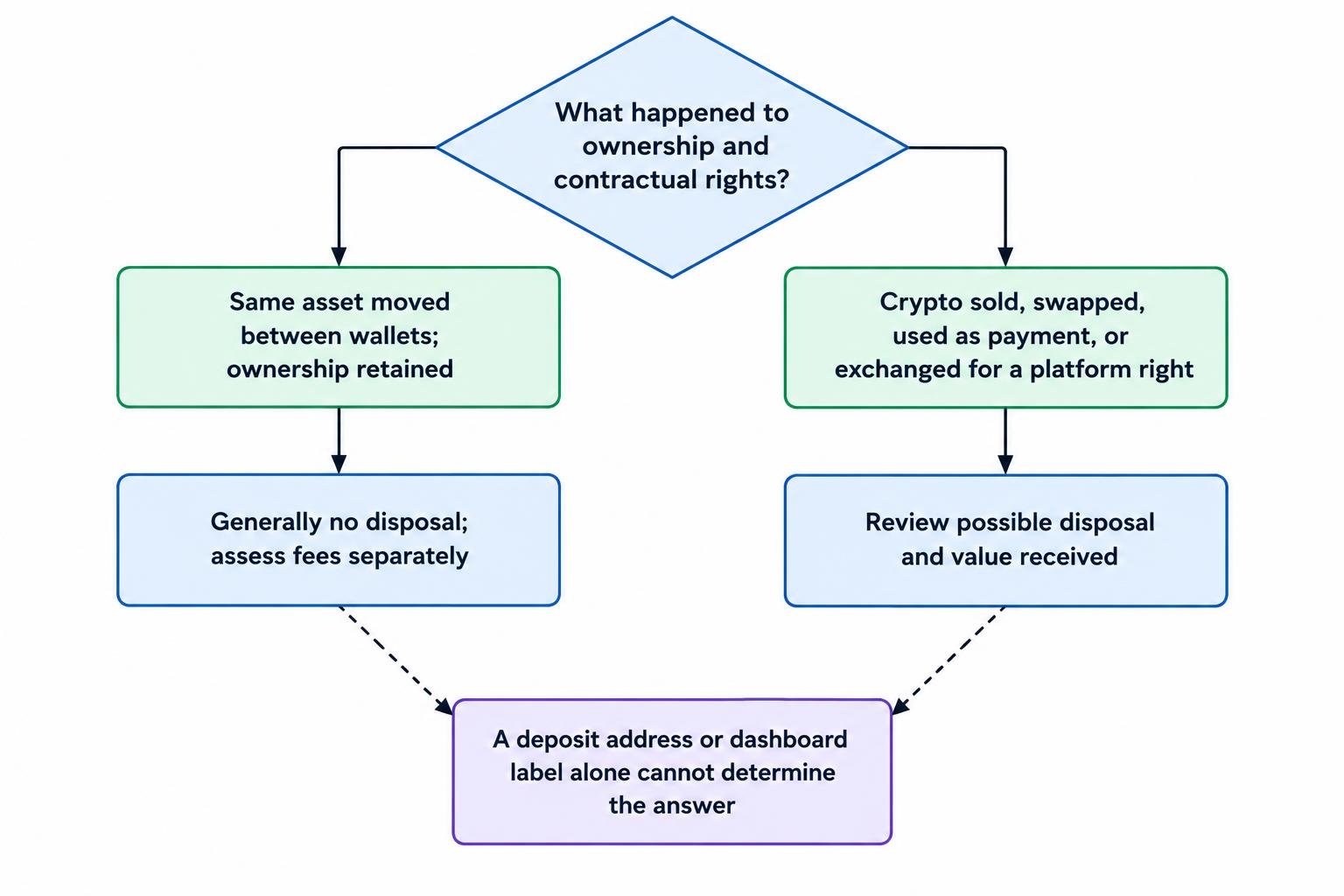
The word “deposit” describes a platform function, not a tax category. Selling investment crypto, swapping it for another token or using it as payment can trigger a disposal. Moving the same asset between wallets while retaining ownership generally does not. These distinctions appear in the ATO’s crypto asset transaction guidance.
The practical question is what happens to your ownership and contractual rights. Does the platform hold your coins for you, or does it take them in exchange for a cash balance or another right? A deposit address alone cannot answer that.
| Funding arrangement | Tax issue to examine |
|---|---|
| Transfer between wallets you own | Whether ownership remains unchanged; assess any crypto used for fees separately. |
| Crypto sold before cash reaches the account | The sale of the crypto, separate from the cash deposit. |
| Bitcoin swapped for USDT before funding | The Bitcoin disposal and acquisition of USDT. |
| Crypto exchanged for a platform balance | Whether the arrangement ends your ownership of the crypto and what you receive in return. |
Keep the funding terms that applied at the time. Look for provisions covering custody, conversion, ownership and repayment. A balance displayed as “BTC” does not prove that the platform holds Bitcoin on your behalf; it may describe how a contractual balance is measured.
Where the terms are unclear, do not automatically label the transaction as a transfer between your own wallets. Flag it for review rather than allowing tax software to make the legal decision.
Work Out the Australian Dollar Value
For investment crypto, the calculation starts with the asset’s cost base and disposal proceeds in Australian dollars. Relevant acquisition costs can form part of the cost base. The ATO’s tax and crypto asset investments factsheet illustrates this approach, including transactions where one crypto asset is exchanged for another.
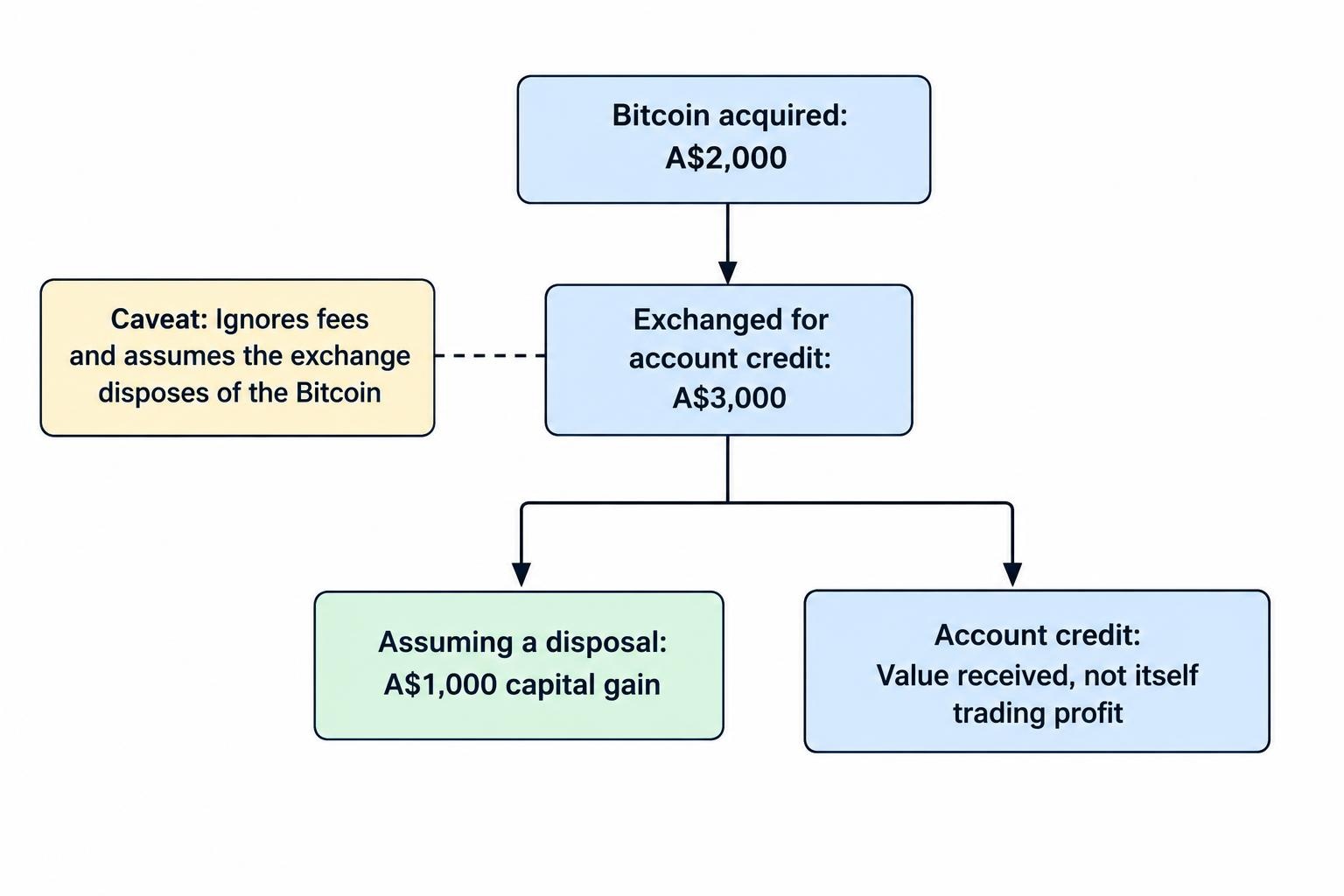
Consider this hypothetical example, ignoring fees and any available concessions:
- You acquire a parcel of Bitcoin for A$2,000.
- You later exchange the entire parcel for a trading account credit worth A$3,000.
- Assuming that exchange disposes of the Bitcoin, the capital gain is A$1,000.
The A$3,000 credit is not itself a A$3,000 trading profit. It is the value received for an asset that already cost A$2,000. Equally, the A$1,000 crypto gain should not disappear from the records just because the proceeds went straight into another account.
If only part of a holding is used, identify the parcel and allocate its cost appropriately. Do not attach the acquisition cost of your entire Bitcoin holding to a small funding transaction.
Preserve the valuation evidence: the conversion receipt, token quantity, timestamp, quoted currency and exchange rate. A year end price cannot replace the value needed for an earlier transaction.
Stablecoins Can Still Produce Gains and Losses
A stablecoin linked to the US dollar can change in Australian dollar value even when its US dollar price barely moves. “Stable” describes the intended peg, not your Australian tax result.
For an investor, USDT does not stop being a crypto asset because its value is tied to fiat currency. The ATO’s response on USDT and exchange rate movements confirms that distinction.
Suppose you acquire 1,000 USDT for A$1,500 and later dispose of those tokens for account credit worth A$1,600. Ignoring fees, that produces a A$100 capital gain under the investment assumption. Your token count did not increase, but its Australian dollar value did.
Also distinguish actual USDT holdings from a platform balance described in US dollars. One may be a crypto asset; the other may be a right to receive money. Similar looking numbers on a dashboard can represent different assets.
Withdrawals Need Their Own Analysis
A withdrawal can return crypto already held for you, purchase new crypto using a cash balance or settle an amount the platform owes you. Do not assume all three arrangements have the same result.
Where a cash balance is converted into newly acquired crypto, record the acquisition separately from the trading results that created the balance. Preserve the conversion value and costs so a later sale of those tokens can be calculated without starting from scratch.
For example, assume an adviser confirms that a withdrawal acquires investment crypto with a cost base of A$4,000. If that crypto is later sold for A$4,300, ignoring selling costs, the later capital gain is A$300. The full A$4,300 is not a second trading profit.
By contrast, a genuine transfer of crypto you already own should not be treated as a new purchase simply because the tokens reach a different wallet.
Ask for statements showing gross withdrawals, conversions and fees. A transaction hash proves an on chain movement, but does not explain how the platform calculated the amount paid.
A Trading Loss Does Not Automatically Cancel a Crypto Gain
A common mistake is to combine every loss and gain associated with the account, regardless of tax character.
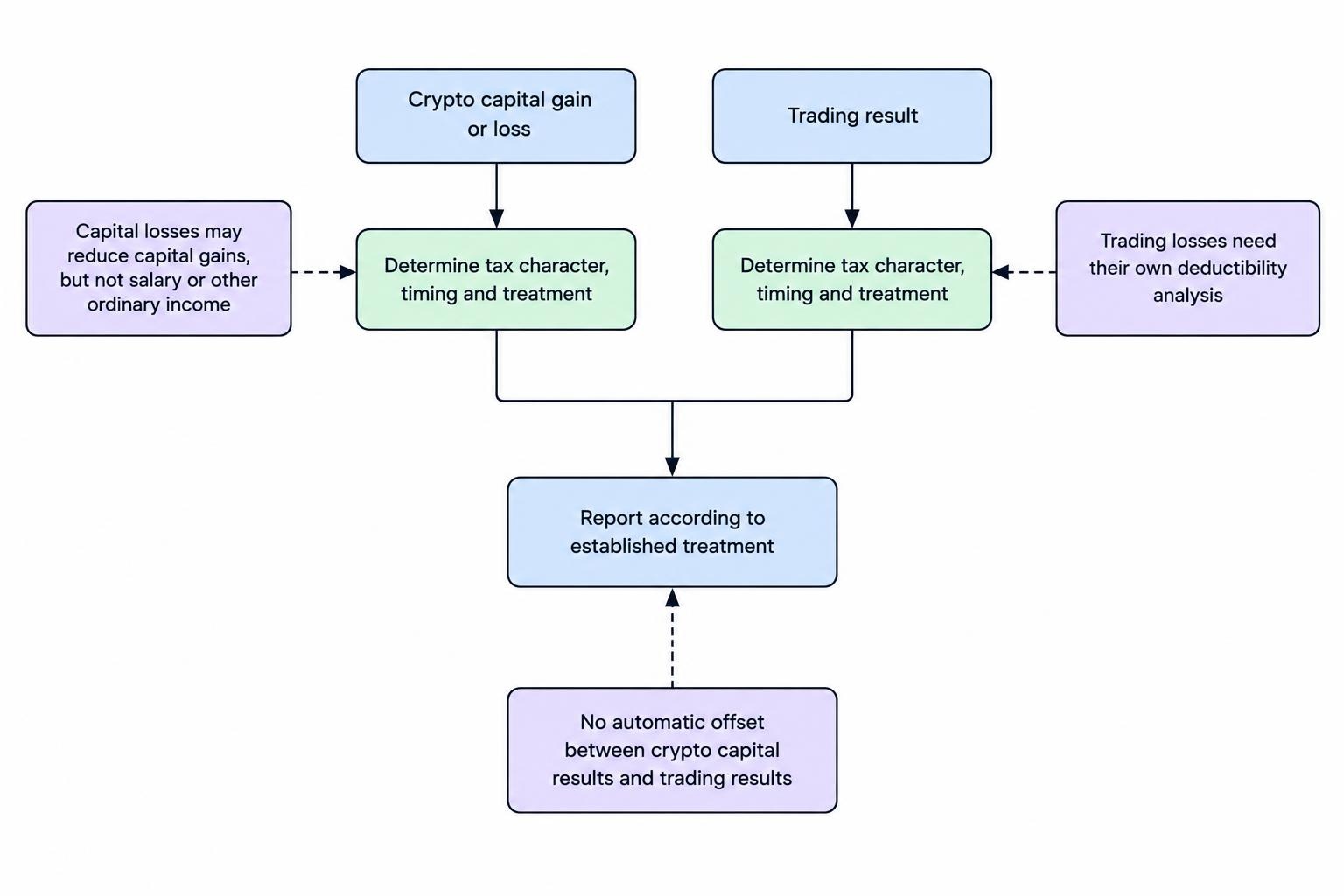
Capital losses can reduce capital gains, including eligible gains from other assets, but cannot be deducted against salary or other ordinary income. Unused net capital losses can carry forward. The ATO’s guidance on crypto losses and reporting sets out this distinction.
Return to the funding example: a Bitcoin disposal creates a A$1,000 capital gain, then the trading account suffers losses. It is not safe to conclude that the Bitcoin gain has vanished. The trading losses need their own classification, timing and deductibility analysis.
The reverse also needs care. A capital loss on crypto does not automatically reduce trading income that belongs on revenue account.
Keep each result separate until its treatment is established. This also makes it easier to spot transactions belonging to different income years. Cash leaving your pocket is an economic loss; whether it is a tax deduction is a different question.
Track Fees Without Claiming Them Twice
Crypto funding can involve acquisition fees, conversion charges, network fees and platform fees. Record each charge against the transaction that generated it rather than entering everything as a general trading expense.
Paying a network fee in crypto can itself dispose of the tokens used for that fee, even where the main transfer preserves ownership. This point is covered in the crypto investment factsheet linked above.
Keep the fee’s token quantity and Australian dollar value. Also distinguish the tax treatment of the fee from the disposal of crypto used to pay it. They are related questions, not interchangeable calculations.
Check imported data for duplication. A fee may already be included in an exchange’s net proceeds or a software calculation. Adding it again manually can overstate the amount claimed. Do not assume every wallet movement creates an immediately deductible expense.
Do Not Assume the Personal Use Exception Applies
Using crypto through a personal account does not automatically make it a personal use asset. Nor does a small deposit create a general exemption.
The test concerns how the asset was kept and used. Crypto held as an investment does not become exempt simply because you eventually spend it. The ATO’s personal use asset guidance distinguishes personal consumption from investment use.
Do not treat funding speculative trading as equivalent to buying an ordinary personal item. Keep evidence of the purpose and actual use, and have any proposed exemption reviewed before relying on it.
Keep Records That Connect the Wallet and the Account
The hardest reconciliation gaps often sit between an exchange, a wallet and a platform. Each service records its own part of the transaction; none necessarily provides the complete chain.
For every funding or withdrawal movement, preserve:
- The asset, network, quantity and transaction hash.
- Sending and receiving public addresses, with an explanation of ownership.
- The timestamp, time zone and Australian dollar valuation.
- Conversion receipts, gross amounts, net credits and fees.
- The platform statement and relevant account terms.
The ATO’s crypto record keeping requirements cover transaction details, Australian dollar values and retention. Generally, keep records for five years from the latest relevant point identified in that guidance, not simply five years after buying the asset.
Export statements regularly and before closing an account. Store copies outside the platform. Public addresses and transaction hashes belong in the reconciliation; seed phrases and private keys should not be included in an ordinary spreadsheet shared with an adviser.
Reconcile the Account Before Preparing the Return
Start with token quantities. Opening holdings, plus acquisitions, less disposals and fees should reconcile to closing holdings. Then reconcile the platform’s opening balance, funding, trading results, charges and withdrawals.
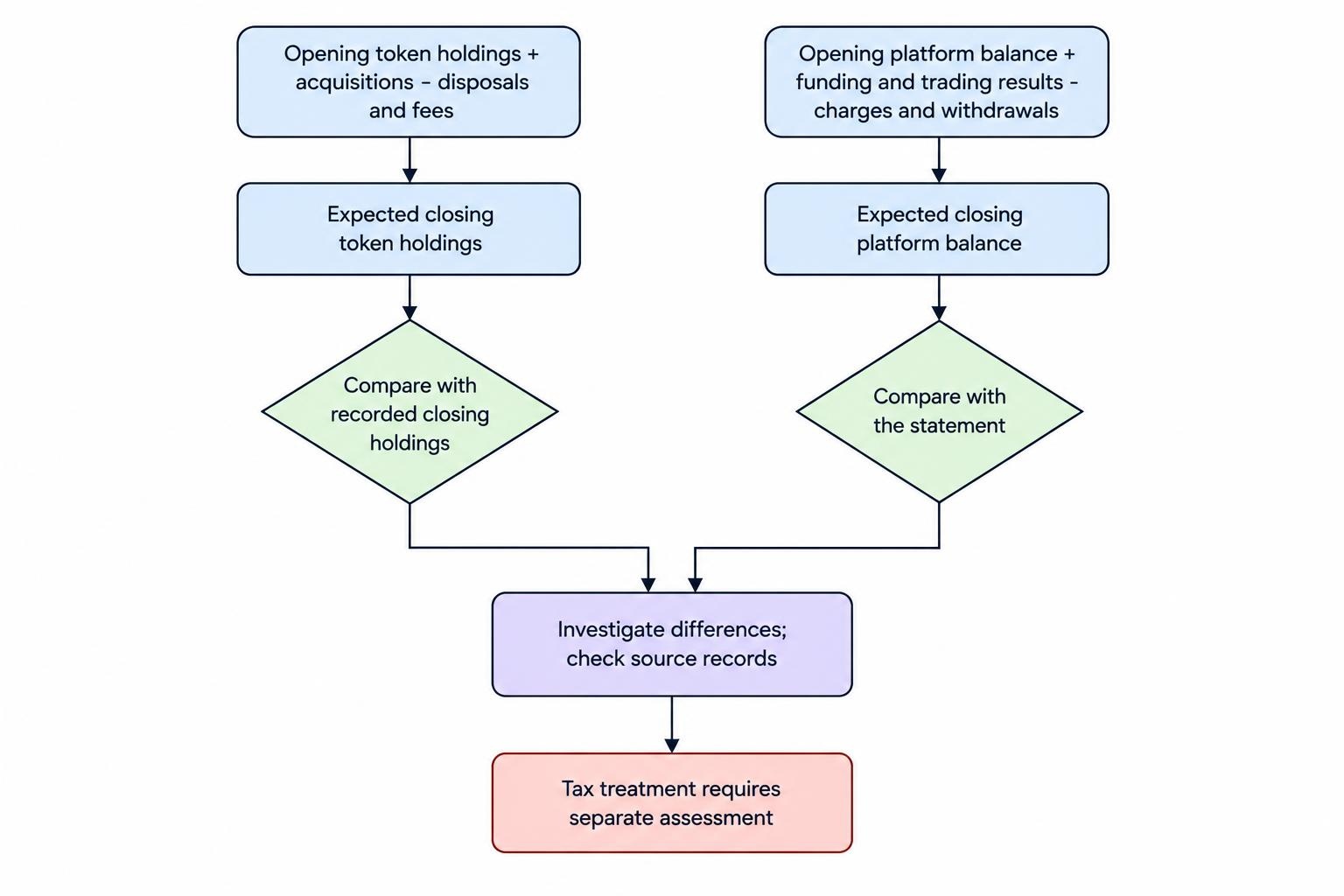
Investigate differences rather than forcing the totals to match. Common checks include missing conversions, fees deducted from the amount received, duplicated imports and transfers incorrectly recorded as sales.
Keep an explanation beside each adjustment, supported by the original receipt or statement. A spreadsheet should lead back to evidence, not replace it. The guide to trading records for Australian tax purposes covers the wider account documentation.
Give a registered tax agent the contract terms as well as the transaction export. Highlight unclear custody arrangements, crypto denominated account balances, business activity and inaccessible funds. These issues need judgment that an automated transaction label cannot provide.
For the broader reporting position, use the Australian binary options tax guide alongside the crypto calculations. The aim is to account for each asset and transaction once, with the correct value, timing and tax treatment—not to treat the bank withdrawal as the whole story.
This article was last updated on: October 22, 2026