Longer expiry binary options strategies test whether a market view remains valid over several hours or days, rather than the next few seconds. The extra time can accommodate a trend, a breakout retest or a recovery from a price extreme. It also leaves the contract exposed to more news and more opportunities for the original idea to fail.
The central question is not simply whether price will rise or fall. It is whether the contract’s settlement price will finish on the required side of its strike at the chosen expiry, at a payout that justifies the risk.
For Australian readers, the legal position comes first: ASIC’s prohibition on issuing and distributing binary options to retail clients runs until 1 October 2031. Choosing a longer expiry does not bypass that restriction. The frameworks below are for education and paper testing, not instructions for accessing prohibited products.
What Longer Expiry Changes
Here, “longer expiry” means several hours, the end of a trading day or several days. The examples use high/low contracts assessed at expiry, not touch contracts whose outcome can depend on a price reached earlier.
Binary options settle against a yes/no condition and pay a predetermined amount or nothing, subject to their terms. They do not provide ownership of the underlying asset. The SEC and CFTC investor alert on binary options describes this distinction. A correct forecast of the broad direction can therefore produce a losing contract if the settlement condition is not met.
Suppose a hypothetical “higher” contract has a strike of 0.6600. The market rises to 0.6640 during the afternoon, then settles at 0.6598. The earlier rise does not rescue a contract that requires a settlement above 0.6600. Equally, a large favourable move does not increase an agreed fixed payout.
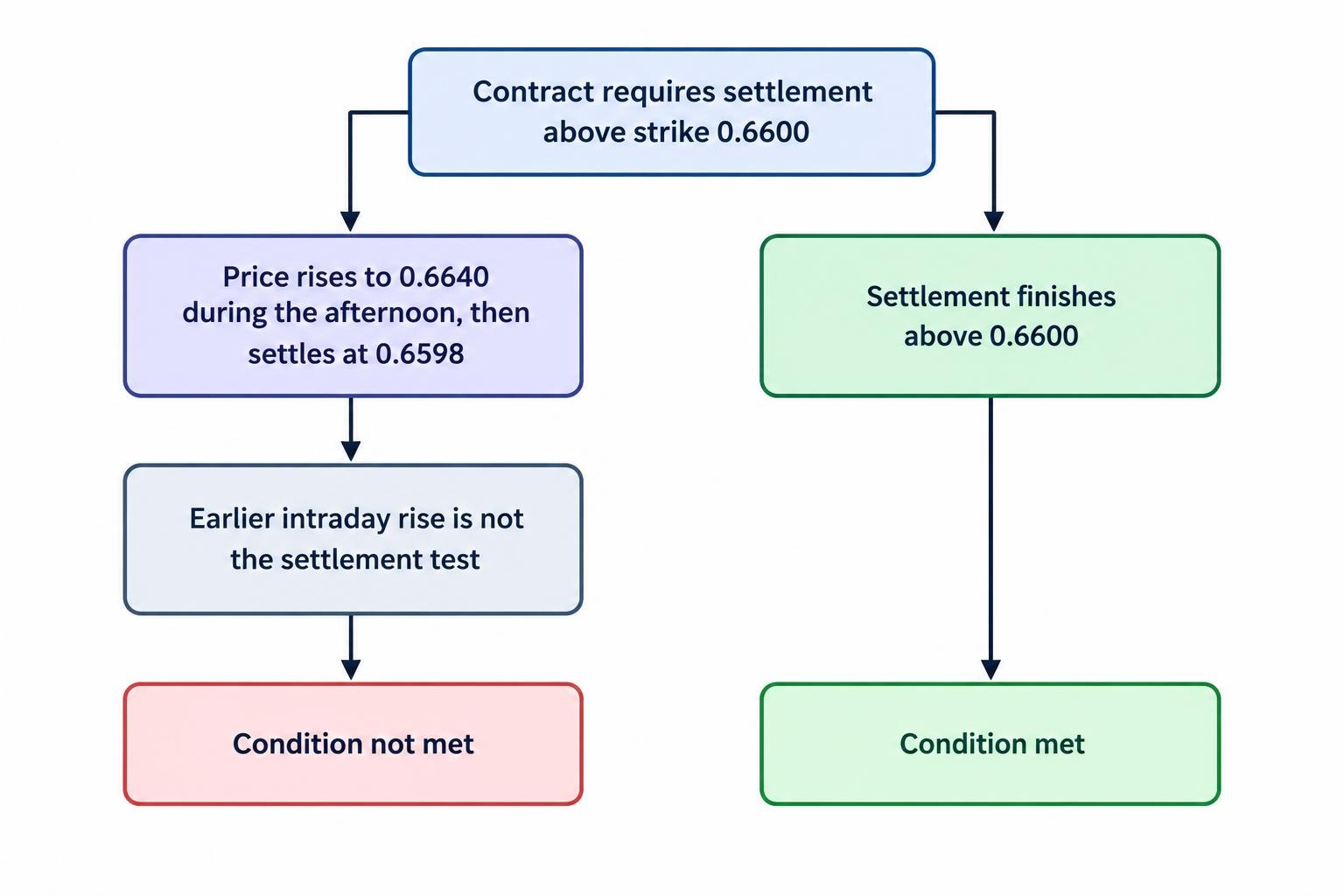
Separate the chart interval from the contract duration. A four hour chart organises price into four hour candles; it does not establish that a four hour expiry is suitable. A daily cutoff and a rolling 24 hour duration are also different. The guide to binary options expiry times covers these timing distinctions.
Three Strategy Frameworks to Paper Test
The following setups are research hypotheses, not proven profitable systems. Their purpose is to make the entry, expiry and rejection rules clear enough to evaluate without rewriting the explanation after each result.
Trend Continuation After a Pullback
A continuation setup asks whether an established move will resume after a temporary retreat. The longer expiry must give that proposed continuation time to develop without extending far beyond the evidence supporting it.
One paper test could identify an upward trend on a four hour chart using rising swing highs and rising swing lows. Only count swings that were already confirmed when the decision was made. Then use an hourly chart to watch a pullback into a previously marked support area.
A possible entry rule is a completed hourly candle closing above the preceding candle’s high after that pullback. Record the next available quote as the hypothetical entry. Test four hour and eight hour expiries as separate versions, rather than choosing whichever later produces a win. Neither duration is automatically preferable.
The trend trading framework addresses trend identification in more detail. For longer expiry research, the extra question is whether the trend evidence supports the full holding period. Reject a new entry if price has already broken the structure used to justify it. Do not give a weakening idea a longer deadline simply because the chart remains broadly upward.
Breakout Followed by a Retest
A breakout setup tests whether price can establish itself beyond a previously defined range. Waiting for a retest creates a different entry rule from buying immediately after the first break; both approaches need separate records.
For a reproducible exercise, mark the highest high and lowest low of eight completed hourly candles. For an upward setup, require an hourly close above the upper boundary. Then require a later candle to revisit that boundary and close back above it. Record a hypothetical entry after confirmation and test a fixed three hour duration.
The boundaries must remain those recorded before the breakout. Moving them afterwards makes the chart look tidier but changes the experiment.
This framework can fail when the breakout reverses or when confirmation arrives after most of the move has occurred. Set an entry distance rule before testing, expressed in price units or relative to the original range. That prevents chasing a late signal under the same label as a well placed retest.
Mean Reversion Within an Established Range
A range based setup tests whether an attempted move beyond a boundary will reverse. It is a directional high/low hypothesis here, not a boundary contract requiring price to remain between two levels.
A paper rule might require two earlier reactions near each edge of a marked range. After price briefly moves below its lower edge, wait for a completed candle to close back inside. Test whether settlement two hours after the hypothetical entry finishes above the entry strike.
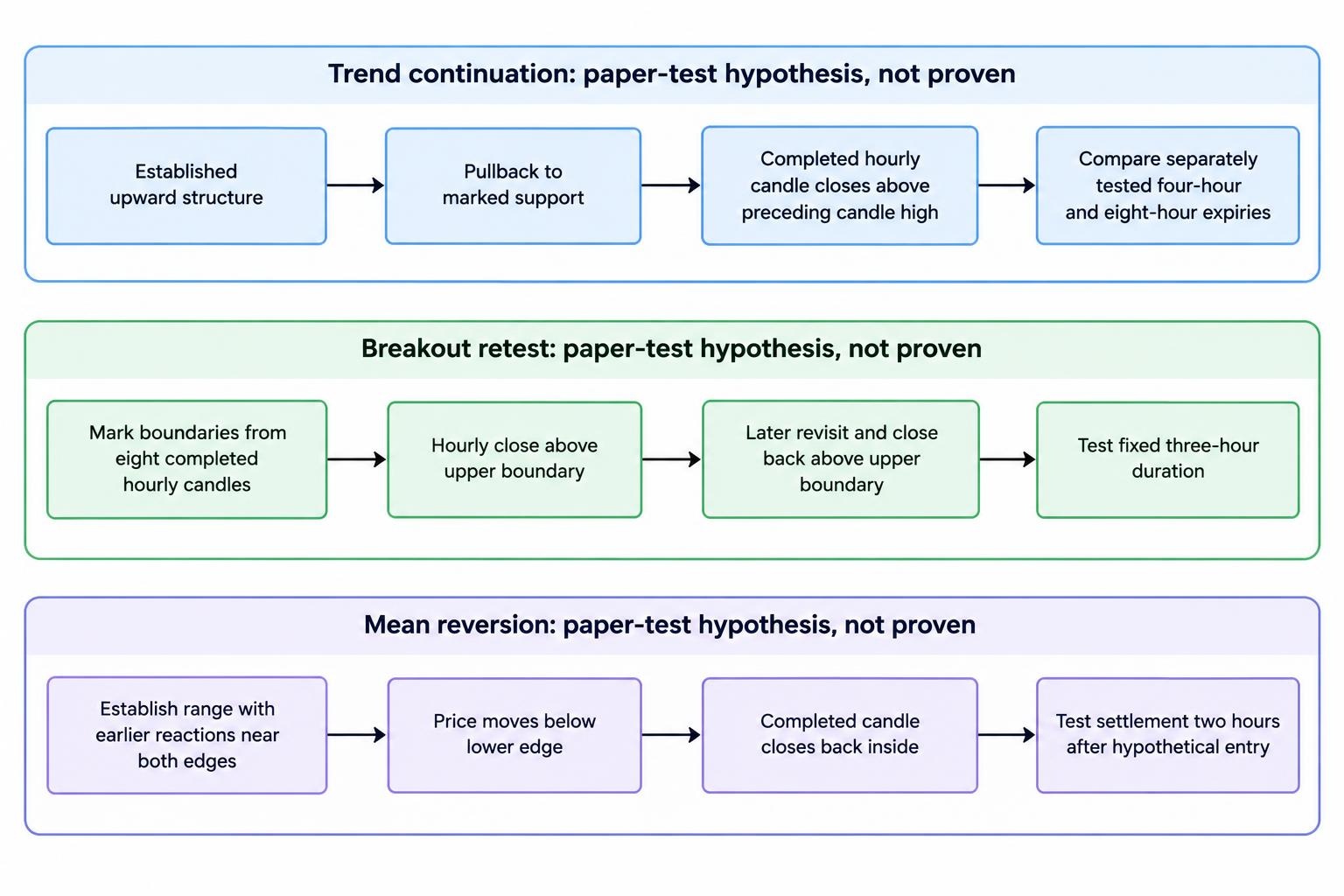
The failure condition matters as much as the signal. If price instead establishes new lows outside the range, reject fresh reversal entries. A market is not obliged to return because it looks stretched.
Also separate touching a reference level from settling beyond the strike. Price might recover halfway through the contract and reverse again before expiry. Record that path for analysis, but score the contract against its actual settlement condition.
Choose Expiry Around the Thesis and the Calendar
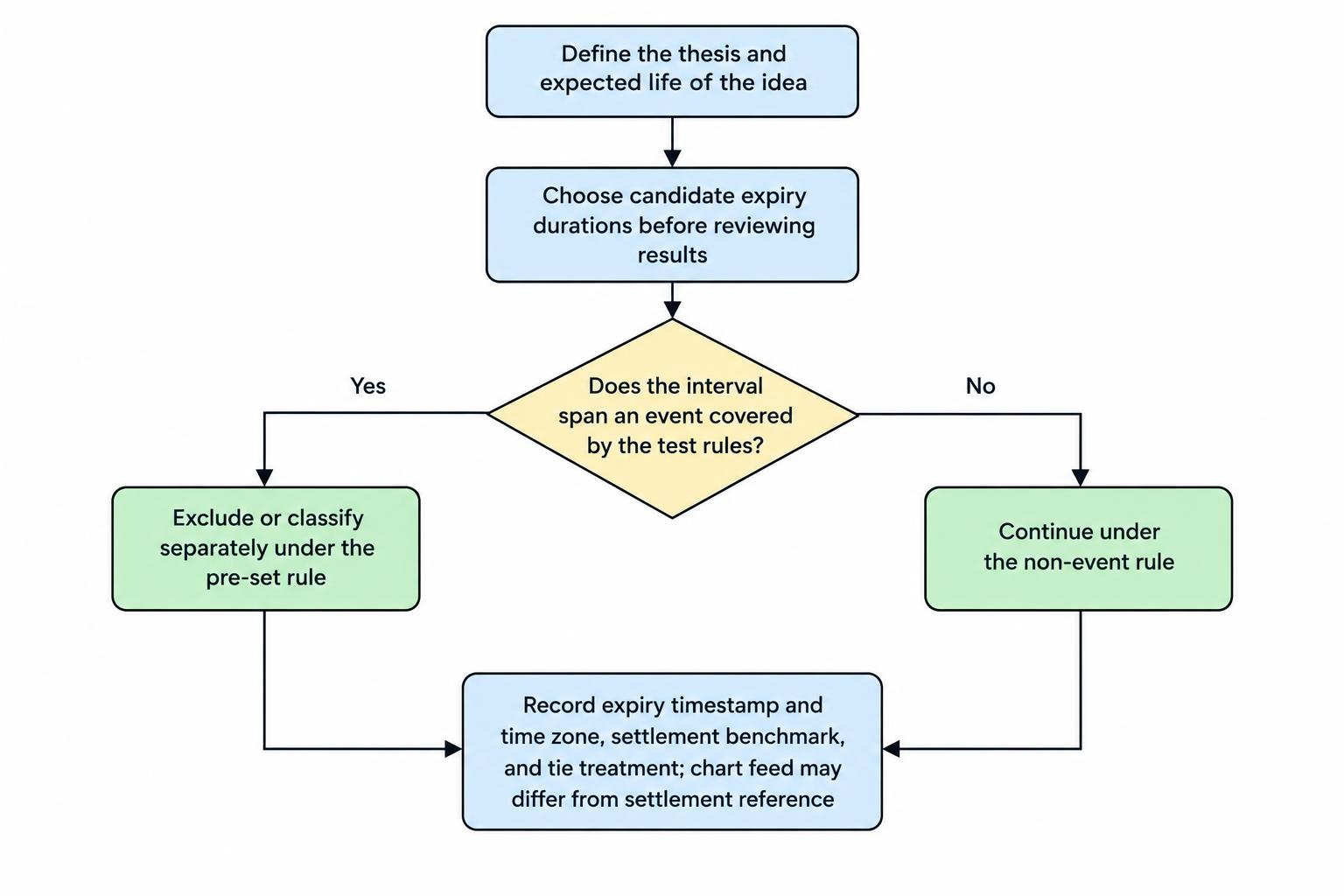
Choose candidate expiries before checking their results. Start with the expected life of the idea: a retest after a session breakout may justify a different research horizon from a trend visible across several daily candles.
Then check what happens between entry and settlement. For an AUD related example, consult the RBA Monetary Policy Board meeting schedule rather than relying on memory. Decide in advance whether the test excludes contracts spanning a policy decision. Mixing event and non-event entries can obscure what the rules are actually testing.
A longer duration should not become an excuse to absorb every announcement. If a setup depends on existing price behaviour continuing, an intervening event may make it a different hypothesis. Record it separately or leave it out under a rule established beforehand.
Market closing procedures also deserve attention. ASX normal cash trading ends at 4:00 pm Sydney time, with closing prices calculated in a later auction, as shown in the ASX cash market trading phases. “At the close” is therefore not a sufficiently precise settlement description.
For every paper contract, record the expiry timestamp, time zone, settlement benchmark and treatment of ties. Establish whether the reference is a cash price, futures price or another defined feed. A chart from a different feed can support analysis without reproducing the contract’s settlement value.
Compare Payouts Before Comparing Win Rates
The examples below assume a fixed stake, full stake loss on a losing contract, and a winning payment consisting of the returned stake plus the stated profit. They exclude fees, rebates and ties. These assumptions matter: different contract structures need different calculations.
Under those assumptions:
Break-even win rate = 1 ÷ (1 + profit rate)
| Profit on a winning stake | Break-even win rate |
|---|---|
| 70% | 58.82% |
| 80% | 55.56% |
| 90% | 52.63% |
Consider 60 hypothetical contracts with an A$50 stake and 80% profit on each winner. With 34 wins and 26 losses, the result is A$60 profit before costs: A$1,360 gained minus A$1,300 lost. Change just one winner into a loss and the result becomes a A$30 loss.
A longer expiry has not changed that arithmetic. Nor can an observed win rate be transferred between durations without accounting for their payouts. The guide to probability and expected value develops the relationship between success probability, profit and loss size.
For research, log the payout attached to each hypothetical entry. If historical payout information is missing, report results under clearly labelled assumptions. A price chart alone cannot establish the return a contract would have delivered.
Control Exposure Across the Full Holding Period
A slower entry schedule does not necessarily mean less money at risk. Several contracts can remain open together, especially when their expiries stretch across sessions.
Set a paper risk budget for all unsettled contracts, not just each entry. Four hypothetical A$25 stakes expose A$100 in total if every contract can lose its full stake. Different expiry times do not reduce that maximum combined loss.
Also group positions by the market view they express. Several currency contracts may depend on the same anticipated US dollar move. Treating them as unrelated entries can hide a concentrated exposure. The guide to correlation and trading risk covers this issue.
Define invalidation separately from exit availability. A chart level can show that the original thesis has failed, but it does not guarantee that a contract can be closed there. If early closure is absent or uncertain, model the full stake as committed until settlement.
Do not extend expiry or increase the next stake to repair a loss. Those actions change the risk and the strategy. They do not improve the evidence supporting the original entry.
Test the Expiry Rule, Not Just the Entry Signal
A useful research record must reproduce the decision as it could have been made at the time. Save the signal timestamp, hypothetical entry quote, strike, expiry timestamp, payout assumption, settlement value and result. Include rejected signals where the rules require them.
Use enough price detail to evaluate the chosen expiry. Daily candles cannot establish a settlement value partway through a session. Even an hourly candle may be insufficient if the contract expires between hourly timestamps. The binary options backtesting guide covers the wider process of constructing a valid historical test.
For longer expiry comparisons, select a small set of durations in advance. Apply the same entry rules to each, then compare net results, losing streaks, overlapping exposure and sensitivity to payout assumptions. Keep session and event categories visible rather than combining everything into one headline win rate.
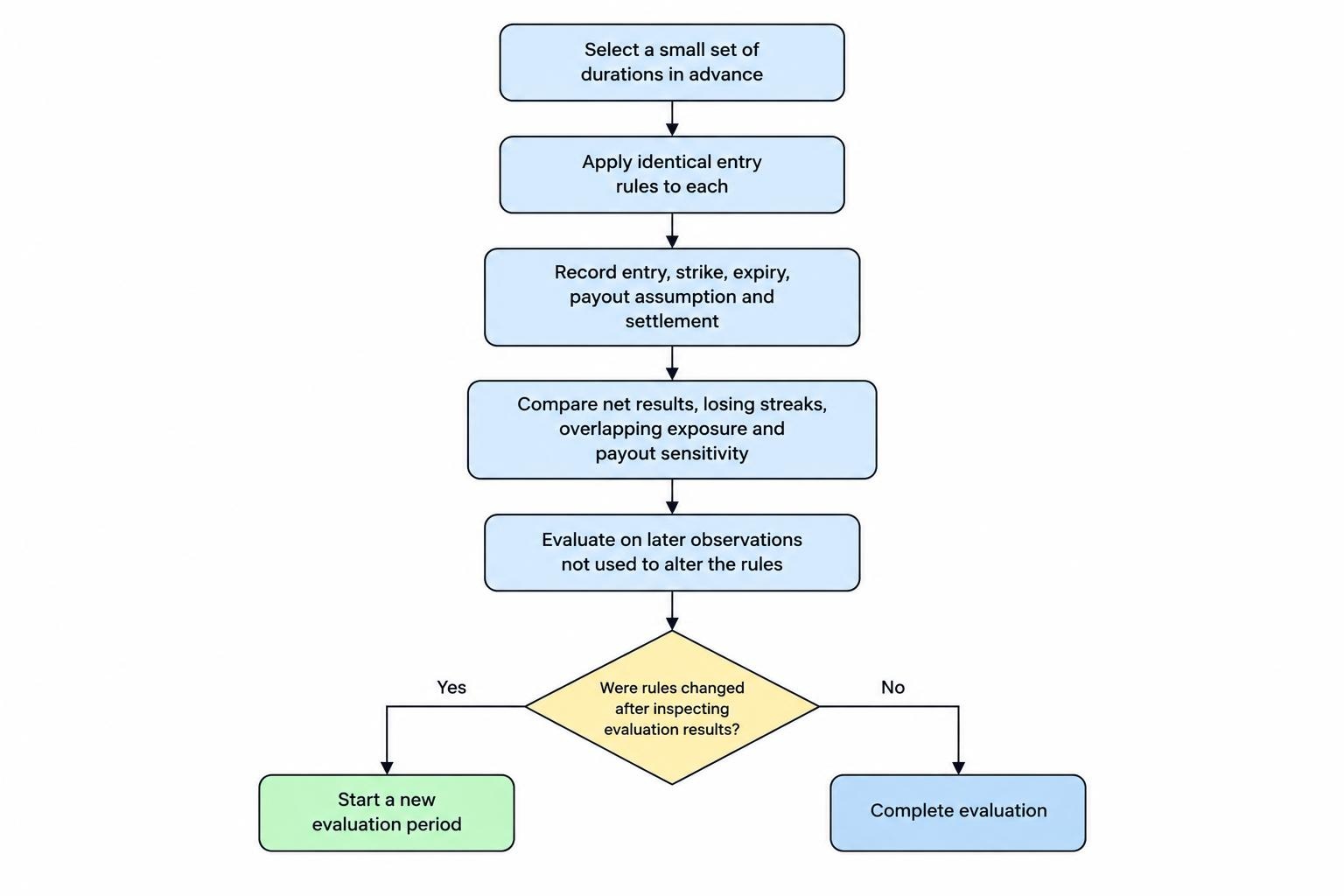
Reserve later observations for evaluation after the rules are fixed. If you inspect those results and change the strategy, they are no longer untouched evaluation data. Start a new evaluation period and retain the earlier version in the research log.
Testing more variations increases the opportunity to select a flattering historical result by chance. The research paper The Probability of Backtest Overfitting examines this selection problem. Trying dozens of expiry choices and reporting only the best one is not evidence that the chosen duration will remain superior.
Finally, paper test the frozen rules on new observations. Do not force extra entries because longer duration setups produce fewer decisions. Several contracts driven by one price move should not be treated as independent proof of repeatable performance.
When to Reject a Longer Expiry Setup
Reject a setup when its settlement terms are unclear, the required payout cannot be established, or its apparent success depends on changing expiry after seeing the outcome. Reject it too when an intervening event invalidates the research assumptions.
Longer expiry is a timing choice, not a safety feature. A defensible paper strategy needs a defined entry, a reason for its holding period, reproducible settlement data and results that survive more than one favourable stretch of history. Extra time alone supplies none of those.
This article was last updated on: October 22, 2026