This binary options glossary defines the terms used in contract descriptions, trading platforms and educational material. Entries are arranged alphabetically, with examples where a label can hide an important difference, especially between payout, profit and the money returned to an account.
Australian context: ASIC’s ban on issuing and distributing binary options to retail clients took effect on 3 May 2021 and runs until 1 October 2031. The ASIC announcement extending the binary options ban sets out its scope. The definitions below explain the products, not a route around that restriction.
A–C: Assets, Binary Contracts and Counterparties
- All-or-nothing
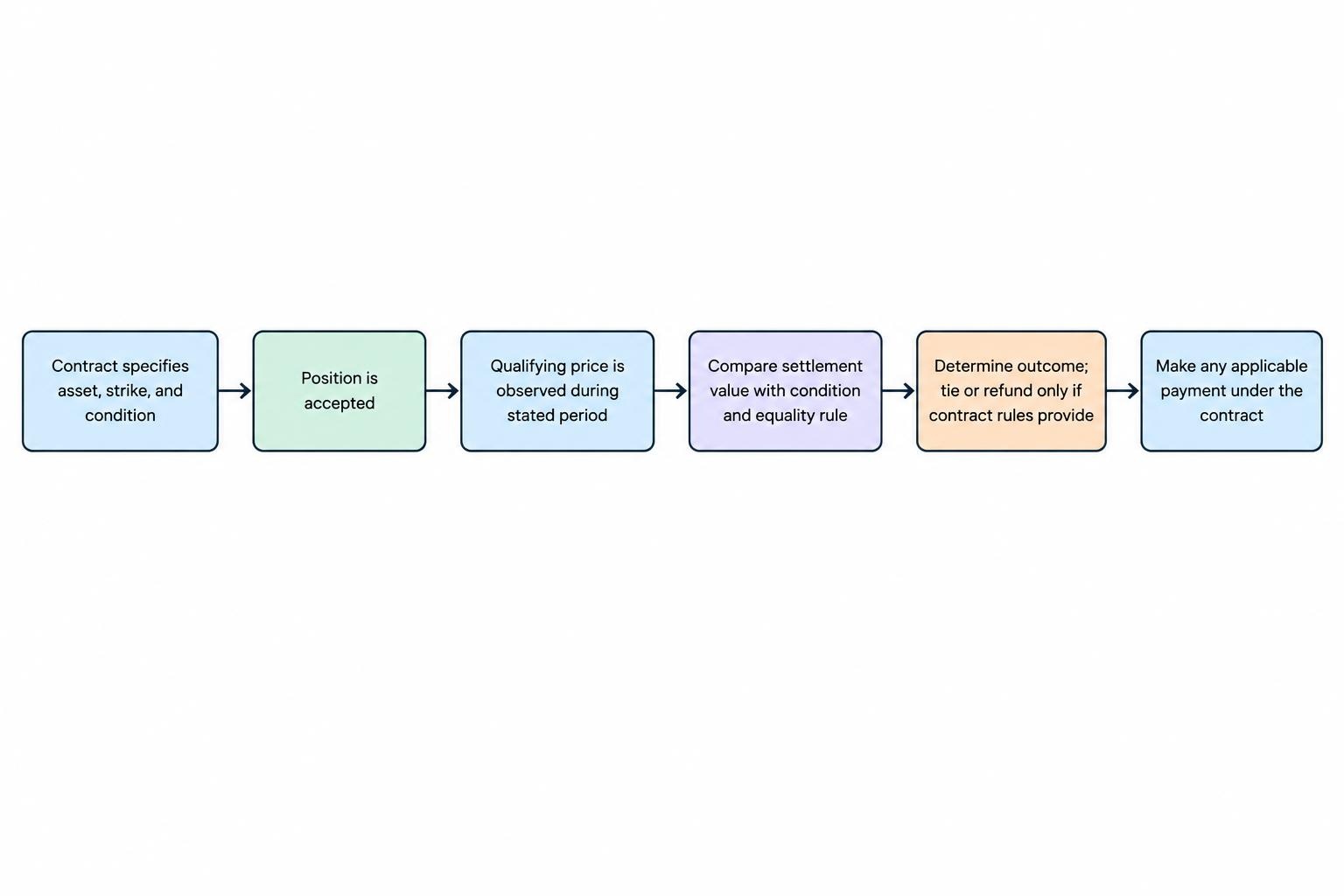
- A description of the basic binary payoff: the contract pays a predetermined amount when its condition is satisfied, or nothing when it is not. Any refund or cancellation provision must be checked separately.
- Asset, or underlying asset
- The market instrument referenced by the contract, such as a currency pair, share, commodity or stock index. A binary option linked to gold does not give the buyer ownership of gold.
- At the money (ATM)
- A position where the underlying price equals the strike price. At expiry, equality can create a tie, but it does not automatically mean a refund. The contract’s comparison rule decides the result.
- Barrier
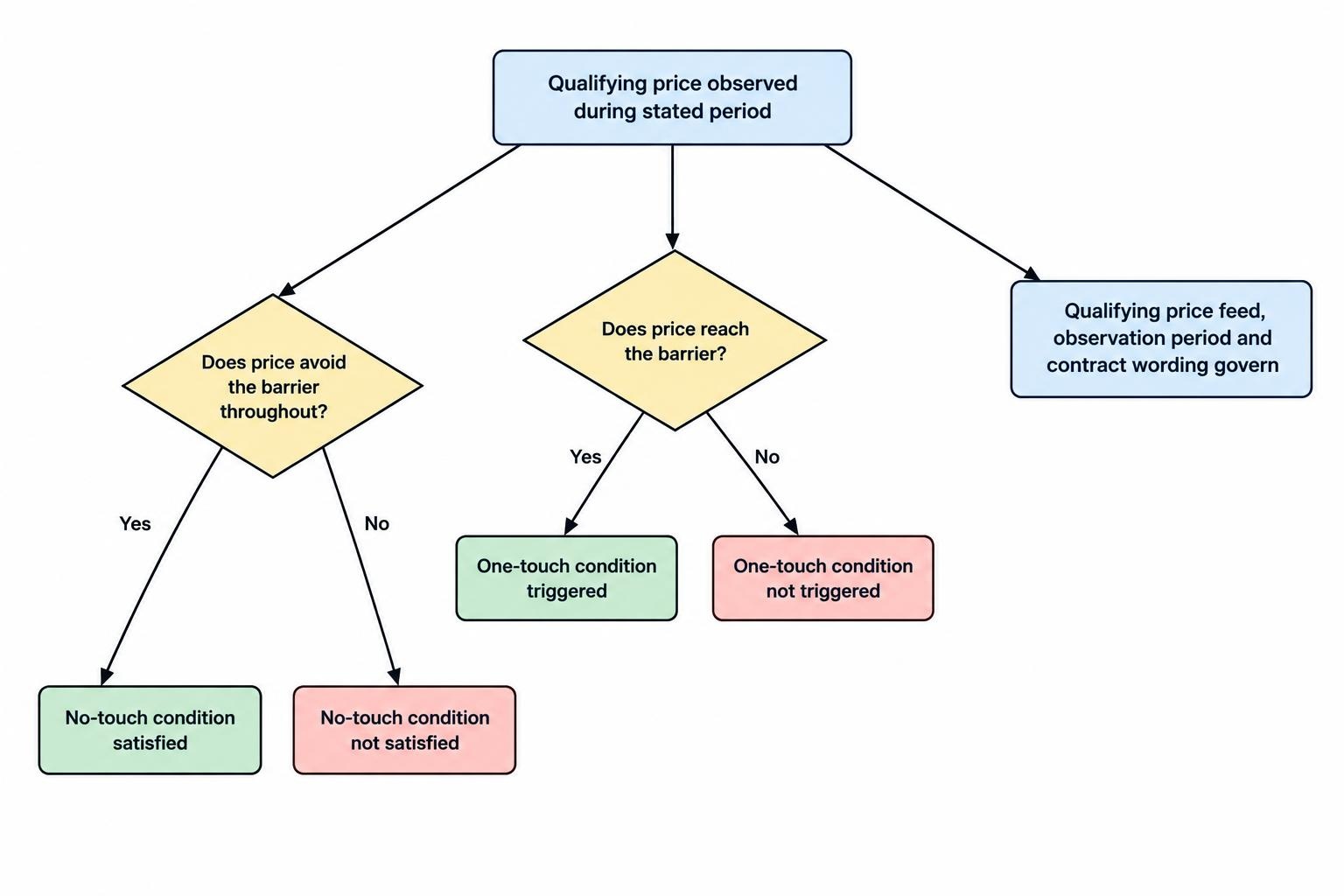
- A price level used to determine a touch, no-touch or other conditional outcome. Whether touching the barrier counts depends on the observation period, qualifying price feed and contract wording.
- Binary option
- An option whose payment depends on a yes/no condition. Unlike a conventional option, it does not give its holder the right to buy or sell the underlying asset. The SEC’s binary options explanation and fraud warning covers this distinction.
- Boundary, or range option
- A contract based on whether a price stays within, finishes within, or moves outside two stated levels. Those conditions are not interchangeable: finishing inside a range does not prove the price stayed inside throughout.
- Break-even win rate
- The proportion of winning trades needed to cover losses. With equal stakes, full stake losses, no refunds or fees, and net winning profit of 80% of the stake, break-even is 1 ÷ 1.8, or approximately 55.56%.
- Broker
- The business through which a customer accesses contracts. In binary options marketing, “broker” may describe the contract issuer itself rather than an intermediary matching customers with an independent market. Identify the actual contracting entity.
- Call, or higher
- A label commonly used for a position that wins if the settlement price is above the strike. It is not the same as purchasing a conventional call option with a right to acquire the asset.
- Contract terms
- The rules governing a position, including its underlying market, strike, observation period, expiry, payout and settlement method. A button labelled “higher” is not a substitute for those rules.
- Counterparty
- The party on the other side of a contract. Counterparty risk is the possibility that this party fails to meet its payment obligations. A correct market prediction does not remove that risk.
- Cut-off time
- The deadline for entering a contract or requesting an available action. It may occur before expiry. An option that settles at 3:00 pm does not necessarily remain open for new positions until 3:00 pm.
D–H: Demo Accounts, Expected Value and Expiry
- Demo account
- A simulated account using virtual funds. It can help explain platform controls and contract mechanics, but displayed profits are not withdrawable money. Demo results do not establish live execution quality, withdrawal reliability or future profitability.
- Derivative
- A contract whose value or payment depends on another price, asset or event. Binary options are derivatives because their outcomes reference something else, rather than representing ownership of that underlying market.
- Double up
- A platform feature that adds another position related to an existing trade. The extra position increases exposure. Its accepted strike, payout and remaining duration may differ from those of the original contract.
- Drawdown
- A decline from an account’s previous peak to a later low. A fall from A$1,000 to A$800 is a 20% drawdown. Recovering from A$800 to A$1,000 then requires a 25% gain.
- Early close, or early exit
- Ending a position before its scheduled expiry, where the contract permits it. The available exit amount may be less than the stake or eventual winning payment. Availability should never be assumed from the presence of a button.
- Entry price
- A potentially ambiguous label. It can mean the underlying market price when a trade is accepted, or the price paid for an exchange-traded contract. Neither meaning should automatically be substituted for the strike price.
- Execution
- The acceptance and creation of a trade under the platform’s rules. Clicking a button and receiving confirmation are separate events. The accepted contract details, rather than the earlier screen display, establish the position.
- Expected value (EV)
- The probability-weighted average profit or loss for stated assumptions. If a hypothetical trade has a 50% chance of winning A$80 and a 50% chance of losing A$100, its EV is minus A$10. The guide to probability and expected value develops the calculation.
- Expiry, or expiration
- The scheduled endpoint used to determine a contract’s outcome. An expiry timestamp needs a date and time zone to be unambiguous. The time when the result appears in an account can be later.
- High/low option
- A directional binary contract based on whether the settlement price finishes above or below a strike. The size of the move generally does not increase the agreed winning payment. Direction and timing both matter.
I–O: Winning Conditions, Market Access and Order Timing
- In the money (ITM)
- A description of a contract whose winning condition is satisfied. Before expiry, being in the money is only a current status, not a secured profit. An above-strike position can move below the strike before settlement.
- Ladder option
- A product presenting several price thresholds, often with different quoted payouts. Each level needs its own probability assessment. A larger advertised return does not make a more distant threshold better value.
- Latency
- The delay between an action, its transmission and the platform’s response. With short contracts, a small delay can alter the accepted entry conditions or remaining duration. Latency is not proof of manipulation, but it affects comparisons.
- Liquidity
- The availability of buyers and sellers at usable prices. Liquidity in an underlying market does not guarantee that a binary contract can be sold early. The contract’s own trading or exit arrangements matter.
- Losing streak
- A run of consecutive losing trades. A streak does not make the next position due to win. Its financial effect depends on stake size and whether the trader increases exposure after each loss.
- Martingale
- A staking approach that increases the amount risked after losses in an attempt to recover them. Simple doubling may not recover previous losses when winning profit is below 100% of the stake. The explanation of martingale in binary options examines the escalating exposure.
- No-touch option
- A contract that wins if the qualifying price avoids a stated barrier during the observation period. A brief qualifying touch can defeat the condition even when the price later moves well away from that level.
- One-touch option
- A contract whose winning condition is triggered when the qualifying price reaches a barrier during the observation period. Triggering the condition and receiving payment need not happen simultaneously; payment timing follows the contract.
- OTC, or over the counter
- A contract arranged outside an exchange. OTC describes how the transaction is organised, not whether it is safe or lawful for a particular customer. It does not automatically mean a weekend market or an artificial price feed.
- Out of the money (OTM)
- A description of a contract whose winning condition is not satisfied. For an above-strike position, a settlement price below the strike normally means an out-of-the-money result. Equality requires a separate check of the rules.
P–R: Payouts, Prices and Returns
- Paper trading
- Recording hypothetical positions without placing real-money trades. A useful record includes the proposed entry time, strike, expiry, available payout and result. Recording only whether a chart moved up or down leaves too much out.
- Payout
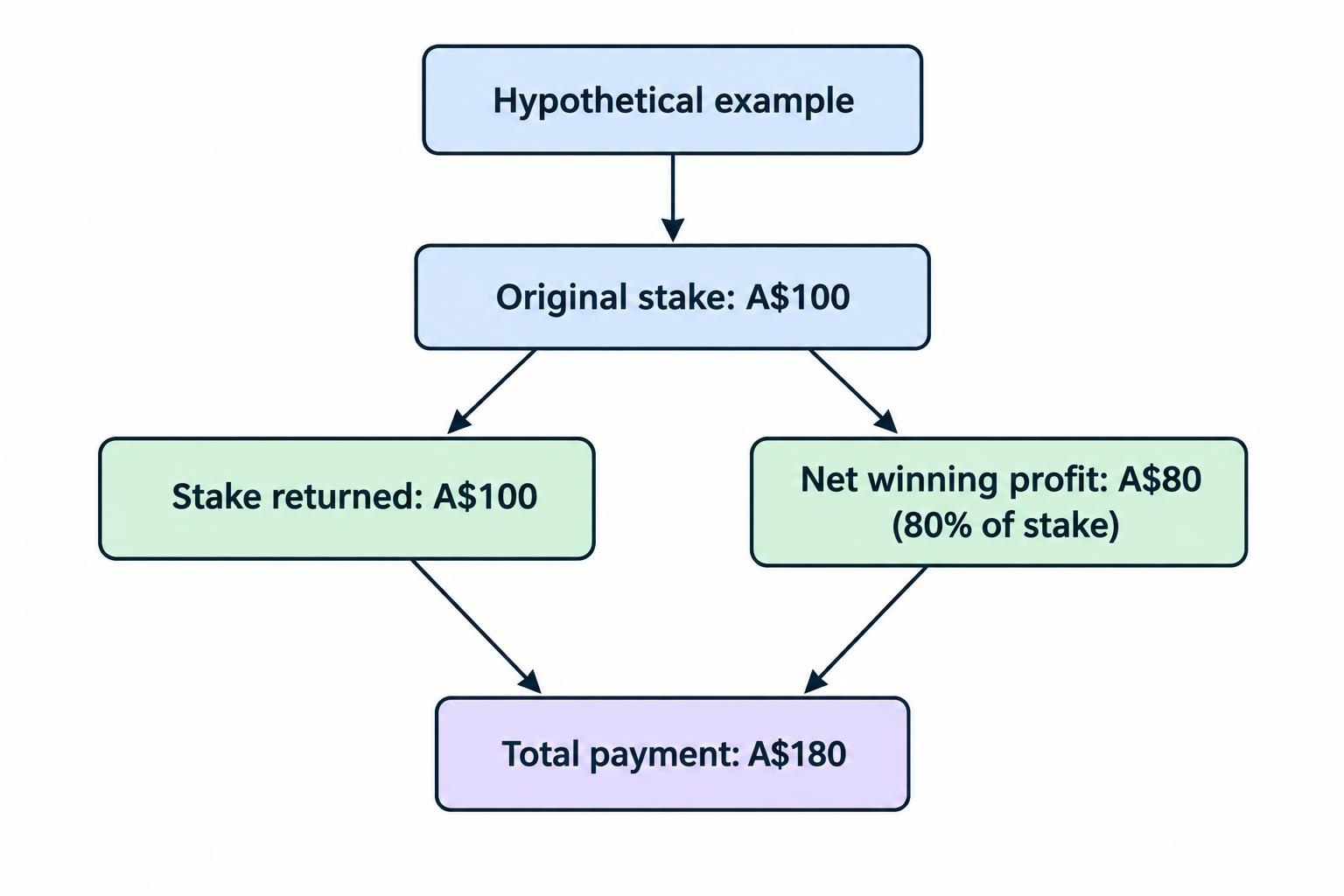
- A label that may refer to net winning profit or the total payment including the returned stake. Under an 80% net-profit convention, a winning A$100 stake returns A$180. The binary options payouts guide separates these figures.
- Pip and point
- Units used to describe price changes. A pip is a quoting unit used in foreign exchange; its decimal location depends on the currency pair. A point depends on the market and quote format.
- Premium
- The amount paid to acquire an option. On a bought binary contract, this is distinct from the fixed settlement payment. Do not assume a displayed contract price is a percentage profit offer.
- Price feed
- The stream of prices supplied to a platform or chart. Two feeds can differ because of their contributors, timestamps or price conventions. The settlement rules determine which feed or benchmark governs the contract’s result.
- Probability
- The estimated chance that a contract’s exact condition will be satisfied. A bullish view is not a probability estimate. The estimate must account for the strike, time remaining and event being tested.
- Profit and loss (P&L)
- The financial gain or loss after relevant costs. Money credited after a winning trade may include returned capital. Count only the amount above the original stake as trading profit, before subtracting any applicable charges.
- Put, or lower
- A label commonly used for a position that wins when settlement is below the strike. It should not be confused with a conventional put option granting the right to sell an underlying asset.
- Rebate, or loss refund
- A contractual return of part of the stake after a losing outcome. Some contracts have included this feature, but it is not universal. The joint SEC and CFTC binary options alert distinguishes partial refunds from the usual full-stake loss.
- Risk/reward ratio
- The relationship between the amount that can be lost and the net profit available. Risking A$100 to make A$80 gives a risk-to-reward ratio of 1.25:1. The returned A$100 stake is not additional reward.
- Rollover
- A platform feature described as extending or replacing a position’s expiry. It may require more money or change other terms. In this context, it should not be confused with forex overnight financing or rolling a futures position.
S–W: Settlement, Stakes and Trading Results
- Settlement
- The process of determining the contractual outcome and applying the resulting payment. The settlement value might use a named quote, index calculation or observation method. It need not equal the last price visible on a separate chart.
- Signal
- A suggested trading action generated by a person, rule or software. A usable binary options signal needs more than direction: timing, market, strike assumptions and expiry affect whether the suggested trade can be reproduced.
- Slippage
- The difference between expected and accepted execution terms. In binary options, that can involve a changed underlying entry level or contract quote. Keep it separate from ordinary price movement after a trade has already been accepted.
- Stake
- The amount committed to a fixed-stake trade. Under a full-loss arrangement, an unsuccessful A$100 trade loses A$100. Assess exposure across all open positions, not just the amount shown on the next order ticket.
- Stop-loss
- An instruction intended to exit a position when a loss threshold is reached. A binary contract does not automatically support conventional stop-loss orders. A personal rule to stop trading after several losses is a different control.
- Strike price
- The threshold against which the qualifying price is tested. It may match the underlying price at entry, but that is not universal. A contract can offer a predetermined strike away from the current market price.
- Tie
- A result where the qualifying settlement price equals the strike. A tie can be treated differently across contracts, depending on equality and refund provisions. The guide to settlement and ties explains why “above” and “at or above” produce different outcomes.
- Timeframe
- The period represented by each chart bar or candle, such as one minute or one hour. It is not the contract’s expiry. A one-minute chart can be used to view a contract with a much longer duration.
- Trading volume
- The amount traded during a period, measured under the data provider’s convention. A platform activity counter, tick count and exchange contract volume are different measures. Check what the displayed number actually represents.
- Volatility
- A measure of price variability, not a forecast of direction. Greater volatility can change the chance of reaching a barrier or finishing beyond a strike. It does not automatically improve the value of a quoted payout.
- Win rate
- Winning trades divided by the relevant trade count. State how ties and cancellations are handled. Win rate alone does not establish profitability because stakes, winning payouts, loss refunds and costs can differ between trades.
- Withdrawal
- The transfer of available account funds back to the customer. It is separate from settling a winning contract. A positive displayed balance is not the same as money received in a bank account or wallet.
Using the Glossary to Read a Contract
Read related terms together. For a hypothetical A$100 higher contract, identify the underlying asset, strike, expiry timestamp and settlement method before interpreting an “80% payout”. Establish whether that figure means A$80 profit, how equality is treated, and whether any fees or refunds apply. These details define the proposition being priced; a directional label does not.
Terminology also provides no assurance that an offer is legitimate. Moneysmart’s binary options warning states that offers to trade these products may be scams. A polished platform and familiar financial vocabulary do not resolve that concern.
For explanations that connect these definitions, use the binary options learning hub, which separates contract mechanics, worked examples and practice material.
This article was last updated on: October 22, 2026