A correct binary options prediction does not guarantee payment. Counterparty risk concerns whether the business that owes you money can and will honour its obligations. Platform risk concerns whether the systems handling orders, prices, settlement and account access work properly. Neither risk disappears because a trading strategy performs well.
These risks require a different response from ordinary market losses. A smaller stake may reduce the amount lost on one contract, but it does not protect the rest of an account balance from an operator’s failure.
For Australian retail clients, the starting point is the restriction on the product itself. ASIC’s prohibition on issuing and distributing binary options to retail clients took effect on 3 May 2021 and has been extended until 1 October 2031. An accessible offshore trading screen should not be mistaken for an authorised Australian retail offering. The dates and scope appear in ASIC’s binary options ban extension.
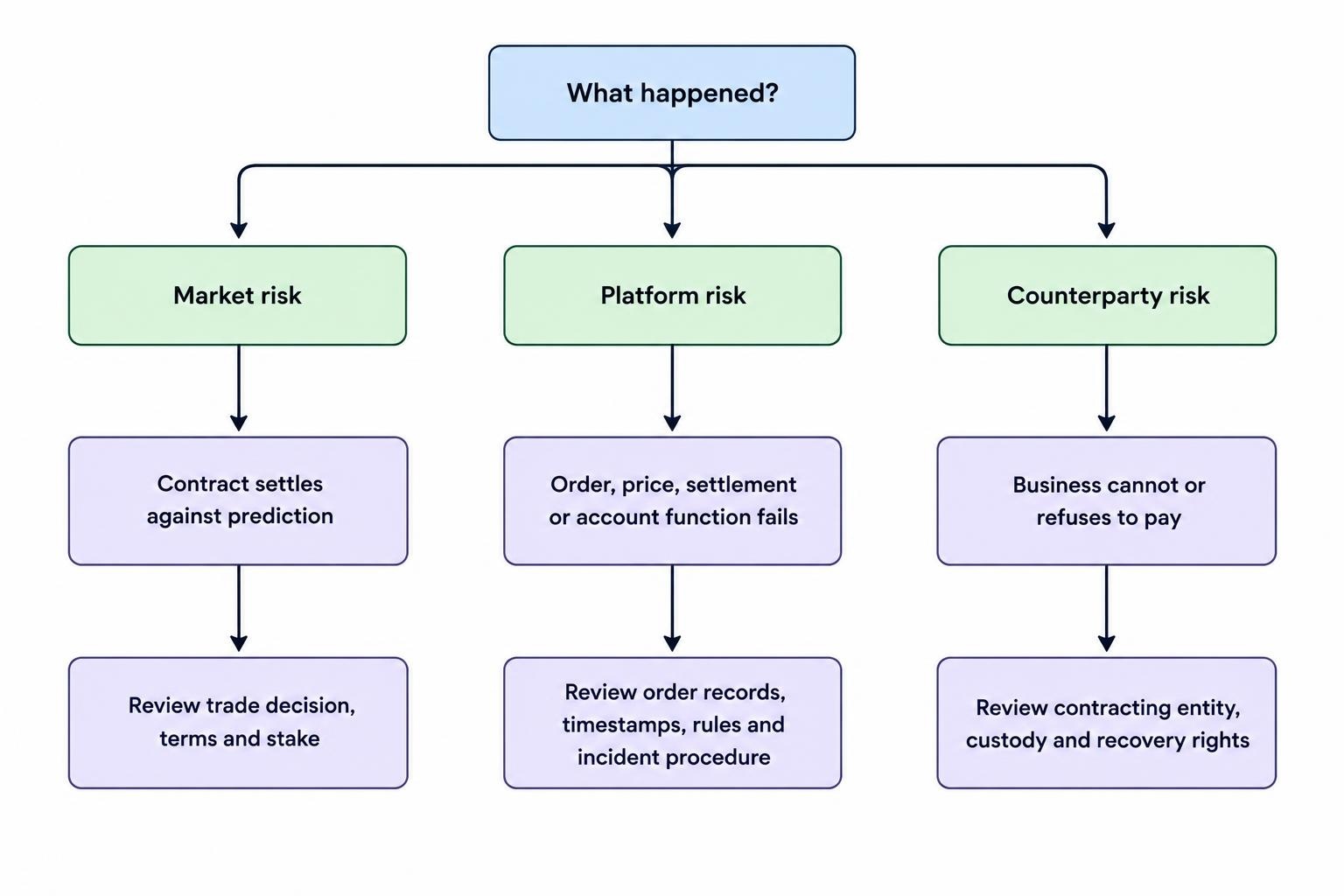
Counterparty Risk and Platform Risk Are Different
The distinction matters when identifying what went wrong. An outage does not establish insolvency, and a delayed withdrawal does not automatically prove fraud. Start with the obligation or process that failed rather than treating every problem as the same event.
| Risk | What can go wrong | What to examine |
|---|---|---|
| Counterparty risk | The business cannot or refuses to pay an amount owed. | Contracting entity, financial resources, custody arrangements and recovery rights. |
| Platform risk | An order, price, settlement calculation or account function fails. | Order records, timestamps, settlement rules and incident procedures. |
| Market risk | The contract settles against the prediction under its agreed terms. | The trade decision, contract conditions and stake. |
Keep these categories separate in any review. A genuine market loss needs a different explanation from an incorrectly processed contract. The broader binary options risk management guide covers how stake limits and trading discipline fit around these operational concerns.
Identify the Business That Actually Owes You Money
Begin with the legal entity named in the customer agreement, not the logo above the chart. Record its full name, registration number, registered address and governing jurisdiction. Then compare those details with the account statement, payment recipient and complaints contact.
Where those names differ, ask for a written explanation. A payment processor may legitimately collect money for another business, but that does not establish which company must settle a contract or return the balance. An unexplained mismatch leaves an important question unanswered.
Use the process for checking a broker’s licence to verify the entity and its permissions independently. Treat a registration certificate as a document to investigate, not a substitute for checking the services the business is authorised to provide.
Next, read the contract’s description of each party’s role. If the issuer takes the other side of the contract and retains that exposure, a customer’s winning result creates a payment obligation for the issuer. That creates a potential conflict, not proof of wrongdoing. The useful questions concern how that conflict is managed and what happens if the issuer cannot pay.
Do not accept a change in client classification simply to regain access. Wholesale clients do not have the same consumer protections as retail clients, and Moneysmart’s binary options warning expressly advises against agreeing to wholesale treatment just to trade these products.
Your Exposure Can Be Larger Than the Open Stake
A trading screen directs attention to the amount committed to the next contract. Counterparty analysis needs a wider view: how much money remains dependent on the operator returning it?
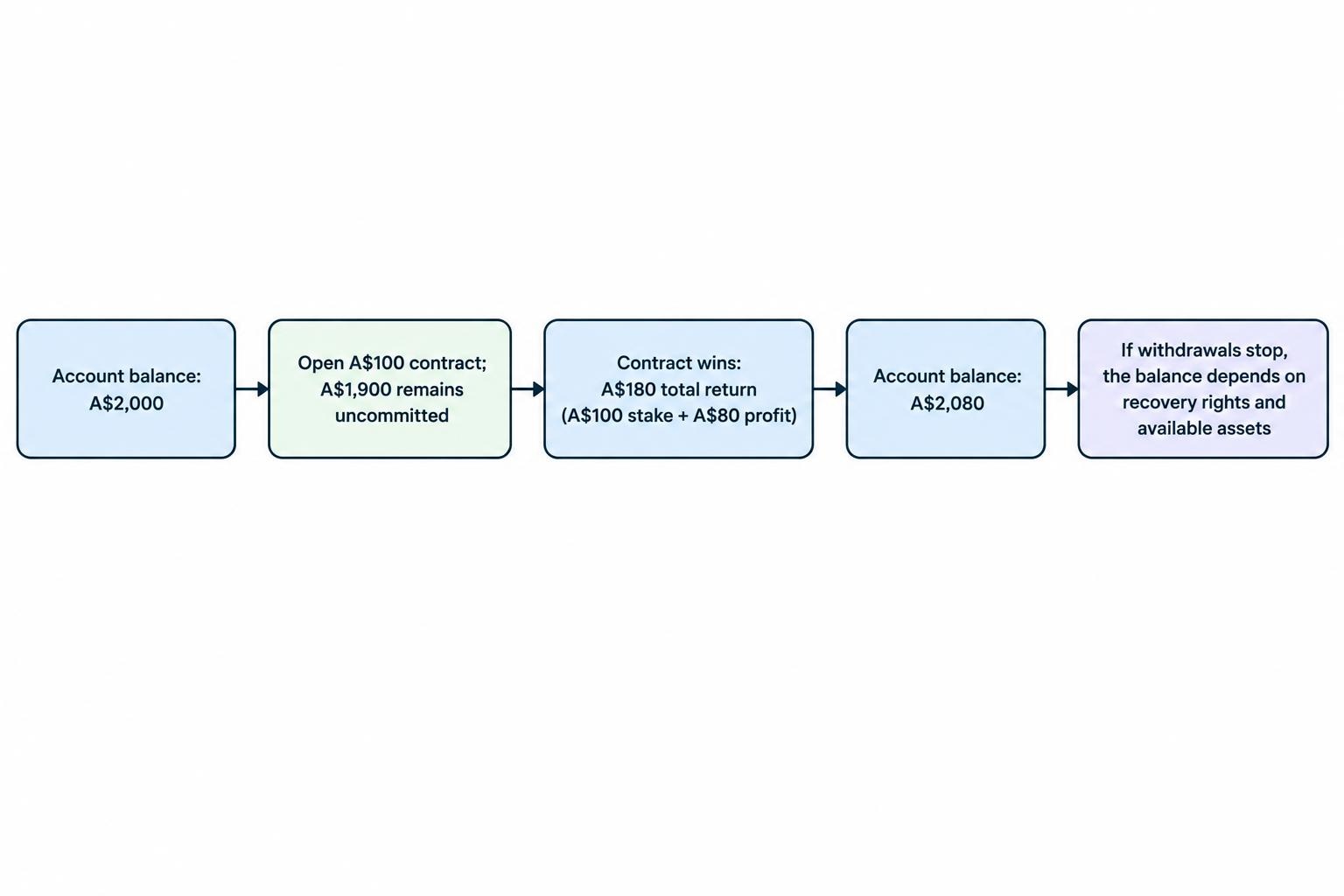
Consider a hypothetical account containing A$2,000 immediately before a A$100 contract is opened. The remaining uncommitted balance is A$1,900. Suppose the contract wins and its terms provide an A$180 total return, comprising the A$100 stake and A$80 profit. The resulting account balance is A$2,080.
If the operator then stops paying withdrawals, the problem is not confined to the original A$100 stake. The A$2,080 balance becomes subject to whatever recovery rights and available assets exist. That does not mean the entire amount must be lost; it means ordinary stake sizing has not protected access to it.
For an existing account, reconcile deposits, settled results, fees and withdrawals received outside the platform. Keep requested withdrawals separate from completed payments. A “processed” status on a dashboard is not the same evidence as money arriving in your own account.
Segregated Funds Are Not a Repayment Guarantee
Do not stop at a claim that customer funds are “segregated”. Ask what arrangement that describes: who holds the money, under which law, for whose benefit, and whether the claim covers the contracting entity.
Australian client money rules illustrate why the detail matters. Client money need not sit in a separate account for each customer; it may be pooled. If an Australian licensee fails and the relevant client money account has a shortfall, the rules provide for proportional payments to entitled persons. These distinctions appear in ASIC Regulatory Guide 212 on OTC derivative client money.
Do not transfer those Australian arrangements onto an offshore account without evidence. Ask for the applicable custody terms and an explanation of how deposited cash, committed stakes and credited winnings are treated. Those amounts should not be assumed to have identical legal protection.
Keep the enquiry focused on recoverability rather than reassuring terminology. The separate guide to client money and broker insolvency examines the legal and custody questions in more detail. A bank name in a footer, by itself, answers very little.
Platform Failures Can Change the Recorded Result
Platform risk includes honest technical failures as well as deliberate misconduct. Investigate the records before deciding which explanation fits. A frozen display, missing confirmation or unexpected settlement deserves examination, but none alone establishes manipulation.
Order Acceptance and Timing
Distinguish the moment an order was submitted from the moment the server accepted it. Preserve the order identifier, acceptance time, strike, expiry and offered return. If no confirmation appears, do not assume the order failed and repeatedly submit it. First establish whether the system created a contract.
Also distinguish a frozen display from a frozen contract. During an incident, ask whether the accepted contract remained active, what settlement process applied, and whether any correction or cancellation policy was used. Request an answer tied to the order rather than a general assurance that everything worked.
Deliberate interference is a documented concern, not a label to attach casually. The SEC and CFTC have received complaints involving refused withdrawals, identity theft and software allegedly manipulated to create losing trades, including arbitrary extensions of expiry countdowns. The joint investor alert on binary options fraud describes those complaint categories.
Prices and Settlement Evidence
For a disputed result, obtain the contract’s named price source, settlement timestamp, time zone, rounding method and treatment of equality. Then compare evidence on the same basis. A screenshot without those details may show a disagreement without establishing its cause.
A price from another chart is not automatically the contractual settlement price. Check whether both displays represent the same instrument and price type at the same instant. The guide to price feeds and settlement benchmarks covers that comparison without treating every difference as misconduct.
Ask for the final observation used to settle the contract and the rule applied to it. If the operator cannot identify either, the result cannot be meaningfully checked. Preserve that failure to explain alongside the original trade records.
Account Security Does Not Establish Operator Safety
For an existing account, use a password that is not reused elsewhere and enable multifactor authentication where available. Secure the linked email account too, and review active sessions, recovery details and withdrawal destinations.
Do not share authentication codes or allow an unsolicited account manager to control your device. Access account support through contact details you have independently verified rather than links in unexpected messages.
These precautions address account access, not the operator’s ability to pay. A strong login process cannot demonstrate adequate financial resources or fair settlement. Equally, a polished app or smoothly running demonstration account should not be treated as a solvency check. Judge each claim using evidence relevant to that claim.
Assess Withdrawal Problems Without Adding More Money
When reviewing a withdrawal delay, compare it with the terms that applied when the request was submitted. Ask for the reason, the outstanding requirement and the expected next step in writing. Separate account verification questions from demands for a fresh payment.
Treat these developments as reasons to stop and investigate:
- A demand for another deposit before existing funds can be released.
- Withdrawal conditions that change without a clear contractual explanation.
- Pressure to place more trades while a payment remains unresolved.
- Requests to send release payments to a different company, person or wallet.
Do not pay an unexplained “tax”, “insurance” or “liquidity” charge simply to test whether it releases the balance. Preserve the demand and examine it independently. The guide to fake tax and withdrawal release fees addresses that pattern.
A previous successful withdrawal is useful evidence that one payment occurred. It does not prove every later balance is recoverable. There is no reason to make a fresh deposit to perform another safety test, particularly given Australia’s retail binary options restriction.
What to Do When a Platform or Counterparty Problem Appears
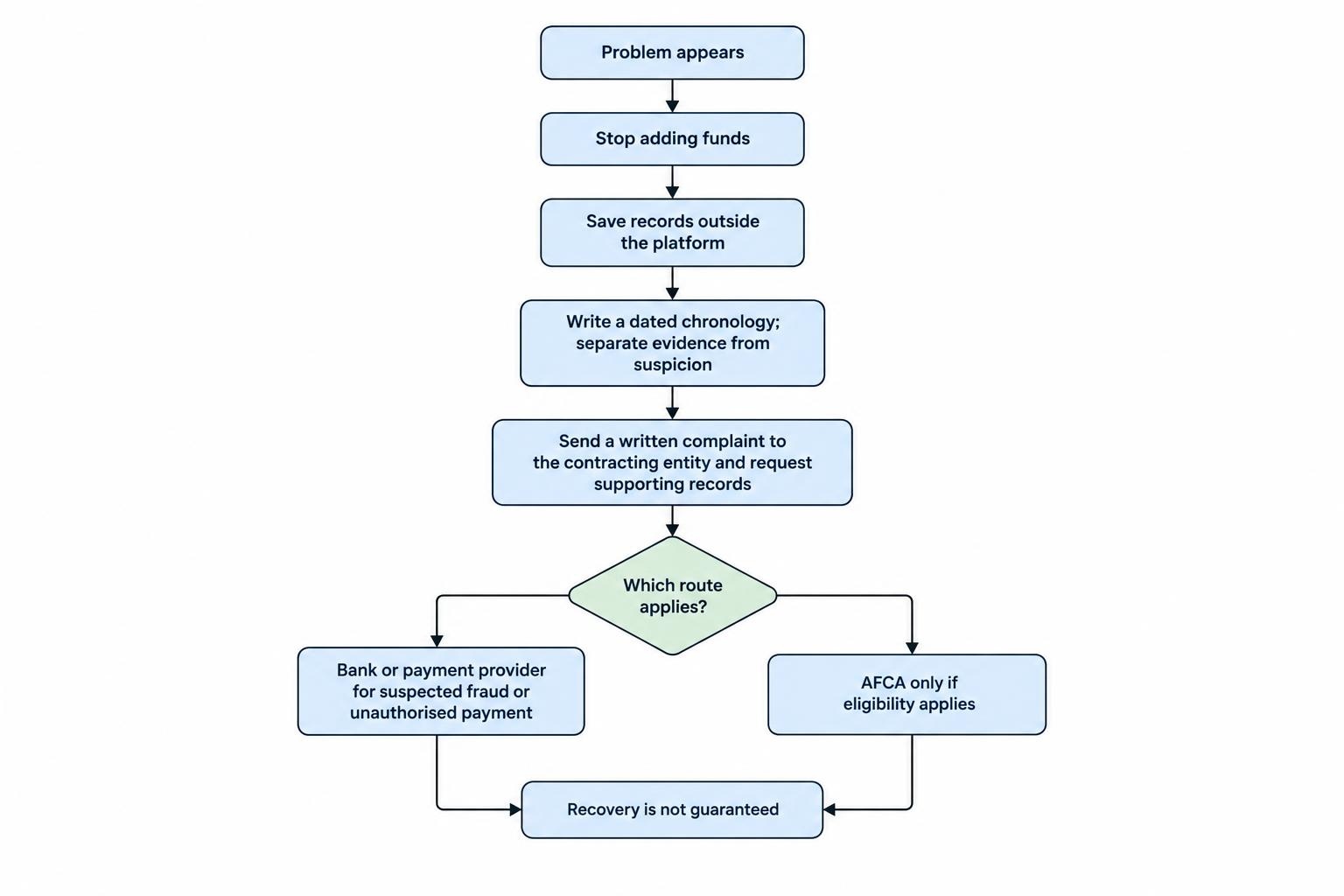
Stop adding funds and preserve evidence before attempting to resolve the argument through repeated support chats. Save the agreement version, account statements, order confirmations, withdrawal requests, payment receipts and correspondence. Keep copies somewhere outside the platform.
Write a short chronology with dates, times, amounts and order identifiers. Separate what you can demonstrate from what you suspect. “Withdrawal requested on this date and not received” is stronger than an accusation unsupported by payment records.
Send the contracting entity a written complaint stating the disputed event, the evidence and the remedy requested. Ask for the contractual clause or technical record supporting its position. Keep a copy of the complaint and every response.
If Australian external dispute resolution may apply, check eligibility before relying on it. AFCA generally requires the complaint to concern an AFCA member and to fall within its rules, time limits and jurisdiction. Its complaint eligibility requirements set out those conditions; access should not be assumed merely because the customer lives in Australia.
If you suspect fraud or an unauthorised payment, contact your bank or payment provider promptly and ask what options remain available. Describe the payment accurately. Do not call an authorised deposit unauthorised simply because the recipient later failed to return it.
For suspected fraud, follow the broader steps for responding to a binary options scam, including securing accounts and preserving evidence. Avoid anyone promising guaranteed recovery in exchange for another upfront payment.
Keep Payment Risk Separate From Trading Performance
A win rate measures recorded contract outcomes. It does not establish that the operator can pay, that its records are correct, or that a dispute can be enforced.
For Australian retail readers, the appropriate response is not to search for an offshore workaround. Respect the retail restriction and assess any existing exposure through the legal entity, custody terms, transaction records and available complaint routes. A convincing dashboard is not a substitute for recoverable money.
This article was last updated on: October 22, 2026