Binary options work by attaching a fixed cash outcome to a yes or no question. A contract might ask whether AUD/USD will finish above a stated price at a stated time. If the winning condition is met, the contract pays the agreed amount. If it is not, the buyer generally loses the money committed to that contract.
For Australian readers, the legal position comes first: ASIC banned the issue and distribution of binary options to retail clients from 3 May 2021, and extended that ban until 1 October 2031. The examples below explain the mechanics, not a route around those restrictions.
The Contract, Not Just the Price Direction
A binary option is a separate contract linked to an underlying market or event. Buying a binary option on a share does not give you ownership of that share, voting rights or dividends. Nor does it give you the right to buy the underlying asset later. The SEC and CFTC investor alert on binary options distinguishes these contracts from conventional options and describes their automatic cash outcome.
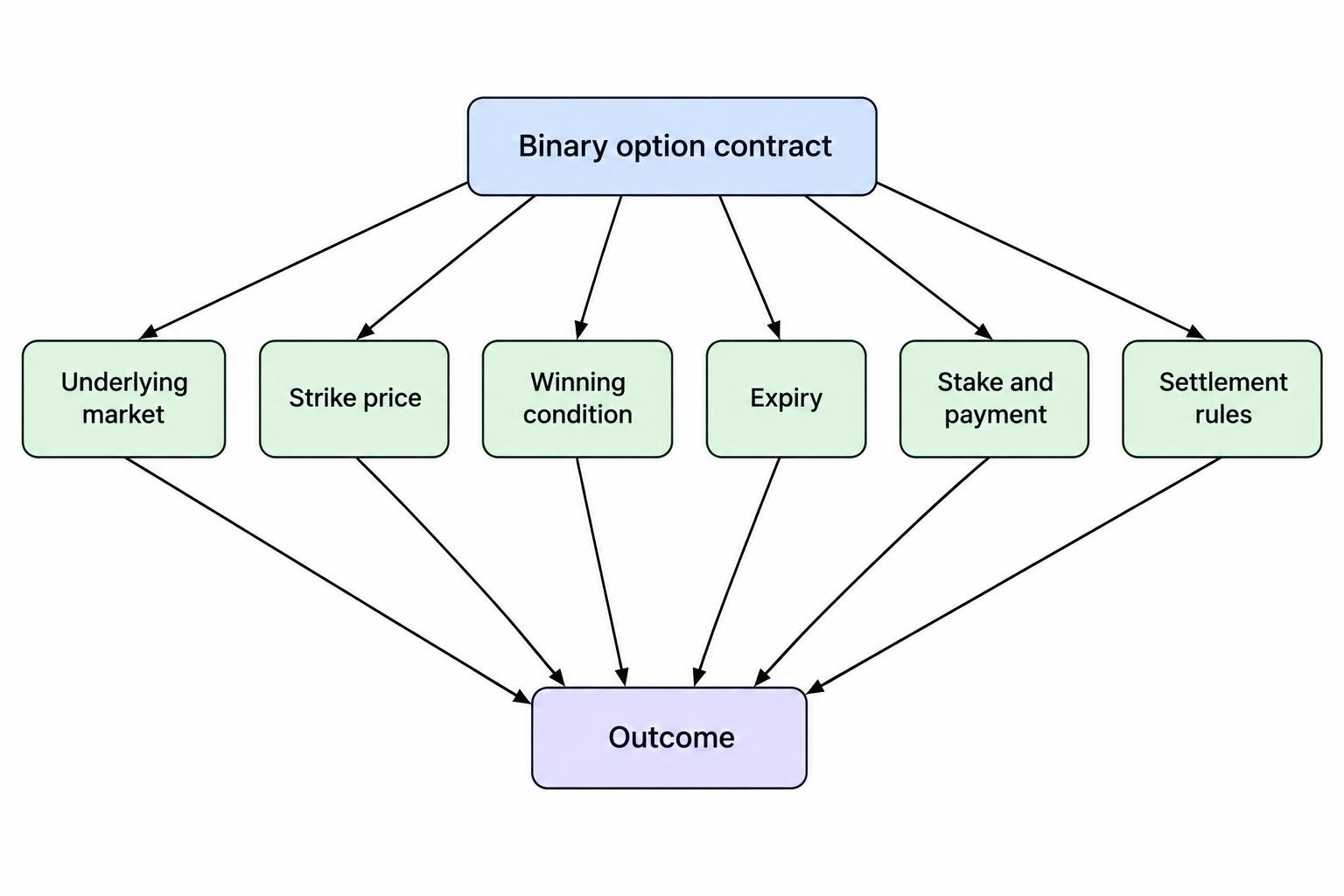
For a straightforward higher or lower contract, the terms need to establish:
- Underlying market: the asset, currency pair or index being measured.
- Strike price: the threshold against which the settlement value is compared.
- Winning condition: such as finishing strictly above that threshold.
- Expiry: the deadline for assessing the condition.
- Stake and payment: the amount committed and the cash payable for each outcome.
- Settlement rules: the reference price, calculation method and treatment of equality.
“Will it rise?” leaves too much unanswered. Above which price, by what deadline, and measured using which value? Those details turn a market opinion into a contract with a defined result.
The Strike Price Sets the Threshold
Suppose the winning condition is “AUD/USD above 0.65000 at expiry”. The strike is 0.65000. It is neither the amount paid for the contract nor the amount received after a win.
In a contract that sets its strike from the market price when an order is accepted, that accepted value matters. A quote seen before clicking may not be the final contractual threshold. Other contracts use a strike chosen from levels already available.
This distinction matters whenever the result is close. Comparing settlement with the price you remember seeing can produce the wrong answer. The guide to binary options strike prices covers how entry levels and contractual thresholds differ.
Expiry Sets the Deadline
Expiry determines when the contract’s condition is assessed. A correct view about the next hour does not establish a winning outcome for a contract expiring in five minutes.
Consider an above-strike contract expiring at 10:05 UTC. The market could move above the strike at 10:02, fall below it at 10:05, then rise again at 10:06. Under an expiry-only condition, that later recovery does not change the result.
Distinguish a duration from a fixed deadline too. A five-minute duration starting on acceptance differs from an expiry fixed at 10:05 UTC, especially if acceptance happens at 10:03. The binary options expiry guide examines these timing differences in more detail.
What Happens Between an Order and Settlement?
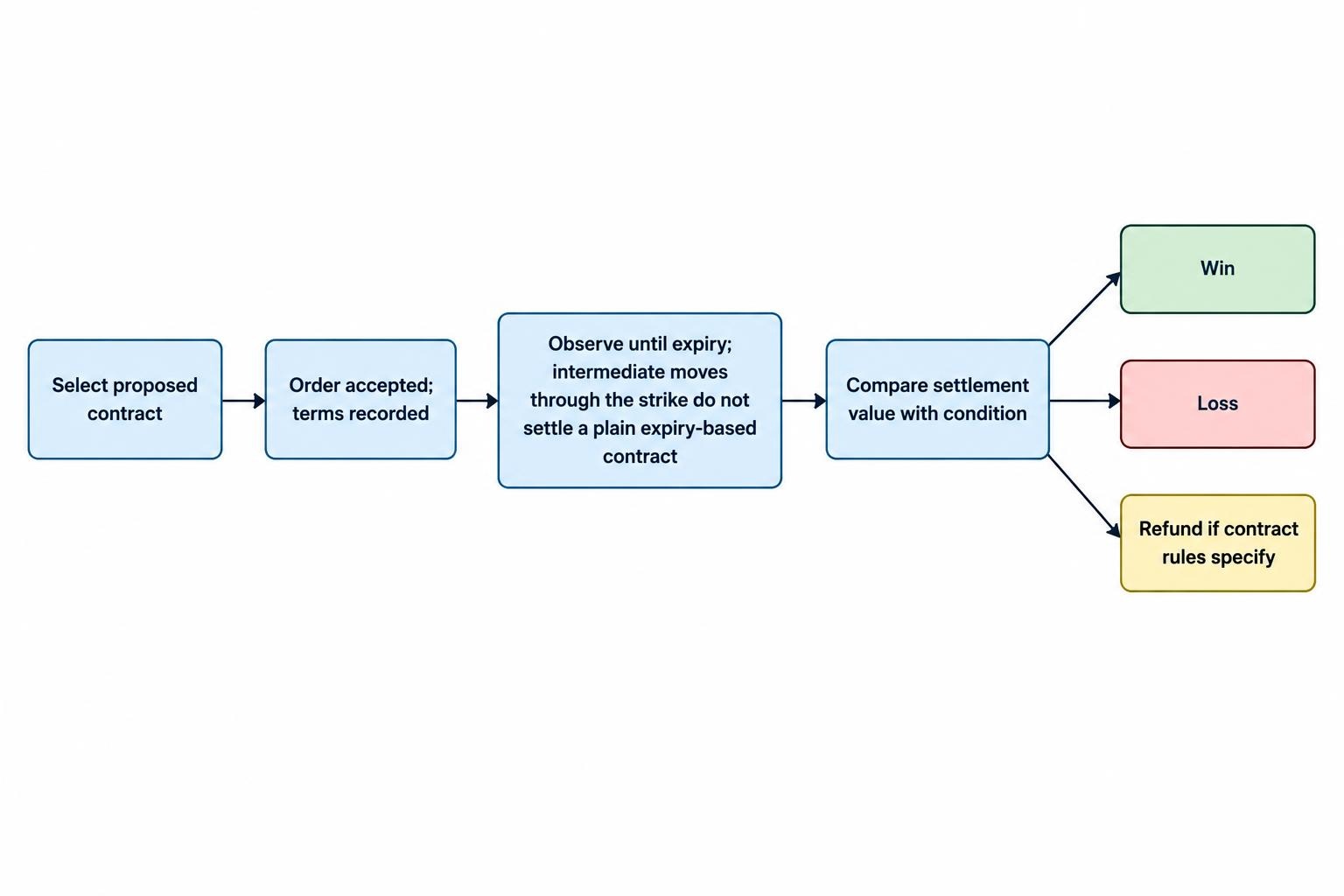
The basic sequence is selection, acceptance, observation and settlement. A buyer selects the proposed contract and submits an order. Once accepted, the contract record should identify the agreed stake, strike, expiry, winning condition and payment terms.
Submitting an order and having it accepted are different events. For any hypothetical reconstruction, use the accepted contract record rather than assuming that a button click secured the quote displayed beforehand.
During the contract’s life, the underlying price can move through the strike repeatedly. For a plain expiry-based contract held to settlement, those crossings do not themselves produce a payment. The final contractual test does.
At expiry, the designated settlement value is assessed against the condition. A winning payment, loss or any contractual refund then follows. There is no separate decision to exercise a standard automatically settling binary option.
Keep the transaction separate from the account balance. Depositing A$500 and committing A$100 to one contract does not make that contract a A$500 position. The uncommitted balance and money exposed through other open contracts are separate amounts.
A Worked Example: A$100 at an 80% Profit Rate
Assume a hypothetical account uses Australian dollars. A contract accepted at 10:00 UTC has an AUD/USD strike of 0.65000 and expires at 10:05 UTC. It wins if the settlement value is strictly above the strike.
The stake is A$100. A win returns that stake plus A$80 profit, giving a total credit of A$180. A loss returns nothing. For this example only, a separate equality rule refunds the stake if settlement exactly matches the strike. There are no fees.
| Settlement value | Result under these terms | Amount credited | Net profit or loss |
|---|---|---|---|
| 0.65001 | Win | A$180 | +A$80 |
| 0.65500 | Win | A$180 | +A$80 |
| 0.64999 | Loss | A$0 | −A$100 |
| 0.65000 | Stake refunded | A$100 | A$0 |
The first two rows show the defining feature: finishing much further above the strike does not increase the agreed expiry payment. The third row shows the reverse. Missing by a tiny amount can still lose the entire stake.
Also separate profit from total money returned. Here, an “80% payout” means 80% profit on the stake, not a total payment of A$80. Labels need checking against the actual cash amounts. The binary options payout guide covers that distinction and other payment structures.
Why Winning Half the Time Can Still Lose Money
Two possible outcomes do not mean two equally likely outcomes. They also do not mean equal financial consequences.
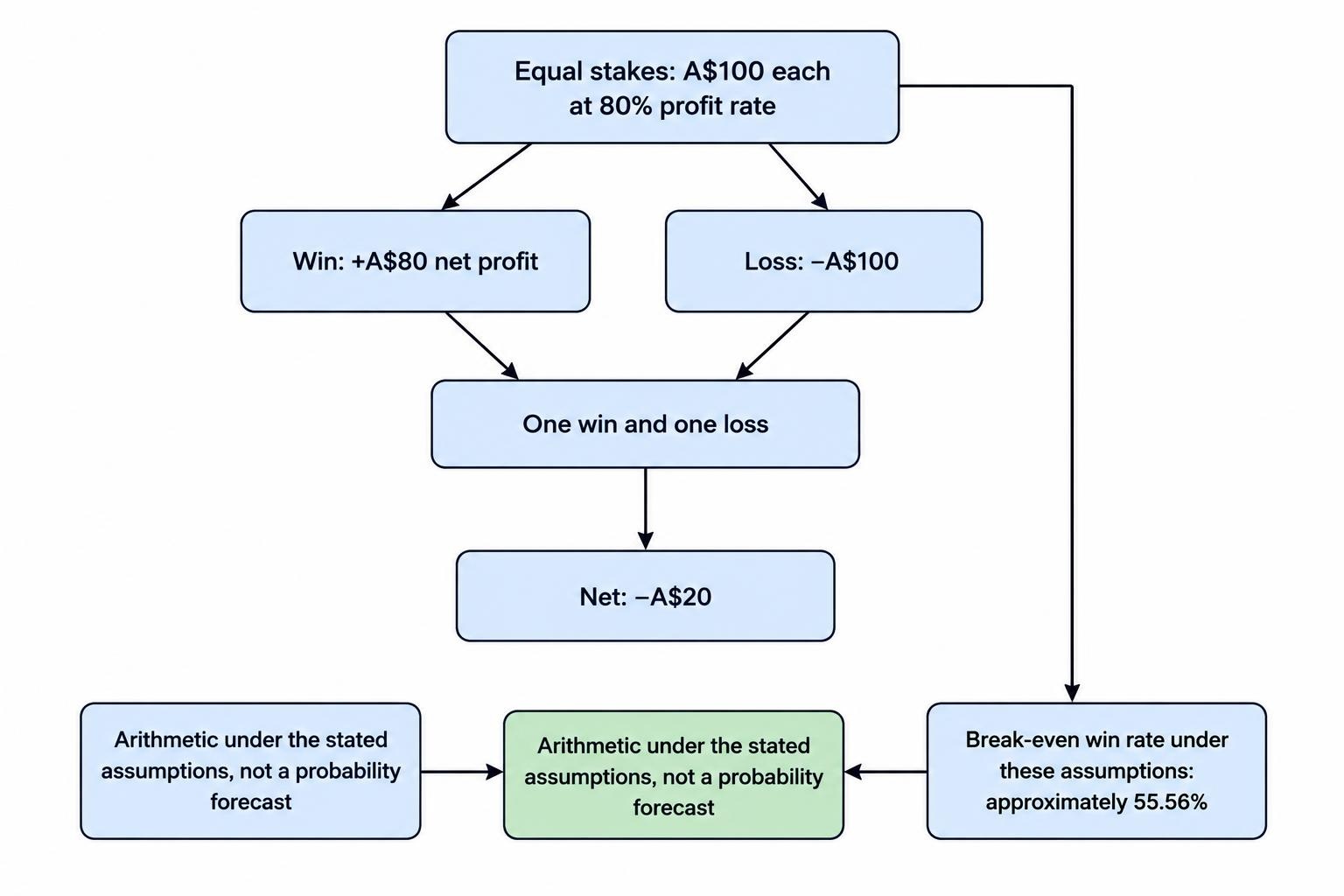
In the example above, a win earns A$80 but a loss costs A$100. One win followed by one loss therefore produces a A$20 net loss. The order of those results does not change that arithmetic.
With a constant stake, an 80% profit rate, full stake losses and no refunds or fees, the break-even calculation is:
Break-even win rate = 1 ÷ (1 + profit rate)
Using 0.80 as the profit rate gives 1 ÷ 1.80, or approximately 55.56%. That is the win rate required to break even under those assumptions, not an estimate of anyone’s chance of achieving it.
Even winning 55 of 100 contracts would fall short. At A$100 per contract, 55 wins generate A$4,400 profit. The other 45 contracts lose A$4,500. The net result is a A$100 loss before costs.
A claimed win rate therefore means little without the associated payment terms. A strategy winning 60% of contracts can have different financial results at different profit rates. Changing stakes, refunds and charges also change the calculation.
The guide to probability and expected value develops this further. The practical point is simple: a winning contract pays conditionally, and a high advertised percentage is not an account growth forecast.
How the Settlement Rules Decide Close Results
The contract must identify the value used to judge the outcome. A chart screenshot is not enough unless it shows the same reference, timestamp and precision required by the settlement terms.
Check whether the contract uses an identified market price, an official index value or a calculated reference. Also check whether it uses a single observation or a calculation over an observation period. Different methods can produce different results near a strike.
Equality deserves particular attention. “Above” and “at or above” are not interchangeable. A refund at the strike is not a universal rule. For example, the Cboe binary index option rules described in an SEC filing give a call option a winning condition at or above the exercise price, while the put condition is below it.
Displayed precision can create another misunderstanding. Two values shown as 0.6500 may differ at a decimal place the display does not show. Establish what precision the settlement method actually uses before treating a displayed match as equality.
For a disputed result, useful records include the accepted contract details, settlement value, timestamp and applicable rule version. The settlement and ties guide covers these questions without assuming every contract follows the same convention.
Can a Binary Option Be Closed Before Expiry?
Do not assume an early exit exists. A contract may require the buyer to wait for settlement, or its terms may permit an earlier termination or sale. Where an exit is available, the amount received needs its own calculation.
Suppose a A$100 position can be closed for A$35. Accepting that offer produces a A$65 loss. It does not produce a A$35 loss, and it does not preserve the original winning payment.
A favourable underlying price before expiry also does not mean an early exit must pay the full winning amount. The expiry condition has not yet been resolved.
Features labelled rollover or double up should not be treated as undo buttons. Read whether they change the deadline, add money at risk or create another position. The separate guide to early close, rollover and double up examines those contractual differences.
Who Is Responsible for the Payment?
For an over-the-counter contract, the buyer contracts with an issuer rather than acquiring the underlying asset. That creates a second question beyond market direction: will the counterparty honour the contract and return money when due?
A mathematically winning result and a successful withdrawal are different events. The CFTC warning about off-exchange binary options identifies complaints involving denied withdrawals, hidden release fees and manipulated historical charts. These are platform and counterparty risks, not failures to predict a price.
A displayed balance is therefore not proof that funds can be withdrawn. Equally, a larger offered profit percentage does not compensate for uncertainty over whether the issuer will pay.
Some binary options use exchange-based arrangements rather than an issuer quoting a stake-based profit percentage. Keep the purchase cost separate from the winning cash settlement. Hypothetically, buying a contract for US$42 that settles at US$100 or zero means a US$58 profit on a win or a US$42 loss on a loss, before fees. The US$100 settlement is not US$100 profit.
Other Conditions Change What Must Happen
The higher or lower example is only one contract design. A condition can instead concern touching a barrier during an observation period, avoiding a barrier, or finishing inside a range.
This changes which price movements matter. An expiry-only contract asks about the settlement value at the deadline. A touch condition asks whether a level was reached during the stated period. The same price path can therefore satisfy one contract and fail another.
Read the full proposition rather than relying on a product name. “Up”, “touch” and “inside” describe different tests, even when they refer to the same underlying market.
Learning the Mechanics Without Funding an Account
A paper exercise is enough to test whether the mechanics make sense. Write down a hypothetical strike, expiry, winning condition, stake and payment. Then calculate a win, a loss and an exact-strike result using explicitly stated rules.
Next, change one term. Reduce the profit rate, move the expiry or replace “above” with “at or above”. If the result changes, identify why. This tests contract reading and arithmetic without exposing money.
Australian retail restrictions remain relevant regardless of how straightforward the interface looks. ASIC’s Moneysmart warning on binary options also cautions against agreeing to wholesale classification just to access these products, because wholesale clients do not have the same consumer protections.
The mechanics come down to a precise condition, a defined observation period and an agreed payment. Being broadly right about a market is not enough. The contract must resolve in your favour, the payment must exceed the losses across other contracts, and the counterparty must honour its obligations.
This article was last updated on: October 22, 2026