An economic calendar lists scheduled announcements that can affect currencies, stock indices and other markets. It helps you check when information is due, compare the result with expectations and identify periods that need extra caution. For binary options education, its strongest use is spotting event risk, not producing automatic trading signals.
Australian retail restriction: ASIC’s ban on issuing and distributing binary options to retail clients remains in force until 1 October 2031. The ASIC announcement extending the binary options ban sets out the restriction. The examples below are for market study and paper practice, not a route around that protection.
How to Read an Economic Calendar
A useful calendar shows more than a release name and a countdown. Read the date, reporting period and measurement together before comparing any numbers.
| Field | What to check |
|---|---|
| Release time | The scheduled publication time and the time zone used by the calendar. |
| Country or currency | The economy covered by the announcement, not every market it might affect. |
| Reference period | The month or quarter being measured, which differs from the publication date. |
| Actual | The published result. A blank field before publication does not mean zero. |
| Forecast | The expected result shown by that provider. Check how the estimate was compiled. |
| Previous | The earlier reading, including whether the new release revises it. |
Check the units as well. Monthly inflation, annual inflation and an index level are different measurements. A result of 0.3% cannot be compared meaningfully with a 3.0% forecast if one measures the monthly change and the other measures the annual change.
Where a calendar includes an impact rating, treat it as the provider’s classification. A high impact label helps with sorting, it does not predict a profitable outcome.
Filter Events Around the Market You Are Studying
Start with the instrument, then identify relevant announcements. For an AUD/USD study, include both Australian and US events rather than filtering for Australia alone. Record the country and release name separately so you can distinguish the two sides of the currency pair.
For US employment and inflation announcements, the Bureau of Labor Statistics release schedule provides publication dates and times for reports including the Employment Situation and Consumer Price Index. Its calendar uses US Eastern Time. Check the current schedule rather than assuming a report will always appear on a familiar weekday.
Keep the event list manageable. Select the releases your exercise needs, but leave enough context to spot overlapping announcements. Ten calendar entries arriving together are not ten clean experiments.
Do not assume a country filter covers every relevant event. Use it to organise your research, then check whether your chosen instrument needs a wider review.
Compare Actual Results With Forecasts and Revisions
A strong economic number is not automatically a positive surprise. The relevant comparison is what was published against what was expected, with revisions to earlier readings considered too. This distinction is examined in RBA research on market responses to economic data surprises.
Consider a fictional employment report. The calendar shows a forecast increase of 25,000 jobs and an actual increase of 40,000. The headline exceeds the forecast by 15,000. However, the same report revises the previous month’s increase from 30,000 to 10,000.
Your notes should capture both changes. Recording only “jobs beat forecast” leaves out part of the announcement. Also check related readings in the same report rather than forcing the whole release into a single good or bad label.
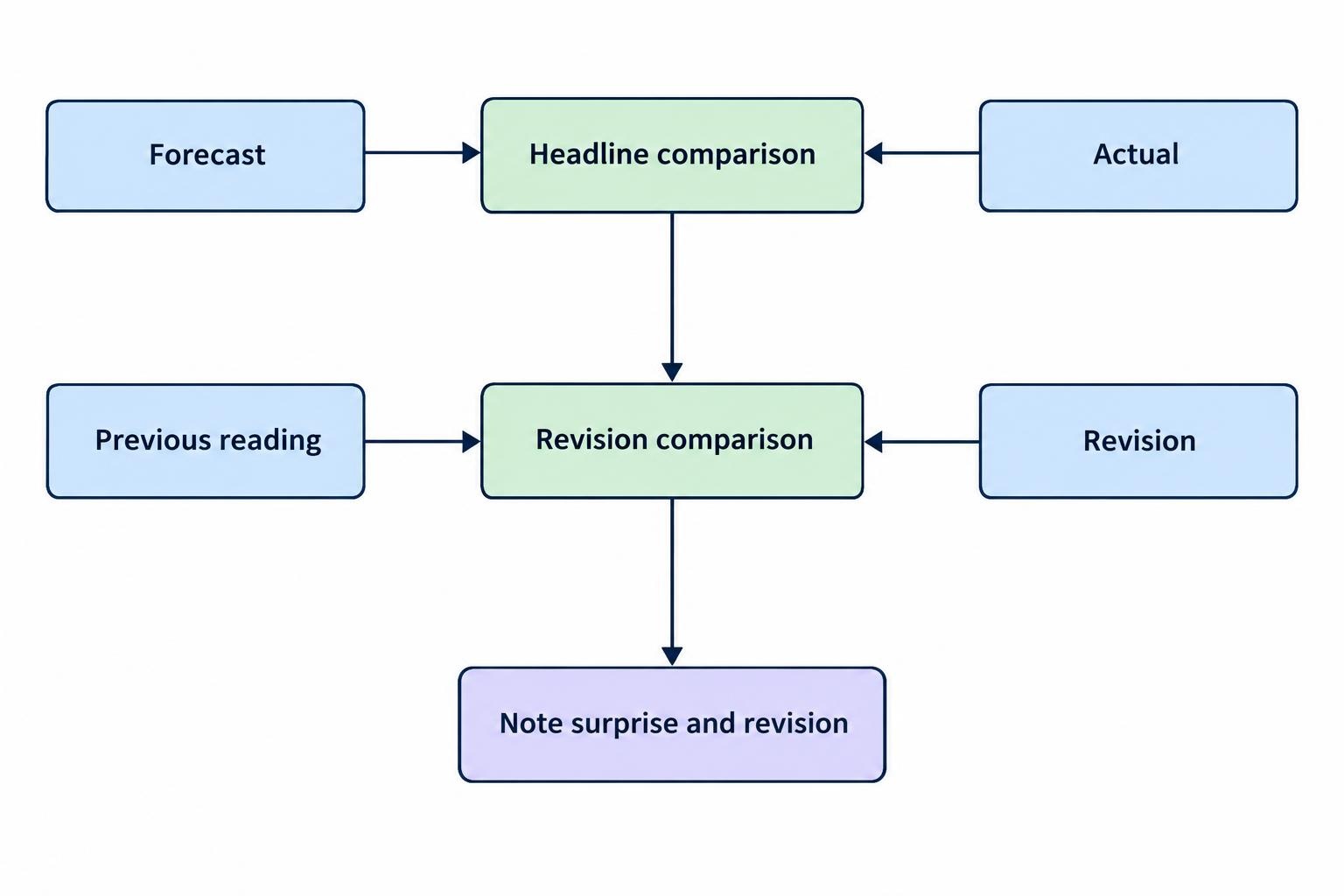
For practice, save the forecast before publication. Do not replace it later with an updated figure and then judge an earlier decision against information that was not available at the time. That produces a tidy spreadsheet, not an honest test.
Set the Time Zone Before Setting Alerts
The Australian Bureau of Statistics future release calendar gives scheduled publication times in Canberra time and warns that release dates may change. Use it to verify Australian statistical releases rather than relying on an old screenshot or a copied weekly schedule.
When using another calendar, select your local city’s time zone where that option exists. Check whether the display follows daylight saving automatically. Avoid saving one fixed hour difference and applying it to every release throughout the year.
Keep three clocks distinct in your records: the official publication time, the calendar’s displayed time and the chart timestamp. Label each one. An alert is useful only if you know which clock it follows.
Before an observation session, reopen the official schedule and confirm the date and time. Treat a postponed release as a changed event, not a reason to keep following the original countdown.
Match the Release Time to the Full Expiry Window
For a high-low binary option, the relevant outcome is the settlement price relative to the strike at expiry. A correct view about the economic announcement does not establish where that price will be at a chosen deadline. The guide to binary options expiry times covers that timing distinction.
In a fictional paper exercise, suppose the observation begins at 11:25 am, ends at 11:35 am and includes a scheduled release at 11:30 am. Mark the exercise as event exposed before it starts. Do not check only whether news is due at the entry time.
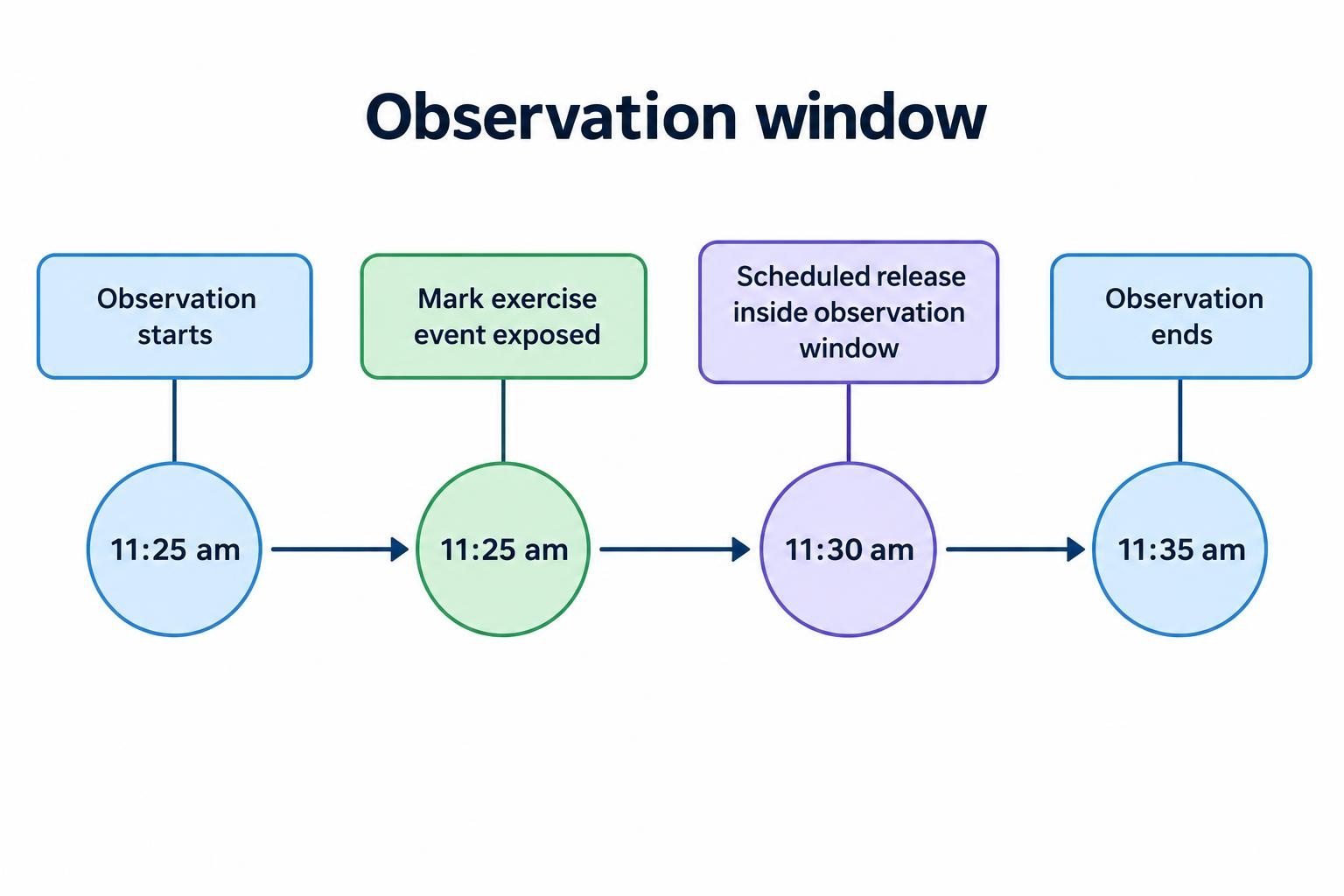
Record the price immediately before publication, shortly afterwards and at the planned expiry. Those are separate observations. A move that appears clear over half an hour may tell a different story over five minutes.
For any exercise intended to exclude scheduled announcements, define the exclusion window in advance. Do not change that rule afterwards to remove inconvenient results.
Treat Central Bank Announcements as a Sequence
A central bank event can require more than one calendar reminder. The RBA’s published 2026 meeting timetable places the policy announcement at 2:30 pm on the second meeting day and the Governor’s media conference at 3:30 pm. It also schedules minutes for two weeks after each meeting.
Mark these as separate items in a study plan. Finishing an observation after the decision but before the media conference does not cover the entire scheduled communication sequence.
The Federal Reserve’s FOMC meeting calendar provides meeting dates and links to policy statements and minutes. Minutes from regularly scheduled meetings are released three weeks after the policy decision. A minutes release is therefore not a fresh rate decision, even if both entries carry the same central bank name.
Know What an Economic Calendar Cannot Tell You
A scheduled publication time is not a promise that the figures will appear on your screen at that exact moment. For practice, record when you actually received the result rather than assuming it was visible at the official release time.
Do not treat an empty calendar as proof that nothing can happen. Scheduled economic releases are only one category of news. Keep unexpected headlines separate in your notes instead of inventing a calendar explanation for every price move.
A calendar also cannot confirm a contract’s settlement feed, quote availability or acceptance time. If those details are missing from a historical exercise, label the result as a price observation rather than presenting it as an achievable trading return.
Build a Repeatable Calendar Review
Use the same short process for each paper session:
- Verify: Confirm the event, publication time, time zone and reference period against the official schedule.
- Prepare: Save the forecast, previous reading and planned observation window before publication.
- Classify: Mark whether the exercise includes or excludes scheduled announcements.
- Observe: Record the actual result, revisions and prices at predetermined times.
- Review: Compare the record with the original plan, including any delay or missing information.
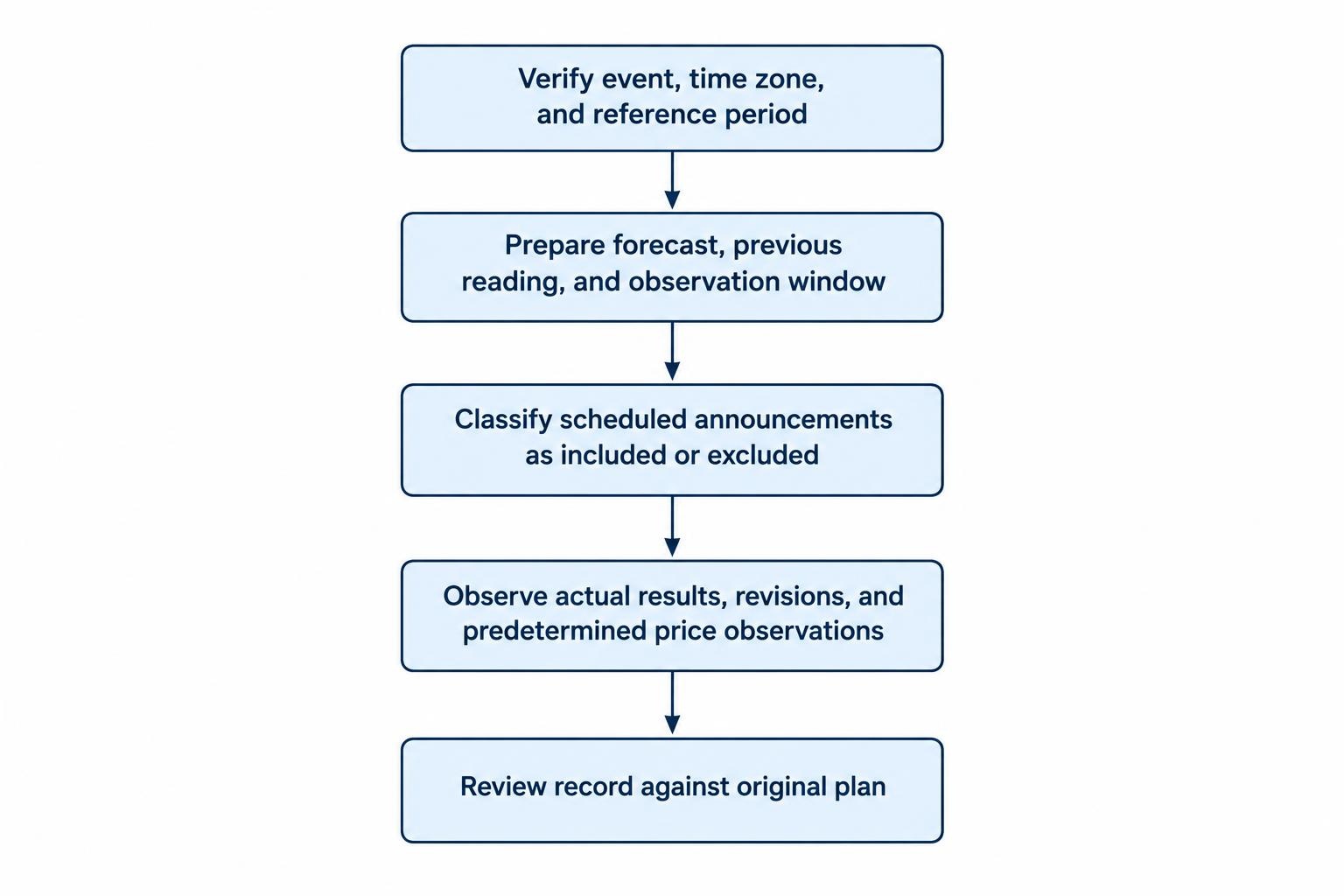
Keep these entries in a trading journal so the calendar becomes part of a consistent research process. Record skipped observations as well as completed ones; otherwise the review may hide how often the rules kept you out.
The useful question is not “Which announcement guarantees a move?” It is “What information is scheduled during this observation window, and have I accounted for it?” An economic calendar helps answer that second question. It does not turn uncertainty into certainty.
This article was last updated on: October 22, 2026