A broker evaluation checklist should answer three questions before comparing payouts or platform features: who holds your money, whether the business can lawfully offer the product to you, and what happens when something goes wrong. A polished trading screen answers none of them.
For Australian retail clients, the first check is decisive. ASIC’s prohibition on issuing and distributing binary options to retail clients took effect on 3 May 2021 and runs until 1 October 2031 under its extended binary options product intervention order. An accessible offshore platform is not evidence that its offer is permitted.
Use this checklist to assess advertising claims, review an existing account or identify missing evidence. It is not a route around the Australian retail ban, and passing operational checks does not make binary options suitable or profitable.
Start With Evidence, Not a Broker Score
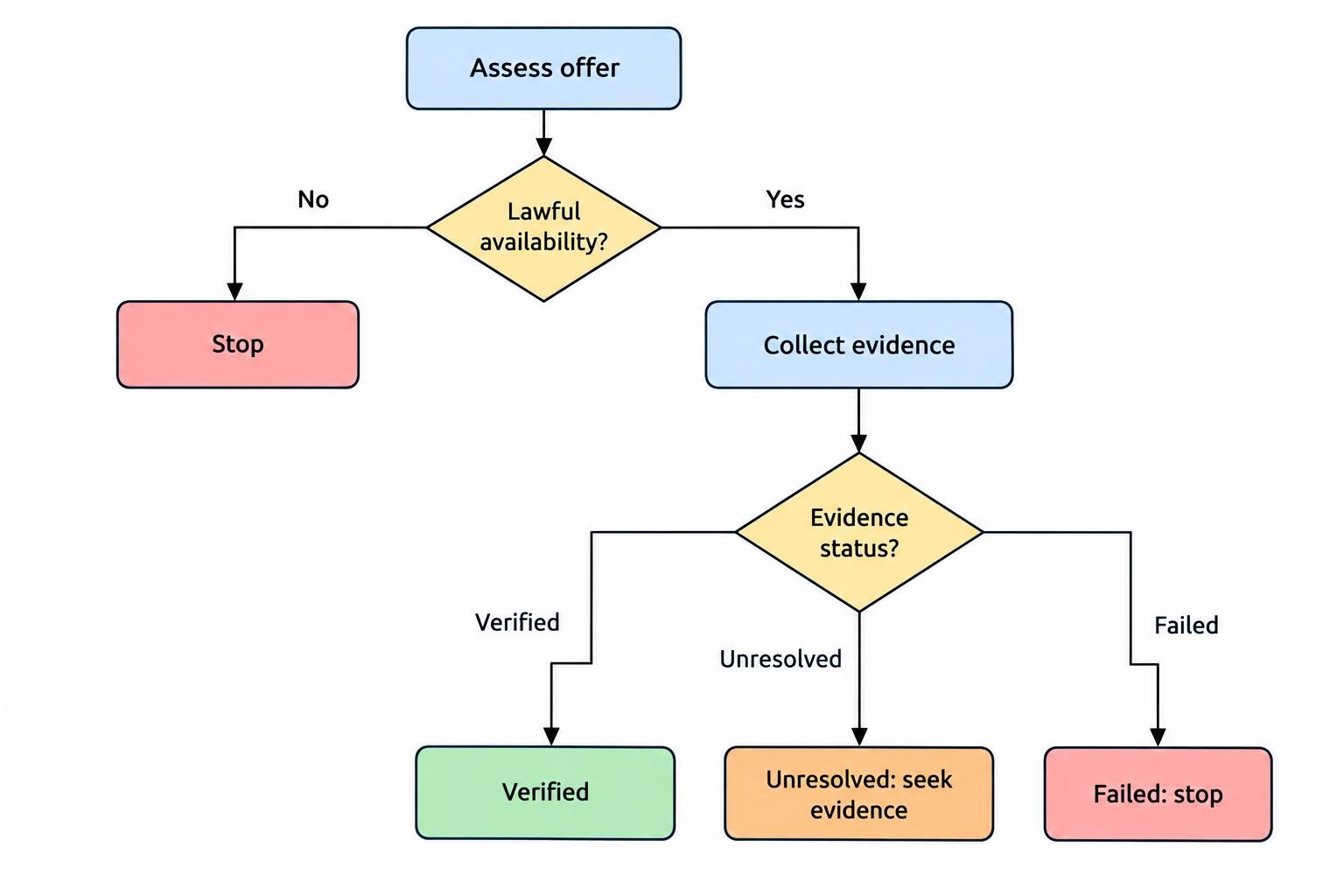
Record each check as verified, unresolved or failed. “Verified” means you have evidence relevant to the exact company and account—not an assurance from a salesperson. An unanswered question stays unresolved.
| Check | Evidence to record | Reason to stop |
|---|---|---|
| Lawful availability | Product, jurisdiction and client classification | The offer conflicts with applicable restrictions |
| Legal identity | Contracting company, registration number and address | The account agreement names an unidentified or different business |
| Authorisation | Official register entry and permitted services | The licence is missing, mismatched or irrelevant |
| Contract terms | Payout calculation, price source, expiry and settlement rules | The outcome cannot be checked against written rules |
| Money movements | Payment recipient, fees and withdrawal conditions | An unexplained recipient or additional payment demand appears |
| Complaints | Internal complaint contact and applicable external process | The claimed complaints route cannot be verified |
Do not average these results into a percentage. Five satisfactory answers cannot cancel out one failed legal eligibility check. The checklist is a set of gates, not a popularity contest.
Identify the Company Behind the Brand
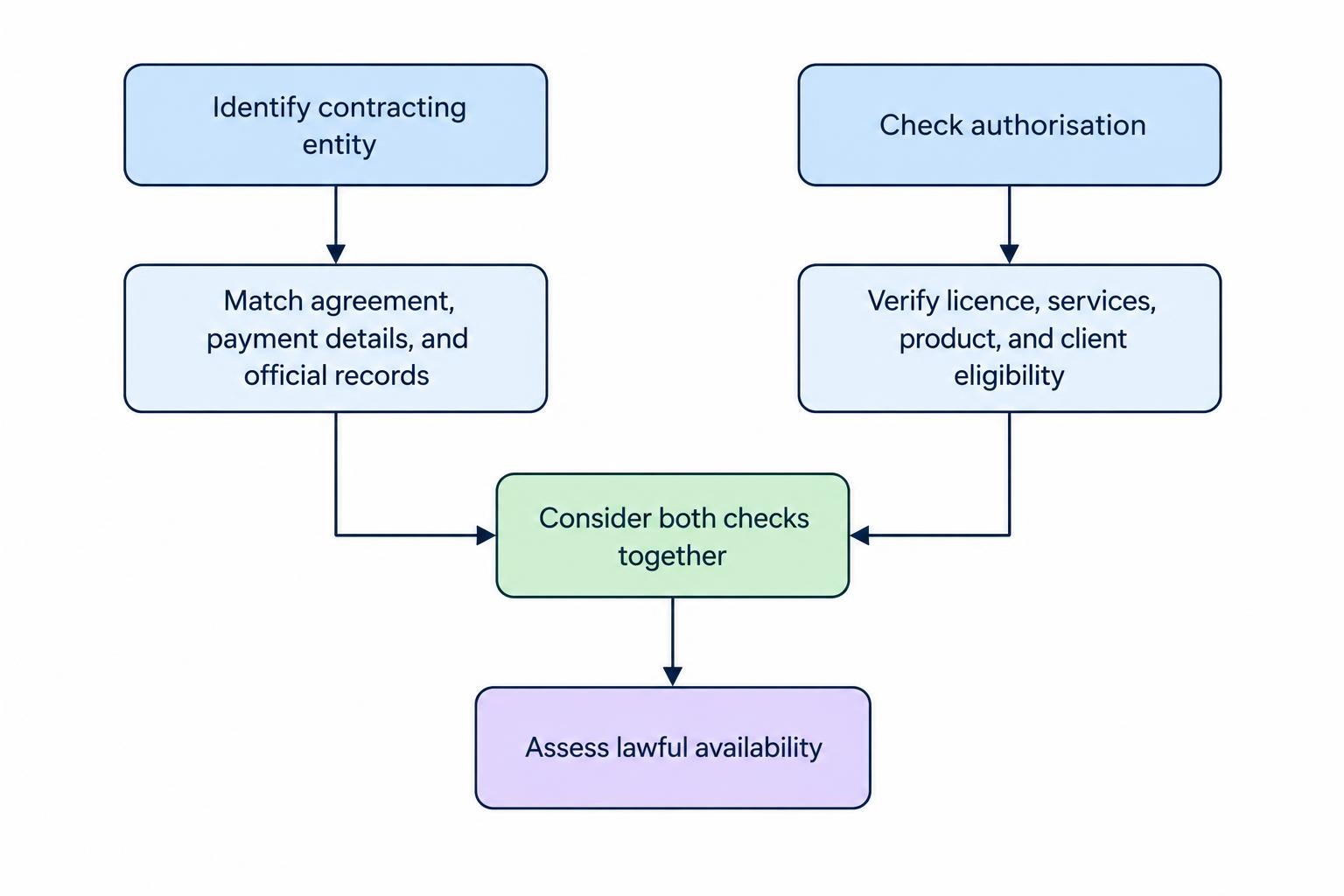
Begin with the account agreement rather than the logo. Record the full legal name, company number, registered address and governing law. Then compare those details with the footer, privacy notice, payment instructions and any product documents. Note which entity would owe you money if a withdrawal became disputed.
Where different group companies appear, ask which one contracts with you and why the others are involved. Do not assume a licence held by one group member covers another.
Company registration and financial services authorisation are different checks. A genuine licence number can also be copied by an unrelated operation. Moneysmart’s investment verification checks address both company registration claims and the misuse of another business’s licence details.
Match the domain and contact details against independently obtained records. If a register provides a principal website address, compare it carefully with the address you are using. A near match is not a match.
For example, if the agreement names Company A but payment instructions name Company B, request a written explanation of their relationship and payment arrangements. Do not fill the gap yourself with “probably the same group”.
Check Permissions and Client Classification
Search by both the legal name and licence number. Check the licence status, authorised services, conditions and any authorised representative relationship. Save the result with the date checked. ASIC’s professional registers search provides information about licensees, authorised representatives and the services they are licensed to provide.
Keep the product question separate from the licence question. Finding a real financial services business does not establish that every product advertised under its name can be offered to every customer.
For a claimed overseas authorisation, record the foreign regulator, exact licensed entity and permitted activities. Do not treat a foreign licence, private certificate or dispute resolution badge as proof that an Australian offer is permissible.
Also check whether an application asks you to become a wholesale or professional client. Do not change your declared circumstances simply to get through the registration process. Moneysmart’s binary options warning states that wholesale clients do not have the same consumer protections as retail clients and warns against accepting wholesale classification just to access binary options.
If lawful availability cannot be established, stop. There is no need to deposit money to finish the rest of the assessment.
Read the Contract Before Comparing Payouts
When reviewing a provider’s claims or an existing account, obtain the terms that applied to the relevant transaction. Record the document version and effective date. Marketing summaries are not enough to reconstruct a disputed result.
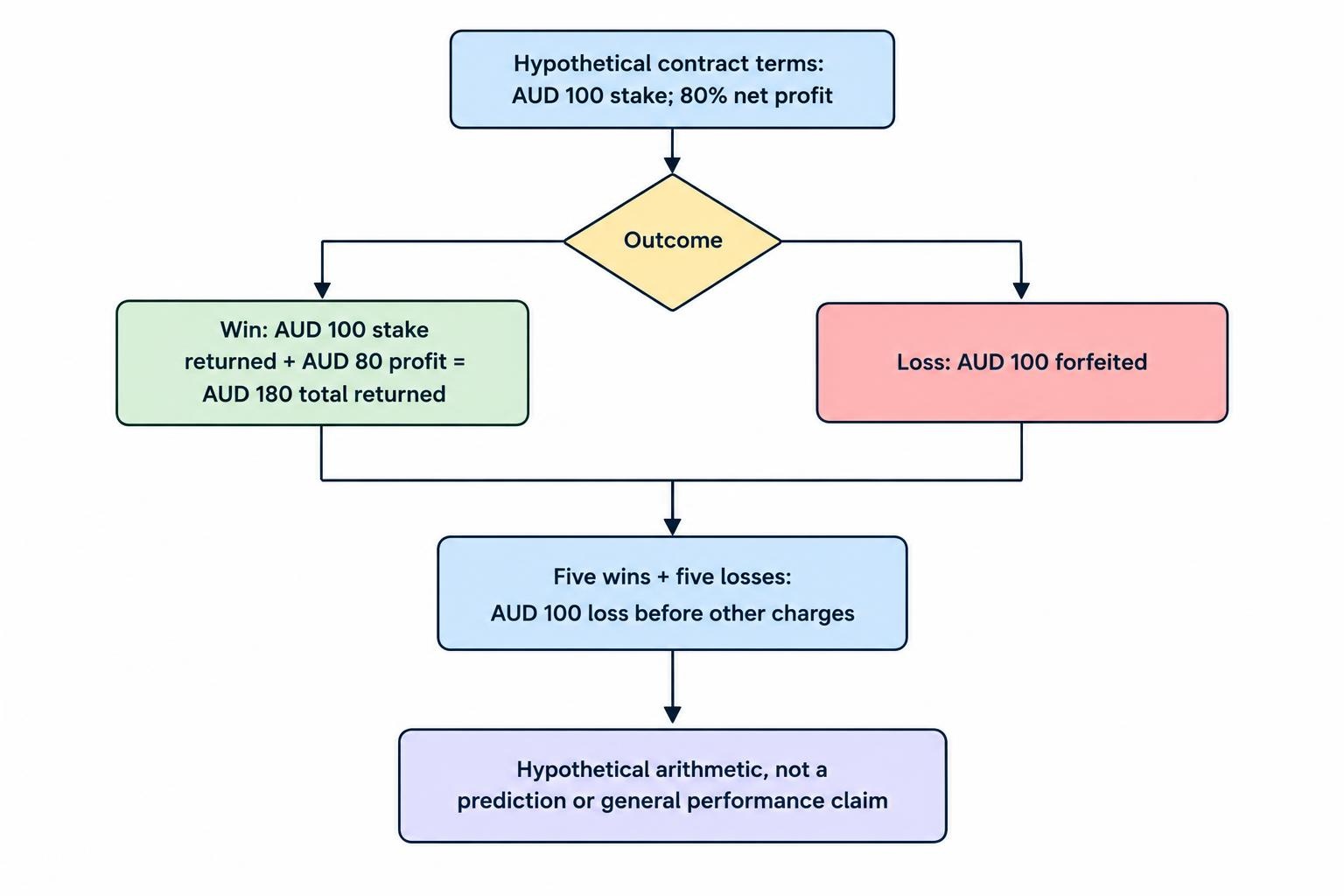
Check how the contract defines the stake, net profit and total amount returned. A displayed “80% payout” needs a clear explanation: does it mean an 80% profit plus the returned stake, or something else? Review the broker payout and contract terms together rather than treating the headline percentage as a standalone benefit.
In a hypothetical contract offering an 80% net profit, a successful AUD 100 stake returns AUD 180: the original AUD 100 plus AUD 80 profit. A losing contract forfeits AUD 100. Five wins and five losses would therefore produce an AUD 100 loss before other charges. A high looking payout is not the same as favourable arithmetic.
The terms should also answer what happens when the settlement price equals the strike, when a quote is unavailable and when the platform rejects an order. Check whether early closure is offered, how its value is calculated and whether availability is discretionary.
Pay attention to clauses allowing trade cancellation, price correction or account closure. Ask what triggers them, what evidence the provider supplies and how a customer can challenge a decision. Avoid relying on a chat message that contradicts the agreement.
Require Prices and Trade Records You Can Check
A chart is useful only if you know what it represents. Ask for the named price source, the instrument identifier, the server time zone and the settlement calculation. “Market price” is not a sufficiently precise answer for a contract decided at a particular instant.
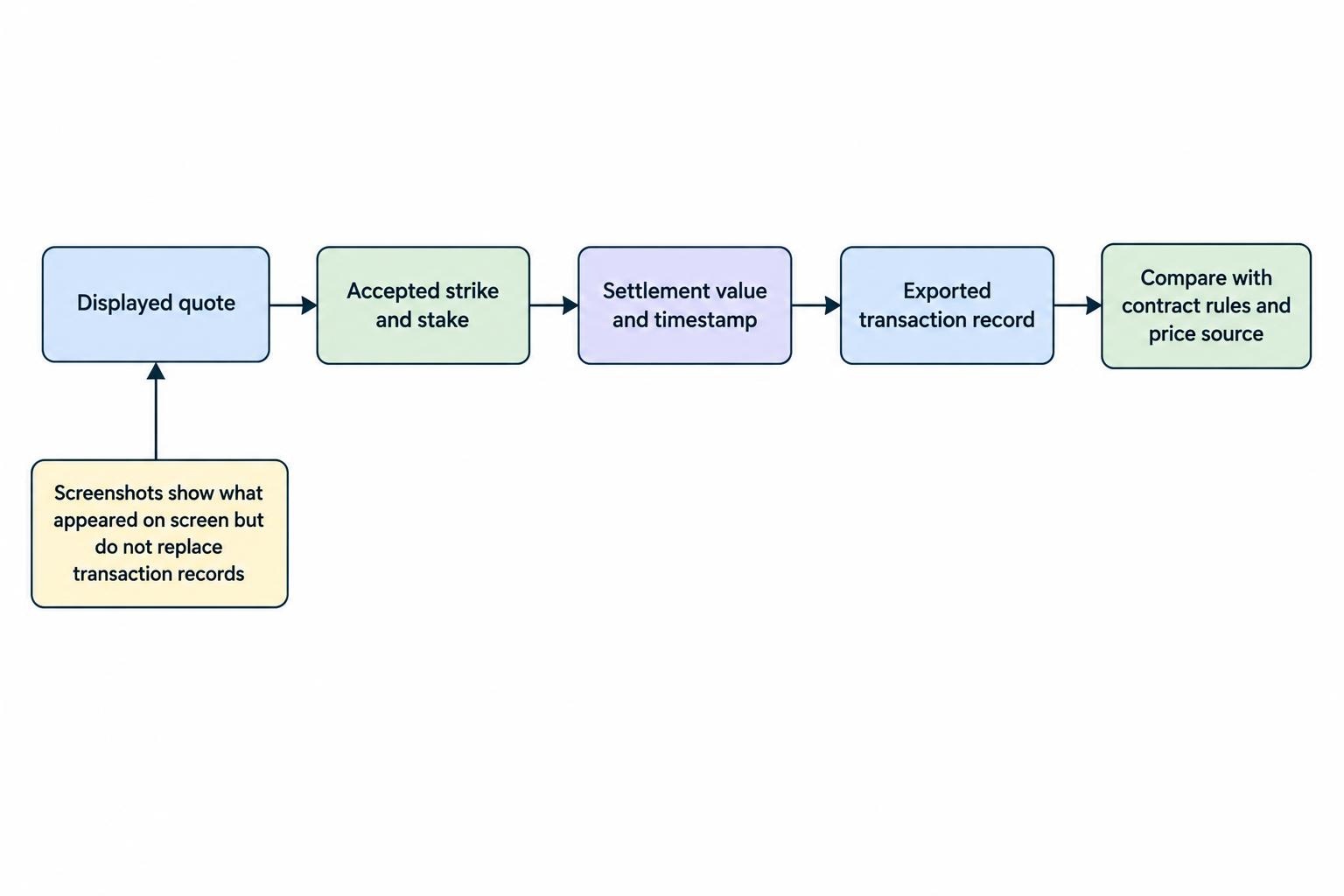
Distinguish between the price shown when you click, the accepted strike and the final settlement value. Request a sample transaction record showing those fields, the accepted stake, payout terms and timestamps.
If you compare the platform with another chart, first establish that both display the same instrument and pricing basis. A cash index, futures contract and provider generated quote should not be treated as interchangeable. The guide to price feeds and settlement benchmarks covers the questions to resolve before drawing conclusions from a mismatch.
For an existing account, export the transaction history rather than keeping screenshots alone. Screenshots preserve what appeared on screen; transaction records help reconstruct the accepted contract.
Ask how outages, delayed requests and disconnections are handled. A useful answer identifies the applicable rule and available records. “Our platform is reliable” does neither.
Examine Withdrawals Without Funding a Test
Read the withdrawal policy before considering payment methods. Record the verification documents requested, minimum withdrawal, charges, processing stages and any restrictions on returning funds through the original payment route. Distinguish the provider’s review time from the time taken by its payment service.
Check bonus terms separately. Ask whether accepting promotional credit introduces turnover conditions, whether those conditions affect deposited money and whether the bonus can be declined. Do not let a large promotional figure distract from a restriction on access to cash.
For an existing account, ask for written reasons when a withdrawal is delayed. Compare the explanation with the terms that applied when the account was funded. Keep the request date, reference number and every subsequent response.
A small successful withdrawal is not proof that a platform is genuine. Scamwatch documents investment scams that permit an early withdrawal to build trust, then demand fees or raise supposed tax issues when customers request more money. Its warning on fake online investment platforms describes this sequence.
Do not send another deposit to “activate”, “insure” or “release” a withdrawal. Pause and independently verify any unexpected demand. Nor should an Australian retail client fund a binary options account merely to test whether withdrawals work. That skips the first and most decisive check.
Check Client Money Claims and Complaint Access
Ask where customer funds are held, who controls the account and which legal entity owes the customer balance. If the provider advertises segregated funds, insurance or compensation, request the applicable documents and eligibility conditions.
Do not mark a protection as verified because a bank logo appears beside it. Ask what the arrangement covers, what it excludes and what process applies if the provider becomes insolvent. If the answer is unclear, record the protection as unresolved rather than guessing its value.
Obtain the internal complaints procedure and the contact details of the team responsible. Then verify any claimed external dispute resolution membership against the contracting entity.
AFCA access is not established by a badge alone. The complaint must concern an AFCA member and satisfy eligibility, jurisdiction and other requirements under its rules. Check AFCA’s complaint eligibility requirements rather than assuming every dispute involving an Australian customer is covered.
If a provider cites a private overseas complaints body, investigate its membership, powers and enforcement arrangements. Ask whether its decisions bind the company and what happens if the company refuses to comply.
Assess Security and Support Without Sharing More Than Necessary
Review the available account security controls, password reset process and notification settings. Ask how payment details can be changed and what checks apply before money is sent to a new destination.
Before uploading identity documents, establish who receives them, why they are requested and how they will be submitted. Do not provide passwords, one time security codes or remote access to your device as part of a broker evaluation.
Test support with a documented question, not a deposit. Ask which company contracts with you, where the relevant term appears or how to submit a complaint. Save the response. Speed matters less than whether the answer is accurate, consistent and usable.
Treat ratings, testimonials and account screenshots as leads for further checking, not substitutes for evidence. Give more weight to identifiable legal entities, official records and written terms than to a reviewer’s profit claim. A five star rating cannot repair a missing contract.
Record a Decision You Can Defend
Keep one assessment file containing the brand and domain, contracting entity, account type, jurisdiction, date checked and supporting documents. Beside each checklist item, record the result and what would be needed to resolve any uncertainty.
Use three decision rules:
- Stop: The offer conflicts with applicable restrictions, identity details do not match, or an unexplained demand for more money appears.
- Leave unresolved: Evidence is missing or inconsistent. Do not treat silence or a sales assurance as confirmation.
- Verify narrowly: Record exactly what the evidence establishes. A verified licence does not verify profitability, withdrawal performance or product suitability.
For an Australian retail binary options offer, the retail prohibition remains the stopping point regardless of attractive operational features.
If you already have money with a provider and suspect misconduct, preserve records and contact your bank promptly rather than continuing to “test” the account. Follow the steps for responding to a suspected binary options scam. The purpose of the checklist is to prevent an unsupported decision—or help document one—not to talk yourself past a failed check.
This article was last updated on: October 22, 2026