Closing a trading account means more than deleting an app or withdrawing the last dollar. Stop new trading activity, save your records, arrange the return of any available balance, then request written confirmation that the account is closed. Treat an unresolved withdrawal or complaint as a separate matter, not something to abandon to get the closure processed.
For Australian retail clients, the regulatory position also matters. The issue and distribution of binary options to retail clients is banned until 1 October 2031 under ASIC’s extended binary options product intervention order. The steps below concern leaving an existing account, including one held with an offshore operator. They are not a recommendation to open or fund another account.
Check What “Closing” Actually Means
Ask the provider to identify the account status it will apply. A trading restriction, an empty account and permanent closure are different outcomes.
| Account status | What to check |
|---|---|
| Zero balance | Whether the account remains open and whether any charges or services continue. |
| Trading disabled | Whether deposits, automated activity and linked accounts are also restricted. |
| Account closed | The effective closure date, final balance and treatment of pending payments. |
| Personal data retained | Which records remain, why they are retained and the applicable retention period. |
Identify the legal entity behind the account, not just its trading brand. Save the company name and contact details shown in your agreement or statements. Address the closure request to that entity and include the relevant account numbers. If you have several currency accounts or profiles, name each one rather than assuming one request covers everything.
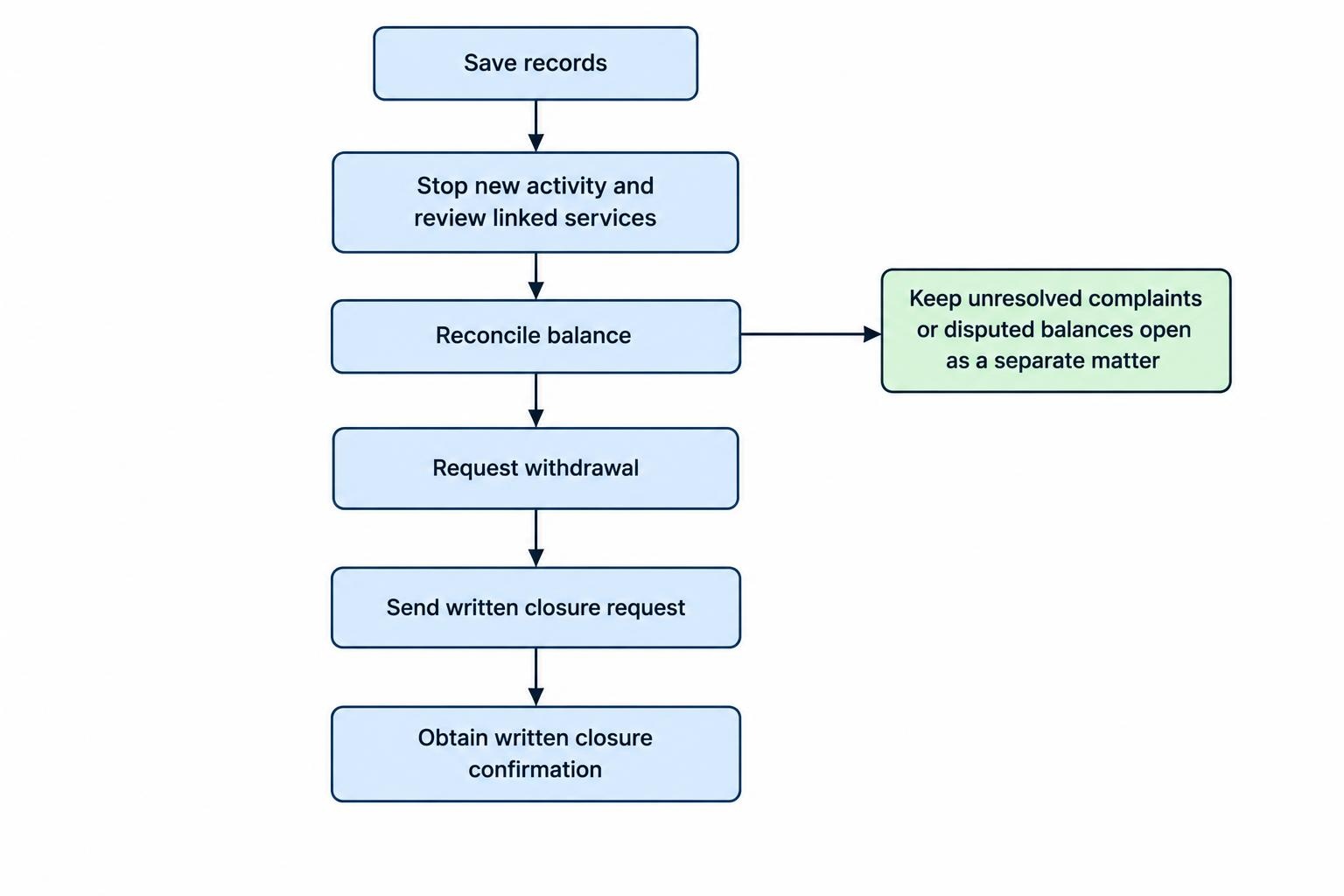
1. Save Your Records Before Losing Access
Export documents before requesting permanent closure. Do not assume you will still have access to the dashboard afterwards. Save downloadable statements in their original format, with screenshots supporting anything the statements leave out.
Your closure file should contain:
- Account statements and transaction history, including deposits, withdrawals, trades and charges.
- The account agreement, fee schedule and any bonus terms that applied.
- Withdrawal requests, payment references and correspondence about outstanding money.
- The closure request, support ticket numbers and eventual written confirmation.
Check that exported files actually open and cover the full period you need. A screenshot showing the current balance is not a substitute for the transactions that produced it. Where dates depend on the platform’s time zone, note that time zone beside your records.
Keep copies outside the trading platform, stored securely. For the accounting side, the guide to trading records for tax purposes covers the documents worth preserving. Closing an account is not a reason to discard the history, particularly where a withdrawal, fee or transaction remains disputed.
2. Stop New Activity and Review Linked Services
Stop placing trades and check for pending orders, automated instructions, copy trading connections and third party access. Where those features exist, disable them and save confirmation. If the account may be compromised, request an immediate security restriction rather than waiting for the normal closure process.
Review open contracts separately. Ask how each outstanding position will be handled under its terms, including its settlement time and whether any early exit is available. Do not assume an account closure request cancels a contract or creates a refund entitlement.
Check recurring deposits and paid services too. A charting subscription, signal service or separately purchased trading tool may have its own cancellation process. Contact that supplier directly rather than relying on the broker to cancel it.
Review the terms for account and inactivity fees, and ask which charges, if any, remain payable before closure. Request the relevant contractual clause and an itemised calculation. There is no need to place another trade just to make an unwanted account look active.
3. Reconcile the Balance and Request Your Withdrawal
Compare the platform’s balance with your exported statement. Separate cash from promotional credit, unsettled transactions and amounts already requested for withdrawal. If the figures do not match, ask for a written reconciliation before accepting the account’s final balance.
For example, a hypothetical dashboard might show AUD 600 made up of AUD 480 in cash and AUD 120 in promotional credit. That display alone does not establish that AUD 600 is withdrawable. Ask the provider to identify the treatment of each amount and the terms it relies on for any deduction or restriction.
Submit the withdrawal through a verified account channel and keep the request number. Confirm the amount, currency, destination, stated processing period and any disclosed charge. The broader guide to broker deposits and withdrawals covers payment arrangements beyond the closure process.
If your original card has expired or your receiving account has changed, ask for the provider’s documented procedure. Do not improvise by using another person’s account. Send identity documents only after checking the recipient and secure submission channel. Never supply your online banking password, card security code or a one time banking code to support staff.
Check the receiving account yourself before treating the withdrawal as complete. An email saying “processed” is not confirmation that the money has arrived. Record the amount received and investigate any difference from the amount requested.
Stop if Closure Becomes a Demand for More Money
A request for another deposit to release an existing balance needs immediate scrutiny. Extra “tax”, insurance or account upgrade payments can be part of a withdrawal scam. These demands are among the warning signs in Scamwatch’s investment scam alert. If you suspect a scam, stop sending money and contact your bank or payment provider immediately.
Distinguish an itemised charge supported by the account agreement from a demand to send fresh money to an unfamiliar recipient. Ask for the explanation in writing, but do not let repeated support conversations delay contacting your bank. Preserve messages and payment details before blocking suspicious contacts.
A screenshot of apparent profits is not a reason to risk another payment. Keep your closure request focused on stopping activity, obtaining records and recovering any money genuinely owed.
4. Send a Clear Written Closure Request
Use the provider’s verified support address or secure account messaging system. If a closure form is required, complete it and retain a copy. Keep the request factual: identify the account, state the outcome you want and ask for confirmation of anything that prevents completion.
The following wording can be adapted to your circumstances:
Subject: Request to close trading account — ACCOUNT NUMBER
Please close my trading account registered under FULL NAME and REGISTERED EMAIL ADDRESS. I do not wish to continue trading or accept promotional offers.
Please disable new trading and further funding immediately. Confirm how any outstanding positions and pending withdrawal requests will be handled, and identify any action required from me.
Please provide a final statement and written confirmation of the effective closure date, final balance, and any charges you consider outstanding, with their contractual basis.
Please remove me from promotional communications. If any personal information must be retained, please explain the purpose and retention period.
This request is not an instruction to withdraw my outstanding complaint or abandon any disputed balance. Please keep complaint reference COMPLAINT NUMBER open for a separate response.
Remove wording that does not apply. If the withdrawal has already arrived, say so and include its reference. If money remains outstanding, identify the amount and request date. Avoid attaching unnecessary identity documents to an ordinary email.
5. Obtain Confirmation, Not Just an Acknowledgement
A ticket saying “we have received your request” is a starting point. Ask for a completion notice that identifies the account and effective closure date. It should also clarify the final balance, outstanding transactions and whether linked accounts or services remain active.
If the provider leaves access available for historical statements, ask whether that access is read only. If access disappears before you have saved your records, request copies directly. Keep the correspondence even if the balance is zero.
Read any closure form before signing it, particularly if it contains settlement, release or complaint withdrawal language. Ask for clarification where the wording goes beyond closing the account. Consider independent legal advice before accepting a proposed settlement involving a disputed sum.
You can decline a retention offer without debating your trading results. “Please proceed with my written closure request” is sufficient.
What if the Broker Delays or Refuses Closure?
Ask for a written reason and a clear description of the remaining steps. A useful response identifies the missing document, unsettled transaction or disputed amount. “Your account is under review” gives you little to act on; request the issue being reviewed and the expected next update.
If routine support does not resolve the problem, send a formal complaint through the firm’s complaints channel. Include a short timeline, the account number, copies of earlier requests and the outcome you want. Separate the remedies: stopping trading, returning an outstanding balance, correcting a charge and closing the account are distinct requests.
For financial firms subject to the Australian internal dispute resolution requirements, standard complaints generally require a response within 30 calendar days, subject to exceptions. ASIC Regulatory Guide 271 on internal dispute resolution sets out those requirements. This is a complaint response period, not a universal deadline for completing account closure or paying a withdrawal.
Keep a dated record of each response and any promised action. Ask the firm to distinguish its final complaint response from a progress update, and do not mark the matter resolved simply because a support ticket has been closed.
Check whether the legal entity is an AFCA member before relying on Australian external dispute resolution. AFCA’s complaint eligibility requirements include membership, time limits and other jurisdictional conditions. An offshore platform accepting Australian customers does not, by itself, establish that AFCA can consider a complaint against it.
Account Closure and Personal Data Deletion Are Separate
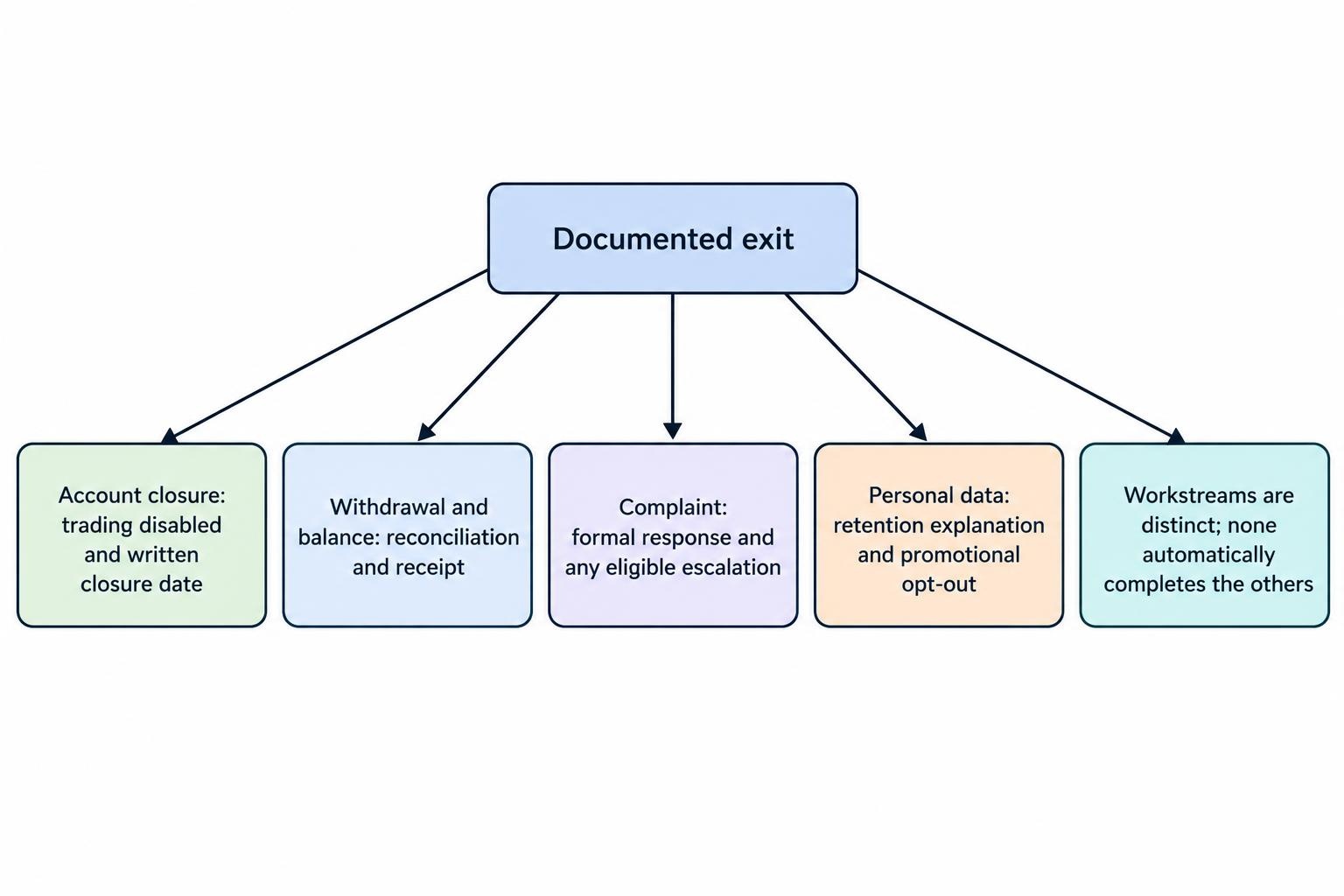
Request closure and data handling information separately. For organisations covered by the Australian Privacy Principles, personal information no longer needed for a permitted purpose must generally be destroyed or de-identified through reasonable steps. Exceptions include information that Australian law or a court or tribunal order requires them to retain. The OAIC’s guidance on APP 11 sets out that distinction.
Ask which categories of information will remain, why they are needed and when retention will be reviewed. Do not assume those Australian requirements cover every offshore operator; check the legal entity and applicable privacy arrangements.
Request removal from promotional communications without asking the provider to erase evidence needed for an active dispute. Keep a working contact address for essential withdrawal, complaint or record requests. You want the sales messages stopped, not the paper trail lost.
Finish With a Documented Exit
Before considering the process complete, check that you have the final statement, the closure confirmation and evidence of any money received. Cancel separately billed services, review payment activity and retain the outstanding complaint file where one exists.
If the account is already empty, still request closure rather than simply leaving it unused. If money remains disputed, ask for trading and further funding to be disabled while that issue continues. The aim is a documented exit: no unwanted activity, no uncertainty about the account’s status and no missing records when you need them.
This article was last updated on: October 22, 2026