A trading fund recovery scam targets someone who has already lost money, then offers a false route to getting it back. The approach may come from a supposed lawyer, investigator, regulator or cryptocurrency specialist. Instead of recovering the original loss, the scammer collects another payment, steals personal information or gains access to an account. These approaches are covered in Scamwatch’s warning about money recovery scams.
For someone dealing with a blocked binary options withdrawal or a vanished trading platform, the offer can arrive at a vulnerable moment. The promise is no longer easy profit. It is relief.
If you are being asked to pay now, pause the payment. Contact your bank or payment provider through a channel you already trust. Do not give the recovery agent remote access, passwords or wallet recovery phrases.
How recovery scammers approach trading victims
The contact may arrive directly through a phone call, email or social media message. Alternatively, you may find the service yourself through an advertisement or a recovery website. Another apparent victim might recommend someone who supposedly helped them.
Do not treat familiarity with your loss as proof of independence. Knowing the trading platform’s name, your account balance or the amount you deposited establishes only that the caller possesses those details. It does not establish that they have recovered anything.
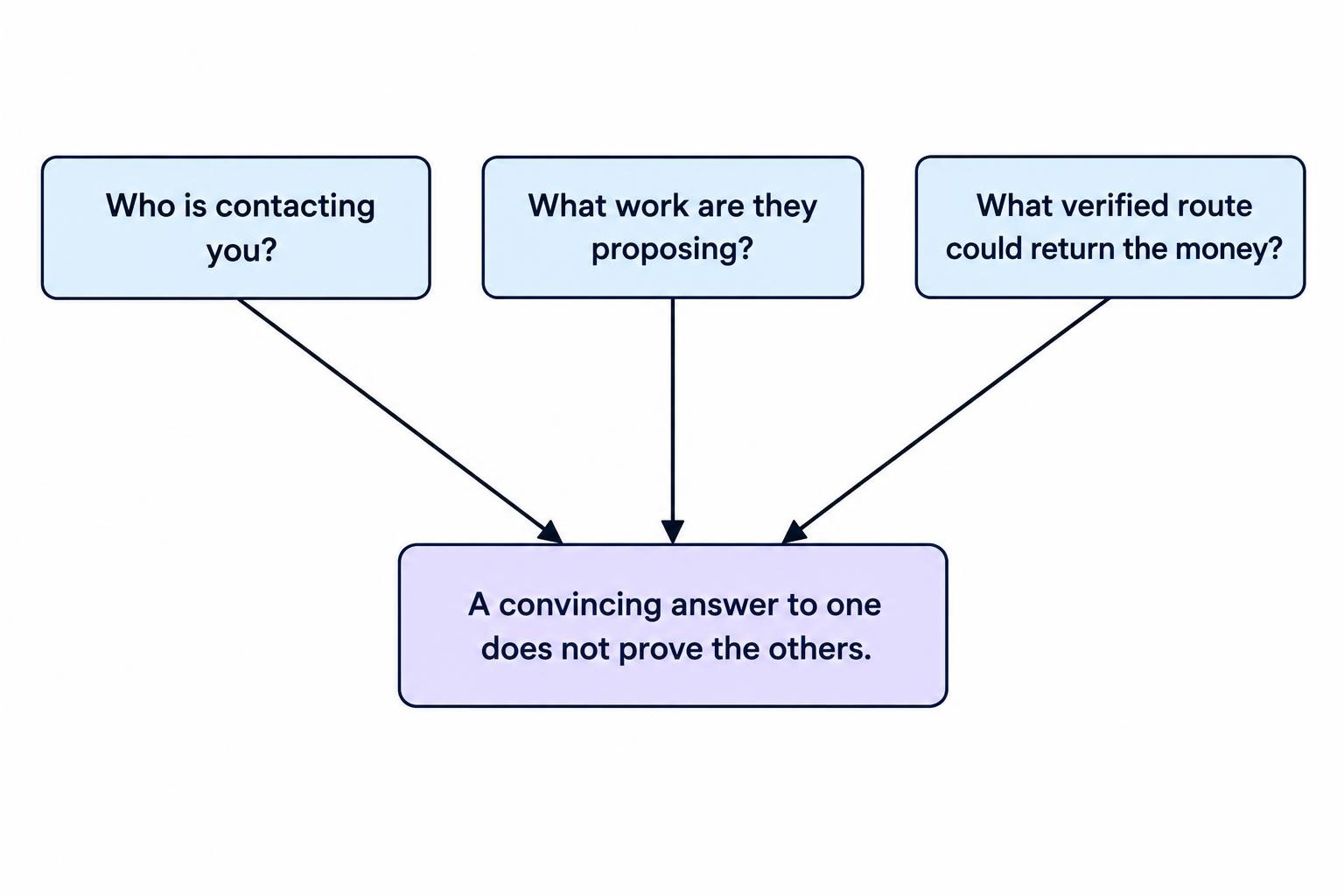
Separate three questions before considering an offer: Who is contacting you? What work are they proposing? What actual route could return your money? A convincing answer to one does not settle the other two. An identifiable company can still offer an unsuitable service, and a detailed description of your loss does not prove control over the missing funds.
How the recovery fee trap works
The central pitch is that a larger payment is waiting, but you must pay a smaller amount to receive it. The charge may be presented as an investigation fee, tax or release payment. Fake recommendations from other victims can reinforce the story. These tactics feature in ASIC’s alert about follow-up recovery scams.
Consider this hypothetical example. An Australian customer loses A$12,000 to a fraudulent binary options platform. Someone claiming to represent a recovery firm says the money has been found and offers to return A$10,800 after costs.
| Stage | Hypothetical demand | Additional money at risk |
|---|---|---|
| Case opening | Pay A$450 to begin the recovery | A$450 |
| Claimed progress | Pay A$900 to release the located funds | A$1,350 in total |
| Final obstacle | Pay A$1,200 for a supposed clearance requirement | A$2,550 in total |
In this example, every payment produces another obstacle rather than a refund. The useful question is not whether the next fee looks small beside A$12,000. It is whether independently verified evidence supports the recovery claim.
The original loss cannot justify a new payment. Assess the next transfer on its own merits, even if stopping means accepting that money already paid to the recovery service may also be lost.
Demands to pay tax before receiving a withdrawal deserve particular caution. Keep the alleged recovery separate from any genuine tax question, and review the warning signs of fake tax and withdrawal release fees.
Warning signs that should stop the conversation
Use the following as reasons to stop and verify, rather than as a scoring system. You do not need to collect five warning signs before refusing a transfer.
- An unsolicited recovery offer: someone approaches you with a ready-made answer to a loss you have already suffered.
- A payment before release: the caller claims money is available but requires another transfer to make it accessible.
- A changing explanation: each payment produces a different charge, authority or condition.
- Borrowed authority: logos, official language and reference numbers replace independent verification.
- Requests for account access: the proposed recovery depends on sharing security codes, wallet secrets or control of your device.
Do not try to resolve doubts by asking the same person for more certificates. Instead, break contact and check through an independent route. Ask a trusted person to review the demand before you respond. Give them the original message, not just the reassuring summary the caller provided.
An official reference number is not enough
A genuine-looking report can still support a false story. In a warning published on 10 December 2025, Scamwatch documented criminals submitting false ReportCyber reports using people’s details, then using the resulting reference numbers to impersonate police and cryptocurrency platforms. The scheme sought cryptocurrency transfers or wallet seed phrases. The police and cryptocurrency exchange impersonation alert shows why a reference number alone is not authentication.
Verify the claimed organisation using contact details you find independently. Do not use the phone number, callback link or messaging account supplied in the suspicious approach. Ask whether the named person works there and whether the organisation recognises the proposed action.
Why tracing cryptocurrency is not the same as recovering it
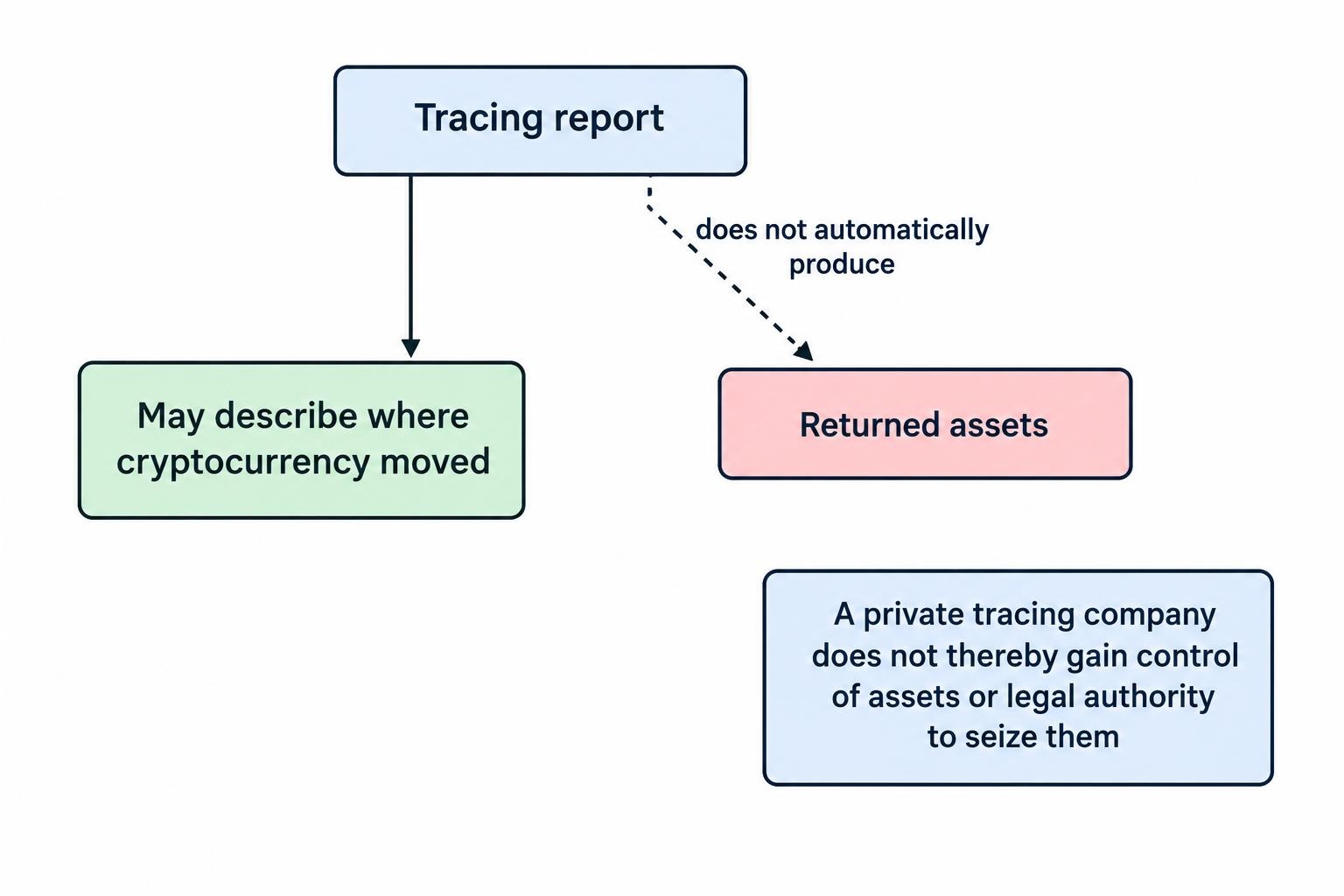
A tracing report and a returned payment are different outcomes. A report may describe where cryptocurrency moved without giving its author control over those assets. Do not accept a transaction diagram as proof that a refund is ready.
Private recovery companies cannot issue legal orders to seize stolen cryptocurrency. Exchanges may freeze accounts through their own processes or in response to court documents. Those distinctions appear in the cryptocurrency recovery section of the FBI’s 2023 Cryptocurrency Fraud Report.
Before buying any tracing service, ask what the fee actually purchases. Is the deliverable a report, assistance preparing a complaint, legal representation or an attempt to recover assets? Who would need to act on the findings? What further costs could follow?
Avoid both extremes: a promise of guaranteed crypto recovery is not credible, but that does not mean every investigation is pointless. The practical issue is whether the proposed work has a realistic purpose and a clearly stated price, without pretending that analysis itself returns money.
Distinguishing professional help from a recovery pitch
Do not decide that a service is genuine simply because it uses a contract, charges after an initial consultation or describes its fee as refundable. Assess the identity of the provider, the written scope of work and the proposed recovery route separately.
If someone claims to be an Australian lawyer, check their practising status through the relevant state or territory legal regulator. For a Victorian practitioner, the Victorian Legal Services Board and Commissioner’s register of lawyers provides an official checking route. Then contact the practice independently to establish whether the person approaching you actually works there.
A matching name is only the beginning of that check. Compare the firm, contact details and identity of the person handling the matter. Do not treat a registration number copied into an email as proof that its sender belongs to the registered business.
An advance payment alone does not answer whether professional assistance is genuine. Before agreeing to paid work, request a written explanation of what will be done, what it costs and what happens if nothing is recovered. Ask whether the work has value beyond producing documents you must submit yourself.
Read “no win, no fee” terms just as closely. Establish what counts as a win, whether other charges remain payable, and whether the provider expects a percentage of money you recover independently. If those terms are unclear, do not sign while someone is pressing you to decide.
What to do if you have already paid
Contact the payment provider immediately
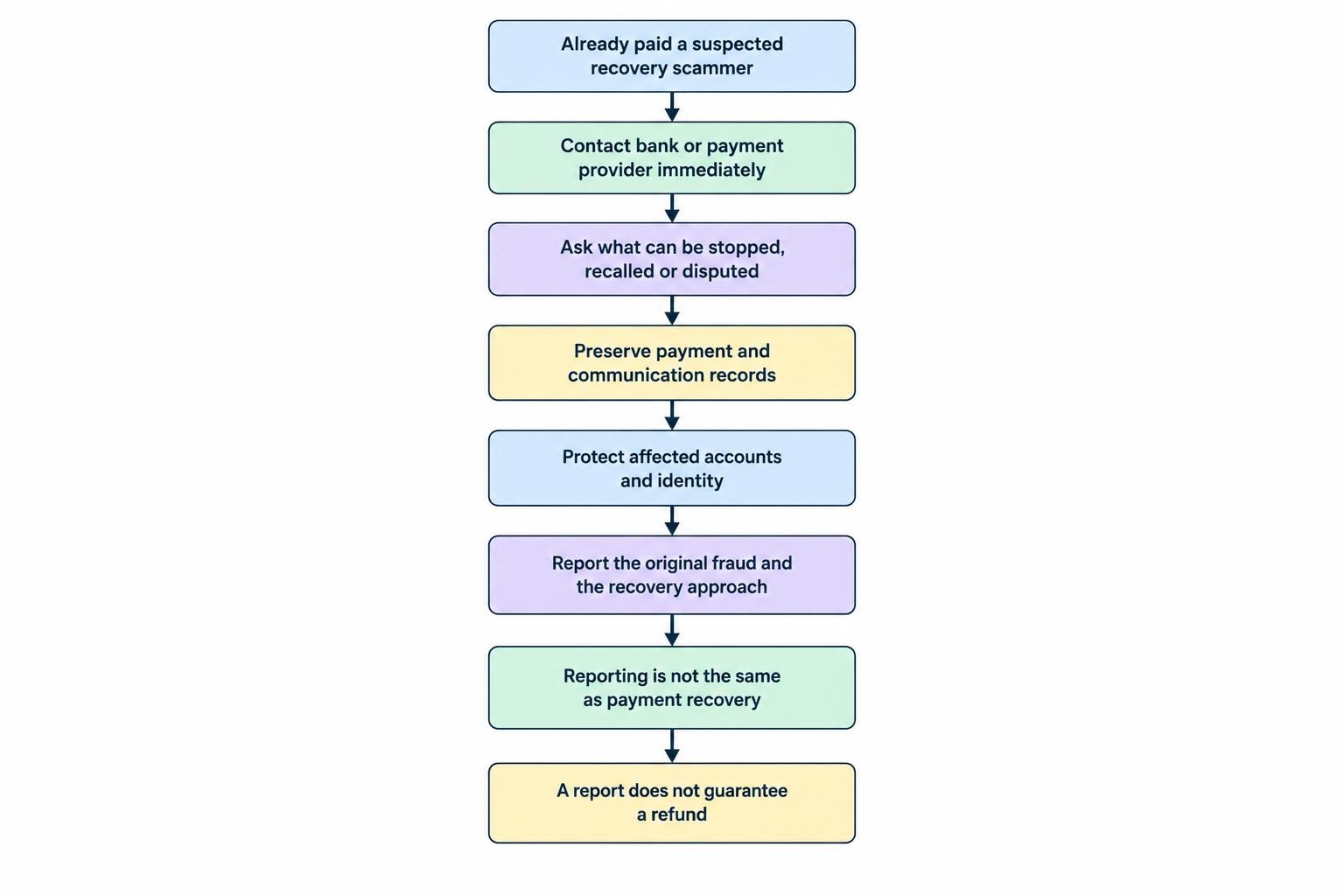
Tell your bank or payment provider that you suspect a recovery scam. Identify the recovery payment separately from the original trading deposit. Ask what can be stopped, recalled or disputed, and keep the case reference. If you sent cryptocurrency, notify the platform or exchange used to send it.
Describe the transaction accurately. State whether you approved the payment and what you were told it would purchase. Do not describe an authorised payment as unauthorised, or invent a complaint about the original trading service.
For card payments, ask whether a dispute is available and what evidence or deadlines apply. A chargeback is not a guaranteed refund, and a losing trade is not, by itself, evidence of fraud. The separate guide to trading payment chargebacks covers that process in more detail.
Preserve a clear record
Keep the recovery contract, invoices, payment confirmations, emails, chat exports and relevant screenshots. For cryptocurrency payments, record the asset, network, destination address and transaction hash. Preserve the website address and the contact details used by the person approaching you.
Build a short timeline that distinguishes the original trading loss from the later recovery approach. Record what was promised, what you paid and when you requested a refund. Give investigators and complaint handlers the underlying records, not just your interpretation of them.
Save what is already available, but do not keep talking to the scammer to collect more evidence. Avoid publishing identity documents, account details or unredacted statements in public requests for help.
Protect accounts and identity
If you shared passwords, replace them with new ones and change any reused credentials. Sign out of affected accounts and enable multifactor authentication. If you supplied identity documents, seek an identity protection plan from IDCARE. If the person accessed your device, arrange appropriate security checks. These actions are covered in Moneysmart’s steps after a scam.
Tell your bank what information or access you provided, even if no further transaction is visible yet. Include any remote access session, shared security code or uploaded identification. Do not assume that ending the phone call also resolves the account security problem.
Report both incidents
Report the original fraud and the recovery approach to Scamwatch. For online fraud, use ReportCyber to make a report to police, following the Australian Signals Directorate’s guidance on getting help during cybercrime. Include any existing case references and explain whether you know the two incidents are connected or only suspect a connection.
Keep reporting separate from payment recovery. Filing a report does not establish that your money has been located or that a refund is coming. Continue dealing with your payment provider rather than waiting for a recovery caller to arrange everything.
When a bank complaint may be appropriate
If you are dissatisfied with your financial institution’s handling of the matter, make a formal complaint through its internal dispute resolution process. State what happened, when you notified it, what response you received and what outcome you want. If the response does not resolve the complaint, consider whether AFCA can review it.
AFCA is free to use, and you do not need a paid representative. Its complaint form and representative guidance also makes clear that you will usually bear the cost of a representative who charges you. Do not pay someone merely because they claim payment is necessary to access the complaints process.
Stop the second loss without abandoning the first complaint
Rejecting an unverified recovery offer does not mean abandoning every legitimate recovery route. It means separating the original problem from a fresh demand for money.
Use the broader action plan after a binary options scam to organise the original incident. Keep any recovery approach in a separate file, with its own payments and promises.
The original loss creates no obligation to pay again. Stop the transfer, verify independently and pursue the routes you can identify without relying on the person selling you the rescue.
This article was last updated on: October 22, 2026