Binary options trading costs are not confined to a commission on each trade. The payout offered on a winning contract affects the return before any separate fees appear. Funding charges, currency conversion, withdrawals, account fees and paid software can then reduce what remains.
The useful question is not simply “Does the platform charge commission?” It is “What result remains after losing stakes and every separate charge?” A profitable trade history and a profitable account are not necessarily the same thing.
For Australian retail clients, the regulatory position comes first. ASIC banned the issue and distribution of binary options to retail clients from 3 May 2021 and extended that ban until 1 October 2031. The ASIC announcement extending the binary options ban sets out that restriction. The calculations below explain costs; they are not a recommendation to open or fund an account.
What Counts as a Binary Options Trading Cost?
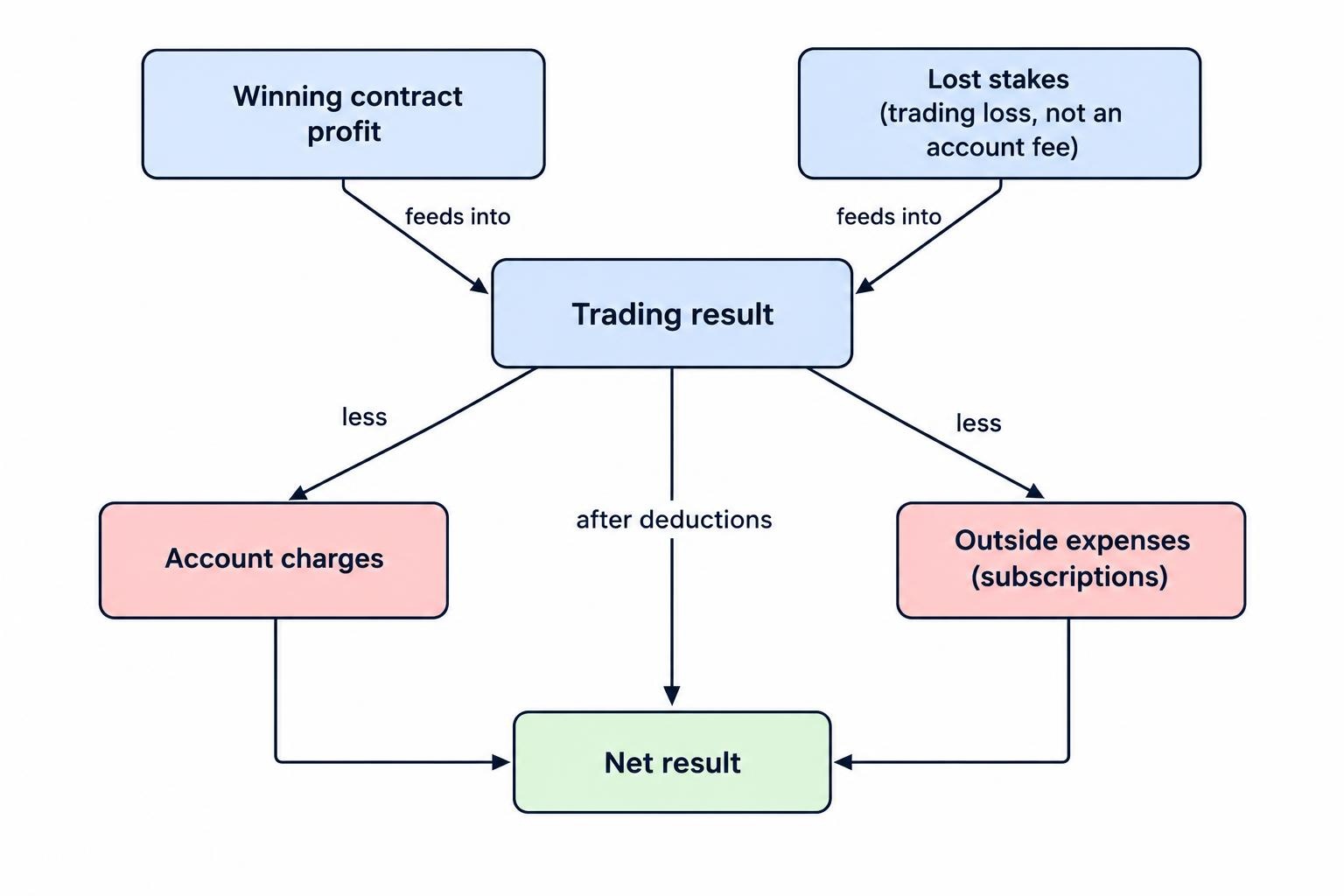
Separate the economics into three parts: the contract payoff, charges connected with the account, and expenses paid elsewhere.
The contract payoff determines what a winning or losing position contributes to your balance. A winning contract might return the original stake plus a profit smaller than that stake. A losing contract might lose the full amount committed. That imbalance is not necessarily shown as a fee, but it determines the accuracy needed to break even.
Account charges are easier to identify. When included in the applicable terms, they can cover deposits, withdrawals, conversion, inactivity or account administration. Outside expenses include subscriptions for signals, charts, data or other tools.
Keep those categories separate. A lost A$10 stake is a trading loss, not a withdrawal charge. A A$30 signal subscription is an expense even if it never appears on the trading statement. Combining everything under “fees” makes it harder to see what actually caused the loss.
The Payout Structure Matters Before Fees
Consider a hypothetical contract with a A$10 stake and an 80% profit payout. A win produces A$8 profit, with the A$10 stake also returned. A loss costs A$10. One win followed by one loss therefore leaves a A$2 loss, before funding or account charges.
This is why a commission-free label does not establish that a contract is cheap. The return offered relative to the amount at risk matters more than whether a separate commission line appears. ASIC identified negative expected returns and a high likelihood of cumulative losses among the harmful product features in its report on consumer harm from binary options and CFDs.
Payout wording also needs care. An “80% payout” might refer to profit above the returned stake, while a total return figure includes the stake itself. In the example above, the winning cash credit is A$18, but only A$8 is profit. Counting the full A$18 as earnings gives a flattering answer to the wrong question.
The examples in this article use payout to mean net profit on a winning contract, expressed as a percentage of the stake. They assume losing contracts lose the full stake, with no rebates, refunds or ties.
How Payouts Change the Break-Even Win Rate
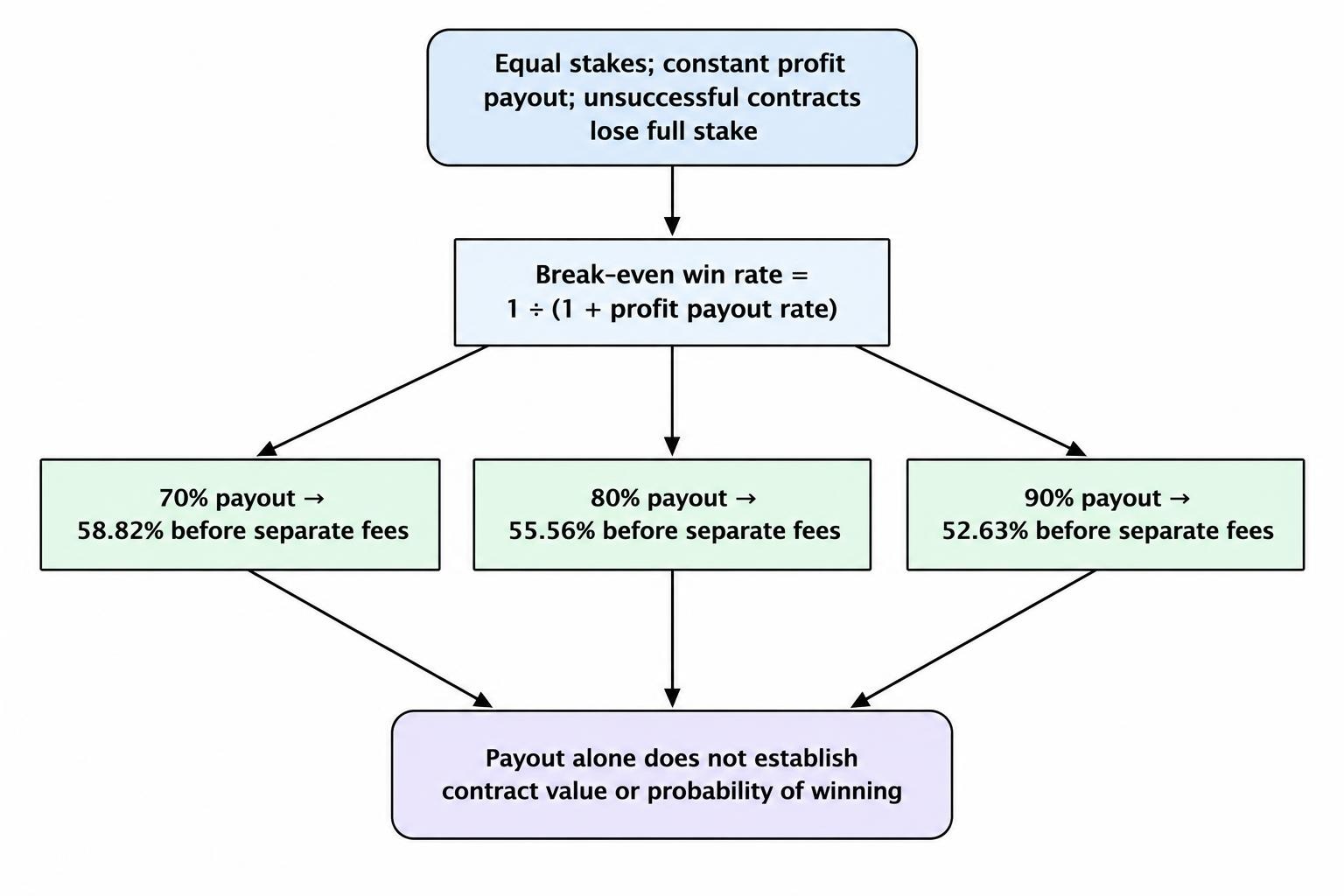
With equal stakes and a constant payout, the break-even win rate before separate costs is:
Break-even win rate = 1 ÷ (1 + profit payout rate)
| Profit payout on a win | Profit on a A$10 winning stake | Break-even win rate |
|---|---|---|
| 70% | A$7 | 58.82% |
| 80% | A$8 | 55.56% |
| 90% | A$9 | 52.63% |
A higher payout lowers the mathematical threshold only when the other assumptions stay unchanged. Two contracts can have different probabilities of winning because their strike prices, expiry times or settlement conditions differ. Comparing payout percentages alone does not compare their value.
The guide to probability and expected value covers that relationship in more detail. For cost analysis, the point is straightforward: calculate the result using the payout actually attached to each trade, not an advertised maximum.
Deposit and Withdrawal Charges
Start a payment audit with both sides of the transaction. A platform’s own charge is only one possible expense; the bank or payment provider has its own terms. International transaction charges are among the fees identified in Moneysmart’s transaction account and debit card comparison guidance.
Check whether a charge is a flat amount, a percentage, or a percentage subject to a minimum. These structures produce different results. A hypothetical A$10 withdrawal fee takes 10% of a A$100 withdrawal but 2% of a A$500 withdrawal. The fee has not changed. Its weight relative to the payment has.
That arithmetic does not justify leaving money with a questionable operator to make a withdrawal look cheaper. Reducing a transaction charge and protecting access to funds are separate decisions.
Minimum deposits and minimum withdrawals need their own treatment. A minimum deposit is not automatically an expense: it is money transferred into an account. A withdrawal threshold is an access condition, not necessarily a fee. Both can still affect how much money is committed and when it can be recovered.
Record the amount debited from the sending account, the amount credited at the destination and every deduction between them. The deposit and withdrawal fee guide examines those payment stages without mixing them into trading performance.
Currency Conversion: Compare the Amount Received
For an Australian dollar budget, a foreign currency account introduces another calculation. Compare the exchange rate applied to the payment, any stated conversion charge and any receiving fee. These are separate features in Moneysmart’s guidance on overseas transfer costs, which also identifies the margin built into a conversion rate.
A hypothetical example shows why “no conversion fee” is not enough. Suppose a reference rate is US$0.65 per Australian dollar, but the payment converts at US$0.63. A A$1,000 conversion produces US$630 rather than US$650. The US$20 difference is a conversion shortfall against that reference, even if the receipt shows no separate fee.
Use a reference rate from the same point in time. Comparing a Monday transaction with Friday’s exchange rate mixes the provider’s pricing with market movement. Also avoid assuming that an indicative market rate was available to you for that payment amount and method.
The return payment needs a separate check. If funds are converted back into Australian dollars, use the actual rate and deductions for that transaction. Do not assume the outgoing percentage applies unchanged on the way back.
Keep exchange rate movement apart from conversion charges. A foreign currency balance can gain or lose Australian dollar value without any trading activity. That is currency exposure, not automatically a fee. The currency conversion cost guide covers how to separate those effects in an AUD ledger.
Account, Inactivity and Administration Fees
If an agreement includes an inactivity charge, establish exactly what starts the clock and what resets it. Do not assume that logging in counts as activity, or that the relevant period begins with the last trade. The written definition is what your records need to capture.
Note the charging interval, the currency used, the amount charged and any stated cap. A monthly fee and a single administration charge require different projections. If the fee is denominated in a foreign currency, its Australian dollar value also needs recording.
Never place an unwanted trade simply to avoid an account fee. That exchanges a known charge for a position that can lose its stake. Ending an account relationship should be assessed separately from the decision to trade.
The account and inactivity fee guide covers the terms to retain and the records needed when checking deductions. Keep dated copies rather than relying on a fee page remaining unchanged.
Signals, Software and Data Subscriptions
A paid tool belongs in the cost calculation whether it supplies signals, charts, historical data or automated analysis. Paying for a service does not establish that it improves results. Its expense must be measured against any benefit rather than treated as an investment that will somehow pay for itself.
Suppose a subscription costs A$30 per month. Allocating it across 100 trades produces A$0.30 per trade. Across 20 trades, the allocation is A$1.50. The bill is identical; only the denominator changes.
Do not respond by creating more trades to make the subscription appear cheaper. Under a negative expected return assumption, more trading increases expected trading losses even as the allocated subscription cost per trade falls. Spreadsheet efficiency is not account profitability.
Before agreeing to a subscription, record its billing currency, renewal price, minimum term and cancellation process. If an annual plan requires payment upfront, distinguish the cash committed from the monthly expense used in your analysis.
The guide to trading signal and software costs covers those recurring expenses. Include subscriptions paid from a different bank account; they do not stop being costs because the trading dashboard cannot see them.
A Worked Example of Total Trading Costs
The following calculation is hypothetical. It does not represent a broker’s fee schedule or a claim about achievable results. All amounts are expressed in Australian dollars, with currency movement excluded and conversion costs stated separately.
Assume 100 settled trades with a constant A$10 stake and an 80% profit payout. There are 57 wins and 43 losses. Winning stakes are returned, losing stakes are lost in full, and there are no ties, rebates or early exits.
The winning contracts produce A$456 in profit: 57 multiplied by A$8. The losing contracts cost A$430: 43 multiplied by A$10. Trading therefore produces a A$26 profit before separate expenses.
| Item | Calculation or assumption | Effect on result |
|---|---|---|
| Profit from winning contracts | 57 × A$8 | +A$456 |
| Losing stakes | 43 × A$10 | −A$430 |
| Trading result before separate costs | A$456 − A$430 | +A$26 |
| Funding fee | Assumed charge | −A$5 |
| Combined conversion costs | Assumed outgoing and return costs | −A$12 |
| Withdrawal fee | Assumed charge | −A$9 |
| Monthly subscription | Assumed charge | −A$30 |
| Net result | A$26 − A$56 | −A$30 |
The 57% win rate clears the 55.56% break-even threshold for an 80% payout before fees. It does not clear the threshold after A$56 of separate costs. A trade history showing a positive result would therefore tell only part of the story.
The total amount staked across the trades is A$1,000. That is turnover, not an additional A$1,000 expense to subtract from the table. Losing stakes have already been deducted, while returned winning stakes are not profit.
For other combinations of payment charges and account expenses, the total trading cost examples provide the companion calculations. Keep the accounting boundary consistent: an expense paid outside the trading account still belongs in the economic result, but it should be counted only once.
Adjusting the Break-Even Rate for Separate Costs
For equal stakes, a constant payout and full losses on unsuccessful contracts, the fee-adjusted calculation is:
Break-even win rate = [1 + total separate costs ÷ total amount staked] ÷ [1 + profit payout rate]
In the example, that becomes [1 + 56 ÷ 1,000] ÷ 1.80, or approximately 58.67%. Across exactly 100 trades, at least 59 wins would be needed to produce a non-negative result under these assumptions.
At 59 wins and 41 losses, trading profit would be A$62. Subtracting A$56 leaves A$6. That narrow remainder shows why rounding, omitted expenses or a different payout can change the answer.
This is an accounting threshold, not a prediction that a strategy can reach it. Variable stakes and payouts require a trade-by-trade calculation rather than one average percentage.
Avoid Double Counting and False Savings
Use either the net profit from each winning contract or its total cash return minus the original stake. Do not use both. Likewise, do not subtract a conversion margin again if it is already included in the conversion cost recorded in your ledger.
A deposit is a transfer of capital, not trading income. A withdrawal is a transfer out, not automatically a loss. Keep funding movements separate from contract results so an account top-up cannot be mistaken for improved performance.
Discount claims need the same discipline. If a hypothetical charge falls from A$10 to A$5, the saving is A$5. It does not offset an unrelated A$50 trading loss. Nor does an account credit count as recovered cash unless it can actually be withdrawn under its terms.
Tax is outside the worked example. Do not assume these accounting categories determine Australian tax treatment, or that every expense is deductible. Keep complete records and obtain advice on your circumstances rather than inserting an assumed tax benefit into the result.
Check the Complete Cost Record
A useful review follows the money from the original payment to the final amount received. For an existing account or a paper calculation, answer these questions:
- What does a win actually pay? Separate returned stake from profit and retain the payout attached to each contract.
- What was charged for moving money? Reconcile sending debits, destination credits and withdrawal receipts.
- What was lost through conversion? Record applied rates, explicit charges and a consistent reference.
- What was paid elsewhere? Include subscriptions and other expenses outside the trading statement.
- Has anything been counted twice? Check returned stakes, deductions already reflected in balances and conversion costs.
Retain transaction confirmations, statements, subscription invoices and dated terms. A clean ledger is more useful than a screenshot of a winning trade. Less exciting, admittedly, but much harder to misread.
When a “Fee” Is a Warning Sign
A demand for a fresh payment to release an existing balance should not be treated as routine cost optimisation. Scamwatch’s warning about fake crypto trading platforms documents platforms that display fictitious trading activity and then request release fees; the extra payments go to scammers and no assets are released.
For any account under review, stop before sending more money in response to an unexpected release demand. Preserve the messages and transaction records, and contact your bank promptly if fraud is suspected. A promise that “this is the final fee” is not evidence that a withdrawal will arrive.
The useful measure of cost is the result after contract losses and all genuine expenses, supported by records and recoverable funds. A commission-free claim, an attractive payout or a positive dashboard balance cannot establish that result on its own.
This article was last updated on: October 22, 2026