High-low binary options settle on a simple question: will an asset’s reference price finish above or below a stated strike price at expiry? A correct prediction produces the payment set by the contract. An incorrect prediction can cost the entire stake. The size of the price movement does not increase the agreed payment.
That makes the contract easy to describe, but not necessarily easy to assess. Direction, timing, payout and settlement rules all matter. Predicting that a market will rise is not enough if the contract requires it to finish above a particular price at a particular second.
In Australia, ASIC’s ban on issuing and distributing binary options to retail clients remains in force until 1 October 2031. The prohibition began on 3 May 2021. The examples below explain contract mechanics for educational purposes, not as a route to accessing a prohibited retail product. See ASIC’s binary options ban extension.
What Does a High-Low Binary Option Predict?
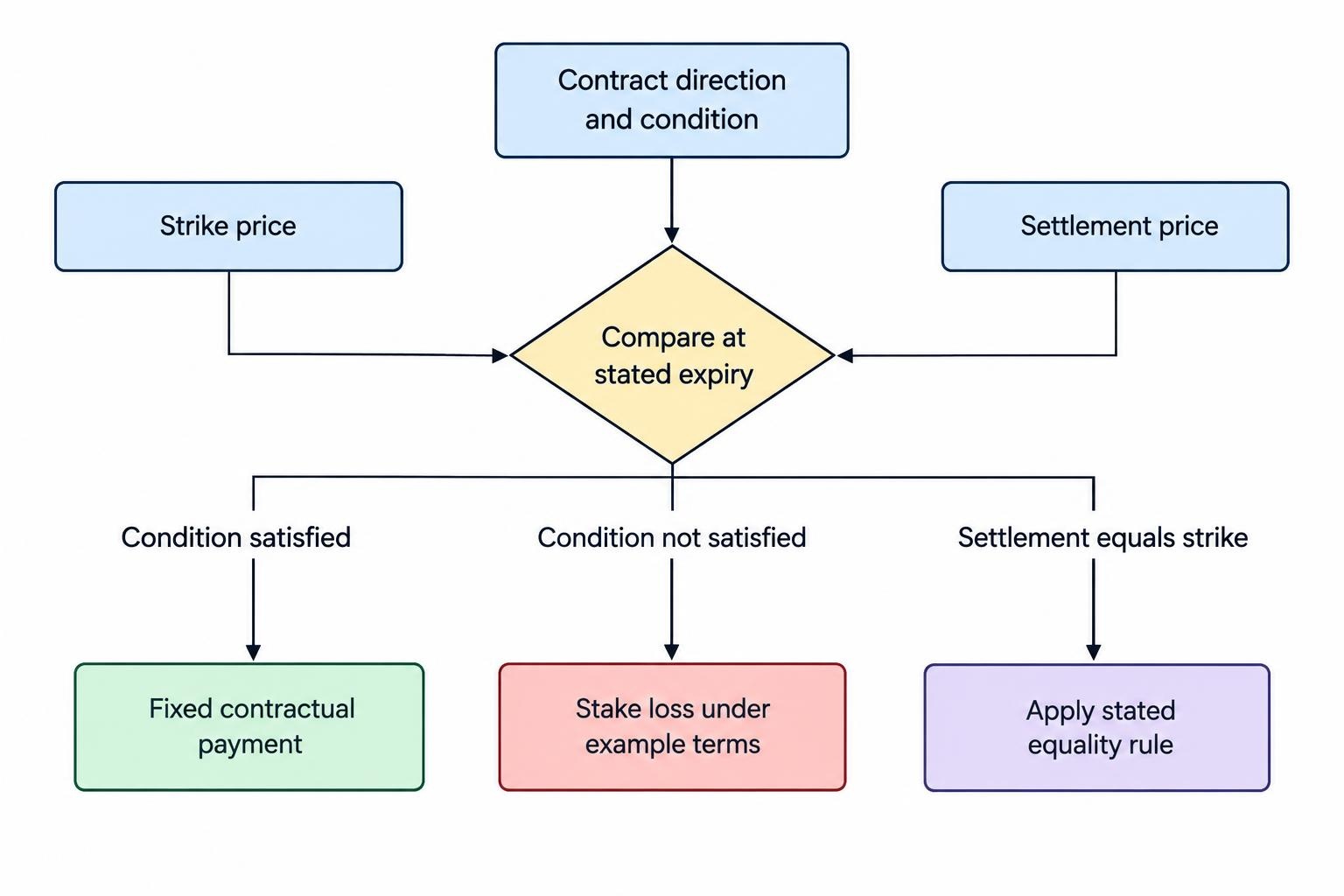
A high-low contract compares its settlement price with its strike price. A Higher position requires the settlement price to satisfy the contract’s higher condition; a Lower position requires the lower condition. Labels such as Up/Down or Call/Put may appear, but the written condition takes priority over the button name.
The position does not give you ownership of the underlying currency, share or commodity. Nor does it give you the right to buy or sell that asset through exercising a conventional option. The payment depends on the contract’s yes/no outcome, a distinction covered in the CFTC–SEC investor alert on binary options.
Consider a hypothetical condition: “Will AUD/USD be above 0.65000 at 14:05 UTC?” A Higher position succeeds if the settlement price satisfies that condition. A rise to 0.65001 can be enough. A much larger rise does not earn a larger fixed payment.
This expiry comparison separates high-low contracts from other types of binary options. A touch contract tests whether a level is reached during a stated period. A range contract tests a condition involving two boundaries. A standard high-low contract tests which side of one strike the settlement price occupies.
The Strike, Expiry and Settlement Rules
Before interpreting a high-low result, establish three things: the price being compared, the time of comparison and the rule used to decide the outcome. A chart alone does not answer all three.
The strike is not always the price you first see
The strike is the threshold against which settlement is measured. Where a contract sets its strike from the reference price at acceptance, that accepted value matters—not an earlier quote displayed while you were considering the position. A contract with a strike selected in advance works differently: its threshold is already stated.
Suppose an entry-based contract shows an indicative price of 0.65000 but confirms a Higher position with a strike of 0.65004. Settlement at 0.65002 is above the earlier display, yet below the accepted strike. Calling that a winning prediction would use the wrong comparison. The guide to binary options strike prices examines this distinction in more detail.
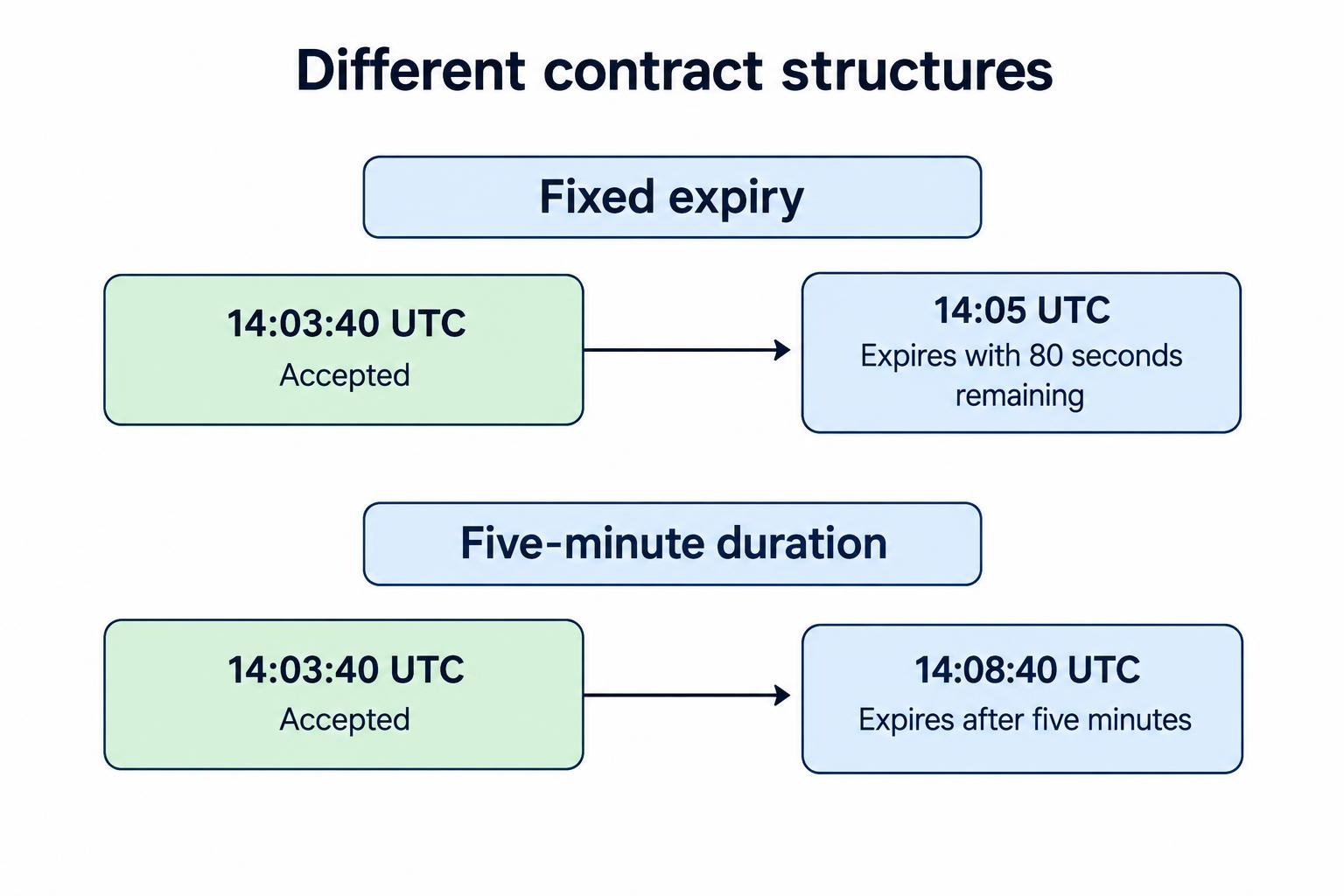
A fixed expiry is different from a fixed duration
A contract expiring at 14:05 UTC does not necessarily provide five minutes of exposure. If it is accepted at 14:03:40, only 80 seconds remain.
By contrast, a hypothetical five-minute contract whose duration starts at acceptance would expire at 14:08:40 if accepted at 14:03:40. The two contracts can produce different results from exactly the same market movement.
Record the stated expiry and its time zone rather than relying on a countdown or the label beside it. The separate guide to binary options expiry times covers these timing arrangements without treating them as interchangeable.
Equality needs its own rule
“Above” and “at or above” are different conditions. If the strike and settlement price are identical, the result depends on the contract. Do not assume equality automatically means a refund, a win or a loss.
Price precision matters too. A chart showing five decimal places may not tell you whether the settlement calculation uses those same displayed values. The terms should identify the reference price, observation time and relevant rounding method.
The settlement and ties guide addresses these edge cases. For a high-low exercise, record the tie rule before observing the outcome. Choosing the interpretation afterwards is an excellent way to produce flattering but useless results.
A Worked High-Low Binary Options Example
Assume a hypothetical AUD/USD contract has a strike of 0.65000 and expires at 14:05 UTC. The stake is A$100. A successful position returns the stake plus an 80% profit, while an unsuccessful position loses the full stake. Fees are excluded.
Under these assumptions, a winning position produces A$180 in total proceeds: the original A$100 plus A$80 profit. A losing position produces no proceeds and a net loss of A$100.
| Settlement price | Higher position | Lower position |
|---|---|---|
| 0.65001 | Wins: A$180 returned, including A$80 profit | Loses: A$100 net loss |
| 0.64999 | Loses: A$100 net loss | Wins: A$180 returned, including A$80 profit |
| 0.65000 | Apply the stated equality rule | Apply the stated equality rule |
The difference between 0.65001 and 0.66000 does not change the agreed A$80 profit for the Higher position. Both satisfy a strict “above 0.65000” condition. The contract rewards the outcome, not the distance travelled.
The route to settlement does not decide this standard expiry-only contract either. AUD/USD could spend most of the period below the strike, then finish above it. The Higher position would still satisfy its condition. A brief move above the strike followed by settlement below it would not.
This is why screenshots taken before expiry cannot establish a final result. They show the position’s status at that moment, not necessarily the value used for settlement.
Payouts and the Accuracy Needed to Break Even
The examples here use a stake-based format in which a successful position returns the stake plus a quoted profit percentage. Always distinguish net profit from total money returned. An “80% payout” defined as profit is not the same as receiving only 80% of the original stake back.
With an 80% profit payout and a 100% loss on unsuccessful positions, one win does not offset one loss:
A$80 profit − A$100 loss = A$20 net loss.
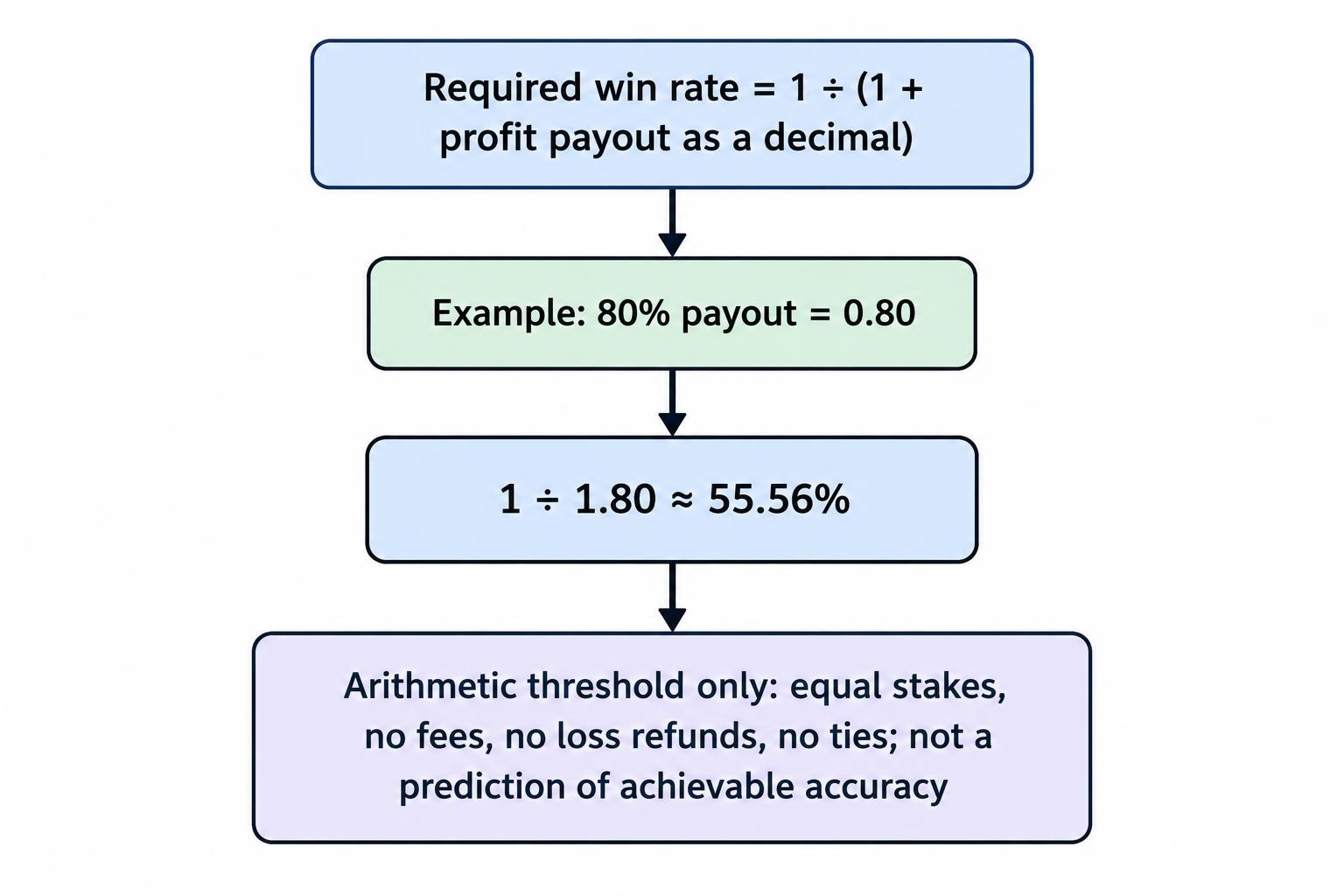
For equal stakes, no fees, no refunds on losses and no ties, the break-even calculation is:
Required win rate = 1 ÷ (1 + profit payout expressed as a decimal).
At an 80% profit payout, the calculation is 1 ÷ 1.80, or about 55.56%. At 70%, it rises to about 58.82%. At 90%, it falls to about 52.63%. These are arithmetic thresholds under the stated assumptions, not estimates of achievable accuracy.
Take 100 hypothetical positions, each risking A$100 at an 80% profit payout. Fifty wins generate A$4,000 profit; fifty losses cost A$5,000. The net result is a A$1,000 loss before fees.
Even 55 wins leave a small deficit: A$4,400 profit against A$4,500 lost. Fifty-six wins produce A$4,480 profit against A$4,400 lost, leaving A$80 before costs.
The guide to probability and expected value develops this calculation further. The practical point is straightforward: a high win rate has little meaning without the payout, loss terms and stake sizes that produced it.
A higher advertised payout also does not prove that a contract offers better value. If its condition is harder to satisfy, the extra payment may be offset by a lower chance of success.
Why a Correct Market View Can Still Lose
High-low contracts demand a more precise forecast than “this market looks bullish” or “the price should fall.” The forecast must match both the strike and the expiry.
Suppose a paper exercise predicts that AUD/USD will rise over an hour, but uses a contract expiring after five minutes. A short pullback can produce a loss even if the currency pair later rises as expected. The broad market view and the contract outcome answer different questions.
The reverse can happen too. A Higher position can win during a brief rebound even while the longer trend remains downward. One result does not validate the wider analysis.
A candle’s colour can also distract from the actual comparison. A green candle describes a rise from that candle’s opening price. It does not prove the settlement price is above the contract’s strike. A red candle can still finish above a strike established earlier.
Nor should the final seconds be treated as a formality. If settlement occurs only slightly above or below the threshold, a small final change can switch the entire outcome. A narrow winning margin receives the same agreed payment as a wide one, but the result can be much more sensitive to the final observation.
When reviewing an exercise, separate three questions: was the direction forecast correct, was the timing suitable, and did the recorded settlement satisfy the actual contract? Combining those questions hides mistakes rather than explaining them.
Contract Risk Is Not the Same as Platform Risk
A clearly written payoff does not prove that a platform will handle prices, account balances or withdrawals properly. Knowing the maximum contractual loss on one position does not establish the safety of money held in an account.
Reported binary options fraud complaints include denied withdrawals, hidden demands for further payments and altered chart histories. These are separate from ordinary losses caused by an incorrect prediction. The CFTC warning on off-exchange binary options documents these concerns.
A discrepancy between a contract’s settlement value and another chart deserves investigation, but does not by itself establish manipulation. Start with the stated benchmark, timestamp, precision and settlement method. Without matching those details, two displayed prices may not be comparable.
For Australian readers, an offer of access should not be mistaken for evidence that the product can lawfully be distributed to retail clients. Do not agree to wholesale classification simply to obtain binary options access; wholesale clients do not receive the same consumer protections. Moneysmart’s binary options warning addresses this issue directly.
How to Study High-Low Contracts Without Funding an Account
A paper exercise can test whether you can apply the rules consistently without depositing money. Its purpose is to learn the mechanics, not to manufacture a profitable record.
Choose an observable market and write down the hypothetical contract before its outcome is known. Record:
- The underlying market and reference data source.
- The strike, direction and exact expiry time, including time zone.
- The assumed stake and profit payout.
- The settlement method, price precision and equality rule.
- The final settlement value and calculated net result.
Keep the assumptions unchanged throughout the exercise. Do not move the strike after an unfavourable entry, extend expiry because the forecast needs more time, or delete awkward ties. Those changes create a different contract after the result has started to unfold.
The guide to paper trading binary options provides a broader framework for recording hypothetical positions. For high-low contracts, the most useful review is often a comparison between the prediction you intended to make and the condition you actually recorded.
A paper result does not demonstrate live execution quality, withdrawal reliability or future profitability. It can, however, reveal whether losses come from the price forecast, the expiry choice or a misunderstanding of the terms. That distinction is worth learning before confusing a simple contract with a simple way to make money.
This article was last updated on: October 22, 2026