Trading as a business is a question of fact under Australian tax law, not a label selected when a tax return produces an inconvenient result. For binary options, the assessment needs to cover both how the activity operates and the tax character of the contracts themselves.
A trading diary, regular transactions and a profit motive may support a business assessment. None settles the question alone. This guide focuses on business status; the broader Australian binary options tax guide covers the surrounding tax issues.
Business Status Does Not Remove Australia’s Retail Ban
Before considering tax treatment, separate business status from permission to offer or access a financial product. ASIC’s prohibition on issuing and distributing binary options to retail clients took effect on 3 May 2021 and has been extended until 1 October 2031. The scope and dates are set out in ASIC’s binary options ban extension.
Do not treat an ABN, business plan or company registration as permission to access binary options. Whether an activity is a business for tax purposes and whether someone qualifies as a retail or wholesale client are separate questions.
This distinction matters when reviewing historical transactions or preparing returns involving offshore accounts. A tax assessment addresses the treatment of transactions; it does not endorse the provider or establish that its services were lawfully available.
What Makes Trading a Business?
The assessment considers the activity as a whole: its commercial purpose, organisation, repetition, scale and prospects of profit. The ATO’s business assessment guidance also distinguishes an intention to start a business from actually commencing one. No single piece of paperwork replaces that assessment.
For a binary options review, useful questions concern what actually happened, not what the account holder called it.
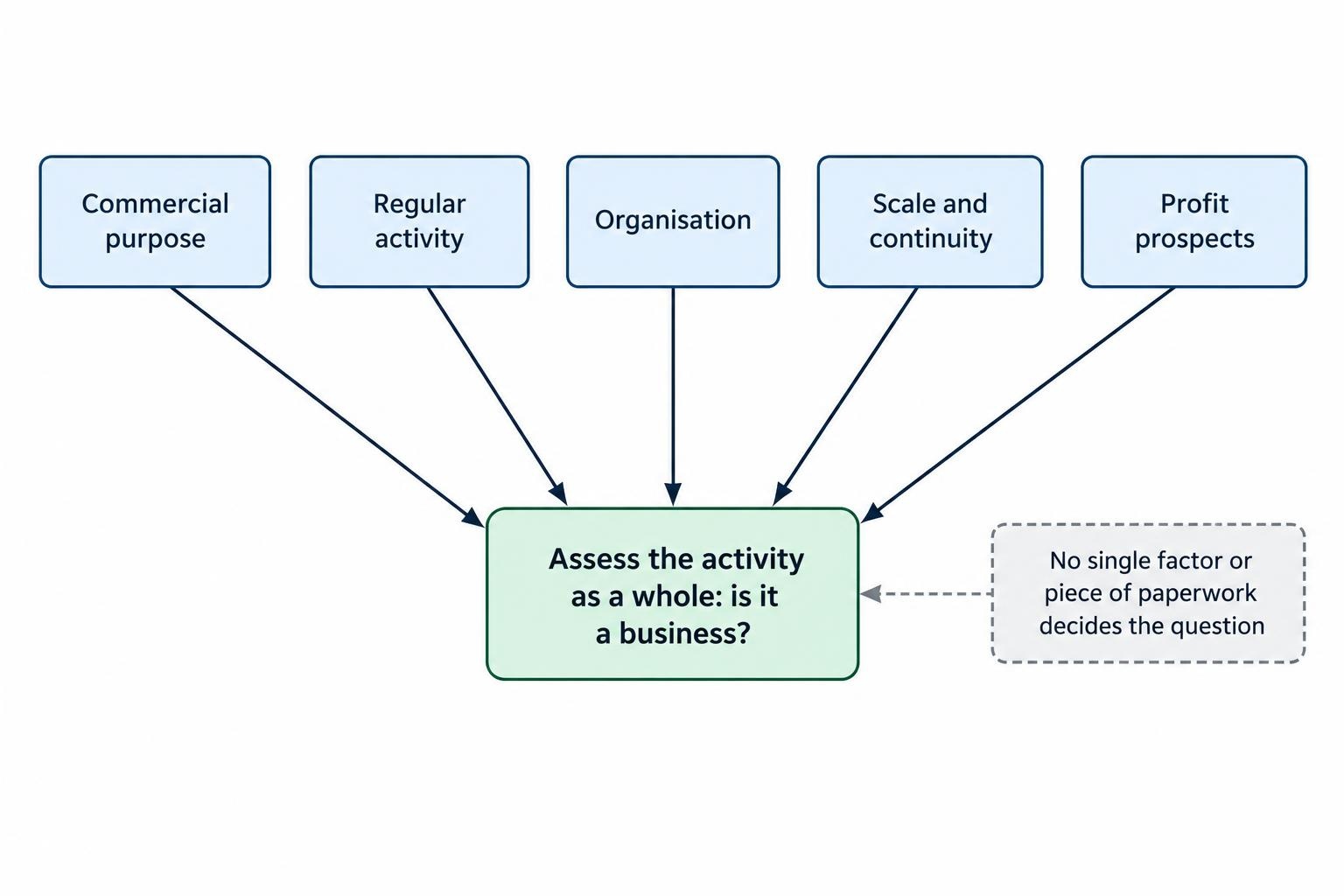
| Area to examine | Useful evidence to gather |
|---|---|
| Commercial purpose | A dated plan explaining the proposed source of profit and expected costs. |
| Regular activity | Complete transaction histories showing the pattern over time. |
| Organisation | Written decision rules, reconciled accounts and periodic reviews. |
| Scale and continuity | Capital committed, time spent and evidence of ongoing operations. |
| Profit prospects | Calculations that include losing transactions, operating costs and realistic assumptions. |
Transaction Volume Needs Context
A large trade count tells an adviser that transactions occurred. It does not explain why they occurred or whether they formed a commercial operation.
Consider two hypothetical account holders who each completed 500 contracts. One followed documented entry rules, reconciled every settlement and reviewed results against a budget. The other increased stakes after losses and kept only screenshots of winning trades. The transaction count matches; the evidence tells two different stories.
When assembling a review, explain unusual bursts of activity, long gaps and changes in approach. A spreadsheet full of numbers is useful, but it should not leave the reader guessing what those numbers represent.
A Profit Forecast Should Survive Basic Questions
Prepare a forecast that another person can challenge. What payout assumptions were used? How were unsuccessful contracts included? What happens if software costs rise or results fall below the forecast?
Keep earlier versions rather than replacing them with a more flattering plan after the year ends. Comparing forecasts with actual results can show whether the approach was reviewed and changed. A business plan should explain decisions, not decorate a folder.
An ABN Does Not Decide the Tax Classification
ABN entitlement is its own assessment. An enterprise can include a business and certain other activities, so the terms are not interchangeable. The Australian Business Register’s ABN entitlement rules require an applicant to establish an entitlement and allow that entitlement to be reviewed.
Keep the registration question separate from the income tax question. Applying for an ABN does not replace an examination of the trading activity.
The same practical caution applies to a business name or separate bank account. These arrangements may improve administration, but they are not substitutes for evidence about operations. If an ABN already exists for unrelated consulting work, give the adviser separate information about the trading account rather than presenting everything as one undifferentiated business.
How Business Status Affects the Tax Analysis
For transactions undertaken as part of a genuine trading business, ordinary income and deduction provisions become central to the assessment. However, contract terms still matter.
Taxation Ruling TR 2005/15 on financial contracts for differences addresses business transactions, commercial profit making transactions and recreational gambling arrangements. It is not a blanket ruling that every product marketed as a binary option receives identical treatment.
Give the adviser the actual agreement, settlement rules and transaction statements. Do not assume that tax guidance for shares or CFDs can be transferred unchanged to a fixed payout contract.
Equally, a finding that an activity is not a business does not automatically establish that its profits are tax free or that capital gains treatment applies. The separate guide to income versus capital tax treatment addresses that classification question.
A useful review therefore asks two questions: what is the character of the activity, and what is the character of its receipts and outgoings? Answering only the first leaves the return unfinished.
Business Expenses Still Need Their Own Assessment
Business status does not make every trading related purchase deductible. Expenses need a business connection, mixed private use must be apportioned, and records must support the claim. Some costs may be deductible immediately, while others fall under rules for deductions over time. These distinctions appear in the ATO’s small business deductions training resource.
For a trading review, separate recurring services from equipment purchases. A market data subscription, computer and introductory course should not be placed in one “trading expenses” total and treated as though they raise the same questions.
Suppose an annual internet service costs A$1,200. If a supportable allocation attributes 30% to the business, the business portion is A$360, subject to the relevant deduction rules. Paying the whole bill from a separate account does not turn private use into business use.
Ask the adviser to review costs incurred before operations began as well. Preserve the purchase date, purpose and supporting invoice rather than assuming that every preparatory expense belongs in the first operating year.
A deduction reduces taxable income where allowed. It does not make the purchase free.
Business Losses Are Not an Automatic Salary Offset
Even after business status is established, an individual’s loss may be deferred under the non-commercial loss rules. These rules can apply to individuals operating alone or in partnership.
The usual pathway requires income for non-commercial loss purposes below A$250,000 and satisfaction of at least one of four tests. The tests concern assessable income, profit history, real property and other assets. Exceptions or a favourable exercise of the Commissioner’s discretion may also matter. The framework is covered in Taxation Ruling TR 2001/14 on non-commercial business losses.
The A$250,000 calculation is not simply salary. It includes taxable income calculated without the relevant deferred business loss, reportable fringe benefits, reportable superannuation contributions and total net investment losses.
One test requires at least A$20,000 of assessable income from the activity. Deposits, cumulative stakes and an account’s advertised “turnover” should not be used as substitutes without checking the correct tax calculation.
If deferral applies, the loss may remain available for later use subject to the rules. It is not an immediate refund. The guide to binary options losses covers loss treatment beyond this business status discussion.
Two Examples of the Assessment Process
The following examples are hypothetical, use Australian dollars and do not establish a tax outcome.
Regular Trading With Weak Supporting Evidence
Alex works full time and has an account showing hundreds of short contracts. There is no written approach, several months of statements are missing, and the expense summary includes the full cost of a family computer. After a poor year, Alex wants to report a business loss.
The immediate task is to reconstruct the facts, not choose a business label. An adviser would need the contracts, complete transaction history, evidence of the activity’s purpose and an explanation of expenses. Frequent transactions alone leave too many questions unanswered.
A useful starting point is a timeline: when activity began, how decisions were made, when stakes changed and what records existed at the time.
Organised Activity With a Separate Loss Question
Priya has reconciled statements, written operating rules, documented reviews and a cost budget. Assume an adviser determines that the activity was a business and that the correctly calculated tax loss is A$8,000.
That finding does not finish the return. If Priya is an individual, the adviser must also assess the non-commercial loss rules before deciding whether the A$8,000 can offset other income immediately.
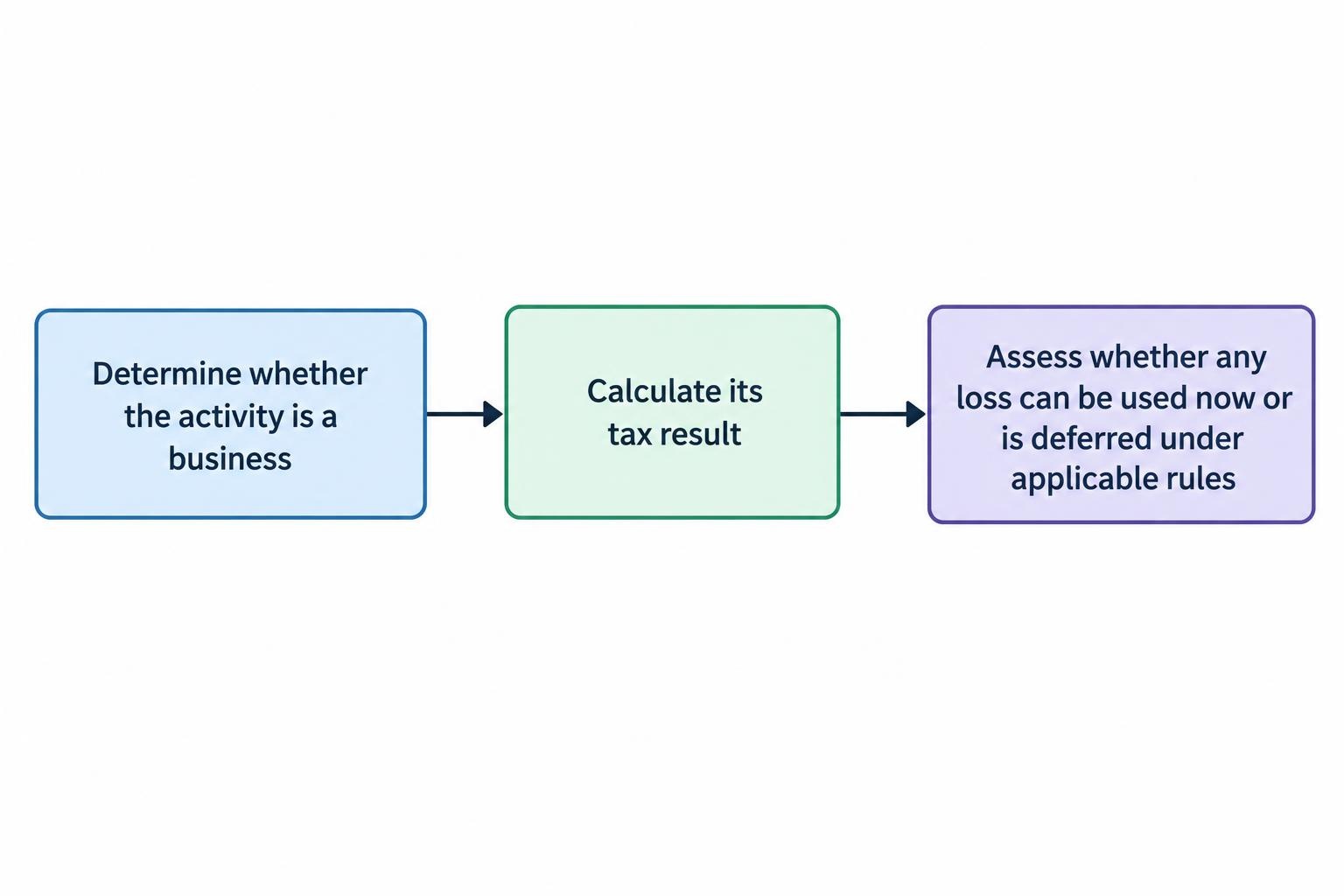
The lesson is procedural: establishing a business, calculating its result and determining when a loss can be used are separate steps.
Does a Company Make Trading More Tax Efficient?
Business status and business structure are different matters. A sole trader reports business income and expenses through their individual return and pays tax based on their individual tax circumstances. Companies have separate obligations. The ATO’s business structure tax obligations sets out the distinctions.
Before forming a company or trust, request a comparison that includes administration, professional fees, access to funds and treatment of losses. Do not compare headline tax rates while ignoring the cost of operating the structure.
Identify who actually held each contract and incurred each expense. If historical transactions occurred through a personal account, give the adviser those facts rather than assuming that later registration changes the earlier position.
Prepare an Evidence File Before Lodging
Build a review file that allows someone unfamiliar with the activity to follow it from beginning to end. Include the contract terms, complete account exports, transaction reconciliations, expense records and dated operating documents.
Record the proposed commencement date and explain why it was chosen. Buying software, opening an account and beginning operations may occur on different dates. Preserve the sequence rather than compressing everything into “started trading”.
For practical organisation, the trading records guide for Australian tax purposes covers the supporting documents. Here, the purpose is to connect those documents to the business assessment: what was done, why it was done and how the activity developed.
Give a registered tax agent the complete picture, including employment income, other business activities and missing information. Ask for a documented assessment of business status, contract treatment, deductions and any loss deferral. Where uncertainty remains material, ask whether an ATO private ruling is appropriate.
The defensible position is the one supported by the facts. Not the label with the most attractive refund.
This article was last updated on: October 22, 2026