Binary options copy trading connects a follower’s account to another trader’s decisions. The service may copy orders automatically or send instructions that the follower approves. Either way, the follower risks their own money, and copying a successful trader does not guarantee the same results.
The appeal is less time spent choosing trades and entering orders. The harder questions concern execution, payouts, stake sizes and whether the advertised record deserves any trust. Automation can remove the clicking. It cannot remove the need to check what happens after each click.
Binary options copy trading in Australia
Australia’s retail restrictions come before any platform comparison. ASIC’s binary options product intervention order prohibits issuing and distributing binary options to retail clients. The prohibition took effect on 3 May 2021 and has been extended until 1 October 2031.
A copy trading feature does not change the underlying product. Calling a service “social trading”, “automated income” or “AI copying” does not establish that it can lawfully offer binary options to Australian retail clients. Nor does an accessible offshore platform establish permission to serve them.
This article examines how these services operate and how to assess their claims. It is not a recommendation to open an offshore account or bypass Australia’s restrictions. Keep that distinction in mind when a promoter presents a foreign registration certificate as the answer to every awkward question.
How binary options copy trading works
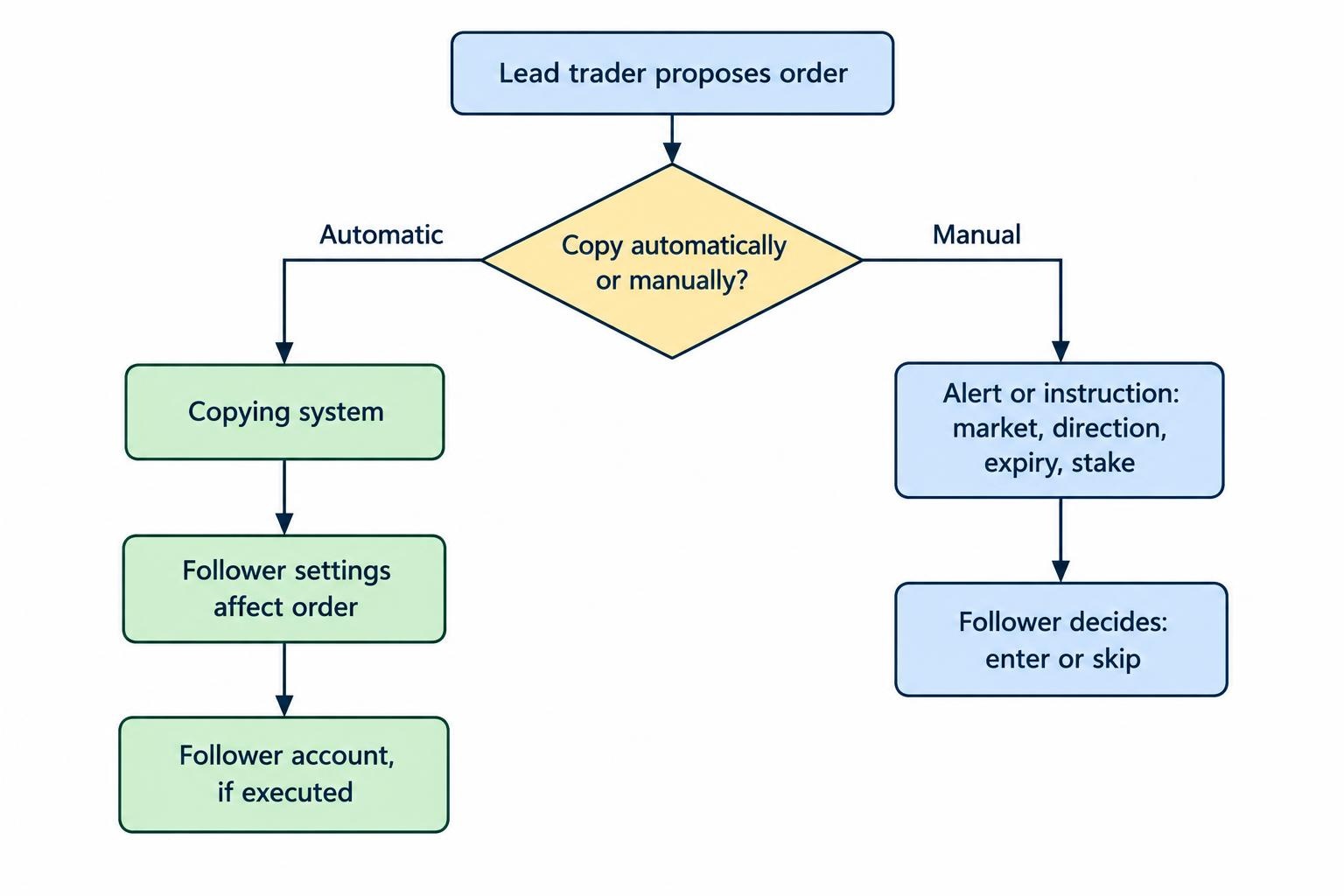
In an automatic arrangement, a lead trader places an order and a copying system attempts to place a corresponding order in the follower’s account. Instructions may include the market, direction, expiry and stake. The follower’s settings determine how much of that instruction transfers across.
Stake allocation can follow different rules. A service might copy the same cash amount, apply a percentage of the follower’s balance or scale the order against the lead trader’s account. These methods are not interchangeable. Copying a A$100 order means something very different in a A$1,000 account than in a A$50,000 account.
Manual copying works differently. A message supplies a proposed trade and the recipient decides whether to enter it. This is closer to a signal service, with the extra delay and discretion that manual entry introduces.
A managed account is another arrangement again: someone receives authority to trade on the account holder’s behalf. Treat requests for direct account access as a separate security and authorisation issue, not a routine part of following another trader.
The broader binary options signals guide covers trade alerts and their delivery methods. For copy trading, the central question is what the system actually reproduces: the decision, the cash stake, the percentage risk, or only part of the order.
Why a copied trade can produce a different result
A matching direction is not a matching contract. The follower needs compatible entry conditions, expiry rules, payouts and settlement terms before the lead trader’s result becomes a useful comparison.
Entry price and timing
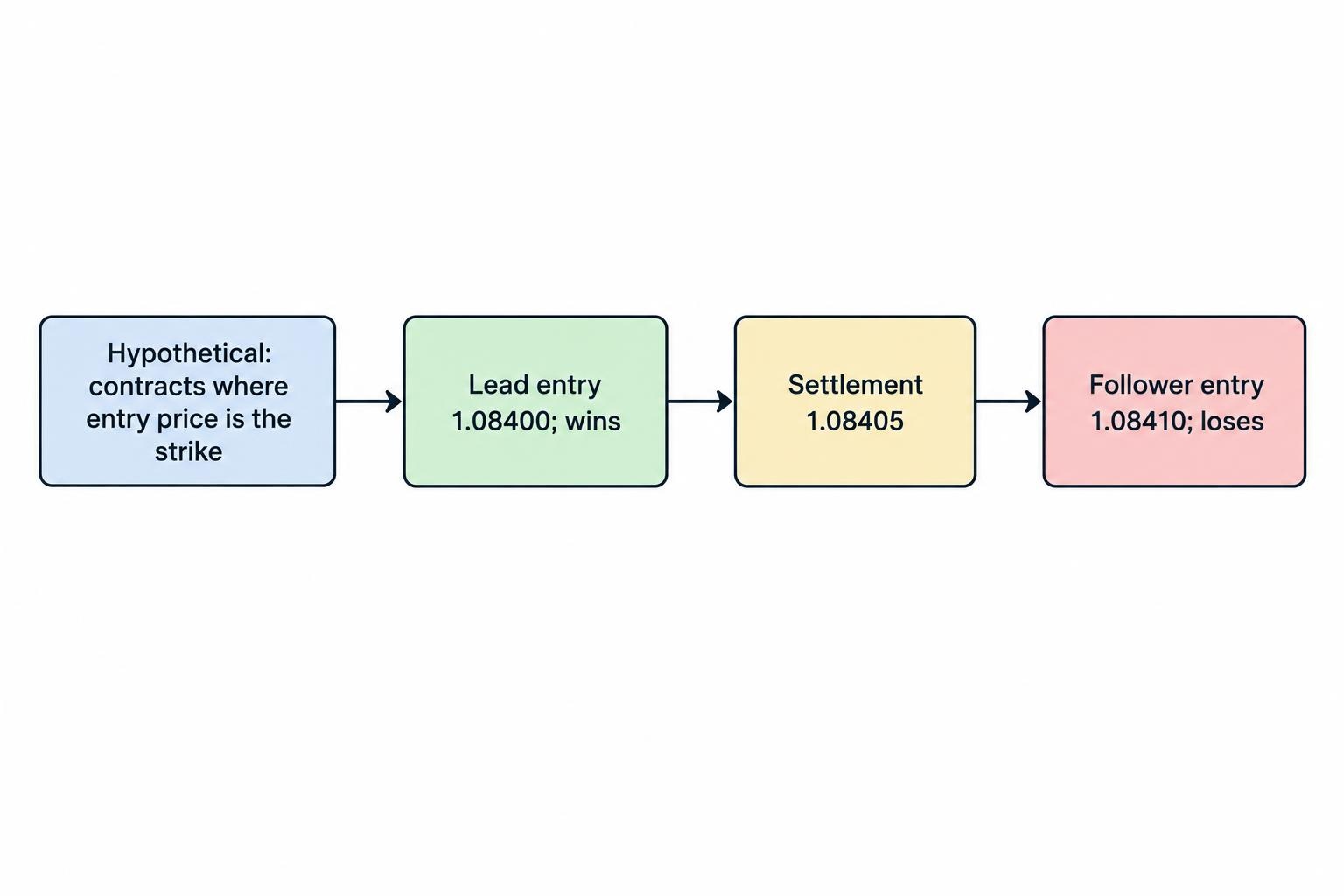
Consider a hypothetical high low contract that wins when the settlement price finishes above its entry price. The lead trader enters “higher” at 1.08400. The follower’s order arrives later and receives an entry of 1.08410. Both contracts expire at the same time, with settlement at 1.08405.
The lead trader wins. The follower loses. Neither result requires a large market move; the settlement price simply falls between the two entry levels.
This example assumes each contract uses its own entry price as the strike. Contracts with a separately stated strike need a different comparison. The lesson is to inspect the actual contract rather than assume that matching the direction reproduces the trade.
Expiry and missing orders
A fixed expiry at 10:05:00 is different from a five minute duration measured from acceptance. A delayed order might retain the original expiry, receive a later expiry or be rejected. Each treatment changes the follower’s exposure.
Rejected and skipped orders matter too. If a copier misses several winning orders but accepts the losing ones, the follower’s record will differ even if every accepted order matches correctly. Compare accepted, rejected and missed instructions, not just the completed trades shown on a dashboard.
These mechanics sit within binary options execution and latency. In a copying assessment, record the lead instruction time, follower acceptance time, entry price and actual expiry separately.
Calculate returns using the follower’s payout
A high win rate does not establish profitability. For a fixed stake contract, a winning trade might earn less than the amount lost on an unsuccessful trade. Copying cannot repair that arithmetic.
Assume a hypothetical series of 100 trades, each staking A$10, with 60 wins and 40 losses. There are no ties, refunds or changing stakes. The payout percentages below mean profit on a winning trade, excluding the returned stake.
| Account or arrangement | Profit per win | Net result across 100 trades |
|---|---|---|
| Lead trader receiving an 80% payout | A$8 | A$480 − A$400 = A$80 |
| Follower receiving a 70% payout | A$7 | A$420 − A$400 = A$20 |
| Follower with the same 70% payout and A$40 in service fees | A$7 before fees | A$20 − A$40 = −A$20 |
All three rows use the same winning percentage. The follower can still lose money because their payout and costs differ.
Without fees, and assuming every loss forfeits the full stake, the break even win rate equals 1 ÷ (1 + the profit payout expressed as a decimal). An 80% payout requires about 55.56% wins; a 70% payout requires about 58.82%. These are mathematical thresholds, not forecasts.
The probability and expected value guide develops that calculation. When reviewing a copier, use the payout available to the follower at acceptance, not the lead trader’s advertised maximum.
Assess the record behind the leaderboard
A leaderboard is a ranking, not an audit. Before treating a trader’s return as evidence, establish what the number measures and which account produced it.
Ask for a complete dated record covering stakes, accepted payouts, outcomes, fees and account cash flows. Deposits are not trading profits. Withdrawals are not trading losses. A useful return calculation separates both from trading performance.
The record should also distinguish live trading from demonstrations, simulations and backtests. A demonstration can illustrate order handling without proving that real funds were traded or that profits were withdrawable.
Four checks deserve particular attention:
- Observation period: Look beyond the best week and inspect losing periods as well as winning ones.
- Stake changes: Check whether apparent consistency depends on increasing the amount risked after losses.
- Follower evidence: Compare actual copied results with the lead account, including missed orders and fees.
- Selection method: Establish whether the ranking excludes closed, abandoned or unsuccessful accounts.
A longer record provides more observations, but trade count alone can mislead. Fifty orders placed around one event do not demonstrate performance across fifty different market conditions. Inspect how results cluster by date, market and trading approach.
Use the guide to evaluating trading signal track records for a fuller evidence review. Copy trading adds another requirement: the lead trader’s history must be reproducible in the follower’s account under the follower’s terms.
Check fees and the trader’s incentives
Start with a plain cash question: who gets paid, how much, and for what?
A proposed arrangement might charge a subscription, deduct a share of profits or reward the lead trader through the platform. Do not assume every service uses these methods. Require written terms identifying the charges that actually apply.
If there is a performance fee, check its calculation period and whether previous losses must be recovered before another fee becomes payable. A fee charged after a profitable week can remain costly if the following week reverses those gains.
Payments tied to copied volume or follower numbers can create incentives that differ from a follower’s interests. Those remuneration conflicts, alongside cost disclosure and marketing, feature in the ESMA supervisory briefing on copy trading. The briefing concerns firms under the EU’s MiFID II framework; it is not permission to distribute retail binary options in Australia.
Ask whether the trader earns more when followers place more orders, deposit more money or generate more activity. A payment arrangement does not prove misconduct, but undisclosed incentives leave a hole in the assessment.
Inspect stake sizing before copying a strategy
A lead trader’s cash stake is not automatically suitable for another account. In a hypothetical comparison, A$20 represents 1% of a A$2,000 balance but 10% of a A$200 balance. Copying the amount rather than the proportion multiplies the follower’s relative exposure.
Minimum order sizes can also distort proportional copying. If the intended copied stake falls below the platform minimum, the system might skip the order or round it upward. Establish which happens. A rounded order can risk more than the allocation setting suggests.
Look at simultaneous trades, not just individual stakes. Five unsettled A$10 contracts expose A$50 if each can lose its full stake. A copier that checks only the size of the next order may overlook the money already committed.
Progressive staking requires particular care. A trader may record many small recoveries while accepting the possibility of a much larger loss. A high winning percentage can conceal that imbalance if the report gives every trade equal weight regardless of stake.
The separate guide to Martingale in binary options trading examines loss recovery staking. For a copier, the practical question is whether the follower can identify and block stake escalation before it occurs, rather than notice it after the balance has fallen.
Following several traders is not automatically diversification either. If they take similar positions at the same time, they may reproduce the same exposure under different profile pictures.
Find out what the account controls actually do
“Stop copying” needs a precise definition. It might stop new instructions without cancelling accepted contracts. It might leave pending orders in place, or take effect only after the system processes the request. Obtain the documented behaviour rather than relying on the button label.
A daily loss setting also needs examination. Does it count settled losses only, or include money committed to unsettled contracts? A threshold based only on settled results may allow further exposure while existing trades are still running.
Other useful questions concern maximum stakes, total unsettled exposure, excluded markets, minimum acceptable payouts and handling after a disconnection. Treat these as requirements to investigate, not features every service provides.
Review access permissions separately. A copying connection should not be confused with permission to withdraw funds. Do not provide remote access to a computer, share one time security codes or disclose wallet recovery phrases because someone says the copier needs “activation”.
Controls can restrict what a system attempts. They cannot guarantee that losses stop at an exact balance, reverse a settled contract or make an unsuitable product suitable.
Separate trading losses from platform fraud
There are two different problems to assess. A genuine trading arrangement can lose money through poor decisions, unfavourable payouts or execution differences. A fraudulent operation may display trades and balances that do not represent genuine trading at all.
Reported binary options fraud includes refusal to return customer funds, misuse of identity documents and alleged software manipulation of prices or payouts. These categories appear in the SEC’s binary options fraud warning. They are reasons to examine the platform as well as the trader being copied.
Be wary of a promoter who controls every part of the evidence: the account, the screenshots, the testimonials and the explanation for each withdrawal delay. A polished dashboard cannot independently verify itself.
A small successful payment does not settle the question. Investment scammers can use small profit payments to build trust, alongside fake platforms and supporting promotional material, as detailed in Moneysmart’s investment scam warning.
Pressure to deposit more, guaranteed returns and demands for extra payments to release a balance should stop the assessment, not start a negotiation. If funds have already been sent and fraud is suspected, preserve account records and messages, contact the payment provider promptly and avoid sending more money to “rescue” the original deposit.
Use paper records to test copying claims
For an Australian retail reader studying a copy trading claim, a paper exercise allows scrutiny without funding a prohibited retail offer.
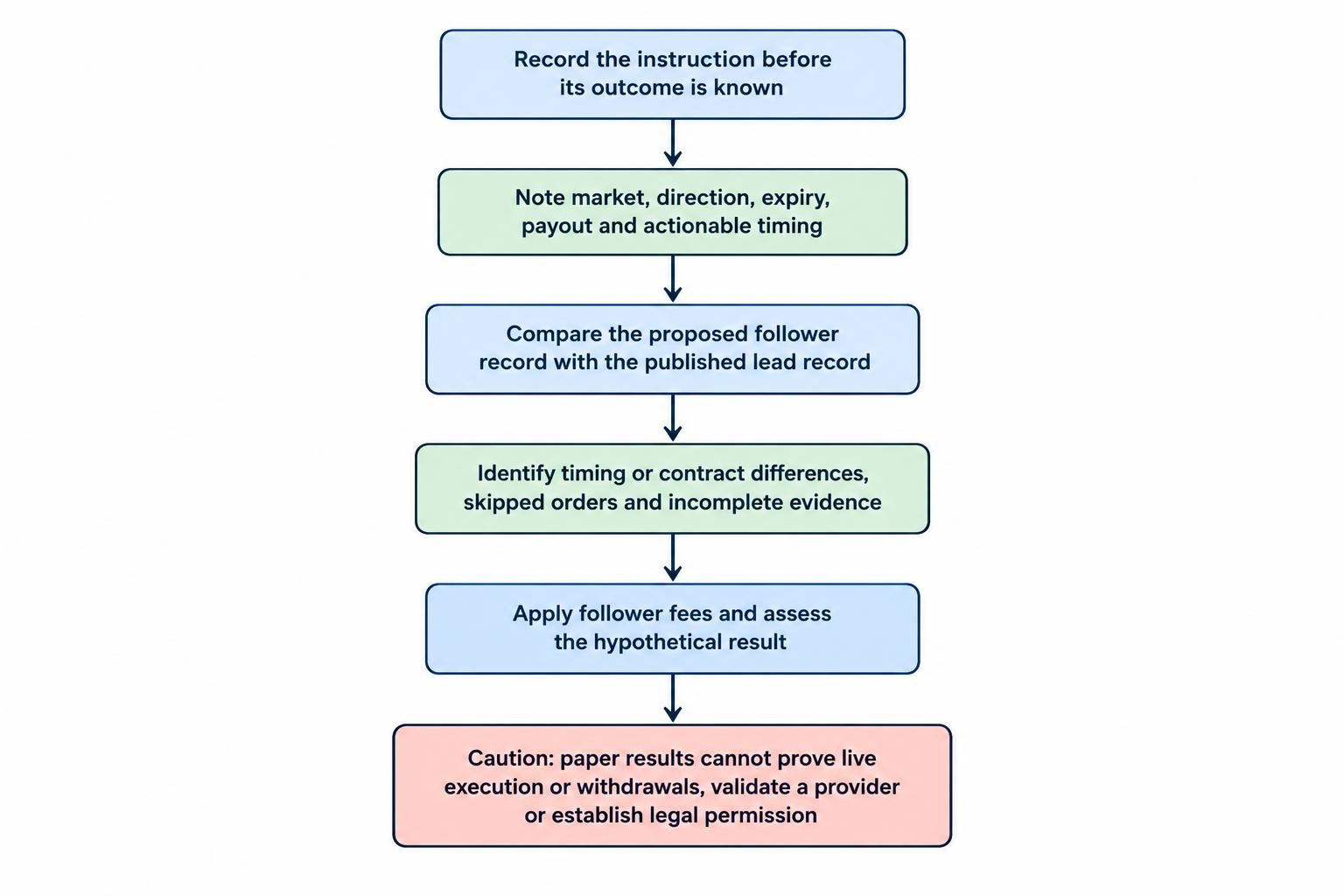
Record instructions when they arrive, before the outcome is known. Note the market, direction, stated expiry, quoted payout and when the instruction could realistically have been acted on. Keep missing information visible. Do not fill gaps later using the provider’s winning screenshot.
Compare the proposed follower record with the published lead record. Where they diverge, identify whether the cause was timing, contract terms, a skipped instruction, a different payout or incomplete evidence. Apply the advertised service fees to the paper calculation too.
The paper trading guide covers recording hypothetical trades. Paper results cannot prove live execution or withdrawal reliability, but they can expose a claim that fails even before those risks enter the calculation.
Keep the legal question separate from the performance question. A convincing spreadsheet does not establish permission to serve Australian retail clients. The guide to binary options regulation in Australia addresses that framework.
The decision should not rest on who tops a ranking. It should rest on whether the offer is permitted, the evidence is complete and the follower’s own contract terms support the claimed result. If any of those checks fails, copying faster is not the answer.
This article was last updated on: October 22, 2026