Silver binary options are contracts whose payout depends on whether a defined condition involving the silver price is met. A common version asks whether a reference price will finish above or below a strike price at expiry. You do not own silver, and a correct forecast does not earn more simply because the metal moves further.
Australian retail restriction: ASIC’s ban on issuing and distributing binary options to retail clients took effect on 3 May 2021 and extends until 1 October 2031. Silver contracts are not an exception to the ASIC binary options product intervention order. The explanations below are educational, not a recommendation to open or fund an account.
How Silver Binary Options Work
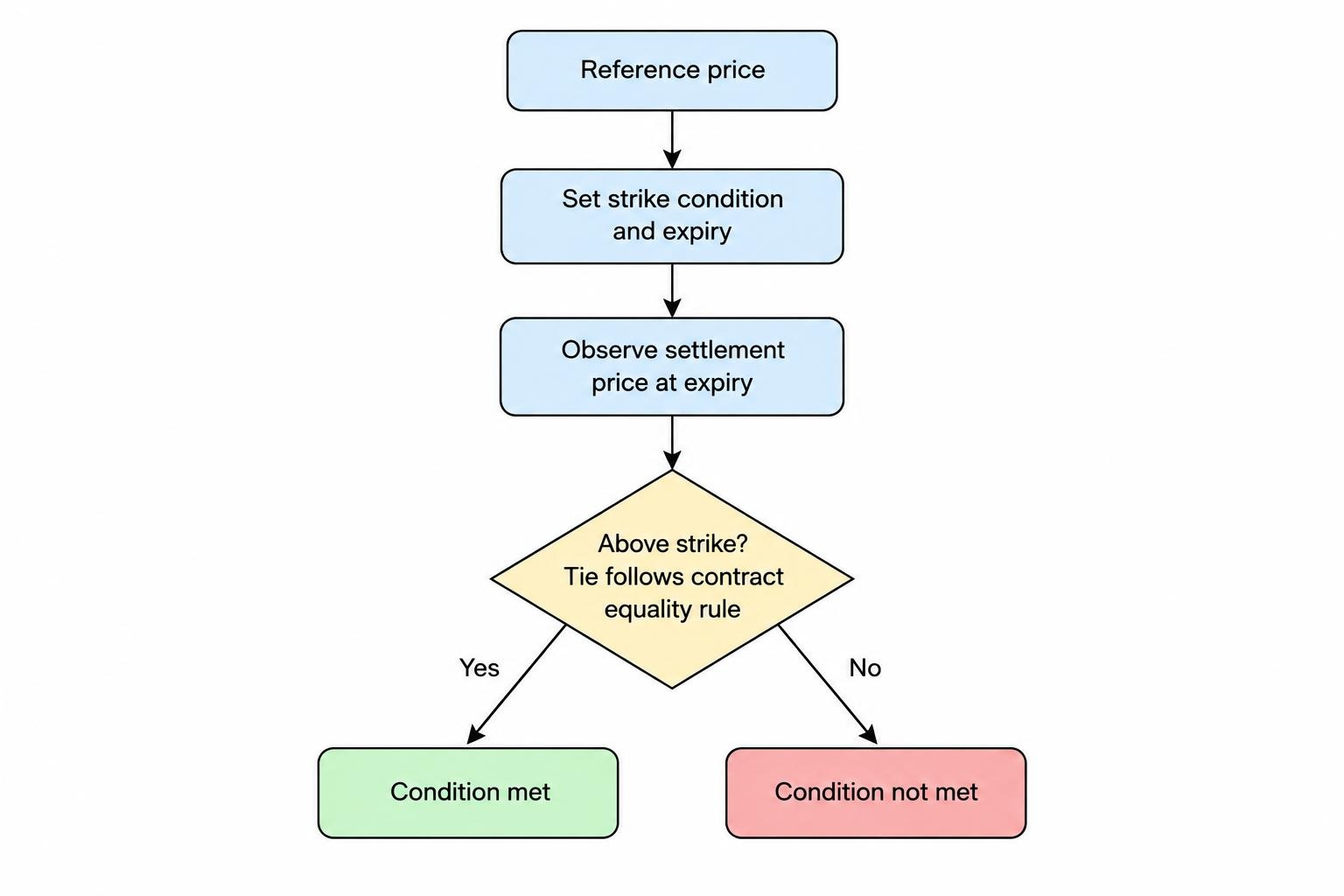
A silver binary option combines a reference price, a condition, an expiry and a payout rule. For a straightforward higher or lower contract, the question might be: will the designated silver price be above US$32.50 per troy ounce at the stated settlement time?
The contract settles against its own terms. Silver could rise during most of the contract’s life, then fall below the strike just before expiry. An above-strike position would still lose. Being right about the general direction is not enough; the condition must be satisfied at the required moment.
Consider a hypothetical contract with an A$100 stake and an 80% net profit payout. A winning result returns the A$100 stake plus A$80 profit. A losing result forfeits the A$100 stake. These figures illustrate the mechanics and are not an available offer or a current silver quotation.
| Settlement price | Result | Net account outcome |
|---|---|---|
| US$32.51 | Winning condition met | Gain of A$80 |
| US$32.49 | Winning condition not met | Loss of A$100 |
| Exactly US$32.50 | Depends on the equality rule | Check the contract terms |
Equality deserves attention. “Above” and “at or above” are different conditions. A tie might trigger a refund, a loss or another treatment under the written rules. Never fill that gap with an assumption.
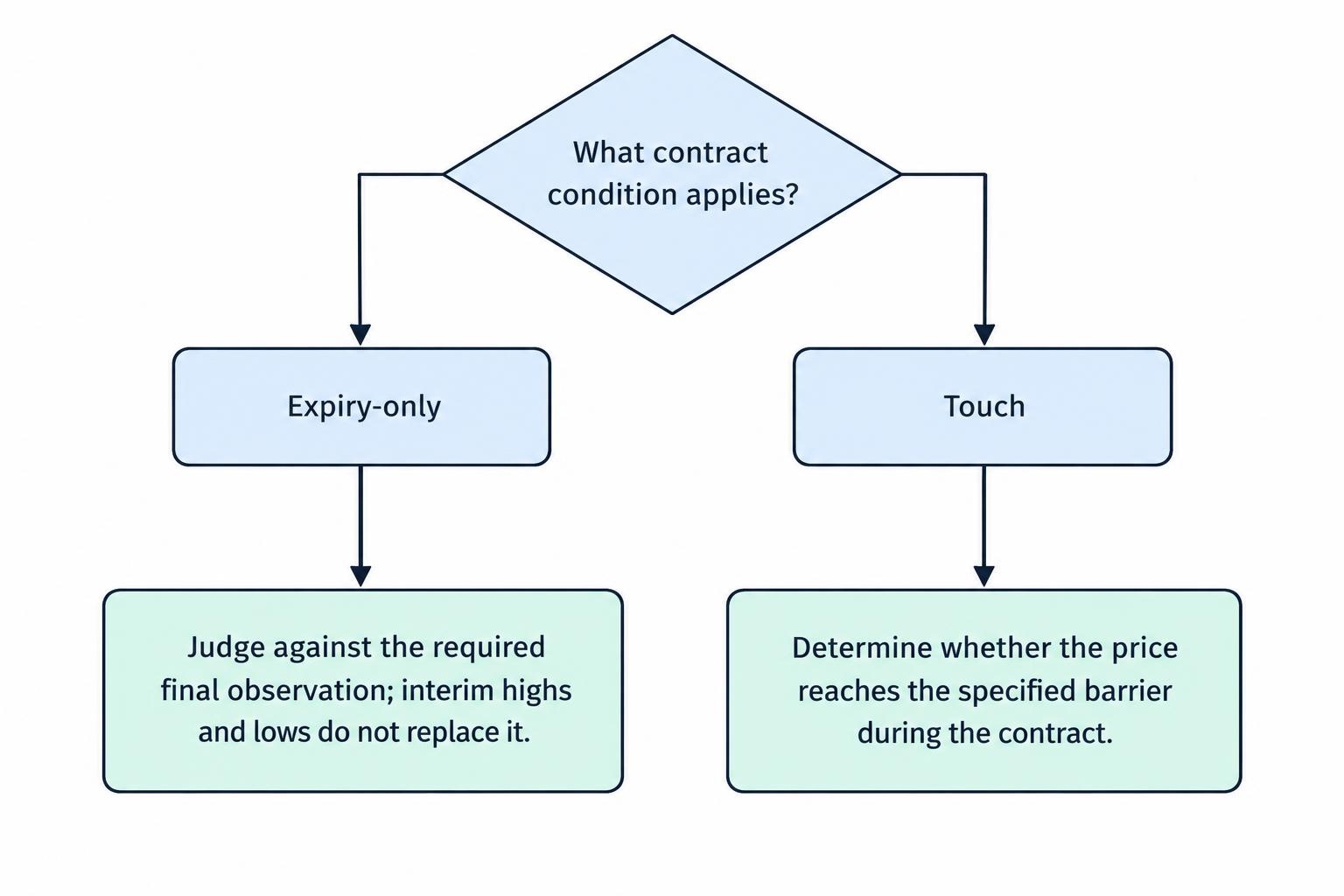
Other structures ask whether silver touches a barrier or stays inside a range. Those conditions require different analysis: a price excursion that does not matter to an expiry-only contract could decide a touch contract immediately.
Which Silver Price Determines the Result?
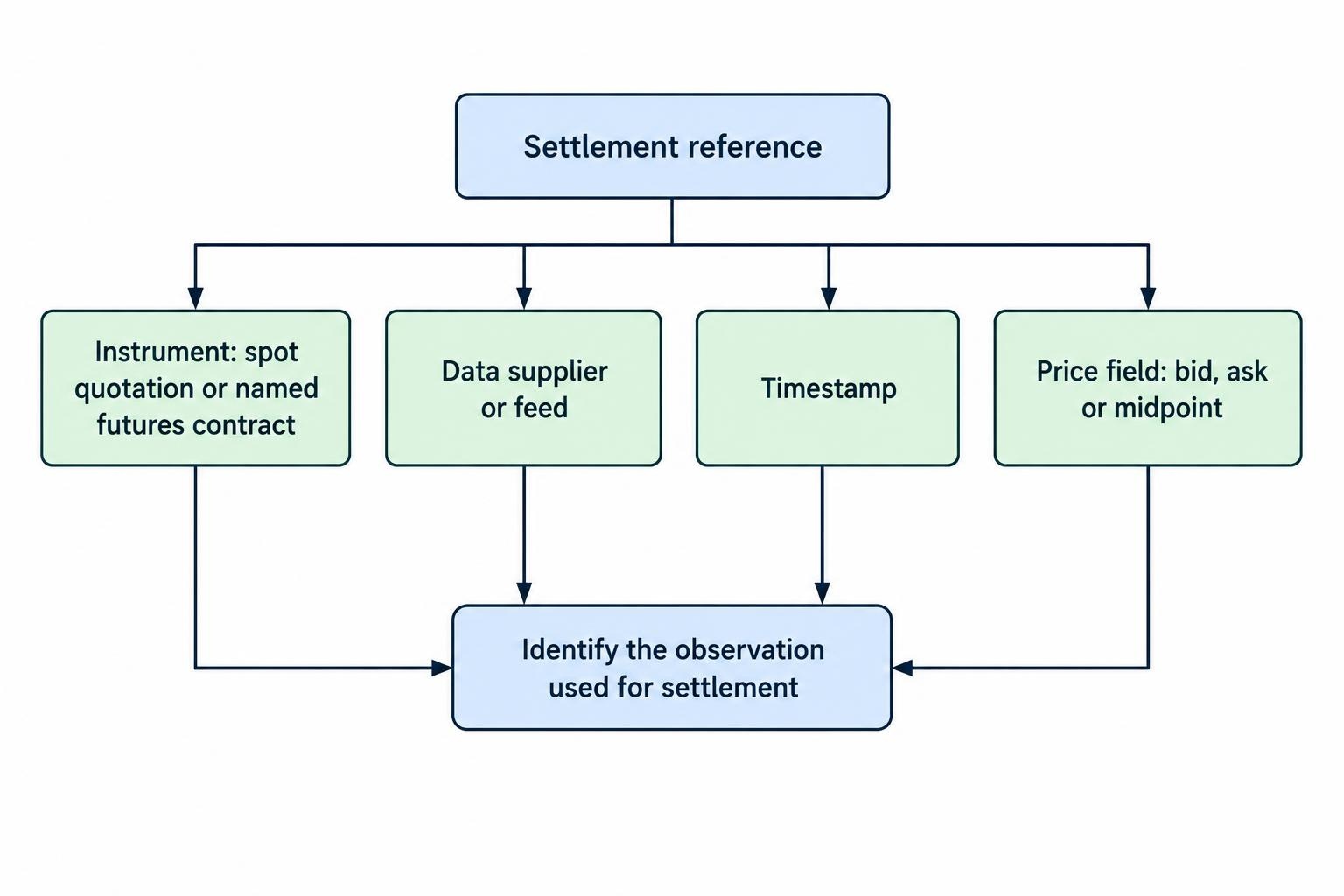
“Silver” is not a complete description of a settlement reference. A screen might display a spot quotation, a named futures contract, a continuous futures chart or a provider’s calculated feed. Similar labels do not make those prices interchangeable.
XAG/USD commonly denotes silver priced in US dollars, usually per troy ounce. The symbol alone does not identify the data supplier, whether the quote is bid, ask or midpoint, or which observation settles the contract. Those details become especially important when the final price sits close to the strike.
The LBMA Silver Price benchmark is set once daily at 12:00 London time in US dollars per troy ounce and is administered by ICE Benchmark Administration. It is not a continuously updating intraday price. A contract expiring at an arbitrary minute should not be assumed to settle against that daily benchmark.
Futures introduce another distinction: the delivery month. A chart of one month’s silver futures is not necessarily the same reference as another month. A continuous chart may also switch between contracts or adjust historical prices, making it unsuitable for checking an exact settlement without further investigation.
Before evaluating a hypothetical result, identify the instrument, feed, timestamp and price field. Keep the chart used for analysis separate from the evidence required to verify settlement. The guide to commodity spot prices, futures and rollovers covers these reference-price differences in more detail.
What Moves the Silver Market?
Silver has both investment and industrial demand. That gives it more than one set of influences, and those influences can pull in opposite directions. A persuasive explanation for a move is not automatically a reliable forecast of the next expiry.
The US Dollar and Interest Rate Expectations
A stronger US dollar can put pressure on dollar-priced silver, while changes in interest rate expectations can alter demand for precious metals. These relationships are conditional rather than mechanical. CME’s discussion of silver’s industrial and precious metal characteristics addresses both its dollar sensitivity and its manufacturing uses.
For contract analysis, the practical issue is whether the observation matches the horizon being studied. A view about interest rates over several months does not establish whether silver will finish above a strike in five minutes. The longer-term thesis and the short-term settlement question are separate problems.
Industrial Demand and Changes in Material Use
Industrial demand is substantial, but it does not rise automatically whenever a silver-using industry expands. Industrial silver demand fell 3% to 657.4 million ounces in 2025. Growth connected with automotive uses, power grids and AI infrastructure was outweighed by weakness in solar demand, including reduced silver use and substitution by manufacturers. These findings appear in the Silver Institute’s World Silver Survey 2026 release.
The analytical lesson is to separate production growth from metal consumption. More finished products need not mean proportionally more silver if each product uses less of it. Annual demand research can inform a market thesis, but it does not provide a timestamped entry signal.
Gold Comparisons Without Automatic Signals
A useful research exercise is to compare silver with gold over the same period, using matching timestamps. Ask whether both metals moved together, whether one lagged, and whether the apparent relationship persisted outside the selected sample.
Do not turn a gold move into an automatic silver instruction. Even a relationship that looks convincing on a daily chart may fail at a short expiry. The companion article on gold binary options examines the other side of that comparison without treating the two markets as substitutes.
Trading Hours and Australian Time Zones
The reference market’s hours matter more than whether a platform displays an active button. Standard 5,000 troy ounce COMEX Silver futures trade on CME Globex from Sunday at 5:00 p.m. to Friday at 4:00 p.m. Chicago time, with a daily one-hour break beginning at 4:00 p.m. These hours are listed in the CME standard Silver futures contract specifications.
That schedule should not be applied to every silver instrument. Other contracts and venues can have different sessions. A weekend quotation needs an identified reference and published methodology, not an assumption that it represents the same market observed during the week.
For an Australian research journal, record the venue’s time zone and the applicable UTC offset alongside local time. Check the conversion for each study period rather than carrying one fixed clock difference through the year.
Also distinguish an exchange’s daily settlement from a binary contract’s expiry. A binary result may use an observation taken during a session rather than the exchange’s official settlement price. Matching the date alone does not establish that the correct price was used.
Why Expiry Changes the Analysis
A directional view needs a deadline before it can be tested as a binary proposition. “Silver looks strong” is too vague. “The designated reference will be above this strike at this timestamp” is measurable, although not necessarily profitable.
Consider a hypothetical path: silver starts at US$32.50, falls to US$32.44 after five minutes, then rises to US$32.70 after an hour. An above-strike contract expiring after five minutes loses, despite the later rally. A longer expiry produces a different question, not a correction to the earlier result.
For expiry-only contracts, interim highs and lows do not replace the final observation. For touch contracts, the path itself may decide the result. Mixing those rules produces misleading backtests.
Very short studies also demand precise data. A one-minute candle cannot reveal every observation within that minute. If a proposed outcome depends on a price at a particular second, minute-level data may be insufficient to establish it. Mark uncertain cases as uncertain rather than awarding the strategy a convenient win.
Payouts Matter as Much as Direction
A binary payout below the amount at risk requires a win rate above 50% to break even. Under the earlier example, each win earns A$80 and each loss costs A$100. Ten wins and ten losses therefore produce A$800 of gains against A$1,000 of losses: a net loss of A$200 before any other costs.
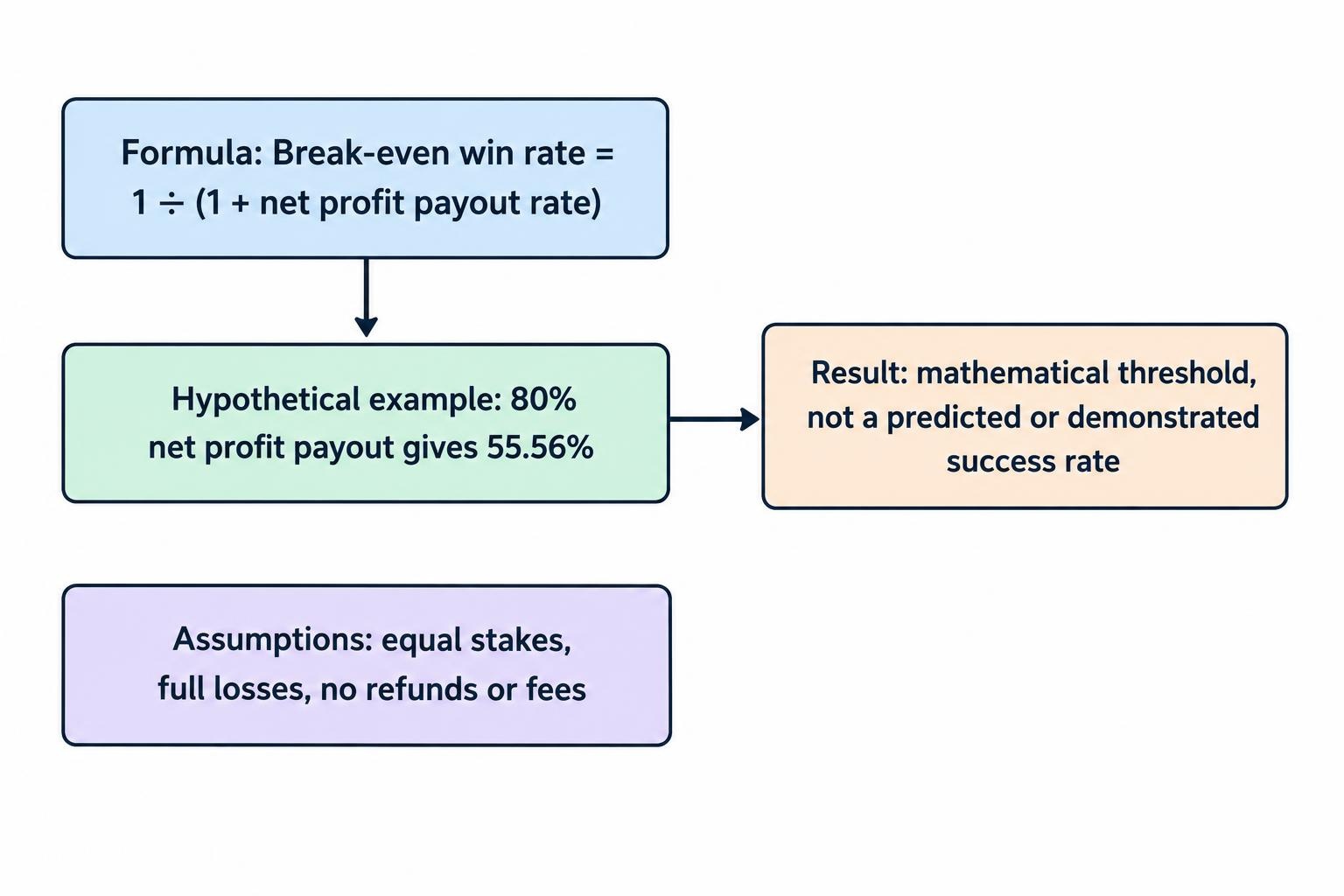
With equal stakes, full losses and no refunds or fees, the break-even calculation is:
Break-even win rate = 1 ÷ (1 + net profit payout rate)
At an 80% net profit payout, the result is 55.56%. That is a mathematical threshold, not evidence that a method can achieve it. A claimed 56% success rate leaves very little room for estimation error or a lower payout.
The broader guide to probability and expected value in binary options explains why strike selection, win rate and payout must be assessed together.
This matters when comparing research samples. A method that looks profitable under an assumed 90% payout may lose money at 70%, even with identical price predictions. Record the payout assumption beside every result. Otherwise the spreadsheet is answering a different question from the one the reader thinks it is answering.
Assessing Silver Chart Ideas Without Overstating Them
Trend, breakout and range hypotheses can all be expressed as testable rules. The weakness often appears in the wording. “Buy strength” is not reproducible; a rule based on a defined price level, observation time and expiry can be checked.
A breakout study should distinguish a brief move through a level from a close beyond it. It should also state whether the strike equals the observed entry price or sits elsewhere. Predicting that silver rises from its current level is not the same as predicting that it clears a higher strike.
Range studies need equally clear boundaries. A price can remain inside a broad chart range yet finish on the losing side of a higher or lower contract. The chart may look calm while the contract loses its entire stake.
Avoid changing the rule after seeing the outcome. If an unsuccessful breakout becomes a “range trade” only in hindsight, the analysis has stopped testing anything. Define exceptions beforehand and preserve unsuccessful observations rather than explaining them away.
A Paper Exercise for Studying Silver Contracts
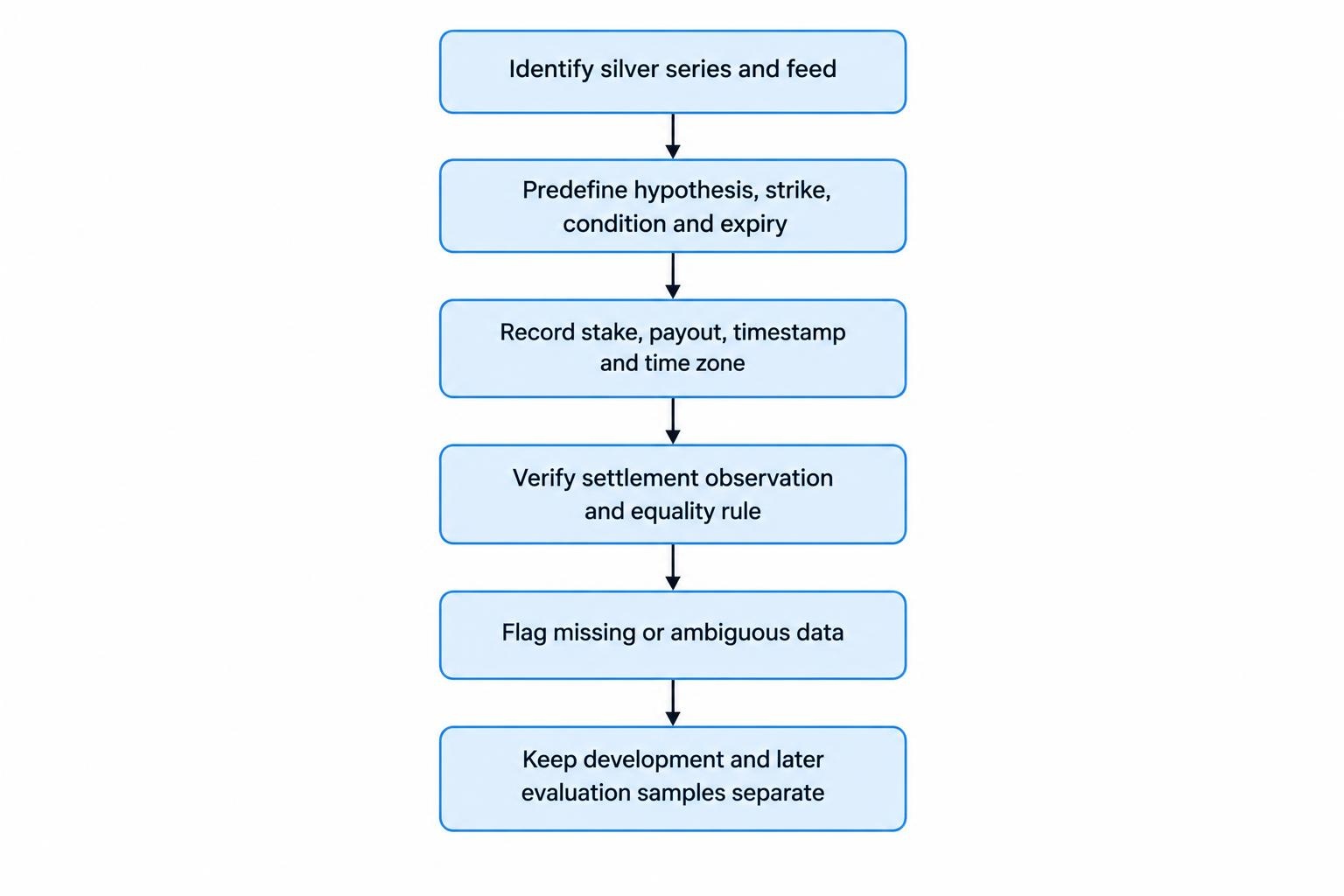
Paper research allows the price question and payout arithmetic to be examined without placing a live binary position. Start with a clearly identified silver series and one narrowly defined hypothesis. The purpose is to find out whether the idea survives consistent measurement, not to produce an attractive collection of screenshots.
For each observation, record:
- The instrument, data supplier, timestamp and time zone.
- The strike, contract condition and expiry.
- The hypothetical stake and net profit payout.
- The settlement observation and treatment of equality.
- Any missing data, ambiguous outcome or departure from the rules.
Keep a development sample separate from a later evaluation sample. Rules adjusted repeatedly on the same historical period can fit that period without working elsewhere. Do not choose an expiry only after checking which deadline would have won.
For silver, it is also useful to label observations by reference instrument and session. That makes it easier to spot whether apparent results depend on mixing futures months, inconsistent clocks or different feeds. The binary options practice plan provides a structure for organising this work.
A successful paper sample still does not establish reliable live execution, fair settlement or the ability to withdraw funds. Nor does it change Australia’s retail prohibition. Silver market analysis, binary contract mathematics and provider risk are separate subjects; confidence in one does not settle the others.
This article was last updated on: October 22, 2026