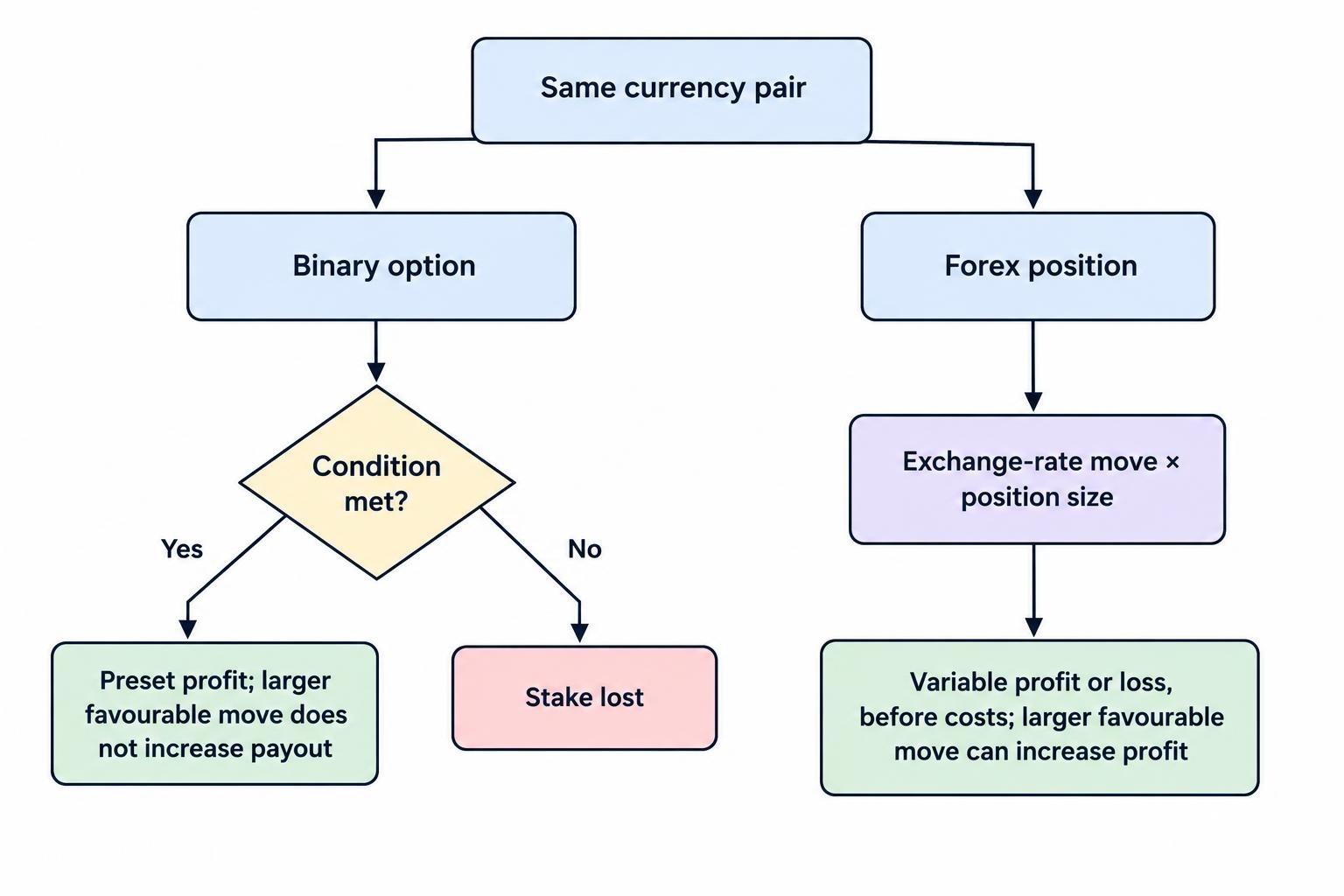
Binary options and forex trading can express the same view about a currency pair, but they turn that view into very different financial outcomes. A binary option pays a preset amount if its condition is met. A forex position produces a profit or loss that changes with the exchange rate, position size and exit price.
For Australian retail clients, the comparison starts with availability. ASIC prohibits the issue and distribution of over the counter binary options to retail clients. The prohibition remains in force, with a scheduled sunset date of 1 October 2031, as set out in the explanatory statement extending Australia’s binary options prohibition. This article compares the mechanics; it is not a recommendation to use an offshore binary options platform.
What Does “Binary Options vs Forex” Actually Compare?
Forex is a market, not a single trading product. You can exchange currencies for travel, hold foreign currency or speculate on exchange rates through derivatives. A binary option is a contract structure that can reference currencies, shares, commodities or other prices.
The usual comparison is therefore between a binary option on a currency pair and a retail margin forex position on that pair. In Australia, margin forex is generally regulated as a contract for difference, or CFD. Neither arrangement requires the trader to take delivery of the currencies. The broader comparison between binary options and CFDs covers the same distinction across other underlying markets.
Both contracts might reference AUD/USD, yet one asks whether a condition will be true at settlement. The other tracks the financial effect of the exchange rate moving between entry and exit. That difference affects almost every trading decision.
| Feature | Binary option | Margin forex |
|---|---|---|
| Profit calculation | Preset return if the contract condition is satisfied | Price movement multiplied by position size, less costs |
| Effect of a larger favourable move | Does not increase the agreed payout on a simple high/low contract | Increases profit while the position remains open |
| Timing | A defined expiry or observation period | Usually open until closed, subject to contract and margin rules |
| Loss exposure | Normally the amount paid for that contract | Depends on exposure, exit execution and account protections |
| Trade management | Early exit may be unavailable or subject to provider terms | Positions can generally be closed or reduced during trading hours |
| Main pricing consideration | Payout relative to the probability of winning | Price movement relative to exposure and trading costs |
How Profits and Losses Differ
Binary options: the condition decides the payout
A simple high/low binary option might ask whether AUD/USD will finish above 0.6500 at a stated time. The trader does not receive extra profit because it finishes far above that level rather than fractionally above it. The CFTC and SEC investor alert on binary options describes this yes/no payout structure and the absence of ownership rights in the underlying asset.
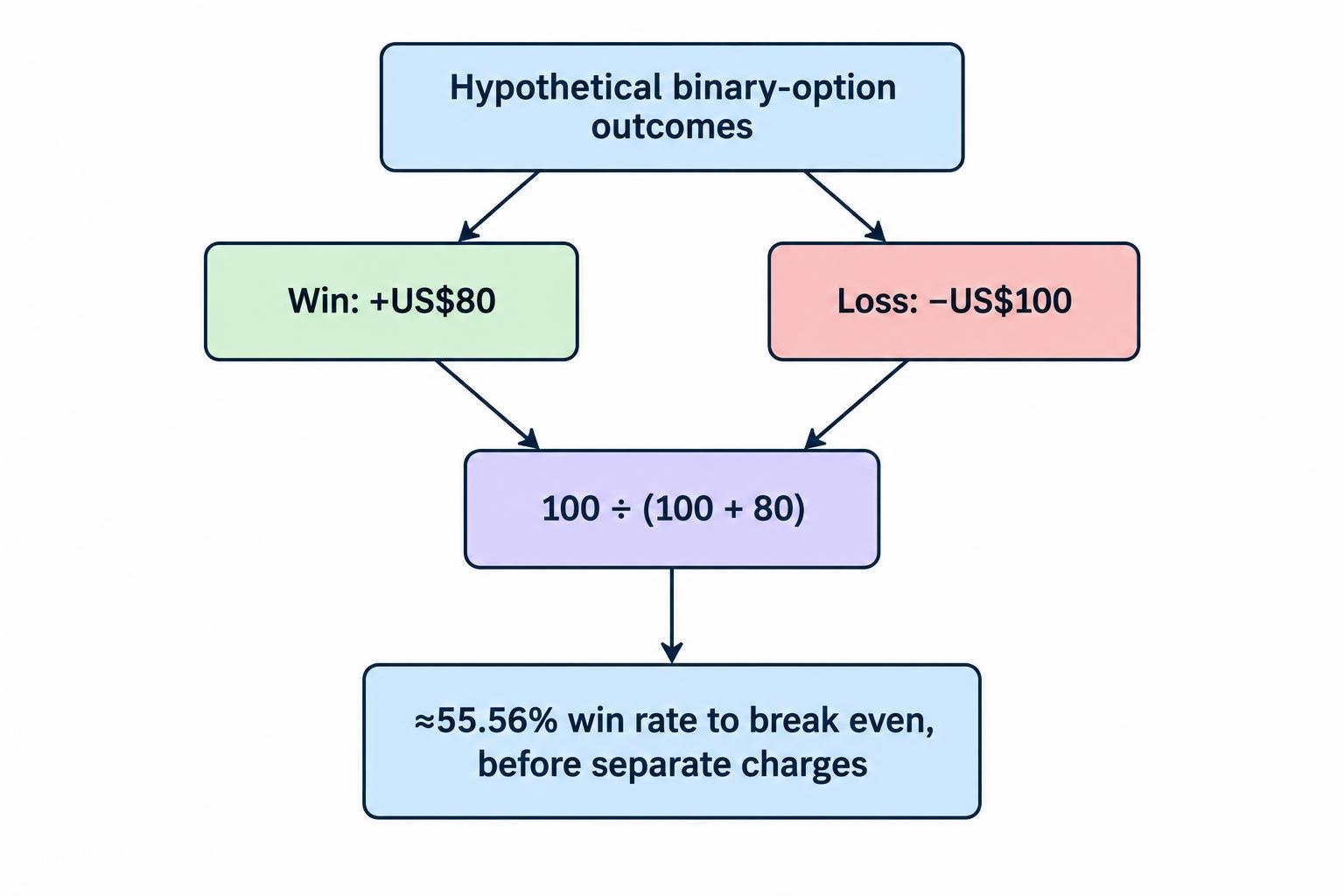
Suppose a hypothetical contract costs US$100 and offers an 80% profit on a successful outcome. A win returns US$180: the original US$100 plus US$80 profit. A loss returns nothing, producing a US$100 loss. Here, “80% payout” means profit on the stake, not the total amount returned.
This example assumes no refund, fees or early exit. A price exactly equal to the strike must be handled under the contract’s settlement rules; do not assume that a tie automatically returns the stake.
Forex: distance and position size decide the result
Consider a hypothetical purchase of A$50,000 against US dollars at AUD/USD 0.6500. If the position closes at 0.6520, the gross profit is US$100. If it closes at 0.6480, the gross loss is US$100. These figures exclude spreads, commissions, financing and any account currency conversion.
The calculation is A$50,000 multiplied by the US$0.0020 exchange rate change. Closing at 0.6540 instead would produce US$200 gross profit. Unlike the binary contract, a larger favourable move produces a larger gain.
These examples do not require the same opening cash. The binary stake is paid for the contract; forex margin supports a much larger exposure. Comparing a US$100 binary stake with a US$100 margin requirement would confuse money committed with money at risk.
Which Product Needs a Higher Winning Percentage?
Winning percentage alone cannot tell you whether either approach makes money. You also need the average amount won, the average amount lost and the costs.
With the hypothetical 80% binary return, each US$100 win earns US$80 while each loss costs US$100. The break even calculation is:
Required win rate = 100 ÷ (100 + 80) = approximately 55.56%.
At 55 wins and 45 losses, using equal US$100 stakes, profits total US$4,400 and losses total US$4,500. The result is a US$100 loss before any separate charges. Winning more often than losing is not enough.
Forex has no universal break even win rate. If average winning trades earn twice the average losing trade, the mathematical threshold is 33.33% before costs. If winners and losers are equal in size, it is 50% before costs. Those are arithmetic thresholds, not evidence that a strategy can achieve them.
The practical comparison is expected profit per unit of risk, rather than advertised accuracy. The guide to probability and expected value in binary options develops that calculation without treating a high payout as proof of good value.
Expiry Changes What Counts as Being Right
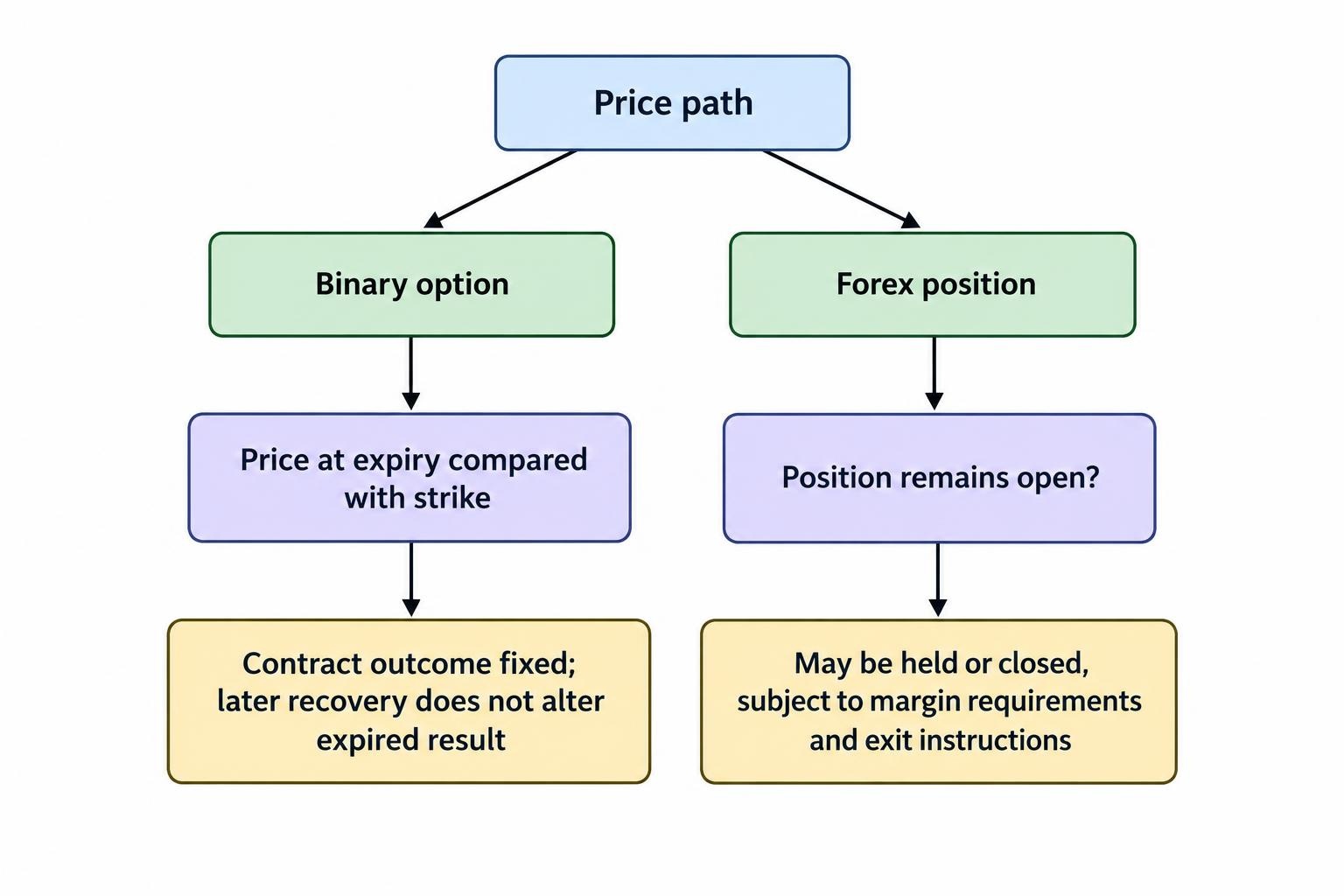
A binary trader can correctly predict the broader direction and still lose. If AUD/USD falls below the strike at expiry before recovering, the later recovery does not rescue an expired high/low contract.
A forex trader can keep a position open through a temporary adverse move, provided the account meets margin requirements and no exit instruction closes it. That flexibility can help a trading plan, but it can also make it easier to postpone accepting a loss.
Consider a forecast that AUD/USD will rise during the afternoon. A five minute binary contract does not directly test that forecast. It tests where the price settles five minutes later. A forex position allows a different holding period, but still needs a defensible exit and loss allowance.
Contract timing must match the forecast being tested. The guide to binary options expiry times examines that timing decision separately. Very short expiry does not make a forecast more precise simply because the result arrives sooner.
Trading Costs Are Presented Differently
Binary options can appear cheaper because a simple stake based contract may not display a spread or commission. However, the difference between the amount earned on a win and the amount lost on a loss still matters. In the 80% example, the payout structure itself raises the required winning percentage above 50%.
Forex costs are more visibly separated. They may include the bid and ask spread, commission and financing charges for holding a position. Frequent transactions can make those charges material even when each looks small. Moneysmart’s forex trading guidance identifies these costs and warns that frequent trading and margin exposure can increase losses.
A useful comparison uses net results. For binaries, record the return actually offered when the hypothetical trade begins. For forex, deduct the costs that would apply to the intended position size and holding period.
A binary return percentage is not directly comparable with a forex return calculated against margin. The denominators are different. Compare profit or loss against the full trading account and the amount genuinely exposed to loss.
Margin Is Not a Forex Loss Limit
Margin is the money required to support a forex position. It is not automatically the maximum that position can lose, nor does it tell you what a sensible position size would be.
For Australian retail CFDs, maximum exposure ratios are 30:1 for major currency pairs and 20:1 for minor currency pairs. The rules also require standardised margin close out arrangements and negative balance protection. These protections appear in ASIC’s CFD product intervention measures. Negative balance protection concerns the retail CFD account; it does not preserve every trade’s opening margin.
At 30:1, the A$50,000 position opened at 0.6500 has a US$32,500 notional value and would require approximately US$1,083.33 initial margin, assuming that maximum ratio applies. A US$100 adverse move still produces a US$100 trading loss, regardless of whether the account holds US$1,100 or US$10,000.
A binary contract offers a more straightforward contractual loss amount: the stake paid. That certainty does not make repeated losses affordable. Ten separate US$100 losses still remove US$1,000, and adding contracts increases total exposure.
For either product, start with the loss the account could absorb, not the largest order the platform accepts. The stake sizing guide covers that account level decision.
Exit Control Does Not Remove Execution Risk
Forex generally gives the trader more ways to manage an open position: closing it, reducing its size, setting a profit target or placing a stop order. Those choices create responsibilities rather than guarantees.
A normal stop order can execute at a worse price than its trigger during a fast market or price gap. Australian CFDs also involve a contract with an issuer rather than ownership of an exchange traded asset. Pricing, execution and the issuer’s ability to meet its obligations therefore matter. Moneysmart’s CFD risk guidance covers these execution and counterparty risks.
Binary contracts concentrate attention on the settlement condition and reference price. A small difference around the strike can decide the entire outcome of a simple high/low contract. Forex positions respond proportionately to price changes, but poor execution can still alter the planned result.
Neither format makes the provider irrelevant. A displayed account balance and a profitable calculation are not substitutes for receiving money owed.
Australian Regulation Makes This More Than a Product Preference
The binary options prohibition means Australian retail clients should not treat an offshore platform accepting registrations as evidence of permission to offer the product. Availability on a screen does not establish regulatory status.
Retail forex CFDs operate under a different framework. As at 21 October 2026, the existing CFD product intervention order is scheduled to expire on 23 May 2027. ASIC has proposed extending and amending it, potentially through to 2037, but that remains a proposal rather than a completed extension. The distinction is stated in ASIC’s October 2026 announcement on proposed CFD protections.
A comparison should therefore separate contract mechanics from lawful distribution and consumer protection. A recognisable currency pair does not make two products subject to the same rules.
Is Forex Better Than Binary Options?
Forex offers more control over position size, holding period and exits. Its variable payoff can also reward a larger favourable move. Those features make it more adaptable to different forecasts, but they introduce more decisions and opportunities for error.
Binary options simplify the outcome to a defined condition and preset return. They do not simplify the task of estimating whether that return fairly compensates for the chance of losing the stake.
Neither structure creates a trading advantage by itself. A sound assessment needs net returns, realistic execution assumptions and a loss budget. For an Australian retail reader, it must also respect the binary options prohibition rather than treating offshore access as a workaround.
This article was last updated on: October 22, 2026