Binary options losses are not automatically tax deductible in Australia. The treatment depends on the contract, the character of the activity and the tax rules that apply to the loss. A deductible trading loss, a capital loss and a private gambling loss can produce very different results, even when the account balance falls by the same amount.
The practical question is not simply “How much did I lose?” It is “What kind of loss did I make, and when can I use it?” This article focuses on individual Australian taxpayers. The broader guide to binary options tax in Australia covers the surrounding reporting issues. All monetary examples below use Australian dollars.
There is also a separate regulatory issue. ASIC’s prohibition on issuing and distributing binary options to retail clients took effect on 3 May 2021 and has been extended until 1 October 2031. The ASIC announcement extending the binary options ban sets out that restriction. A possible tax deduction should never be treated as approval of a provider or its products.
Establish the character of the loss first
Start with the legal agreement and the activity that produced the loss. Do not begin by choosing whichever tax return label gives the largest refund.
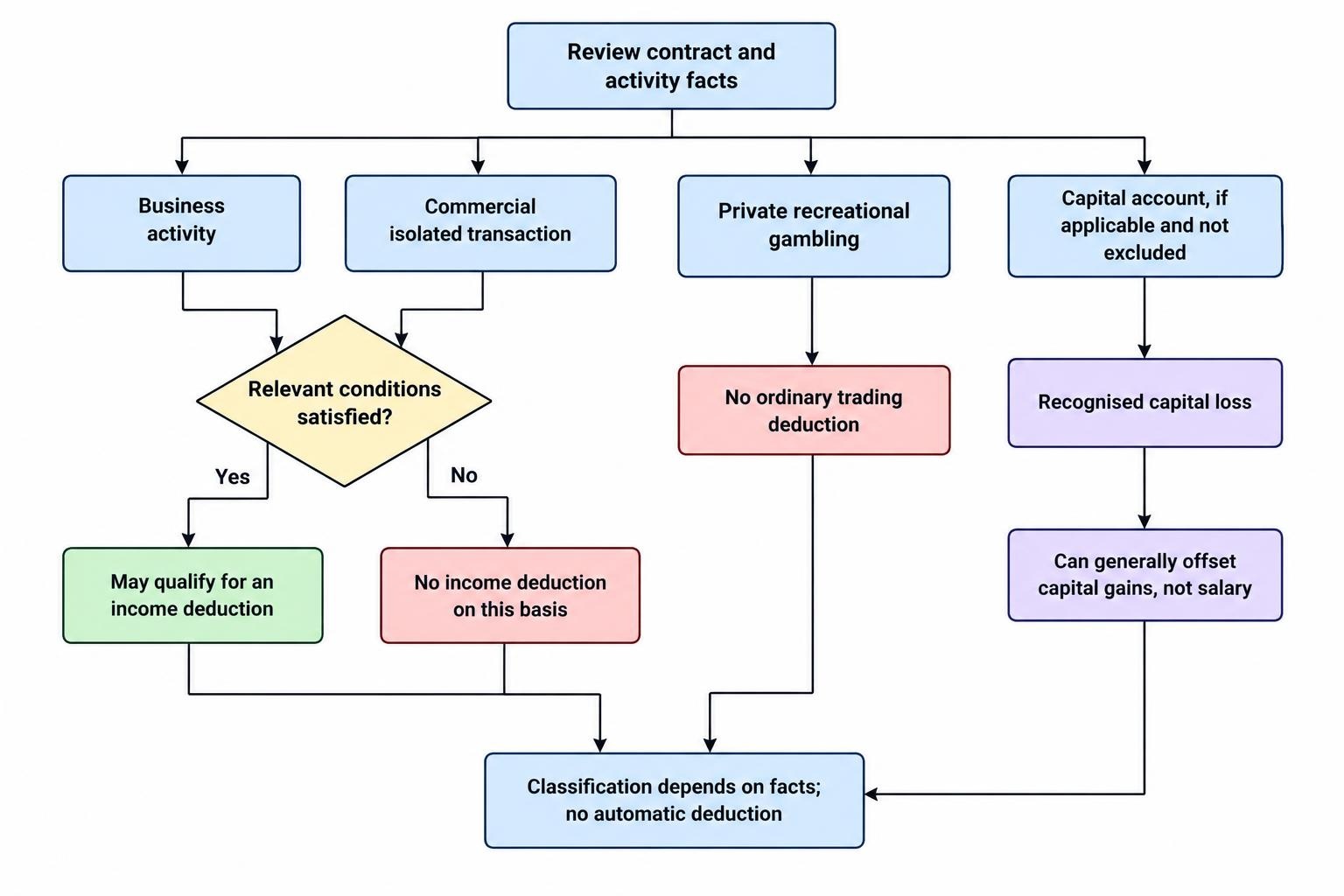
Ask whether the transactions formed part of a business, a commercial profit making transaction outside a business, or private recreation. Then consider whether capital gains tax provisions apply and whether any exclusion prevents recognition of the loss.
These are questions of substance. Useful evidence includes the contract terms, how returns were calculated, the purpose of entering the transactions and the way the activity was organised. Calling an account an “investment account” does not settle the issue. Neither does calling every losing transaction a bet.
Keep the analysis consistent between profitable and loss making transactions. If the facts have changed between years, document what changed rather than assuming that a different result justifies a different classification.
When a loss may be deductible against income
Losses connected with a trading business
Section 8-1 of the Income Tax Assessment Act 1997 permits deductions for losses and outgoings connected with producing assessable income or carrying on a business for that purpose. It excludes capital, private and certain other amounts. The general deduction rules in section 8-1 provide the starting point, not an automatic deduction for every account loss.
Before claiming, prepare evidence of how the activity operated. That might include a written plan, transaction records, research, risk controls and accounts. Those documents help an adviser assess the activity; they do not manufacture a business after the event.
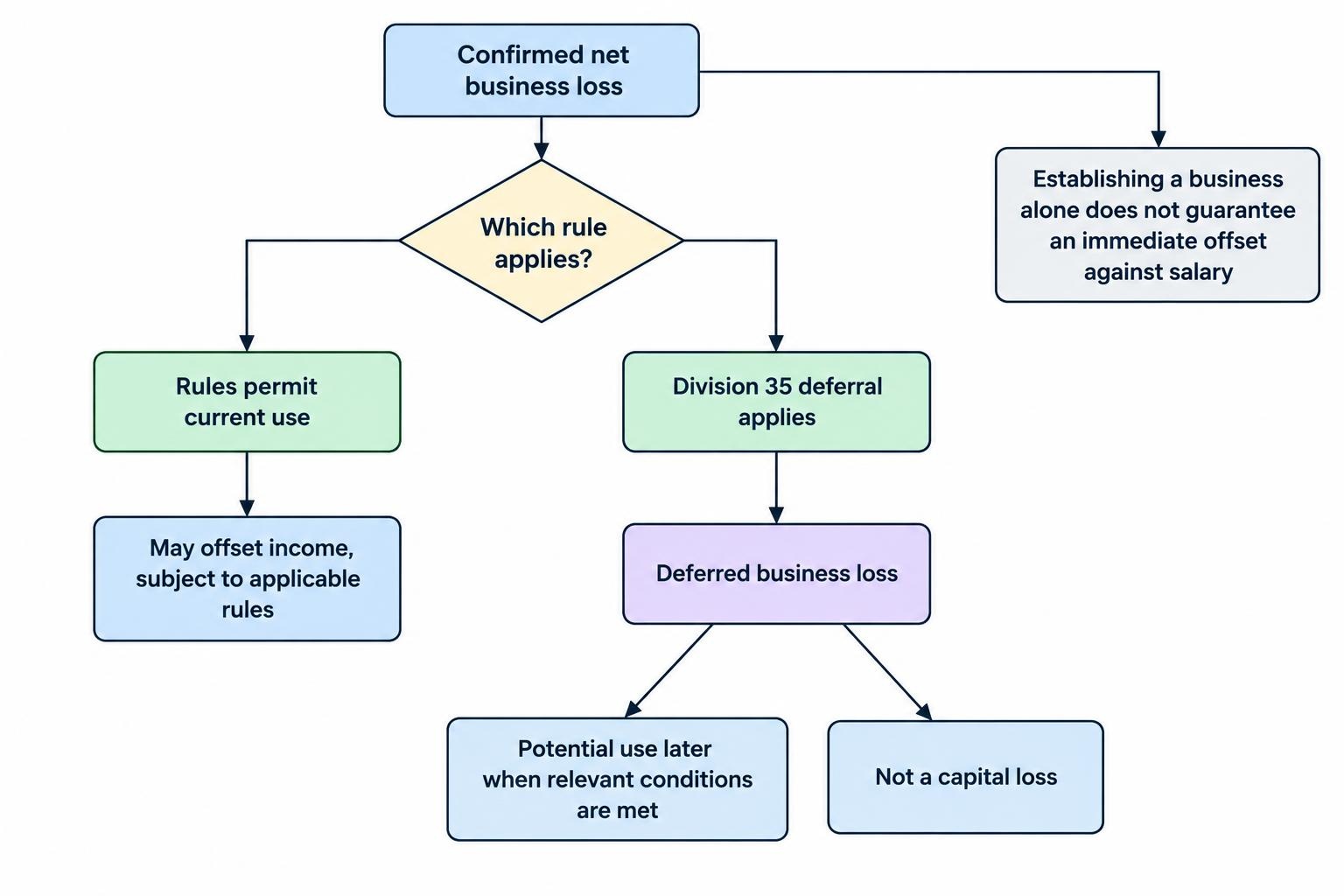
The distinction matters because identifying a deductible business expense and obtaining an immediate deduction against salary are separate steps. The non-commercial loss rules discussed below may defer the net business loss.
Commercial transactions outside a business
Not carrying on a business does not automatically rule out a revenue deduction. A loss from an isolated transaction may be deductible where the taxpayer intended to derive an assessable profit and the transaction had the required business or commercial character. Both conditions matter under ATO Taxation Ruling TR 92/4 on isolated transaction losses.
“I wanted to make money” is therefore not a complete tax analysis. Provide the agreement and explain the transaction’s purpose, structure and execution. An adviser needs enough detail to distinguish a commercial transaction from private risk taking.
Do not apply CFD guidance to binary options without checking
The ATO’s Taxation Ruling TR 2005/15 on financial contracts for differences addresses income, deductions and recreational gambling for contracts within its scope. Its description includes returns that depend on exposure to each point of price movement.
A fixed payout binary option does not automatically fit that description. Treat the ruling as relevant background where appropriate, not a blanket ruling that every binary options loss is deductible. Ask the adviser to identify the provision supporting the claim for the actual contract.
Private gambling losses and capital losses are different
Where an activity is properly characterised as private recreational gambling rather than an income producing activity, losing money does not create an ordinary trading deduction. The classification must follow the facts; neither the word “binary” nor the short duration of a contract decides it.
The capital gains tax rules also disregard capital gains and losses relating directly to gambling, games or competitions with prizes. That exclusion appears in section 118-37 of the Income Tax Assessment Act 1997, alongside the Act’s broader capital loss provisions.
If a loss is instead recognised on capital account, it can reduce capital gains, not salary or ordinary business income. An unused net capital loss may be carried forward for use against later capital gains, subject to the applicable rules.
Capital treatment is not a fallback box for any loss that fails the revenue deduction test. There must be a relevant asset, a capital gains tax event and a loss that survives the exclusions. “Not deductible against income” and “available as a capital loss” are not interchangeable statements.
For a worked capital example, assume an adviser confirms a recognised capital loss of $6,000 and eligible capital gains of $2,000 in the same year. The loss reduces those gains, leaving $4,000 unused. It does not reduce employment income by $4,000, and it does not produce a $4,000 refund.
Can a business loss reduce your salary income?
Possibly, but establishing a business is not enough. Division 35 can prevent an individual’s net loss from a business activity being offset against salary or other income in the year it arises. Instead, the loss is deferred.
The usual pathway requires income for the non-commercial loss rules to be below $250,000 and the activity to satisfy one of four tests. These concern assessable income, profits over several years, real property and other assets. Exceptions and the Commissioner’s discretion can also affect the outcome. ATO Taxation Ruling TR 2001/14 on non-commercial business losses explains the framework.
The income requirement is not simply a salary threshold. Its calculation includes taxable income with adjustments, reportable fringe benefits, reportable superannuation contributions and net investment losses.
Do not assume that deposits, stakes or the platform’s displayed “turnover” establish the assessable income test. Give the adviser the transaction data needed to calculate the relevant amount.
Consider an individual with a confirmed $9,000 net business loss. If the deferral rules apply, that loss does not immediately reduce their salary income. It remains a deferred business loss, potentially available against later income from the activity or otherwise usable when the relevant conditions are met. It has not become a capital loss.
Calculate the trading result without counting the stake twice
Tax classification comes first, but the arithmetic still needs checking. Platform statements can mix deposits, returned stakes, profits, bonuses and withdrawals. Treating every credit as profit will distort the result. Deducting returned stakes again will distort it in the other direction.
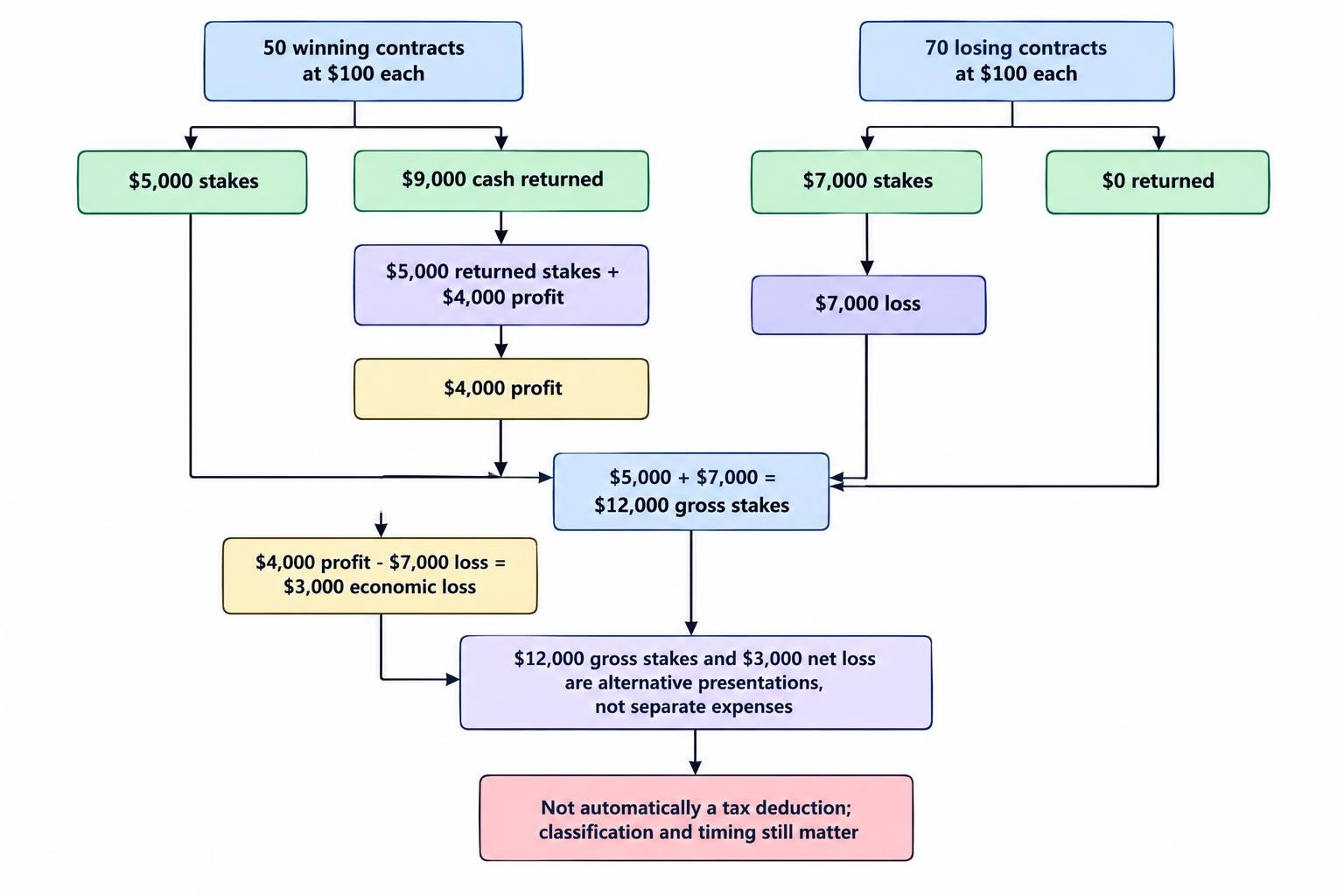
Assume a hypothetical account contains the following settled transactions, with no fees, rebates or bonuses:
| Transaction group | Stakes paid | Cash returned, including returned stakes | Net result |
|---|---|---|---|
| 50 winning contracts at $100 each, with an 80% profit payout | $5,000 | $9,000 | $4,000 profit |
| 70 losing contracts at $100 each | $7,000 | $0 | $7,000 loss |
| Combined result | $12,000 | $9,000 | $3,000 loss |
Each winning contract returns $180: the original $100 stake plus $80 profit. Across the winning contracts, profit is $4,000, not $9,000. Subtracting the $7,000 lost on unsuccessful contracts produces a $3,000 economic loss.
The table reconciles cash flows. It does not establish a $3,000 tax deduction. That requires the classification and timing analysis already discussed.
Also avoid deducting both the $12,000 of stakes and the $3,000 net loss. They are different presentations of the same activity, not separate expenses. Keep the gross figures and the reconciliation so the adviser can use the correct reporting method.
A deduction is not reimbursement of the loss
Even an immediately usable deduction does not normally repay the amount lost. It reduces the income on which tax is calculated.
As a simplified illustration, if a usable $3,000 deduction reduces tax at an assumed rate of 30%, the tax reduction is $900. The economic loss remains $3,000 before that tax effect, leaving a $2,100 cost after it. This illustration excludes Medicare levy, offsets and other interactions, and does not assume that the deduction is available.
Do not add an expected refund to the trading balance or use it to justify another deposit. Until the treatment has been checked, it is an assumption rather than money available to spend.
Separate trading losses from missing account money
A contract settling unsuccessfully is different from a provider refusing a withdrawal. Keep those events separate in the records.
If money is inaccessible, ask the adviser to examine what remains: unsettled contracts, a cash balance, a claim against the provider, or evidence that no genuine trading occurred. Do not describe the entire deposit as a settled trading loss simply because the account cannot be accessed.
Prepare a chronology showing payments, transactions, withdrawal requests and provider responses. Preserve the original messages and payment confirmations. Ask what evidence would establish a loss, which provision might recognise it and when recognition could occur. A screenshot of a disappearing balance leaves too many questions unanswered.
For offshore accounts, also provide the original account currency and conversion records. The guide to offshore trading accounts and income covers that separate reporting topic. Avoid combining a disputed account balance with settled trading results before the two have been reviewed.
Prepare a loss file before completing the return
A useful loss file should let someone reconstruct the calculation without guessing what a platform label means. Download the underlying records rather than relying on a dashboard total.
- Contract evidence: the agreement, payout terms, settlement rules and contracting entity.
- Transaction evidence: stakes, returns, losses, fees, cancellations and settlement timestamps.
- Cash reconciliation: opening balance, deposits, withdrawals, adjustments and closing balance.
- Classification evidence: the purpose of the activity, how it operated and the basis for the proposed tax treatment.
- Loss history: amounts previously reported, deferred, carried forward or already used.
Keep the original exports and a separate calculation workbook. Record corrections rather than overwriting unexplained differences. The trading records guide for tax purposes provides a broader record keeping framework.
Where transactions cross 30 June, flag them for review and retain both opening and settlement timestamps, including the time zone. Do not choose the tax year solely from the date money reached a bank account. Ask the adviser to confirm the recognition date under the treatment being applied.
Resolve uncertainty before claiming the loss
For an uncertain or material claim, obtain advice from a registered tax agent who can review the contract rather than just the platform summary. Ask for the classification, supporting provision, calculation, recognition year and any restriction on using the loss.
A private ruling may provide certainty about how the law applies to your circumstances. Its protection depends on matters including the facts supplied and whether the ruling applies to you. The ATO ruling on private rulings and their binding effect explains those conditions.
The correct outcome may be an immediate deduction, a deferred business loss, a carried forward capital loss or no recognised tax loss. Establish that outcome before entering a number in the return. A lower account balance proves an economic loss; it does not, by itself, prove a tax deduction.
This article was last updated on: October 22, 2026